Book chapter on Type-2 Fuzzy Gaussian Pyramid optical flow for video stabilization.
Book_Computational_Intelligence_From_Theory_to_Application_explores_augmented_optical_flow_methods_for_video_stabilization
https://www.pirahansiah.com/notes/pubs/books/Book_Computational_Intelligence_From_Theory_to_Application_explores_augmented_optical_flow_methods_for_video_stabilization/
Computational Intelligence: From Theory to Application
Chapter 4: Augmented Optical Flow Methods for Video Stabilization
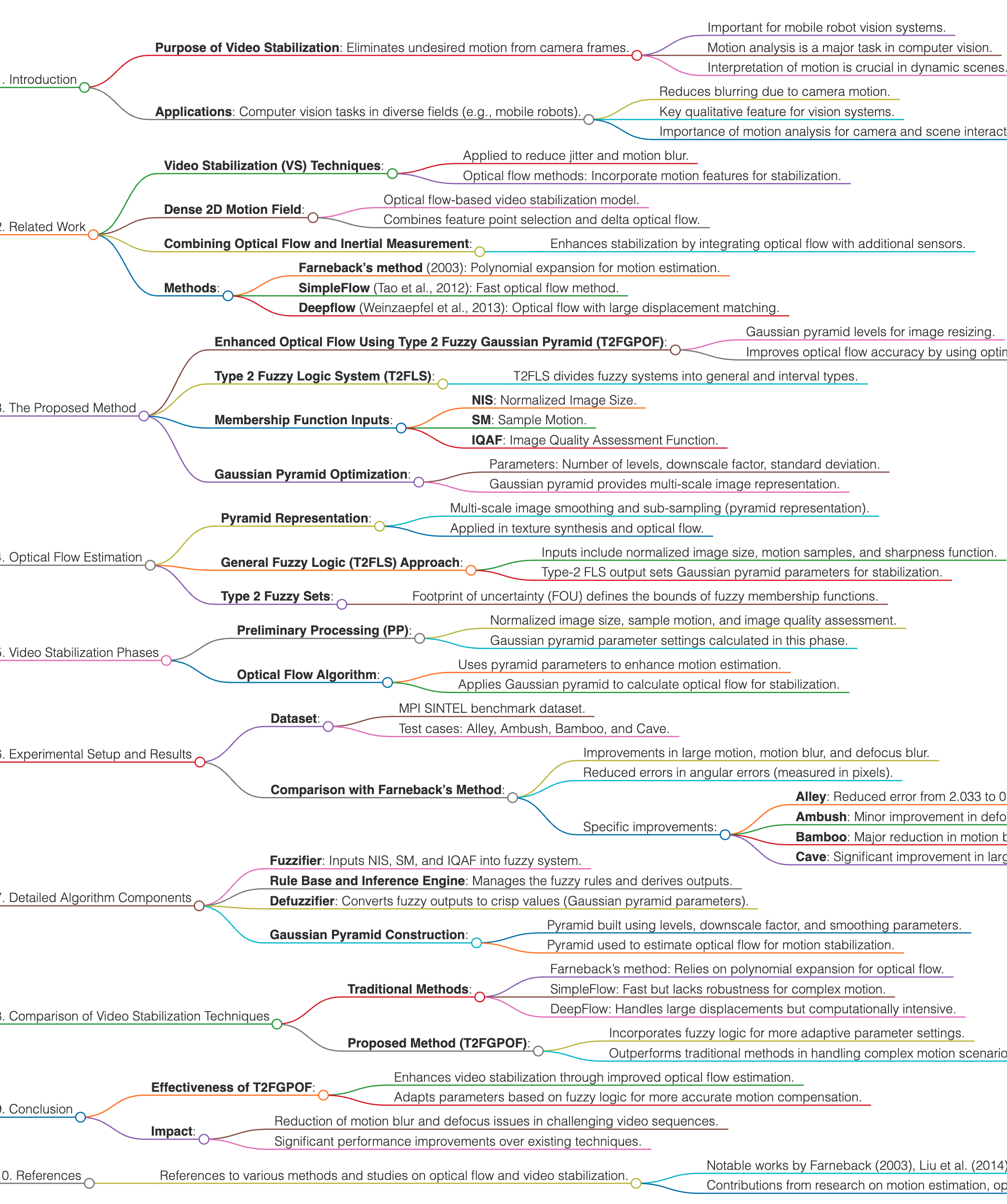
1. Introduction
- Purpose of Video Stabilization: Eliminates undesired motion from camera frames.
- Important for mobile robot vision systems.
- Motion analysis is a major task in computer vision.
- Interpretation of motion is crucial in dynamic scenes.
- Applications: Computer vision tasks in diverse fields (e.g., mobile robots).
- Reduces blurring due to camera motion.
- Key qualitative feature for vision systems.
- Importance of motion analysis for camera and scene interactions.
2. Related Work
- Video Stabilization (VS) Techniques:
- Applied to reduce jitter and motion blur.
- Optical flow methods: Incorporate motion features for stabilization.
- Dense 2D Motion Field:
- Optical flow-based video stabilization model.
- Combines feature point selection and delta optical flow.
- Combining Optical Flow and Inertial Measurement:
- Enhances stabilization by integrating optical flow with additional sensors.
- Methods:
- Farneback’s method (2003): Polynomial expansion for motion estimation.
- SimpleFlow (Tao et al., 2012): Fast optical flow method.
- Deepflow (Weinzaepfel et al., 2013): Optical flow with large displacement matching.
3. The Proposed Method
- Enhanced Optical Flow Using Type 2 Fuzzy Gaussian Pyramid (T2FGPOF):
- Gaussian pyramid levels for image resizing.
- Improves optical flow accuracy by using optimized Gaussian settings.
- Type 2 Fuzzy Logic System (T2FLS):
- T2FLS divides fuzzy systems into general and interval types.
- Membership Function Inputs:
- NIS: Normalized Image Size.
- SM: Sample Motion.
- IQAF: Image Quality Assessment Function.
- Gaussian Pyramid Optimization:
- Parameters: Number of levels, downscale factor, standard deviation.
- Gaussian pyramid provides multi-scale image representation.
4. Optical Flow Estimation
- Pyramid Representation:
- Multi-scale image smoothing and sub-sampling (pyramid representation).
- Applied in texture synthesis and optical flow.
- General Fuzzy Logic (T2FLS) Approach:
- Inputs include normalized image size, motion samples, and sharpness function.
- Type-2 FLS output sets Gaussian pyramid parameters for stabilization.
- Type 2 Fuzzy Sets:
- Footprint of uncertainty (FOU) defines the bounds of fuzzy membership functions.
5. Video Stabilization Phases
- Preliminary Processing (PP):
- Normalized image size, sample motion, and image quality assessment.
- Gaussian pyramid parameter settings calculated in this phase.
- Optical Flow Algorithm:
- Uses pyramid parameters to enhance motion estimation.
- Applies Gaussian pyramid to calculate optical flow for stabilization.
6. Experimental Setup and Results
- Dataset:
- MPI SINTEL benchmark dataset.
- Test cases: Alley, Ambush, Bamboo, and Cave.
- Comparison with Farneback’s Method:
- Improvements in large motion, motion blur, and defocus blur.
- Reduced errors in angular errors (measured in pixels).
- Specific improvements:
- Alley: Reduced error from 2.033 to 0.721 pixels.
- Ambush: Minor improvement in defocus blur.
- Bamboo: Major reduction in motion blur from 2.575 to 0.884 pixels.
- Cave: Significant improvement in large motion reduction.
7. Detailed Algorithm Components
- Fuzzifier: Inputs NIS, SM, and IQAF into fuzzy system.
- Rule Base and Inference Engine: Manages the fuzzy rules and derives outputs.
- Defuzzifier: Converts fuzzy outputs to crisp values (Gaussian pyramid parameters).
- Gaussian Pyramid Construction:
- Pyramid built using levels, downscale factor, and smoothing parameters.
- Pyramid used to estimate optical flow for motion stabilization.
8. Comparison of Video Stabilization Techniques
- Traditional Methods:
- Farneback’s method: Relies on polynomial expansion for optical flow.
- SimpleFlow: Fast but lacks robustness for complex motion.
- DeepFlow: Handles large displacements but computationally intensive.
- Proposed Method (T2FGPOF):
- Incorporates fuzzy logic for more adaptive parameter settings.
- Outperforms traditional methods in handling complex motion scenarios.
9. Conclusion
- Effectiveness of T2FGPOF:
- Enhances video stabilization through improved optical flow estimation.
- Adapts parameters based on fuzzy logic for more accurate motion compensation.
- Impact:
- Reduction of motion blur and defocus issues in challenging video sequences.
- Significant performance improvements over existing techniques.
10. References
- References to various methods and studies on optical flow and video stabilization.
- Notable works by Farneback (2003), Liu et al. (2014), Wagner & Hagras (2010).
- Contributions from research on motion estimation, optical flow algorithms, and fuzzy logic systems.
Source: Pirahansiah, F. “Augmented Optical Flow for Video Stabilization”. pirahansiah.com, updated 2026-09-19. Canonical URL https://pirahansiah.com/farshid/content/books-computational-intelligence/ · markdown source books-computational-intelligence.md · how to cite, quote and link this site.