PSNR-based adaptive thresholding for image segmentation in OCR and license plate recognition.
Adaptive_Image_Thresholding_Based_on_the_Peak_Signal-to-noise_Ratio
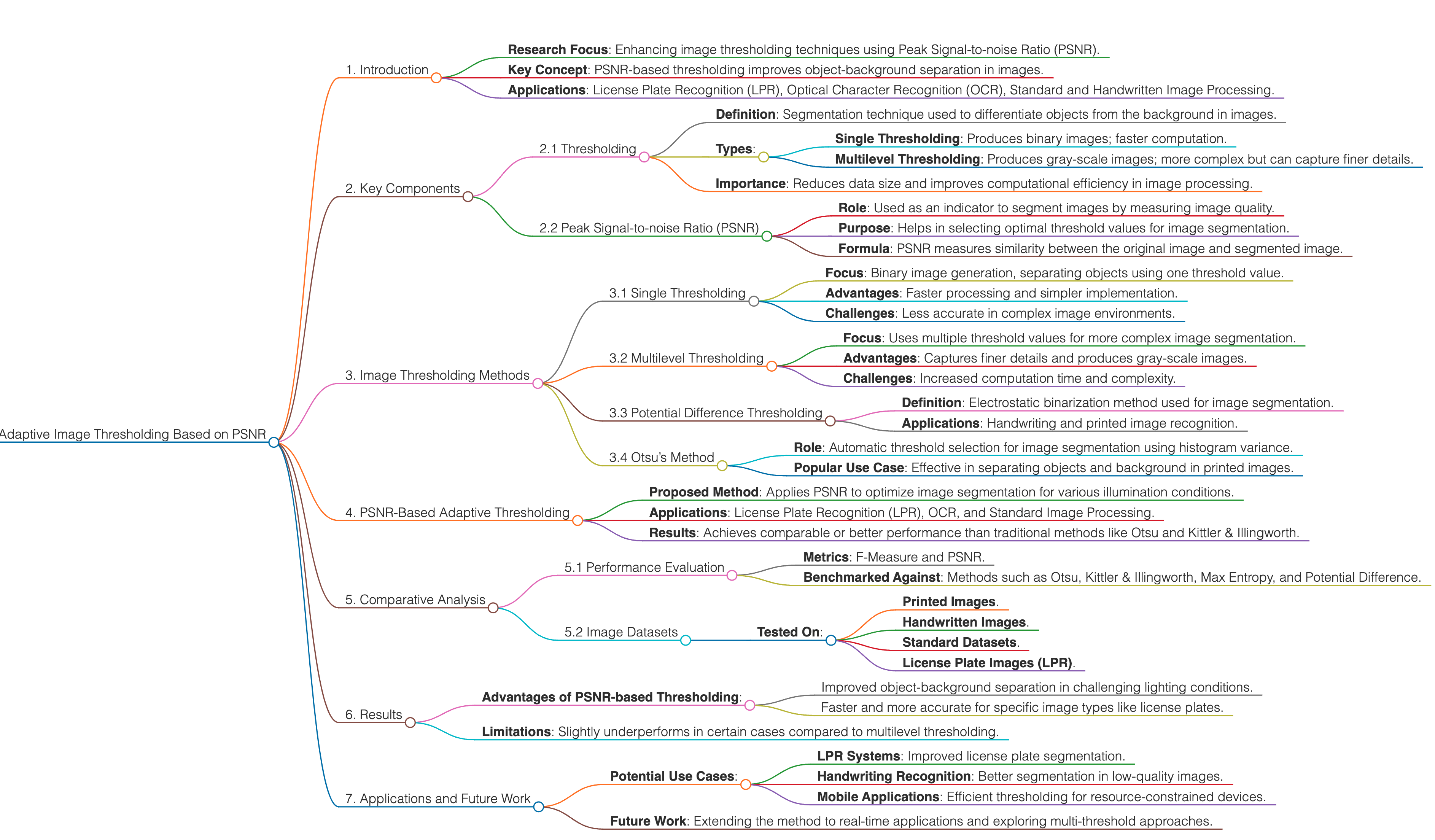
Mind Map: Adaptive Image Thresholding Based on PSNR
1. Introduction
- Research Focus: Enhancing image thresholding techniques using Peak Signal-to-noise Ratio (PSNR).
- Key Concept: PSNR-based thresholding improves object-background separation in images.
- Applications: License Plate Recognition (LPR), Optical Character Recognition (OCR), Standard and Handwritten Image Processing.
2. Key Components
2.1 Thresholding
- Definition: Segmentation technique used to differentiate objects from the background in images.
- Types:
- Single Thresholding: Produces binary images; faster computation.
- Multilevel Thresholding: Produces gray-scale images; more complex but can capture finer details.
- Importance: Reduces data size and improves computational efficiency in image processing.
2.2 Peak Signal-to-noise Ratio (PSNR)
- Role: Used as an indicator to segment images by measuring image quality.
- Purpose: Helps in selecting optimal threshold values for image segmentation.
- Formula: PSNR measures similarity between the original image and segmented image.
3. Image Thresholding Methods
3.1 Single Thresholding
- Focus: Binary image generation, separating objects using one threshold value.
- Advantages: Faster processing and simpler implementation.
- Challenges: Less accurate in complex image environments.
3.2 Multilevel Thresholding
- Focus: Uses multiple threshold values for more complex image segmentation.
- Advantages: Captures finer details and produces gray-scale images.
- Challenges: Increased computation time and complexity.
3.3 Potential Difference Thresholding
- Definition: Electrostatic binarization method used for image segmentation.
- Applications: Handwriting and printed image recognition.
3.4 Otsu’s Method
- Role: Automatic threshold selection for image segmentation using histogram variance.
- Popular Use Case: Effective in separating objects and background in printed images.
4. PSNR-Based Adaptive Thresholding
- Proposed Method: Applies PSNR to optimize image segmentation for various illumination conditions.
- Applications: License Plate Recognition (LPR), OCR, and Standard Image Processing.
- Results: Achieves comparable or better performance than traditional methods like Otsu and Kittler & Illingworth.
5. Comparative Analysis
5.1 Performance Evaluation
- Metrics: F-Measure and PSNR.
- Benchmarked Against: Methods such as Otsu, Kittler & Illingworth, Max Entropy, and Potential Difference.
5.2 Image Datasets
- Tested On:
- Printed Images.
- Handwritten Images.
- Standard Datasets.
- License Plate Images (LPR).
6. Results
- Advantages of PSNR-based Thresholding:
- Improved object-background separation in challenging lighting conditions.
- Faster and more accurate for specific image types like license plates.
- Limitations: Slightly underperforms in certain cases compared to multilevel thresholding.
7. Applications and Future Work
- Potential Use Cases:
- LPR Systems: Improved license plate segmentation.
- Handwriting Recognition: Better segmentation in low-quality images.
- Mobile Applications: Efficient thresholding for resource-constrained devices.
- Future Work: Extending the method to real-time applications and exploring multi-threshold approaches.
Source: Pirahansiah, F. “Adaptive Thresholding Based on PSNR”. pirahansiah.com, updated 2026-09-19. Canonical URL https://pirahansiah.com/farshid/content/journals-adaptive-thresholding/ · markdown source journals-adaptive-thresholding.md · how to cite, quote and link this site.