Adaptive image segmentation using PSNR for license plate recognition systems.
Adaptive_Image_Segmentation_Based_on_PSNR_for_License_Plate_Recognition
https://www.pirahansiah.com/notes/pubs/papers/Adaptive_Image_Segmentation_Based_on_PSNR_for_License_Plate_Recognition
PDF Download My Conference Paper
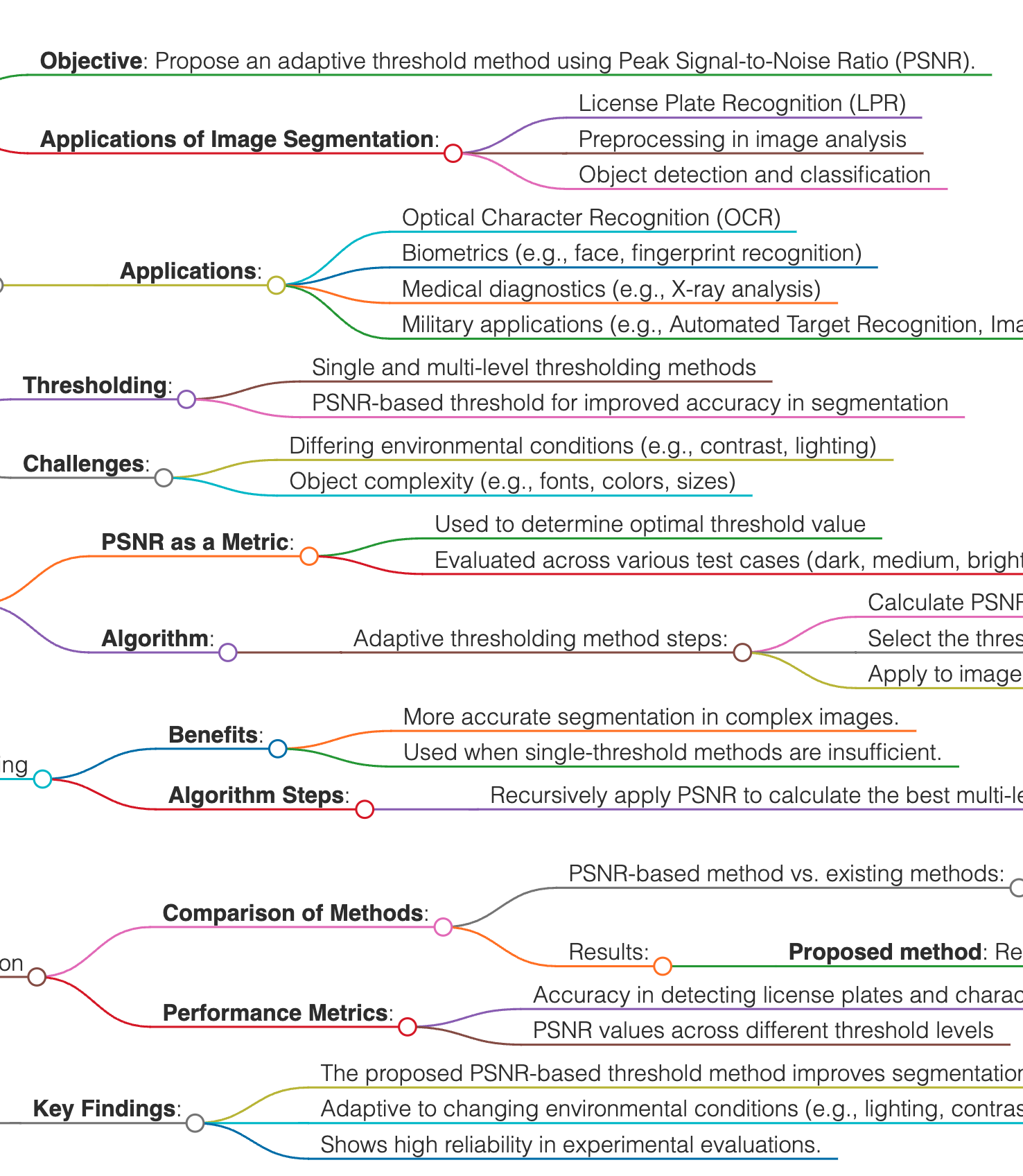
Adaptive Image Segmentation Based on PSNR for License Plate Recognition
1. Introduction
- Objective: Propose an adaptive threshold method using Peak Signal-to-Noise Ratio (PSNR).
- Applications of Image Segmentation:
- License Plate Recognition (LPR)
- Preprocessing in image analysis
- Object detection and classification
2. Pattern Recognition
- Applications:
- Optical Character Recognition (OCR)
- Biometrics (e.g., face, fingerprint recognition)
- Medical diagnostics (e.g., X-ray analysis)
- Military applications (e.g., Automated Target Recognition, Image Segmentation)
3. Motivation
- Thresholding:
- Single and multi-level thresholding methods
- PSNR-based threshold for improved accuracy in segmentation
- Challenges:
- Differing environmental conditions (e.g., contrast, lighting)
- Object complexity (e.g., fonts, colors, sizes)
4. Proposed Method
- PSNR as a Metric:
- Used to determine optimal threshold value
- Evaluated across various test cases (dark, medium, bright images)
- Algorithm:
- Adaptive thresholding method steps: 1. Calculate PSNR for different threshold values. 2. Select the threshold value with the highest PSNR. 3. Apply to image segmentation for license plate detection.
5. Multi-Level Thresholding
- Benefits:
- More accurate segmentation in complex images.
- Used when single-threshold methods are insufficient.
- Algorithm Steps:
- Recursively apply PSNR to calculate the best multi-level thresholds.
6. Experimental Evaluation
- Comparison of Methods:
- PSNR-based method vs. existing methods:
- Kittler and Illingworth’s MET
- Potential Difference
- Otsu's method
- Results:
- Proposed method: Reliable for high/low contrast situations (e.g., night, midday, rainy conditions).
- Performance Metrics:
- Accuracy in detecting license plates and characters
- PSNR values across different threshold levels
7. Conclusion
- Key Findings:
- The proposed PSNR-based threshold method improves segmentation in license plate recognition.
- Adaptive to changing environmental conditions (e.g., lighting, contrast).
- Shows high reliability in experimental evaluations.
Source: Pirahansiah, F. “PSNR-Based Segmentation for LPR”. pirahansiah.com, updated 2026-09-19. Canonical URL https://pirahansiah.com/farshid/content/papers-adaptive-segmentation/ · markdown source papers-adaptive-segmentation.md · how to cite, quote and link this site.