Mind map and guide to orchestrating multiple AI agents for complex task completion using LLMs.
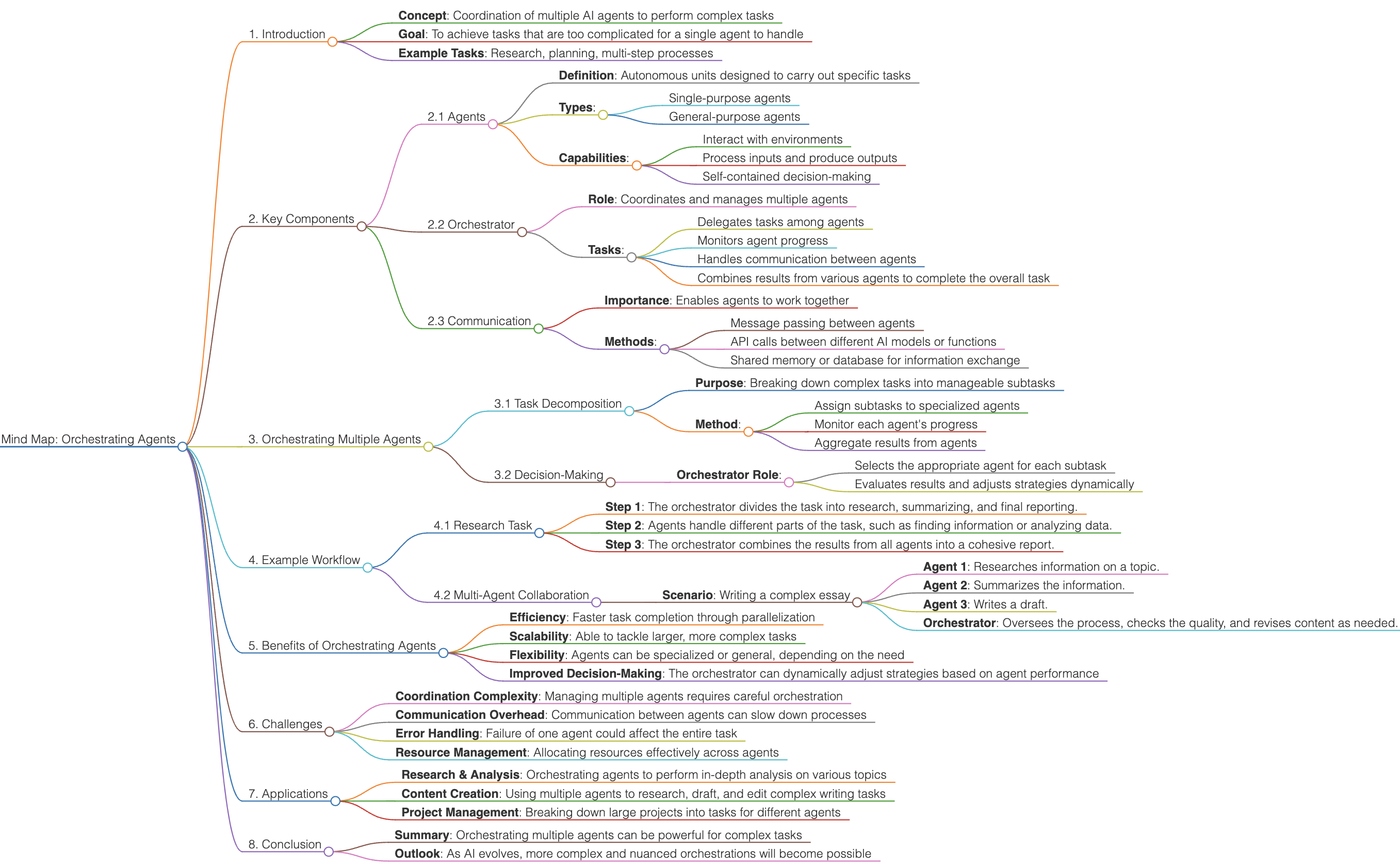
Mind Map: Orchestrating Agents
1. Introduction
- Concept: Coordination of multiple AI agents to perform complex tasks
- Goal: To achieve tasks that are too complicated for a single agent to handle
- Example Tasks: Research, planning, multi-step processes
2. Key Components
2.1 Agents
- Definition: Autonomous units designed to carry out specific tasks
- Types:
- Single-purpose agents
- General-purpose agents
- Capabilities:
- Interact with environments
- Process inputs and produce outputs
- Self-contained decision-making
2.2 Orchestrator
- Role: Coordinates and manages multiple agents
- Tasks:
- Delegates tasks among agents
- Monitors agent progress
- Handles communication between agents
- Combines results from various agents to complete the overall task
2.3 Communication
- Importance: Enables agents to work together
- Methods:
- Message passing between agents
- API calls between different AI models or functions
- Shared memory or database for information exchange
3. Orchestrating Multiple Agents
3.1 Task Decomposition
- Purpose: Breaking down complex tasks into manageable subtasks
- Method:
- Assign subtasks to specialized agents
- Monitor each agent's progress
- Aggregate results from agents
3.2 Decision-Making
- Orchestrator Role:
- Selects the appropriate agent for each subtask
- Evaluates results and adjusts strategies dynamically
4. Example Workflow
4.1 Research Task
- Step 1: The orchestrator divides the task into research, summarizing, and final reporting.
- Step 2: Agents handle different parts of the task, such as finding information or analyzing data.
- Step 3: The orchestrator combines the results from all agents into a cohesive report.
4.2 Multi-Agent Collaboration
- Scenario: Writing a complex essay
- Agent 1: Researches information on a topic.
- Agent 2: Summarizes the information.
- Agent 3: Writes a draft.
- Orchestrator: Oversees the process, checks the quality, and revises content as needed.
5. Benefits of Orchestrating Agents
- Efficiency: Faster task completion through parallelization
- Scalability: Able to tackle larger, more complex tasks
- Flexibility: Agents can be specialized or general, depending on the need
- Improved Decision-Making: The orchestrator can dynamically adjust strategies based on agent performance
6. Challenges
- Coordination Complexity: Managing multiple agents requires careful orchestration
- Communication Overhead: Communication between agents can slow down processes
- Error Handling: Failure of one agent could affect the entire task
- Resource Management: Allocating resources effectively across agents
7. Applications
- Research & Analysis: Orchestrating agents to perform in-depth analysis on various topics
- Content Creation: Using multiple agents to research, draft, and edit complex writing tasks
- Project Management: Breaking down large projects into tasks for different agents
8. Conclusion
- Summary: Orchestrating multiple agents can be powerful for complex tasks
- Outlook: As AI evolves, more complex and nuanced orchestrations will become possible
Source: Pirahansiah, F. “Mind Map: Orchestrating AI Agents”. pirahansiah.com, updated 2026-09-27. Canonical URL https://pirahansiah.com/farshid/content/note-llm-agents/ · markdown source note-llm-agents.md · how to cite, quote and link this site.