Comparison of 2D and 3D mapping approaches for environment movement detection.
tags: [3d-mapping, object-detection, computer-vision, robotics] hashtags: "#3dmapping #objectdetection #cv #robotics"
My_Conference_Paper_2D_versus_3D_Map_for_Environment_Movement_Objects
https://www.pirahansiah.com/notes/pubs/papers/conference-paper_2D_versus_3D_Map_for_Environment_Movement_Objects
PDF Download My Conference Paper
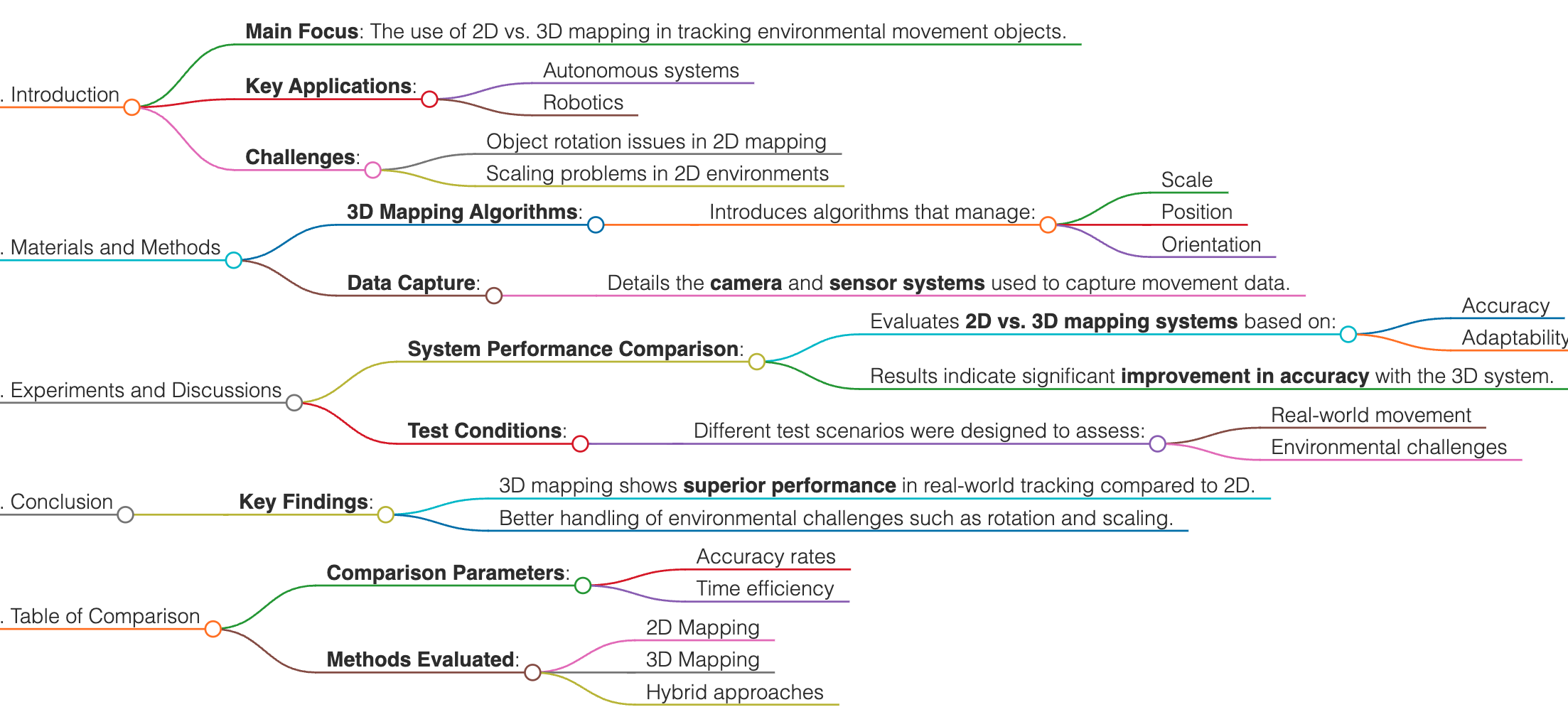
Paper: 2D versus 3D Map for Environment Movement Objects
1. Introduction
- Main Focus: The use of 2D vs. 3D mapping in tracking environmental movement objects.
- Key Applications:
- Autonomous systems
- Robotics
- Challenges:
- Object rotation issues in 2D mapping
- Scaling problems in 2D environments
2. Materials and Methods
- 3D Mapping Algorithms:
- Introduces algorithms that manage:
- Scale
- Position
- Orientation
- Data Capture:
- Details the camera and sensor systems used to capture movement data.
3. Experiments and Discussions
- System Performance Comparison:
- Evaluates 2D vs. 3D mapping systems based on:
- Accuracy
- Adaptability to different conditions
- Results indicate significant improvement in accuracy with the 3D system.
- Test Conditions:
- Different test scenarios were designed to assess:
- Real-world movement
- Environmental challenges
4. Conclusion
- Key Findings:
- 3D mapping shows superior performance in real-world tracking compared to 2D.
- Better handling of environmental challenges such as rotation and scaling.
5. Table of Comparison
- Comparison Parameters:
- Accuracy rates
- Time efficiency
- Methods Evaluated:
- 2D Mapping
- 3D Mapping
- Hybrid approaches
Source: Pirahansiah, F. “2D vs 3D Mapping for Moving Objects”. pirahansiah.com, updated 2026-09-19. Canonical URL https://pirahansiah.com/farshid/content/papers-2d-3d-mapping/ · markdown source papers-2d-3d-mapping.md · how to cite, quote and link this site.