 # Paper: 2D versus 3D Map for Environment Movement Objects
## 1. Introduction
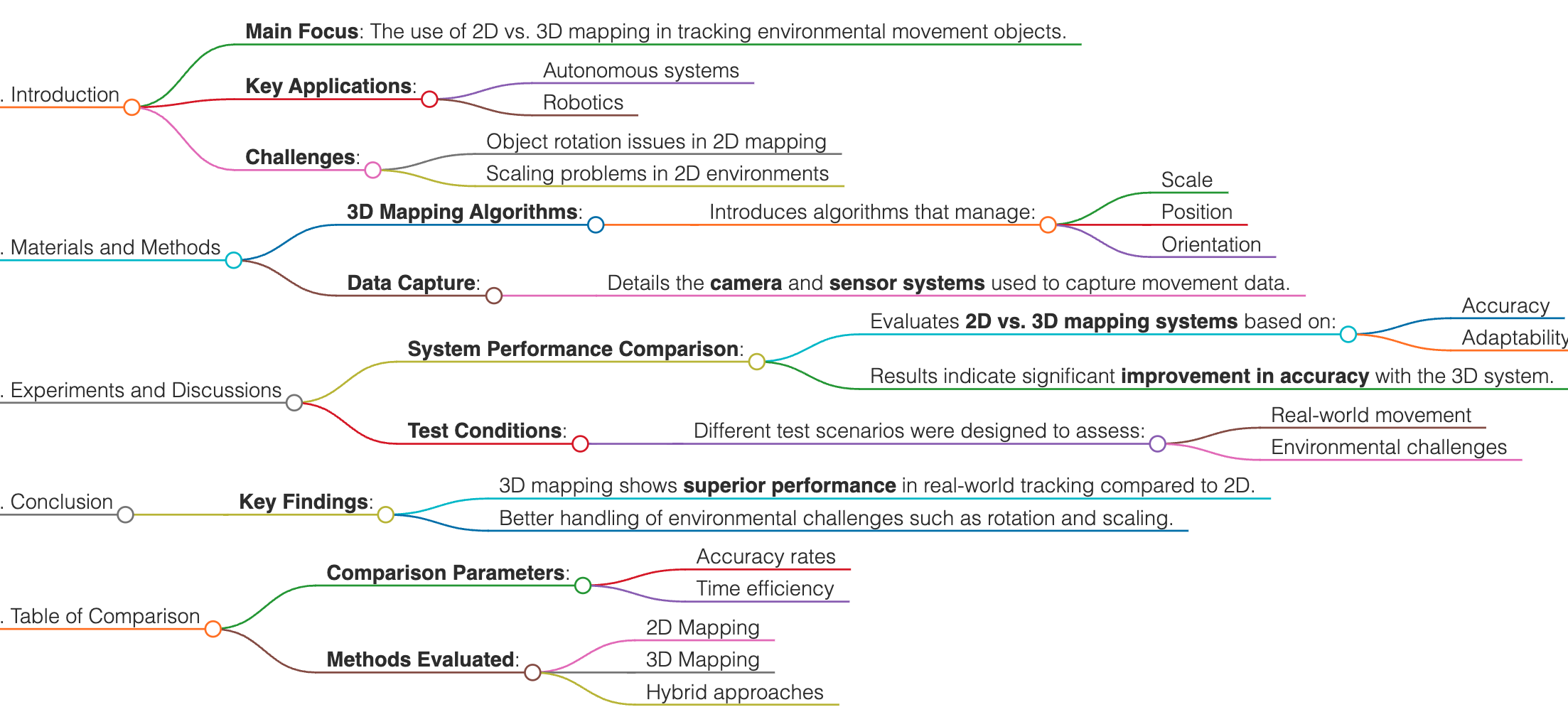
- **Main Focus**: The use of 2D vs. 3D mapping in tracking environmental movement objects.
- **Key Applications**:
- Autonomous systems
- Robotics
- **Challenges**:
- Object rotation issues in 2D mapping
- Scaling problems in 2D environments
## 2. Materials and Methods
- **3D Mapping Algorithms**:
- Introduces algorithms that manage:
- Scale
- Position
- Orientation
- **Data Capture**:
- Details the **camera** and **sensor systems** used to capture movement data.
## 3. Experiments and Discussions
- **System Performance Comparison**:
- Evaluates **2D vs. 3D mapping systems** based on:
- Accuracy
- Adaptability to different conditions
- Results indicate significant **improvement in accuracy** with the 3D system.
- **Test Conditions**:
- Different test scenarios were designed to assess:
- Real-world movement
- Environmental challenges
## 4. Conclusion
- **Key Findings**:
- 3D mapping shows **superior performance** in real-world tracking compared to 2D.
- Better handling of environmental challenges such as rotation and scaling.
## 5. Table of Comparison
- **Comparison Parameters**:
- Accuracy rates
- Time efficiency
- **Methods Evaluated**:
- 2D Mapping
- 3D Mapping
- Hybrid approaches
---
## 3D SLAM and Humanoid Robot Linkages
URL: https://pirahansiah.com/farshid/content/journals-3d-slam-humanoid.md
Survey of 3D SLAM techniques for localization, mapping, and humanoid robot applications.
3D_SLAM_Simultaneous_Localization_And_Mapping_Trends_And_Humanoid_Robot_Linkages
https://www.pirahansiah.com/notes/pubs/journals/3D_SLAM_Simultaneous_Localization_And_Mapping_Trends_And_Humanoid_Robot_Linkages/
[spotify](https://podcasters.spotify.com/pod/show/pirahansiah/episodes/3D-SLAM-Simultaneous-Localization-And-Mapping-Trends-And-Humanoid-Robot-Linkages-e2prg07)
[PDF Download](http://journalarticle.ukm.my/6644/1/4429-10302-1-SM.pdf )
 # Simultaneous Localization and Mapping Trends and Humanoid Robot Linkages
## 1. Introduction
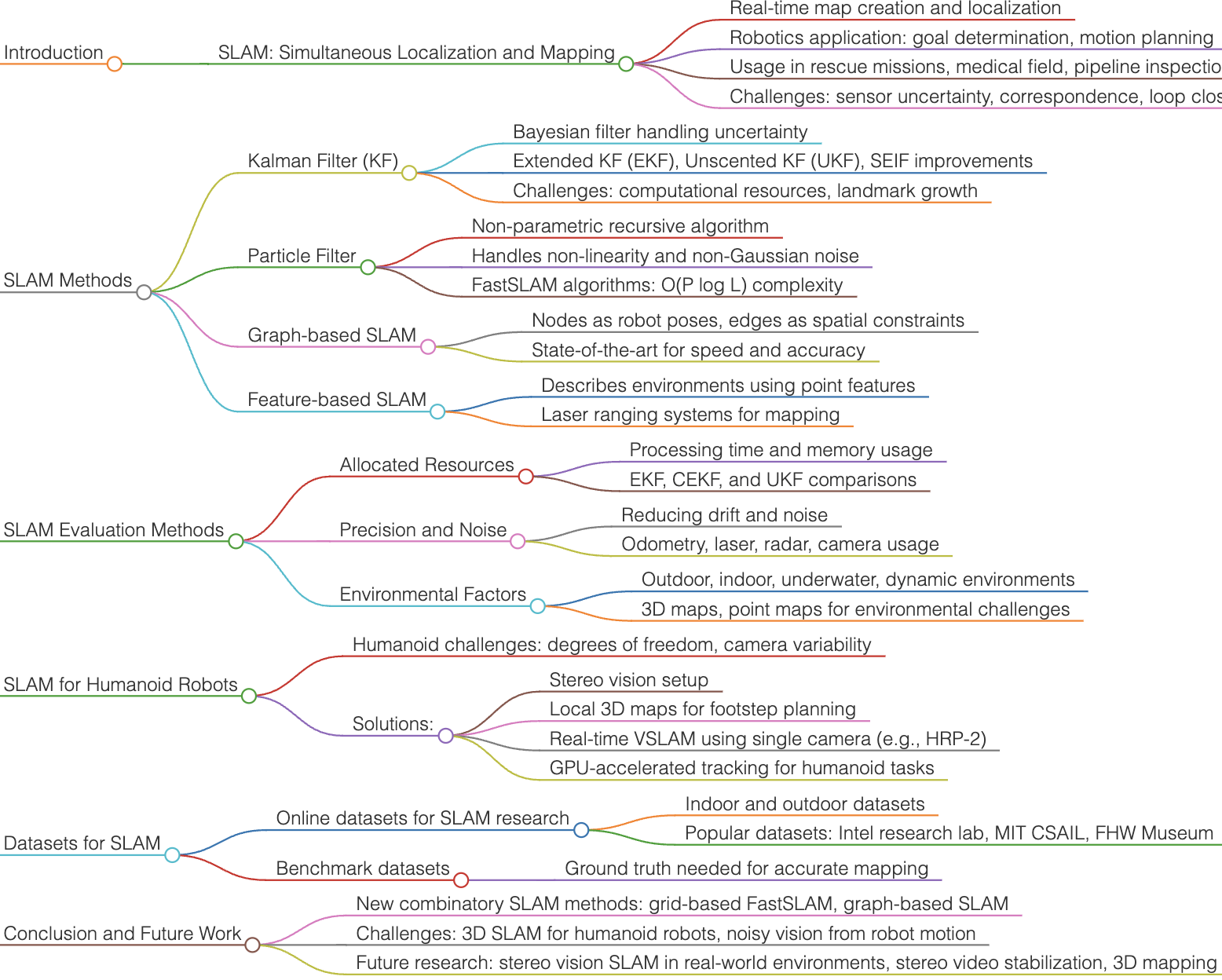
- SLAM: Simultaneous Localization and Mapping
- Real-time map creation and localization
- Robotics application: goal determination, motion planning
- Usage in rescue missions, medical field, pipeline inspection, and more
- Challenges: sensor uncertainty, correspondence, loop closing, time complexity
## 2. SLAM Methods
- Kalman Filter (KF)
- Bayesian filter handling uncertainty
- Extended KF (EKF), Unscented KF (UKF), SEIF improvements
- Challenges: computational resources, landmark growth
- Particle Filter
- Non-parametric recursive algorithm
- Handles non-linearity and non-Gaussian noise
- FastSLAM algorithms: O(P log L) complexity
- Graph-based SLAM
- Nodes as robot poses, edges as spatial constraints
- State-of-the-art for speed and accuracy
- Feature-based SLAM
- Describes environments using point features
- Laser ranging systems for mapping
## 3. SLAM Evaluation Methods
- Allocated Resources
- Processing time and memory usage
- EKF, CEKF, and UKF comparisons
- Precision and Noise
- Reducing drift and noise
- Odometry, laser, radar, camera usage
- Environmental Factors
- Outdoor, indoor, underwater, dynamic environments
- 3D maps, point maps for environmental challenges
## 4. SLAM for Humanoid Robots
- Humanoid challenges: degrees of freedom, camera variability
- Solutions:
- Stereo vision setup
- Local 3D maps for footstep planning
- Real-time VSLAM using single camera (e.g., HRP-2)
- GPU-accelerated tracking for humanoid tasks
## 5. Datasets for SLAM
- Online datasets for SLAM research
- Indoor and outdoor datasets
- Popular datasets: Intel research lab, MIT CSAIL, FHW Museum
- Benchmark datasets
- Ground truth needed for accurate mapping
## 6. Conclusion and Future Work
- New combinatory SLAM methods: grid-based FastSLAM, graph-based SLAM
- Challenges: 3D SLAM for humanoid robots, noisy vision from robot motion
- Future research: stereo vision SLAM in real-world environments, stereo video stabilization, 3D mapping
---
## Adaptive Thresholding Based on PSNR
URL: https://pirahansiah.com/farshid/content/journals-adaptive-thresholding.md
PSNR-based adaptive thresholding for image segmentation in OCR and license plate recognition.
Adaptive_Image_Thresholding_Based_on_the_Peak_Signal-to-noise_Ratio
[spotify](https://podcasters.spotify.com/pod/show/pirahansiah/episodes/Adaptive-Image-Thresholding-Based-on-the-Peak-Signal-to-noise-Ratio-e2pnbgj)
[PDF Download](https://ieeexplore.ieee.org/document/5735125)
[PDF Download](https://pdfs.semanticscholar.org/05b2/d39fce4e8a99897e95f8c75416f65a5a0acc.pdf)
 # Mind Map: Adaptive Image Thresholding Based on PSNR
## 1. Introduction
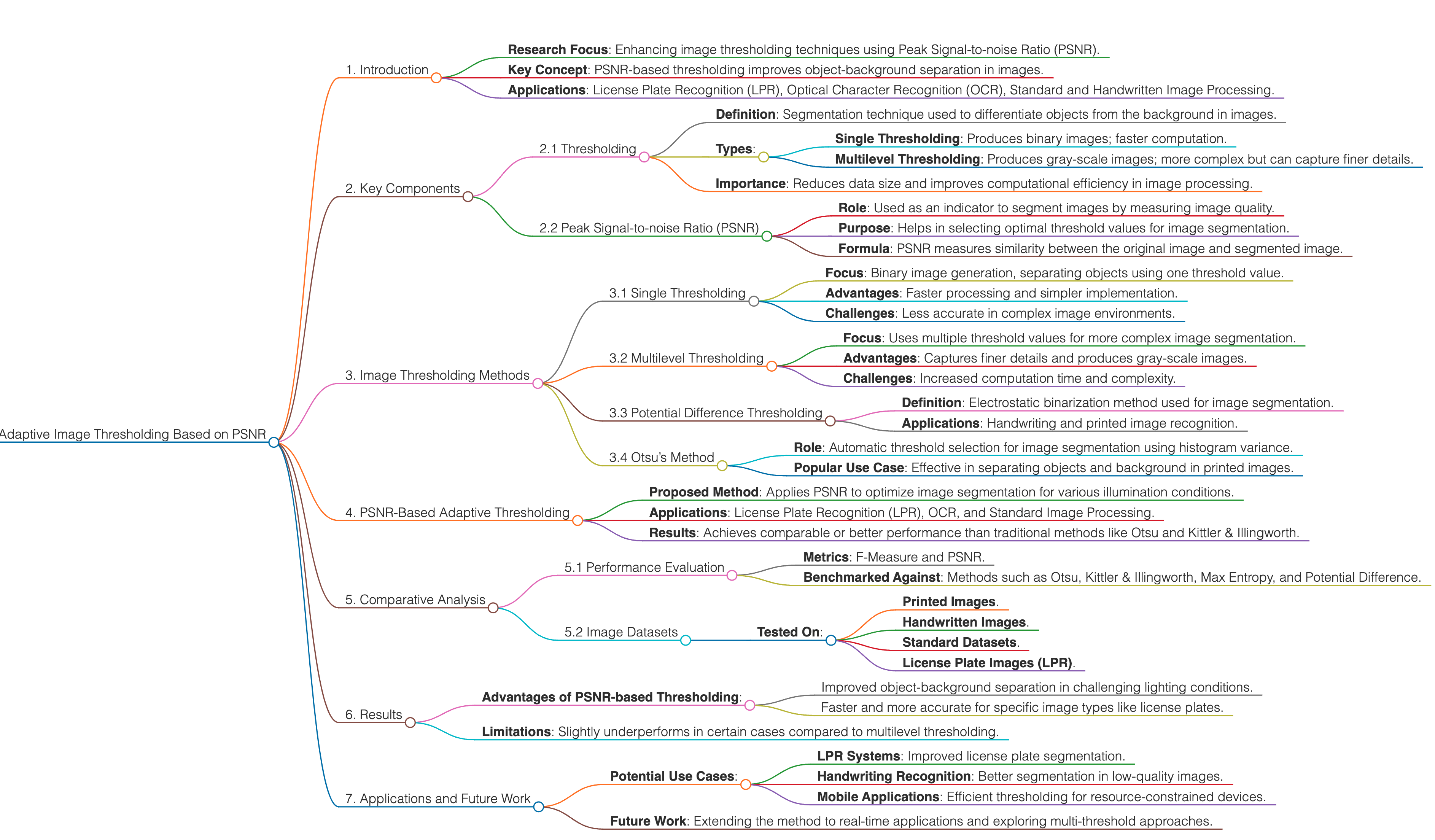
- **Research Focus**: Enhancing image thresholding techniques using Peak Signal-to-noise Ratio (PSNR).
- **Key Concept**: PSNR-based thresholding improves object-background separation in images.
- **Applications**: License Plate Recognition (LPR), Optical Character Recognition (OCR), Standard and Handwritten Image Processing.
## 2. Key Components
### 2.1 Thresholding
- **Definition**: Segmentation technique used to differentiate objects from the background in images.
- **Types**:
- **Single Thresholding**: Produces binary images; faster computation.
- **Multilevel Thresholding**: Produces gray-scale images; more complex but can capture finer details.
- **Importance**: Reduces data size and improves computational efficiency in image processing.
### 2.2 Peak Signal-to-noise Ratio (PSNR)
- **Role**: Used as an indicator to segment images by measuring image quality.
- **Purpose**: Helps in selecting optimal threshold values for image segmentation.
- **Formula**: PSNR measures similarity between the original image and segmented image.
## 3. Image Thresholding Methods
### 3.1 Single Thresholding
- **Focus**: Binary image generation, separating objects using one threshold value.
- **Advantages**: Faster processing and simpler implementation.
- **Challenges**: Less accurate in complex image environments.
### 3.2 Multilevel Thresholding
- **Focus**: Uses multiple threshold values for more complex image segmentation.
- **Advantages**: Captures finer details and produces gray-scale images.
- **Challenges**: Increased computation time and complexity.
### 3.3 Potential Difference Thresholding
- **Definition**: Electrostatic binarization method used for image segmentation.
- **Applications**: Handwriting and printed image recognition.
### 3.4 Otsu’s Method
- **Role**: Automatic threshold selection for image segmentation using histogram variance.
- **Popular Use Case**: Effective in separating objects and background in printed images.
## 4. PSNR-Based Adaptive Thresholding
- **Proposed Method**: Applies PSNR to optimize image segmentation for various illumination conditions.
- **Applications**: License Plate Recognition (LPR), OCR, and Standard Image Processing.
- **Results**: Achieves comparable or better performance than traditional methods like Otsu and Kittler & Illingworth.
## 5. Comparative Analysis
### 5.1 Performance Evaluation
- **Metrics**: F-Measure and PSNR.
- **Benchmarked Against**: Methods such as Otsu, Kittler & Illingworth, Max Entropy, and Potential Difference.
### 5.2 Image Datasets
- **Tested On**:
- **Printed Images**.
- **Handwritten Images**.
- **Standard Datasets**.
- **License Plate Images (LPR)**.
## 6. Results
- **Advantages of PSNR-based Thresholding**:
- Improved object-background separation in challenging lighting conditions.
- Faster and more accurate for specific image types like license plates.
- **Limitations**: Slightly underperforms in certain cases compared to multilevel thresholding.
## 7. Applications and Future Work
- **Potential Use Cases**:
- **LPR Systems**: Improved license plate segmentation.
- **Handwriting Recognition**: Better segmentation in low-quality images.
- **Mobile Applications**: Efficient thresholding for resource-constrained devices.
- **Future Work**: Extending the method to real-time applications and exploring multi-threshold approaches.
---
## Ant Colony Optimization for Image Processing
URL: https://pirahansiah.com/farshid/content/journals-ant-colony.md
ACO-based optimization for image thresholding and edge detection in OCR systems.
USING_AN_ANT_COLONY_OPTIMIZATION_ALGORITHM
- https://www.pirahansiah.com/notes/pubs/journals/USING_AN_ANT_COLONY_OPTIMIZATION_ALGORITHM/
- [spotify](https://podcasters.spotify.com/pod/show/pirahansiah/episodes/USING_AN_ANT_COLONY_OPTIMIZATION_ALGORITHM-e2prlrn)
- [PDF Download](http://www.jatit.org/volumes/Vol95No21/1Vol95No21.pdf)
 # Ant Colony Optimization for Image Edge Detection
## 1. Introduction
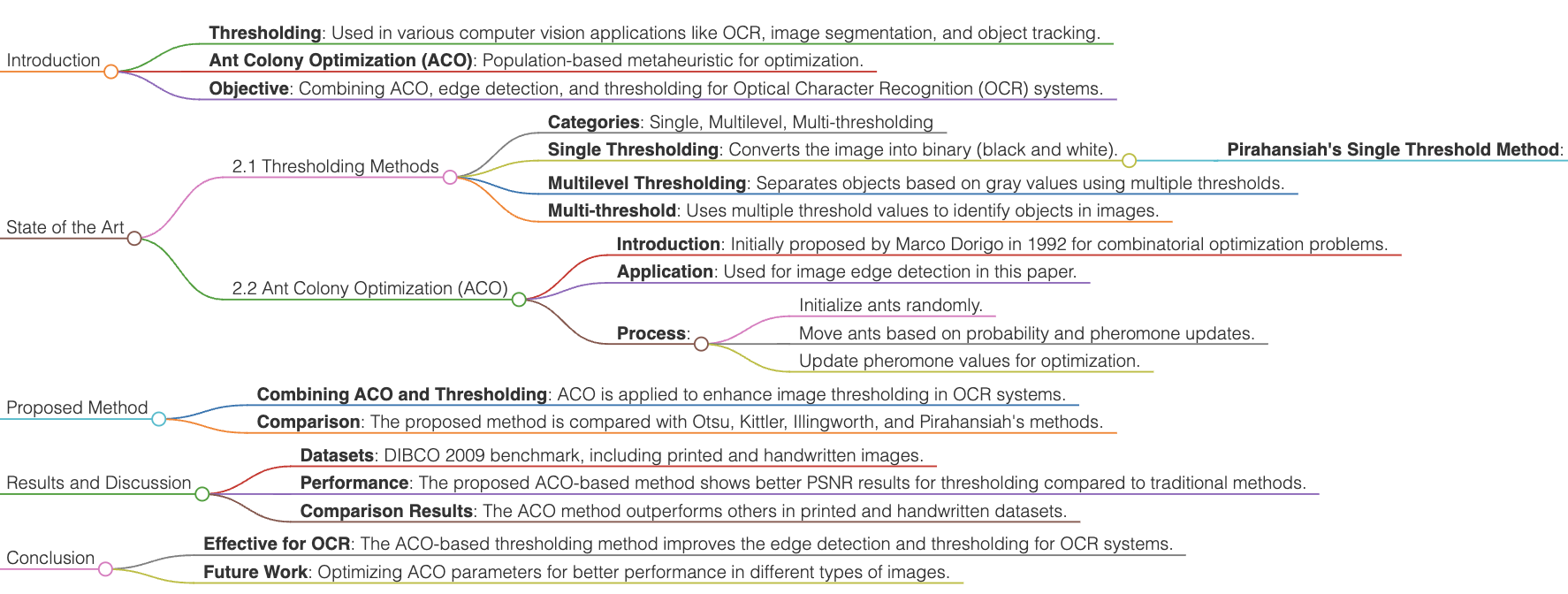
- **Thresholding**: Used in various computer vision applications like OCR, image segmentation, and object tracking.
- **Ant Colony Optimization (ACO)**: Population-based metaheuristic for optimization.
- **Objective**: Combining ACO, edge detection, and thresholding for Optical Character Recognition (OCR) systems.
## 2. State of the Art
### 2.1 Thresholding Methods
- **Categories**: Single, Multilevel, Multi-thresholding
- **Single Thresholding**: Converts the image into binary (black and white).
- **Pirahansiah's Single Threshold Method**: A custom single threshold method using PSNR.
- **Multilevel Thresholding**: Separates objects based on gray values using multiple thresholds.
- **Multi-threshold**: Uses multiple threshold values to identify objects in images.
### 2.2 Ant Colony Optimization (ACO)
- **Introduction**: Initially proposed by Marco Dorigo in 1992 for combinatorial optimization problems.
- **Application**: Used for image edge detection in this paper.
- **Process**:
1. Initialize ants randomly.
2. Move ants based on probability and pheromone updates.
3. Update pheromone values for optimization.
## 3. Proposed Method
- **Combining ACO and Thresholding**: ACO is applied to enhance image thresholding in OCR systems.
- **Comparison**: The proposed method is compared with Otsu, Kittler, Illingworth, and Pirahansiah's methods.
## 4. Results and Discussion
- **Datasets**: DIBCO 2009 benchmark, including printed and handwritten images.
- **Performance**: The proposed ACO-based method shows better PSNR results for thresholding compared to traditional methods.
- **Comparison Results**: The ACO method outperforms others in printed and handwritten datasets.
## 5. Conclusion
- **Effective for OCR**: The ACO-based thresholding method improves the edge detection and thresholding for OCR systems.
- **Future Work**: Optimizing ACO parameters for better performance in different types of images.
---
## Augmented Optical Flow for Video Stabilization
URL: https://pirahansiah.com/farshid/content/books-computational-intelligence.md
Book chapter on Type-2 Fuzzy Gaussian Pyramid optical flow for video stabilization.
Book_Computational_Intelligence_From_Theory_to_Application_explores_augmented_optical_flow_methods_for_video_stabilization
https://www.pirahansiah.com/notes/pubs/books/Book_Computational_Intelligence_From_Theory_to_Application_explores_augmented_optical_flow_methods_for_video_stabilization/
[spotify](https://podcasters.spotify.com/pod/show/pirahansiah/episodes/Book_Computational_Intelligence_From_Theory_to_Application_explores_augmented_optical_flow_methods_for_video_stabilization-e2profn)
[PDF Download book chapter titled “Augmented Optical Flow Methods for Video Stabilization", In Computational Intelligence: from theory to application. (2017) (p18).](http://www.ukm.my/penerbit/penerbitan-2017/)
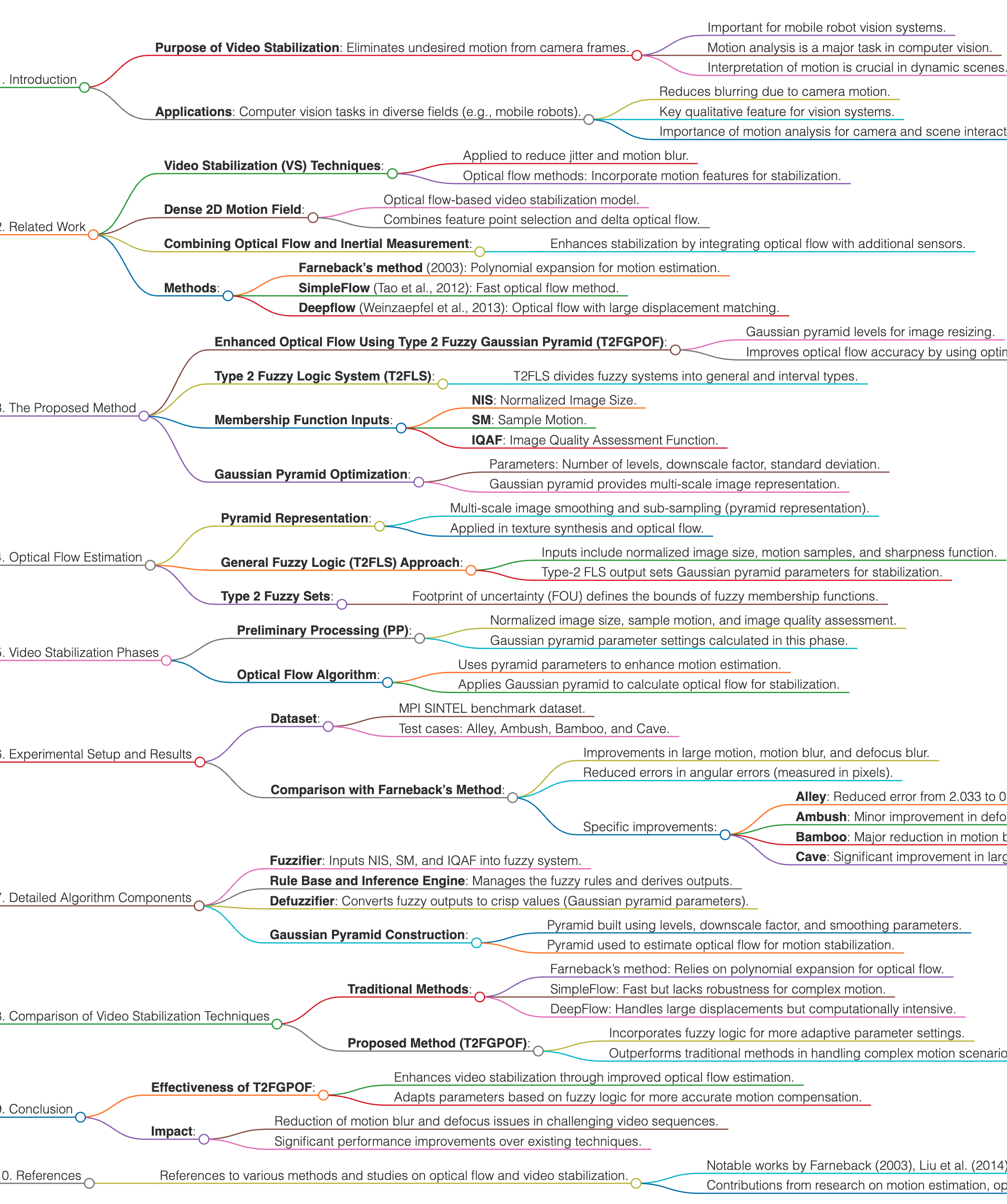
 # Computational Intelligence: From Theory to Application
## Chapter 4: Augmented Optical Flow Methods for Video Stabilization
### 1. Introduction
- **Purpose of Video Stabilization**: Eliminates undesired motion from camera frames.
- Important for mobile robot vision systems.
- Motion analysis is a major task in computer vision.
- Interpretation of motion is crucial in dynamic scenes.
- **Applications**: Computer vision tasks in diverse fields (e.g., mobile robots).
- Reduces blurring due to camera motion.
- Key qualitative feature for vision systems.
- Importance of motion analysis for camera and scene interactions.
### 2. Related Work
- **Video Stabilization (VS) Techniques**:
- Applied to reduce jitter and motion blur.
- Optical flow methods: Incorporate motion features for stabilization.
- **Dense 2D Motion Field**:
- Optical flow-based video stabilization model.
- Combines feature point selection and delta optical flow.
- **Combining Optical Flow and Inertial Measurement**:
- Enhances stabilization by integrating optical flow with additional sensors.
- **Methods**:
- **Farneback’s method** (2003): Polynomial expansion for motion estimation.
- **SimpleFlow** (Tao et al., 2012): Fast optical flow method.
- **Deepflow** (Weinzaepfel et al., 2013): Optical flow with large displacement matching.
### 3. The Proposed Method
- **Enhanced Optical Flow Using Type 2 Fuzzy Gaussian Pyramid (T2FGPOF)**:
- Gaussian pyramid levels for image resizing.
- Improves optical flow accuracy by using optimized Gaussian settings.
- **Type 2 Fuzzy Logic System (T2FLS)**:
- T2FLS divides fuzzy systems into general and interval types.
- **Membership Function Inputs**:
- **NIS**: Normalized Image Size.
- **SM**: Sample Motion.
- **IQAF**: Image Quality Assessment Function.
- **Gaussian Pyramid Optimization**:
- Parameters: Number of levels, downscale factor, standard deviation.
- Gaussian pyramid provides multi-scale image representation.
### 4. Optical Flow Estimation
- **Pyramid Representation**:
- Multi-scale image smoothing and sub-sampling (pyramid representation).
- Applied in texture synthesis and optical flow.
- **General Fuzzy Logic (T2FLS) Approach**:
- Inputs include normalized image size, motion samples, and sharpness function.
- Type-2 FLS output sets Gaussian pyramid parameters for stabilization.
- **Type 2 Fuzzy Sets**:
- Footprint of uncertainty (FOU) defines the bounds of fuzzy membership functions.
### 5. Video Stabilization Phases
- **Preliminary Processing (PP)**:
- Normalized image size, sample motion, and image quality assessment.
- Gaussian pyramid parameter settings calculated in this phase.
- **Optical Flow Algorithm**:
- Uses pyramid parameters to enhance motion estimation.
- Applies Gaussian pyramid to calculate optical flow for stabilization.
### 6. Experimental Setup and Results
- **Dataset**:
- MPI SINTEL benchmark dataset.
- Test cases: Alley, Ambush, Bamboo, and Cave.
- **Comparison with Farneback’s Method**:
- Improvements in large motion, motion blur, and defocus blur.
- Reduced errors in angular errors (measured in pixels).
- Specific improvements:
- **Alley**: Reduced error from 2.033 to 0.721 pixels.
- **Ambush**: Minor improvement in defocus blur.
- **Bamboo**: Major reduction in motion blur from 2.575 to 0.884 pixels.
- **Cave**: Significant improvement in large motion reduction.
### 7. Detailed Algorithm Components
- **Fuzzifier**: Inputs NIS, SM, and IQAF into fuzzy system.
- **Rule Base and Inference Engine**: Manages the fuzzy rules and derives outputs.
- **Defuzzifier**: Converts fuzzy outputs to crisp values (Gaussian pyramid parameters).
- **Gaussian Pyramid Construction**:
- Pyramid built using levels, downscale factor, and smoothing parameters.
- Pyramid used to estimate optical flow for motion stabilization.
### 8. Comparison of Video Stabilization Techniques
- **Traditional Methods**:
- Farneback’s method: Relies on polynomial expansion for optical flow.
- SimpleFlow: Fast but lacks robustness for complex motion.
- DeepFlow: Handles large displacements but computationally intensive.
- **Proposed Method (T2FGPOF)**:
- Incorporates fuzzy logic for more adaptive parameter settings.
- Outperforms traditional methods in handling complex motion scenarios.
### 9. Conclusion
- **Effectiveness of T2FGPOF**:
- Enhances video stabilization through improved optical flow estimation.
- Adapts parameters based on fuzzy logic for more accurate motion compensation.
- **Impact**:
- Reduction of motion blur and defocus issues in challenging video sequences.
- Significant performance improvements over existing techniques.
### 10. References
- References to various methods and studies on optical flow and video stabilization.
- Notable works by Farneback (2003), Liu et al. (2014), Wagner & Hagras (2010).
- Contributions from research on motion estimation, optical flow algorithms, and fuzzy logic systems.
---
## Camera Calibration & Video Stabilization
URL: https://pirahansiah.com/farshid/content/books-camera-calibration.md
Springer book chapter on fuzzy camera calibration and video stabilization for robot localization.
My_Book_chapter_Camera_Calibration_and_Video_Stabilization_Framework_for_Robot_Localization in the Book entitled “Control Engineering in Robotics and Industrial Automation" published in Springer
https://www.pirahansiah.com/notes/pubs/books/My_Book_chapter_Camera_Calibration_and_Video_Stabilization_Framework_for_Robot_Localization/
[spotify](https://podcasters.spotify.com/pod/show/pirahansiah/episodes/My-book-chapter-titled-Camera-Calibration-and-Video-Stabilization-Framework-for-Robot-Localization-in-the-Book-entitled-Control-Engineering-in-Robotics-and-Industrial-Automation-published-Springer-e2prs80)
[PDF Download book chapter titled “book chapter titled “Camera Calibration and Video Stabilization Framework for Robot Localization” in the Book entitled “Control Engineering in Robotics and Industrial Automation" published in Springer](https://www.waterstones.com/book/control-engineering-in-robotics-and-industrial-automation/muralindran-mariappan/mohd-rizal-arshad/9783030745394)
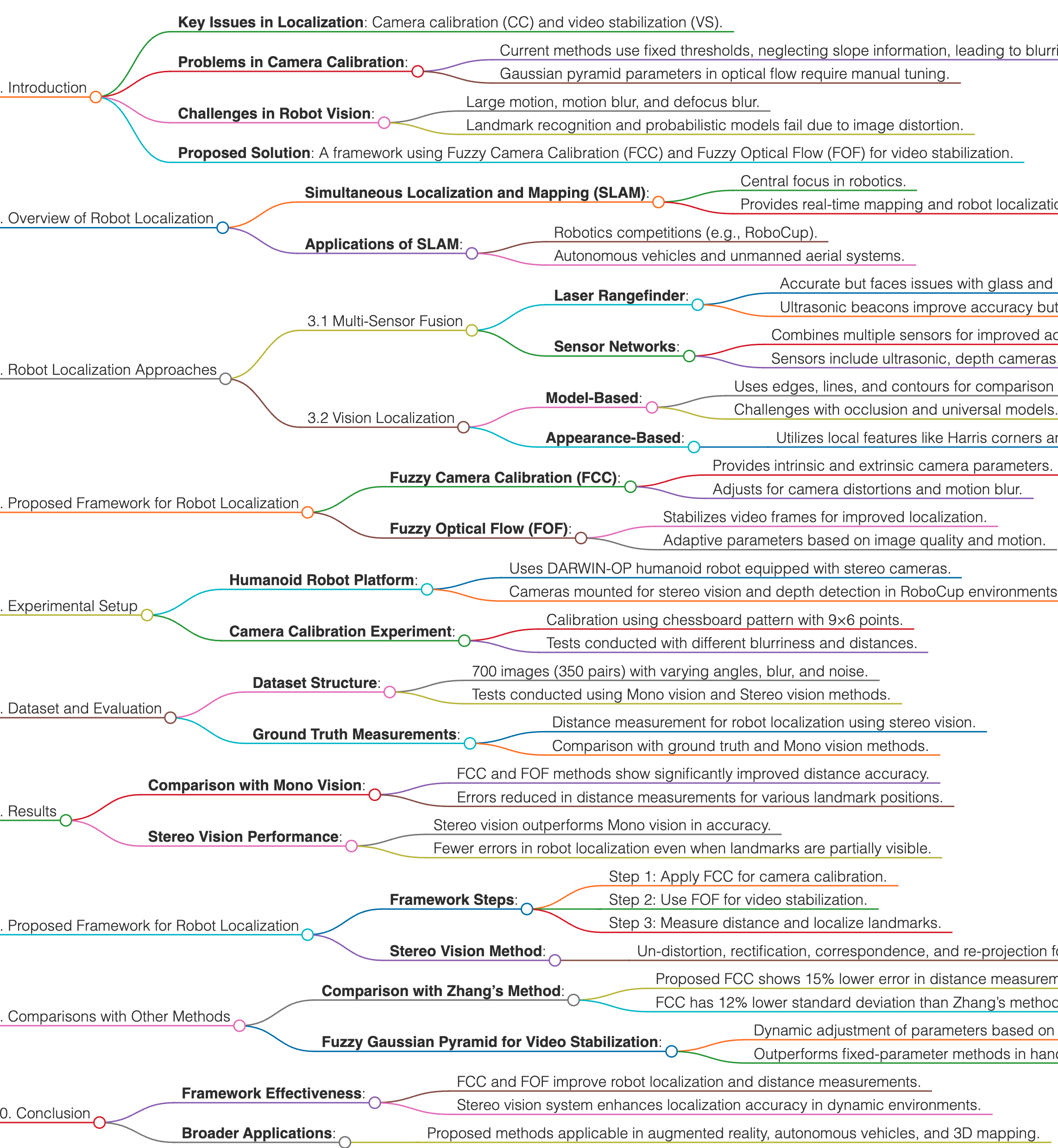
 # Camera Calibration and Video Stabilization Framework for Robot Localization
## 1. Introduction
- **Key Issues in Localization**: Camera calibration (CC) and video stabilization (VS).
- **Problems in Camera Calibration**:
- Current methods use fixed thresholds, neglecting slope information, leading to blurring.
- Gaussian pyramid parameters in optical flow require manual tuning.
- **Challenges in Robot Vision**:
- Large motion, motion blur, and defocus blur.
- Landmark recognition and probabilistic models fail due to image distortion.
- **Proposed Solution**: A framework using Fuzzy Camera Calibration (FCC) and Fuzzy Optical Flow (FOF) for video stabilization.
## 2. Overview of Robot Localization
- **Simultaneous Localization and Mapping (SLAM)**:
- Central focus in robotics.
- Provides real-time mapping and robot localization.
- **Applications of SLAM**:
- Robotics competitions (e.g., RoboCup).
- Autonomous vehicles and unmanned aerial systems.
## 3. Robot Localization Approaches
### 3.1 Multi-Sensor Fusion
- **Laser Rangefinder**:
- Accurate but faces issues with glass and reflective surfaces.
- Ultrasonic beacons improve accuracy but are more error-prone.
- **Sensor Networks**:
- Combines multiple sensors for improved accuracy.
- Sensors include ultrasonic, depth cameras, and lasers.
### 3.2 Vision Localization
- **Model-Based**:
- Uses edges, lines, and contours for comparison with object models.
- Challenges with occlusion and universal models.
- **Appearance-Based**:
- Utilizes local features like Harris corners and SIFT for object recognition and tracking.
## 4. Proposed Framework for Robot Localization
- **Fuzzy Camera Calibration (FCC)**:
- Provides intrinsic and extrinsic camera parameters.
- Adjusts for camera distortions and motion blur.
- **Fuzzy Optical Flow (FOF)**:
- Stabilizes video frames for improved localization.
- Adaptive parameters based on image quality and motion.
## 5. Experimental Setup
- **Humanoid Robot Platform**:
- Uses DARWIN-OP humanoid robot equipped with stereo cameras.
- Cameras mounted for stereo vision and depth detection in RoboCup environments.
- **Camera Calibration Experiment**:
- Calibration using chessboard pattern with 9×6 points.
- Tests conducted with different blurriness and distances.
## 6. Dataset and Evaluation
- **Dataset Structure**:
- 700 images (350 pairs) with varying angles, blur, and noise.
- Tests conducted using Mono vision and Stereo vision methods.
- **Ground Truth Measurements**:
- Distance measurement for robot localization using stereo vision.
- Comparison with ground truth and Mono vision methods.
## 7. Results
- **Comparison with Mono Vision**:
- FCC and FOF methods show significantly improved distance accuracy.
- Errors reduced in distance measurements for various landmark positions.
- **Stereo Vision Performance**:
- Stereo vision outperforms Mono vision in accuracy.
- Fewer errors in robot localization even when landmarks are partially visible.
## 8. Proposed Framework for Robot Localization
- **Framework Steps**:
- Step 1: Apply FCC for camera calibration.
- Step 2: Use FOF for video stabilization.
- Step 3: Measure distance and localize landmarks.
- **Stereo Vision Method**:
- Un-distortion, rectification, correspondence, and re-projection for distance measurement.
## 9. Comparisons with Other Methods
- **Comparison with Zhang’s Method**:
- Proposed FCC shows 15% lower error in distance measurements.
- FCC has 12% lower standard deviation than Zhang’s method.
- **Fuzzy Gaussian Pyramid for Video Stabilization**:
- Dynamic adjustment of parameters based on image sharpness and motion.
- Outperforms fixed-parameter methods in handling large motions.
## 10. Conclusion
- **Framework Effectiveness**:
- FCC and FOF improve robot localization and distance measurements.
- Stereo vision system enhances localization accuracy in dynamic environments.
- **Broader Applications**:
- Proposed methods applicable in augmented reality, autonomous vehicles, and 3D mapping.
---
## Camera Calibration for Multi-Modal Vision
URL: https://pirahansiah.com/farshid/content/papers-multimodal-calibration.md
Automatic calibration framework for multi-modal robot vision using IQA metrics.
Camera_Calibration_for_Multi-Modal_Robot_Vision
https://www.pirahansiah.com/notes/pubs/papers/Camera_Calibration_for_Multi-Modal_Robot_Vision
[spotify](https://podcasters.spotify.com/pod/show/pirahansiah/episodes/My-Conference-Paper-Camera-Calibration-for-Multi-Modal-Robot-Vision-e2ps1fn )
[PDF Download My Conference Paper](https://ieeexplore.ieee.org/document/7360336 )
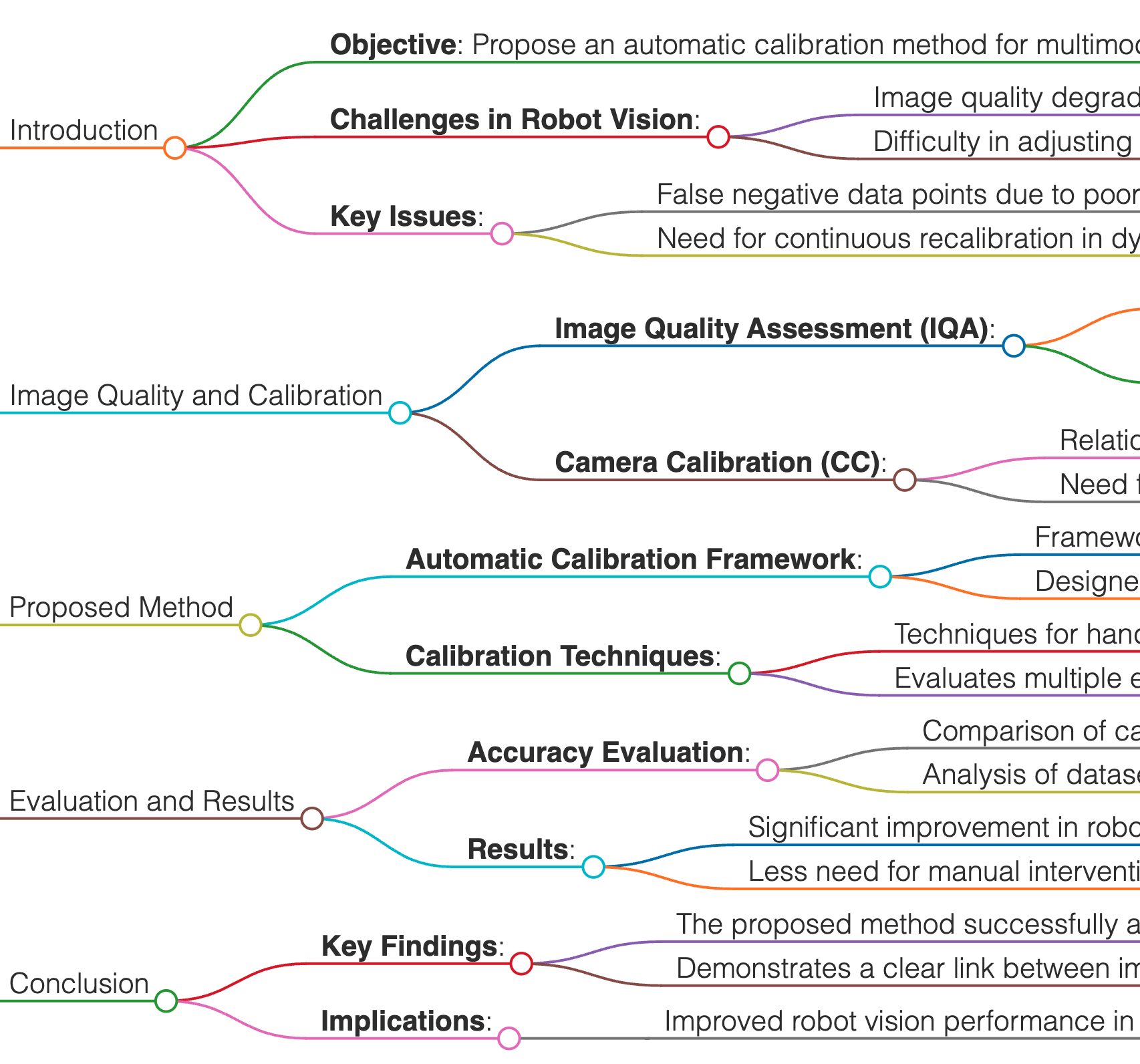
 # Camera Calibration for Multi-Modal Robot Vision
## 1. Introduction
- **Objective**: Propose an automatic calibration method for multimodal robot vision.
- **Challenges in Robot Vision**:
- Image quality degradation
- Difficulty in adjusting to different environments
- **Key Issues**:
- False negative data points due to poor calibration
- Need for continuous recalibration in dynamic environments
## 2. Image Quality and Calibration
- **Image Quality Assessment (IQA)**:
- Impact of poor image quality on robot vision
- Key metrics:
- Peak Signal-to-Noise Ratio (PSNR)
- Structural Similarity Index (SSIM)
- **Camera Calibration (CC)**:
- Relationship between image quality and calibration accuracy
- Need for automatic calibration techniques
## 3. Proposed Method
- **Automatic Calibration Framework**:
- Framework based on IQA metrics like PSNR and SSIM
- Designed to adjust calibration automatically in real-time as image quality changes
- **Calibration Techniques**:
- Techniques for handling dynamic environments and maintaining accuracy
- Evaluates multiple environments to test robustness
## 4. Evaluation and Results
- **Accuracy Evaluation**:
- Comparison of calibration methods in different test scenarios
- Analysis of datasets generated with automatic calibration
- **Results**:
- Significant improvement in robot vision accuracy using the proposed automatic calibration method
- Less need for manual intervention in real-time environments
## 5. Conclusion
- **Key Findings**:
- The proposed method successfully addresses the challenge of automatic camera calibration in dynamic environments.
- Demonstrates a clear link between image quality assessment and calibration performance.
- **Implications**:
- Improved robot vision performance in various applications (e.g., autonomous humanoid robots).
---
## Character & Object Recognition via Features
URL: https://pirahansiah.com/farshid/content/journals-character-recognition.md
Global feature extraction methods for character and object recognition in computer vision.
CHARACTER_AND_OBJECT_RECOGNITION_BASED_ON_GLOBAL_FEATURE_EXTRACTION
[spotify](https://podcasters.spotify.com/pod/show/pirahansiah/episodes/Character-and-Object-Recognition-Based-on-Global-Feature-Extraction-e2pptrp)
[PDF Download](http://www.jatit.org/volumes/Vol52No2/6Vol52No2.pdf )
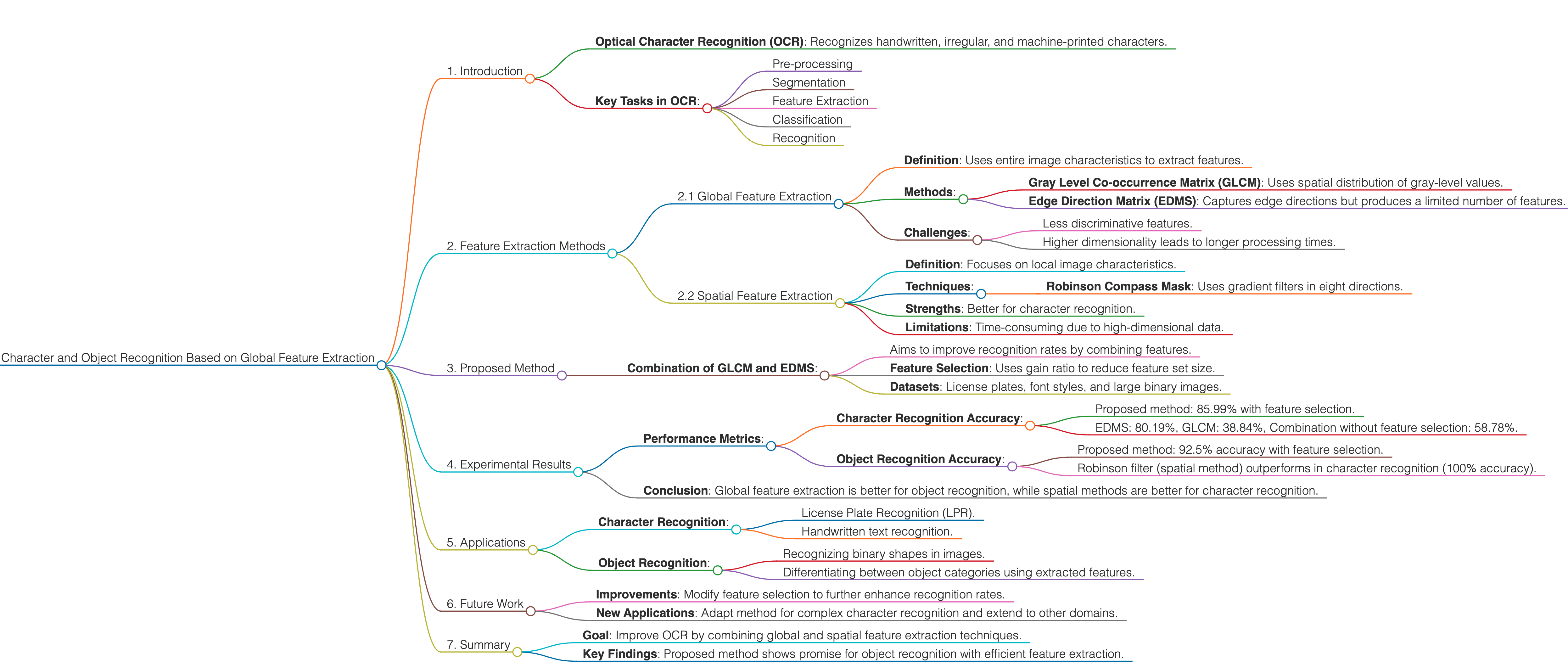
 # Mind Map: Character and Object Recognition Based on Global Feature Extraction
## 1. Introduction
- **Optical Character Recognition (OCR)**: Recognizes handwritten, irregular, and machine-printed characters.
- **Key Tasks in OCR**:
- Pre-processing
- Segmentation
- Feature Extraction
- Classification
- Recognition
## 2. Feature Extraction Methods
### 2.1 Global Feature Extraction
- **Definition**: Uses entire image characteristics to extract features.
- **Methods**:
- **Gray Level Co-occurrence Matrix (GLCM)**: Uses spatial distribution of gray-level values.
- **Edge Direction Matrix (EDMS)**: Captures edge directions but produces a limited number of features.
- **Challenges**:
- Less discriminative features.
- Higher dimensionality leads to longer processing times.
### 2.2 Spatial Feature Extraction
- **Definition**: Focuses on local image characteristics.
- **Techniques**:
- **Robinson Compass Mask**: Uses gradient filters in eight directions.
- **Strengths**: Better for character recognition.
- **Limitations**: Time-consuming due to high-dimensional data.
## 3. Proposed Method
- **Combination of GLCM and EDMS**:
- Aims to improve recognition rates by combining features.
- **Feature Selection**: Uses gain ratio to reduce feature set size.
- **Datasets**: License plates, font styles, and large binary images.
## 4. Experimental Results
- **Performance Metrics**:
- **Character Recognition Accuracy**:
- Proposed method: 85.99% with feature selection.
- EDMS: 80.19%, GLCM: 38.84%, Combination without feature selection: 58.78%.
- **Object Recognition Accuracy**:
- Proposed method: 92.5% accuracy with feature selection.
- Robinson filter (spatial method) outperforms in character recognition (100% accuracy).
- **Conclusion**: Global feature extraction is better for object recognition, while spatial methods are better for character recognition.
## 5. Applications
- **Character Recognition**:
- License Plate Recognition (LPR).
- Handwritten text recognition.
- **Object Recognition**:
- Recognizing binary shapes in images.
- Differentiating between object categories using extracted features.
## 6. Future Work
- **Improvements**: Modify feature selection to further enhance recognition rates.
- **New Applications**: Adapt method for complex character recognition and extend to other domains.
## 7. Summary
- **Goal**: Improve OCR by combining global and spatial feature extraction techniques.
- **Key Findings**: Proposed method shows promise for object recognition with efficient feature extraction.
---
## Character Recognition via Global Features
URL: https://pirahansiah.com/farshid/content/papers-global-feature-recognition.md
Hybrid GLCM and EDMS method for character recognition in OCR applications.
Character_Recognition_Based_on_Global_Feature
https://www.pirahansiah.com/notes/pubs/papers/Character_Recognition_Based_on_Global_Feature
[spotify]( https://podcasters.spotify.com/pod/show/pirahansiah/episodes/My-Conference-Paper-Character-Recognition-Based-on-Global-Feature-e2ps1tp)
[PDF Download My Conference Paper]( https://doi.org/10.1109/ICEEI.2011.6021649 )
 # Character Recognition Based on Global Feature Extraction
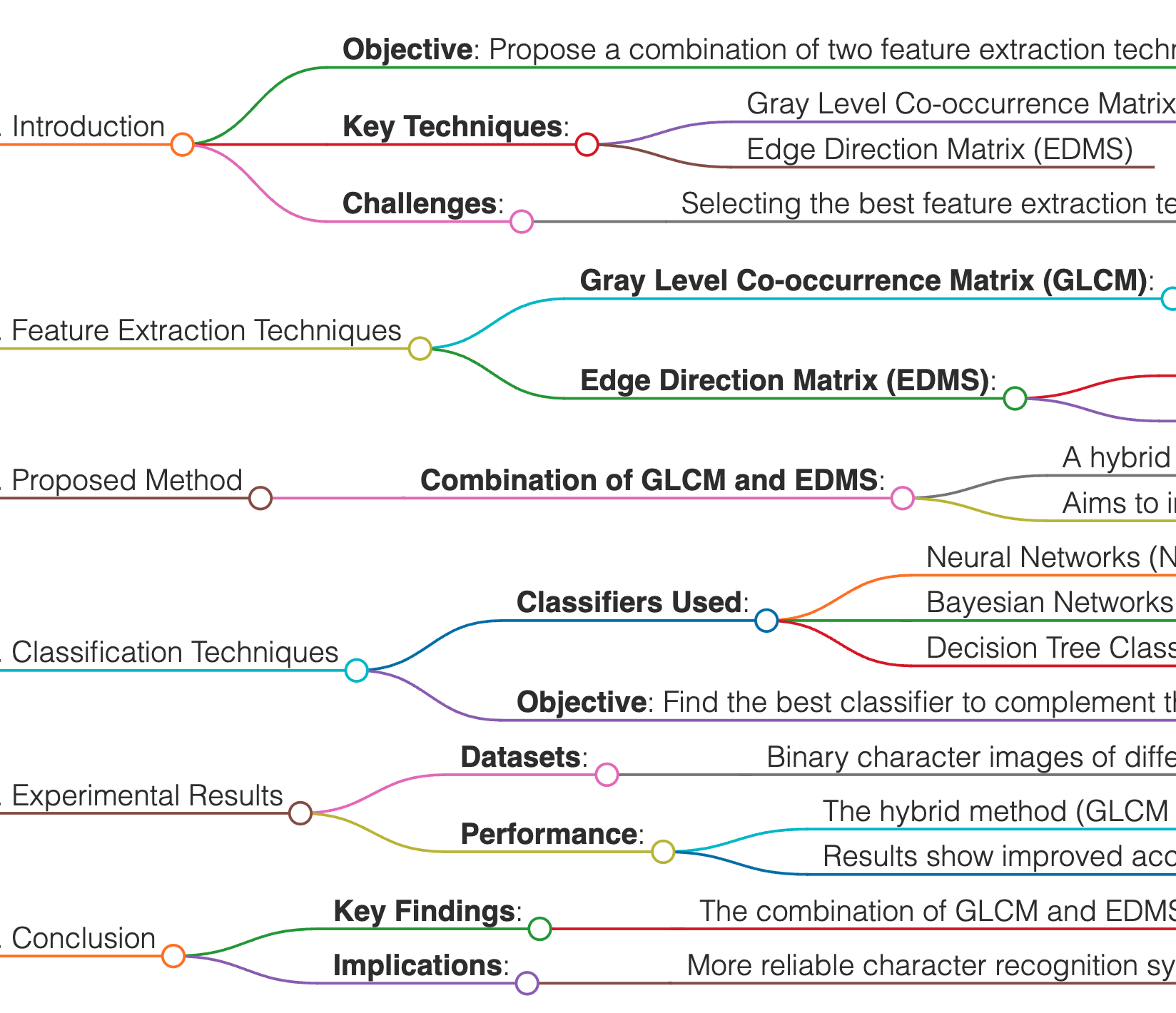
## 1. Introduction
- **Objective**: Propose a combination of two feature extraction techniques for character recognition.
- **Key Techniques**:
- Gray Level Co-occurrence Matrix (GLCM)
- Edge Direction Matrix (EDMS)
- **Challenges**:
- Selecting the best feature extraction technique for various character recognition tasks.
## 2. Feature Extraction Techniques
- **Gray Level Co-occurrence Matrix (GLCM)**:
- Focuses on texture and pixel relationships in the image.
- Extracts texture features for character recognition.
- **Edge Direction Matrix (EDMS)**:
- Emphasizes edges and directions in character images.
- Extracts shape features.
## 3. Proposed Method
- **Combination of GLCM and EDMS**:
- A hybrid approach that leverages both texture and edge features.
- Aims to improve accuracy over using either GLCM or EDMS alone.
## 4. Classification Techniques
- **Classifiers Used**:
- Neural Networks (NN)
- Bayesian Networks (BN)
- Decision Tree Classifiers
- **Objective**: Find the best classifier to complement the hybrid feature extraction method.
## 5. Experimental Results
- **Datasets**:
- Binary character images of different sizes used for testing.
- **Performance**:
- The hybrid method (GLCM + EDMS) outperforms individual feature extraction techniques.
- Results show improved accuracy in character recognition tasks.
## 6. Conclusion
- **Key Findings**:
- The combination of GLCM and EDMS provides better recognition performance than using either technique alone.
- **Implications**:
- More reliable character recognition systems for real-world applications.
---
## Classification with Geometrical Features
URL: https://pirahansiah.com/farshid/content/papers-geometrical-topological.md
Evaluation of classification techniques using enhanced geometrical and topological features.
An_evaluation_of_classification_techniques_using_enhanced_Geometrical_Topological_Feature_Analysis
https://www.pirahansiah.com/notes/pubs/papers/An_evaluation_of_classification_techniques_using_enhanced_Geometrical_Topological_Feature_Analysis
[spotify]( https://podcasters.spotify.com/pod/show/pirahansiah/episodes/My-Conference-Paper-An-evaluation-of-classification-techniques-using-enhanced-Geometrical-Topological-Feature-Analysis-e2ps17l)
[PDF Download My Conference Paper](https://scholar.google.com/scholar?oi=bibs&cluster=3038184255311332521&btnI=1&hl=en )
 # An Evaluation of Classification Techniques Using Enhanced Geometrical Topological Feature Analysis
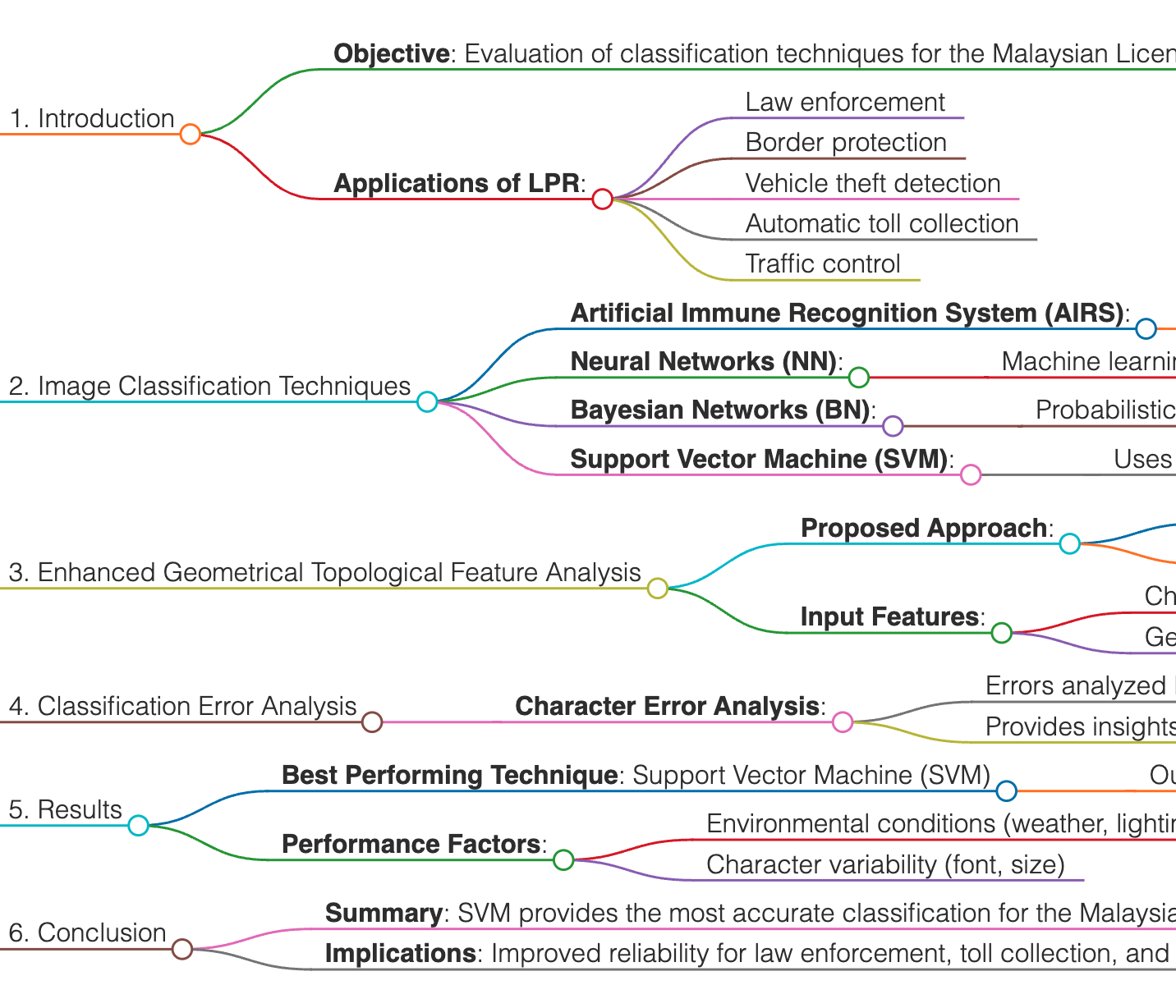
## 1. Introduction
- **Objective**: Evaluation of classification techniques for the Malaysian License Plate Recognition (LPR) system.
- **Applications of LPR**:
- Law enforcement
- Border protection
- Vehicle theft detection
- Automatic toll collection
- Traffic control
## 2. Image Classification Techniques
- **Artificial Immune Recognition System (AIRS)**:
- Mimics biological immune systems for pattern recognition.
- **Neural Networks (NN)**:
- Machine learning technique that models the human brain to classify images.
- **Bayesian Networks (BN)**:
- Probabilistic graphical models to classify data based on probability distributions.
- **Support Vector Machine (SVM)**:
- Uses geometric representations to classify data.
## 3. Enhanced Geometrical Topological Feature Analysis
- **Proposed Approach**:
- Focuses on improving image classification accuracy for Malaysian license plates.
- Uses topological features from license plate characters and numbers.
- **Input Features**:
- Character shapes
- Geometrical features
## 4. Classification Error Analysis
- **Character Error Analysis**:
- Errors analyzed based on classification methods.
- Provides insights into which methods perform better in specific conditions.
## 5. Results
- **Best Performing Technique**: Support Vector Machine (SVM)
- Outperforms AIRS, Neural Networks, and Bayesian Networks in accuracy for Malaysian LPR.
- **Performance Factors**:
- Environmental conditions (weather, lighting)
- Character variability (font, size)
## 6. Conclusion
- **Summary**: SVM provides the most accurate classification for the Malaysian LPR system.
- **Implications**: Improved reliability for law enforcement, toll collection, and traffic control systems.
---
## Computer Vision Meets LLM
URL: https://pirahansiah.com/farshid/content/books-cv-meets-llm.md
Book exploring multimodal AI combining computer vision with large language models.
tags: [computer-vision, llm, multimodal, rag]
hashtags: "#cv #llm #multimodal #rag"
[Computer Vision Meets LLM](/farshid/content/books-cv-meets-llm.md)
# AI computer vision locally LLMs on device
## Computer Vision Meets LLM: Multi-Agent Swarm with RAG for Images and Videos
### **Introduction**
The convergence of Computer Vision (CV) and Large Language Models (LLMs) marks a significant advancement in artificial intelligence, enabling more comprehensive and intelligent systems capable of understanding and interacting with the world in multimodal ways. By integrating multi-agent swarms with Retrieval-Augmented Generation (RAG), developers can create sophisticated applications that process and analyze images and videos alongside textual data. This synergy enhances capabilities in areas such as image recognition, video analysis, document processing, and interactive user experiences.
### **1. Integration of Computer Vision and Large Language Models**
Combining CV and LLMs leverages the strengths of both modalities:
- **Computer Vision** excels in interpreting and analyzing visual data, identifying patterns, objects, and actions within images and videos.
- **Large Language Models** (e.g., GPT-4) are proficient in understanding and generating human-like text, enabling nuanced interactions and contextual understanding.
Together, they enable applications that require both visual and textual comprehension, such as automated content creation, intelligent video summarization, and enhanced accessibility features.
### **2. Multi-Agent Swarm with Retrieval-Augmented Generation (RAG)**
**Multi-Agent Swarms** involve multiple AI agents working collaboratively to perform complex tasks. When combined with **Retrieval-Augmented Generation (RAG)**, these swarms can efficiently retrieve relevant information from diverse sources and generate contextually appropriate responses or actions.
- **RAG Mechanism**: Enhances LLMs by integrating a retrieval component that fetches relevant data from external sources (e.g., databases, documents, images) to inform the generation process.
- **Multi-Agent Coordination**: Different agents specialize in various aspects of data processing (e.g., one handles image analysis, another manages textual data), ensuring comprehensive and efficient task execution.
### **3. Token Costs and Pricing for Image Processing with GPT-4 Turbo Vision**
OpenAI's GPT-4 Turbo with Vision capabilities offers powerful tools for processing images and videos. Understanding the token costs associated with these operations is crucial for budgeting and optimizing usage.
#### **a. Low Mode**
- **Description**: Processes an image at a fixed cost, suitable for straightforward image analysis tasks.
- **Cost**: 85 tokens per image.
#### **b. High Mode**
- **Description**: Handles more complex images by resizing and partitioning them into manageable segments before processing.
- **Procedure**:
1. **Scaling**: The image is scaled to fit within a 2048 x 2048 pixel square.
2. **Resizing**: The shortest side of the image is resized to 768 pixels.
3. **Partitioning**: The resized image is divided into multiple 512-pixel squares.
4. **Cost Calculation**:
- **Base Cost**: 85 tokens.
- **Additional Cost**: 170 tokens per 512-pixel square.
- **Total Cost**: `(Number of squares * 170) + 85` tokens.
- **Example**: A 1080x1080 pixel image processed in vision mode costs approximately $0.00765 per image.
#### **c. Token Cost Management**
- **Tools**: Utilize AI Model Cost Calculators to estimate and manage token costs effectively.
- [AI Model Cost Calculator](/farshid/content/computer-vision.md)
### **4. Implementing Retrieval-Augmented Generation (RAG) Systems with Multimodal Data**
Building and implementing RAG systems using multimodal data involves several key techniques and considerations:
#### **a. Contrastive Learning**
- **Purpose**: Trains models to distinguish between similar and dissimilar data points across different modalities.
- **Application**: Enhances the model's ability to retrieve relevant information by understanding the relationships between text, images, audio, and video.
#### **b. Any-to-Any Search Systems**
- **Functionality**: Allows users to input data in one form (e.g., an image) and retrieve related data in another format (e.g., text or video).
- **Use Cases**:
- **Document Analysis**: Extracting and summarizing information from scanned invoices.
- **Multimodal Recommender Systems**: Providing recommendations based on a combination of user preferences and visual data.
#### **c. Training Multimodal Models**
- **Techniques**:
- **Data Integration**: Combining datasets from various modalities to train comprehensive models.
- **Model Architecture**: Designing architectures that can handle and process multiple data types simultaneously.
### **5. Real-World Applications**
#### **a. Analyzing Documents and Invoices**
- **Process**:
1. **OCR Processing**: Extract text from scanned documents using CV.
2. **Data Retrieval**: Use RAG to fetch relevant financial data.
3. **Automated Calculation**: Compute costs and generate summaries.
- **Outcome**: Streamlined invoice processing with reduced manual intervention.
#### **b. Multimodal Recommender Systems**
- **Functionality**: Combines user behavior data (text) with visual preferences (images) to provide personalized recommendations.
- **Benefit**: Enhanced user experience through more accurate and relevant suggestions.
#### **c. Defect Detection in Manufacturing**
- **Method**:
- **Image Analysis**: Detect defects in products using CV.
- **Data Augmentation**: Use RAG to correlate defects with production data.
- **Result**: Improved quality control and reduced defect rates.
#### **d. Graphs to Code Conversion**
- **Description**: Transform visual graph representations into executable code using LLMs.
- **Application**: Facilitates rapid prototyping and development based on visual designs.
#### **e. PowerBI Integration**
- **Use Case**: Enhance data visualization and analysis by integrating AI-driven insights into PowerBI dashboards.
- **Advantage**: More dynamic and insightful business intelligence solutions.
### **6. Prompting Strategies**
Effective prompting strategies are essential for maximizing the performance of AI systems in multimodal environments.
#### **a. Zero-Shot Prompting**
- **Definition**: Instructing the model to perform a task without providing specific examples.
- **Usage**: Suitable for straightforward tasks where the model's general knowledge suffices.
#### **b. Few-Shot Prompting**
- **Definition**: Providing a few examples to guide the model in performing a task.
- **Usage**: Enhances performance in more complex or nuanced tasks by offering contextual guidance.
### **7. Context Window Management**
Managing the context window is crucial for maintaining coherence and relevance in AI-generated responses, especially when dealing with large amounts of data from multiple modalities.
- **Techniques**:
- **Chunking Data**: Breaking down large datasets into smaller, manageable chunks.
- **Summarization**: Condensing information to fit within the context window without losing essential details.
- **Prioritization**: Focusing on the most relevant information to maximize the effectiveness of the model's responses.
### **8. Tools and Platforms**
#### **a. OpenAI's Vision API**
- **Capabilities**: Enables image and video processing with GPT-4 Turbo, supporting tasks like OCR and detailed analysis.
- **Documentation**: [OpenAI Vision Guide](https://platform.openai.com/docs/guides/vision)
#### **b. Azure AI Studio**
- **Features**:
- **Data Integration**: Upload and manage documents and images.
- **Visual Search**: Implement GPT-4 for image-based search queries.
- **Access**: [Azure AI Studio](https://portal.azure.com/#browse/Microsoft.MachineLearningServices%2Faistudio)
### **9. Token Costs Associated with Processing Images Using GPT-4 Turbo with Vision**
Understanding token costs is vital for optimizing the use of GPT-4 Turbo's vision capabilities. Here's a breakdown of how token costs are calculated:
#### **a. Low Mode**
- **Fixed Cost**: 85 tokens per image.
- **Use Case**: Suitable for simple image processing tasks where extensive analysis is not required.
#### **b. High Mode**
- **Procedure**:
1. **Scaling**: Fit the image within a 2048 x 2048 pixel square.
2. **Resizing**: Adjust the shortest side to 768 pixels.
3. **Partitioning**: Divide the image into 512-pixel squares.
4. **Cost Calculation**: `(Number of squares * 170) + 85` tokens.
- **Example**:
- **1080x1080 Pixel Image**:
- Number of 512-pixel squares: Calculated based on the resized dimensions.
- Total Cost: Approximately $0.00765 per image in vision mode.
### **10. Best Practices for Building and Implementing Multimodal RAG Systems**
#### **a. Optimize Data Processing**
- **Efficient Scaling and Resizing**: Ensure images are processed optimally to balance quality and token costs.
- **Batch Processing**: Handle multiple images or videos simultaneously to reduce processing time and costs.
#### **b. Enhance Retrieval Mechanisms**
- **Diverse Data Sources**: Incorporate a wide range of data sources to improve the relevance and accuracy of retrieved information.
- **Continuous Learning**: Update retrieval models regularly to adapt to new data and evolving requirements.
#### **c. Ensure Ethical AI Usage**
- **Bias Mitigation**: Continuously monitor and address biases in both CV and LLM components.
- **Transparency**: Maintain clear documentation and explainability for AI-driven decisions and processes.
### **11. Resources and Further Reading**
#### **a. Official Documentation**
- **OpenAI Vision Documentation**: [OpenAI Vision Guide](https://platform.openai.com/docs/guides/vision)
- **Azure AI Studio Documentation**: [Azure AI Studio](https://portal.azure.com/#browse/Microsoft.MachineLearningServices%2Faistudio)
#### **b. GitHub Repositories**
- **Hugging Face Transformers**: [huggingface/transformers](https://github.com/huggingface/transformers)
- **OpenAI Gym**: [openai/gym](https://github.com/openai/gym)
- **Ray**: [ray-project/ray](https://github.com/ray-project/ray)
#### **c. Online Courses**
- **Deep Learning Specialization (Coursera)**: [Coursera - Deep Learning](https://www.coursera.org/specializations/deep-learning)
- **AI for Everyone (Coursera)**: [Coursera - AI for Everyone](https://www.coursera.org/learn/ai-for-everyone)
#### **d. Books**
- **"Hands-On Machine Learning with Scikit-Learn, Keras, and TensorFlow" by Aurélien Géron**: [O'Reilly Media](https://www.oreilly.com/library/view/hands-on-machine-learning/9781492032632/)
- **"Deep Learning" by Ian Goodfellow, Yoshua Bengio, and Aaron Courville**: [Deep Learning Book](https://www.deeplearningbook.org/)
#### **e. Communities and Forums**
- **OpenAI Community**: [OpenAI Community Forum](https://community.openai.com/)
- **Reddit - r/MachineLearning**: [r/MachineLearning](https://www.reddit.com/r/MachineLearning/)
- **Stack Overflow**: [Stack Overflow AI](https://stackoverflow.com/questions/tagged/artificial-intelligence)
### **12. Conclusion**
The integration of Computer Vision with Large Language Models through multi-agent swarms and Retrieval-Augmented Generation represents a frontier in AI development. This powerful combination enables the creation of intelligent systems capable of understanding and interacting with the world in rich, multimodal ways. By effectively managing token costs, employing robust implementation strategies, and adhering to ethical practices, developers can harness the full potential of these technologies to build innovative applications that address complex real-world challenges.
As AI continues to evolve, the symbiosis between visual and textual data processing will unlock new possibilities, driving advancements in industries ranging from healthcare and education to marketing and manufacturing. Embracing these technologies while maintaining the human advantage—creativity, emotional intelligence, and ethical judgment—will be key to fostering a future where AI serves as a catalyst for positive and sustainable progress.
---
Computer Vision Meet LLM: Multi agent swarm with RAG for image and videos
https://www.pirahansiah.com/farshid/content/computer-vision.md
https://community.openai.com/t/how-do-i-calculate-image-tokens-in-gpt4-vision/492318
https://platform.openai.com/docs/guides/vision
Multi agent swarm with RAG for image and videos
token costs associated with processing images using GPT-4 Turbo with Vision capabilities
1. Low Mode:
The image is processed for a fixed cost of 85 tokens.
2. High Mode:
• The image is first scaled to fit within a 2048 x 2048 pixel square.
• Then, the shortest side is resized to 768 pixels.
• The model calculates how many 512-pixel squares the image consists of.
• The total cost is calculated by multiplying the number of squares by 170 tokens and adding 85 tokens as the base.
token costs associated with processing images using GPT-4 Turbo with Vision capabilities
OpenAI’s GPT-4 Turbo with Vision capabilities enables various applications, including optical character recognition (OCR) and detailed image analysis. The pricing for these image-based interactions varies based on image size. For instance, a 1080x1080 pixel image costs $0.00765 per image to process in vision mode. This feature is part of the multimodal capabilities added to GPT-4 Turbo, making it a powerful tool for developers to integrate both text and image inputs into their applications
https://cookbook.openai.com/examples/gpt_with_vision_for_video_understanding
how to build and implement Retrieval-Augmented Generation (RAG) systems using multimodal data such as text, images, audio, and video. It covers various techniques like contrastive learning to train models that can retrieve information across multiple modalities. The course guides learners through creating any-to-any search systems, where you can input data in one form (e.g., an image) and retrieve related data in other formats (e.g., text or video).
Some of the key takeaways include:
Building multimodal RAG systems that retrieve and reason over multimodal data to generate contextually relevant responses.
Training models to process multimodal inputs, allowing for seamless retrieval and reasoning.
Implementing real-world applications, such as analyzing documents like invoices and creating multimodal recommender systems.
Image
Context is everything
PowerBI
Graphs to code
Defect detection
Zero-shot prompting
Few-shot prompting
Context window
https://portal.azure.com/#browse/Microsoft.MachineLearningServices%2Faistudio
doc+images+content>add your data>visual search>gpt4
Image inputs are metered and charged in tokens
---
## CV — Dr. Farshid Pirahansiah
URL: https://pirahansiah.com/farshid/content/computer-vision.md
Curriculum vitae covering 12+ years of computer vision R&D, 21 publications, and 3 patents.
As an AI and computer vision expert with over a decade of experience collaborating with esteemed global organizations, my expertise encompasses AI research and development, machine learning, deep learning, Internet of Things (IoT), and model optimization for edge and cloud-based solutions. With a portfolio of 21 publications, three patents, and extensive practical experience in real-time computer vision applications, I have spearheaded groundbreaking projects in generative AI, video analytics, and intelligent systems. Proficient in C++, Python, OpenCV, and advanced GPU optimization, I am recognized for bridging the gap between cutting-edge research and commercially viable products.
# Me
- I have a total of 21 publications, including 3 patents, 2 book chapters, 6 journal articles, and 10 conference papers. My Google Scholar profile indicates 137 citations, an h-index of 7, and an i10-index of 5.
- [Dr. Farshid Pirahansiah CV](/farshid/content/computer-vision.md)
- [My podcast](https://podcasters.spotify.com/pod/show/pirahansiah)
## My Academic Contributions and Publications
- [My Google Scholar Profile](https://scholar.google.com/citations?user=GvCEy4QAAAAJ&hl=en)
| Metric | Value |
|--------------|-------|
| **Citations**| 142 |
| **h-index** | 8 |
| **i10-index**| 5 |
- [ScienceOpen Collection](https://www.scienceopen.com/collection/da288fa0-3d52-46dc-9e07-73dfc597dfb8)
## My Publications ( Total 21 )
### My Patents (3)
- [My Patents: A METHOD FOR AUGMENTING A PLURALITY OF FACE IMAGES WO2021060971A1](/farshid/content/patents-face-augmentation.md)
- [My Patents: SYSTEM AND METHOD FOR PROVIDING ADVERTISEMENT CONTENTS BASED ON FACIAL ANALYSIS WO2020141969A2](/farshid/content/patents-facial-analysis.md)
- [My Patents: A METHOD FOR DETECTING A MOVING VEHICLE WO2021107761A1](/farshid/content/patents-vehicle-detection.md)
### My Books (2)
- [My Book: My_Book_chapter_Camera_Calibration_and_Video_Stabilization_Framework_for_Robot_Localization in the Book entitled “Control Engineering in Robotics and Industrial Automation" published in Springer](/farshid/content/books-camera-calibration.md)
- [My Book: Computational Intelligence: From Theory to Application explores augmented optical flow methods for video stabilization](/farshid/content/books-computational-intelligence.md)
### My Journals (6)
- [My Journal Publications: Adaptive Image Thresholding Based on the Peak Signal-to-noise Ratio (PSNR) ](/farshid/content/journals-adaptive-thresholding.md)
- [My Journal Publications: CHARACTER AND OBJECT RECOGNITION BASED ON GLOBAL FEATURE EXTRACTION](/farshid/content/journals-character-recognition.md)
- [My Journal Publications: GSFT-PSNR Global Single Fuzzy Threshold](/farshid/content/journals-fuzzy-thresholding.md)
- [My Journal Publications: PEAK SIGNAL-TO-NOISE RATIO BASED ON THRESHOLD METHOD FOR IMAGE SEGMENTATION](/farshid/content/journals-psnr-segmentation.md)
- [My Journal Publications: 3D SLAM Simultaneous Localization And Mapping Trends And Humanoid Robot Linkages](/farshid/content/journals-3d-slam-humanoid.md)
- [My Journal Publications: USING AN ANT COLONY OPTIMIZATION ALGORITHM](/farshid/content/journals-ant-colony.md)
### My Conference Papers (10)
- [My Conference Papers: 2D versus 3D Map for Environment Movement Objects ](/farshid/content/papers-2d-3d-mapping.md)
- [My Conference Papers: Adaptive Image Segmentation Based on PSNR for License Plate Recognition ](/farshid/content/papers-adaptive-segmentation.md)
- [My Conference Papers: An evaluation of classification techniques using enhanced Geometrical Topological Feature Analysis ](/farshid/content/papers-geometrical-topological.md)
- [My Conference Papers: Camera Calibration for Multi-Modal Robot Vision ](/farshid/content/papers-multimodal-calibration.md)
- [My Conference Papers: Character Recognition Based on Global Feature ](/farshid/content/papers-global-feature-recognition.md)
- [My Conference Papers: Comparison single thresholding method for handwritten images segmentation ](/farshid/content/papers-handwritten-thresholding.md)
- [My Conference Papers: License Plate Recognition with Multi-Threshold Based on Entropy ](/farshid/content/papers-license-plate-recognition.md)
- [My Conference Papers: Multi-threshold Approach for License Plate Recognition System ](/farshid/content/papers-multi-threshold-plate.md)
- [My Conference Papers: Pattern Image Significance for Camera Calibration](/farshid/content/papers-pattern-calibration.md)
- [My Conference Papers: TafreshGrid Grid computing in Tafresh university ](/farshid/content/papers-grid-computing.md)
# Hardware I Used and Can Work With
- **Axelera AI M2**
- Axelera Metis M.2 on Raspberry Pi 5
- M.2 AI Inference Acceleration card: Axelera® AI’s M.2 card, powered by a single, quad-core Metis® AIPU, is perfect for constrained devices that require high-performance AI inference.
- **Hailo AI**
- The Hailo-15 SBC development kit : Hailo-15 AI Vision Processor
- Hardware: a single board computer (SBC) with integrated Hailo-15, supporting sensor interfaces as well as data, memory, communication and display interfaces.
- Software: a complete Yocto based Linux distribution, full-stack DSP libraries, BSP and drivers.
- **FPGA Xilinx: Kria KV260 Vision AI Starter Kit**
- Kria KV260 Vision AI Starter Kit: Zynq™ UltraScale+™ MPSoC, SOM + Carrier Card + Thermal Solution,
- The development platform for AMD Kria™ K26 SOMs, the KV260 Starter Kit is built for advanced vision application development without requiring complex hardware design knowledge.
- advance computer vision applications
- **Raspberry Pi 3,4,5**
- Edge computing, low-power processing
- **Intel Neural Compute Stick 2**
- Portable AI inference, accelerated deep learning
- **OpenCV AI Kit**
- Integrated AI vision processing, depth sensing
- **Google Coral (TPU)**
- On-device ML, low-latency AI processing
- **Nvidia Jetson Nano**
- AI at the edge, accelerated vision tasks
- **Nvidia GPU (RTX 1080 to 5090)**
- High-performance GPU computing, deep learning training
# Platforms and Architectures
- **ARM**
- Low-power consumption, mobile CV applications
- **Apple Silicon**
- Efficient CV workflows, ML model optimization
- **x86-64**
- Versatile performance, large-scale CV model training
# Operating Systems
- **Linux**
- Preferred for CV development, extensive libraries and tools
- **Windows**
- Compatibility with development environments, AI frameworks
- **MacOS**
- Optimized ML support, Apple-specific AI frameworks
# Patent Summary
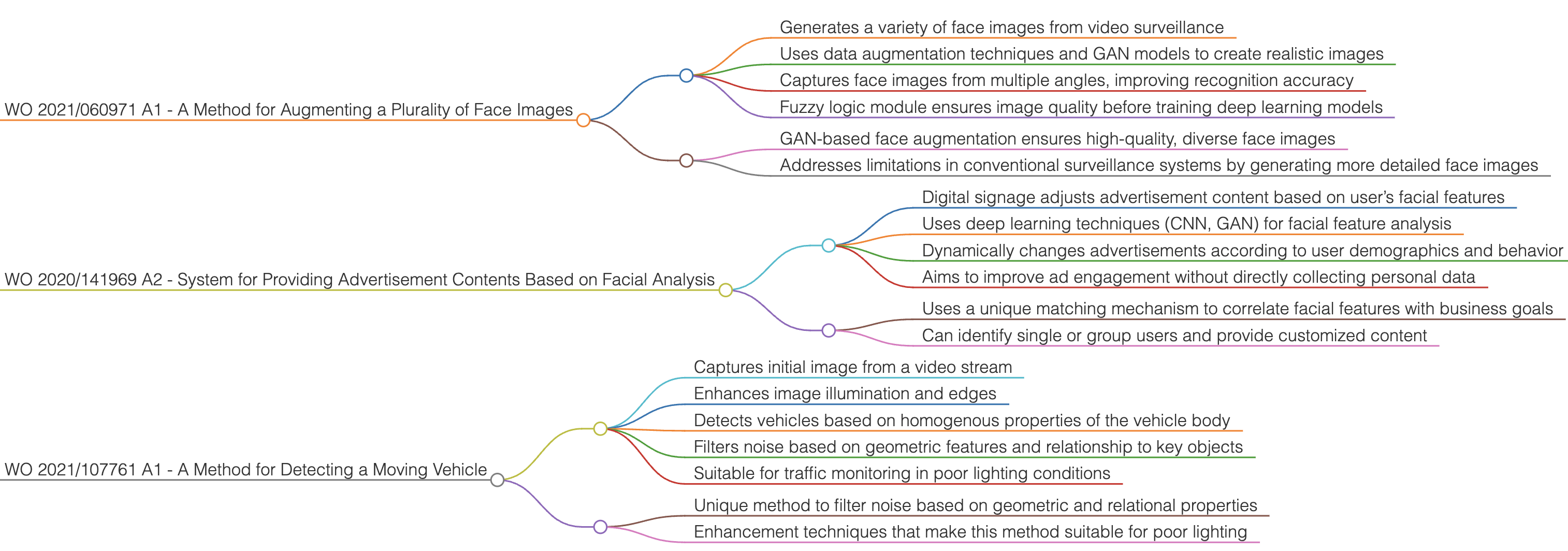
 This collection of patents presents cutting-edge innovations in computer vision and facial analysis, enhancing applications in surveillance, advertising, and vehicle detection.
The first patent, **A Method for Augmenting a Plurality of Face Images** (*WO 2021/060971 A1*), leverages Generative Adversarial Networks (GAN) to augment face images from surveillance videos, creating realistic face images from multiple angles to enhance recognition accuracy.
The second patent, **System for Providing Advertisement Contents Based on Facial Analysis** (*WO 2020/141969 A2*), utilizes facial recognition technology to dynamically adjust digital advertisements based on the analysis of facial features, improving engagement while safeguarding user privacy.
The third patent, **A Method for Detecting a Moving Vehicle** (*WO 2021/107761 A1*), introduces an advanced image processing system that captures and enhances video footage to accurately detect moving vehicles, even under challenging lighting conditions, using noise filtering and edge enhancement techniques.
Together, these patents demonstrate innovative applications of deep learning, facial analysis, and image processing to solve real-world challenges in traffic surveillance, targeted advertising, and facial recognition.
---
###### WO 2021/060971 A1 - A Method for Augmenting a Plurality of Face Images
**Title**: Augmenting Face Images for Video Surveillance
**Subtitle**: Enhancing Surveillance with GAN-Based Face Augmentation
**Short Description**: This patent presents a method for augmenting face images in surveillance systems using Generative Adversarial Networks (GAN) to generate realistic face images from multiple viewpoints.
**Hashtags**: #FaceAugmentation #GAN #Surveillance
**Main Points**:
- Generates a variety of face images from video surveillance
- Uses data augmentation techniques and GAN models to create realistic images
- Captures face images from multiple angles, improving recognition accuracy
- Fuzzy logic module ensures image quality before training deep learning models
**Highlights**:
- GAN-based face augmentation ensures high-quality, diverse face images
- Addresses limitations in conventional surveillance systems by generating more detailed face images
**Summary**:
This patent offers a method for augmenting face images in video surveillance systems using Generative Adversarial Networks (GANs). The system captures face images from various viewpoints, augments them through data transformations, and generates high-quality face images using GANs. The augmented images are then selected based on quality for training deep learning models. This system significantly improves face recognition accuracy, especially in environments where capturing full facial details is difficult.
---
###### WO 2020/141969 A2 - System for Providing Advertisement Contents Based on Facial Analysis
**Title**: Targeted Digital Advertising via Facial Recognition
**Subtitle**: Enhancing Digital Ad Engagement Through Facial Analysis
**Short Description**: This patent covers a system that uses facial recognition to dynamically adjust digital advertisements based on a user’s facial features.
**Hashtags**: #DigitalAdvertising #FacialRecognition #TargetedAds
**Main Points**:
- Digital signage adjusts advertisement content based on user’s facial features
- Uses deep learning techniques (CNN, GAN) for facial feature analysis
- Dynamically changes advertisements according to user demographics and behavior
- Aims to improve ad engagement without directly collecting personal data
**Highlights**:
- Uses a unique matching mechanism to correlate facial features with business goals
- Can identify single or group users and provide customized content
**Summary**:
This patent describes a system for providing more engaging digital advertisements by analyzing users' facial features using deep learning models. The system identifies key features such as age, gender, and emotions to display tailored ad content on digital signage. This enhances the relevance of displayed content and increases the likelihood of engagement. It is designed to improve marketing efficiency without directly collecting personal data.
###### WO 2021/107761 A1 - A Method for Detecting a Moving Vehicle
**Title**: Advanced Vehicle Detection in Surveillance
**Subtitle**: Enhancing Vehicle Detection via Image Processing
**Short Description**: This patent describes a system that detects moving vehicles by enhancing images from video streams through edge detection and noise filtering techniques.
**Hashtags**: #VehicleDetection #ImageProcessing #TrafficSurveillance
**Main Points**:
- Captures initial image from a video stream
- Enhances image illumination and edges
- Detects vehicles based on homogenous properties of the vehicle body
- Filters noise based on geometric features and relationship to key objects
- Suitable for traffic monitoring in poor lighting conditions
**Highlights**:
- Unique method to filter noise based on geometric and relational properties
- Enhancement techniques that make this method suitable for poor lighting
**Summary**:
This patent introduces an innovative method for detecting moving vehicles in surveillance footage by utilizing advanced image processing techniques. It outlines processes such as illumination enhancement, Sobel edge detection, and a sophisticated method to close open edges and identify vehicles based on homogenous body properties. It is particularly adept at handling noise in the image using geometric filtering and relational analysis, improving the accuracy of vehicle detection even in low-light conditions.
---
Visual Language Models (VLM)
As an experienced director and team leader, I excel in scaling operations, expanding teams, and creating a flexible, collaborative work culture. I bring proven expertise in team building and leadership, with a hands-on approach that adapts to any role or challenge. Self-motivated and highly organized, I can independently manage projects from inception to completion, ensuring continuous progress through swift issue resolution.
I’m adept at translating complex technical concepts for non-technical stakeholders and investors, enabling me to effectively pitch ideas, secure funding, and drive growth. With a keen eye for opportunities and process optimization, I have a track record of scaling teams and organizations while maintaining operational excellence. My leadership style empowers cross-functional teams, fosters innovation, and aligns efforts toward shared goals. Thriving in dynamic environments, I’m dedicated to building sustainable, high-performing teams that achieve long-term success.
Experienced in Full Stack LLM development, including model training, fine-tuning, deployment, and integrating LLMs with scalable applications and APIs.
---
## Entropy-Based Multi-Threshold LPR
URL: https://pirahansiah.com/farshid/content/papers-license-plate-recognition.md
Multi-threshold license plate recognition using entropy-based image segmentation.
License_Plate_Recognition_with_Multi-Threshold_Based_on_Entropy
https://www.pirahansiah.com/notes/pubs/papers/License_Plate_Recognition_with_Multi-Threshold_Based_on_Entropy
[spotify]( https://podcasters.spotify.com/pod/show/pirahansiah/episodes/License-Plate-Recognition-with-Multi-threshold-based-on-Entropy-e2ps290)
[PDF Download My Conference Paper]( https://doi.org/10.1109/ICEEI.2011.6021627 )
 # License Plate Recognition with Multi-threshold based on Entropy
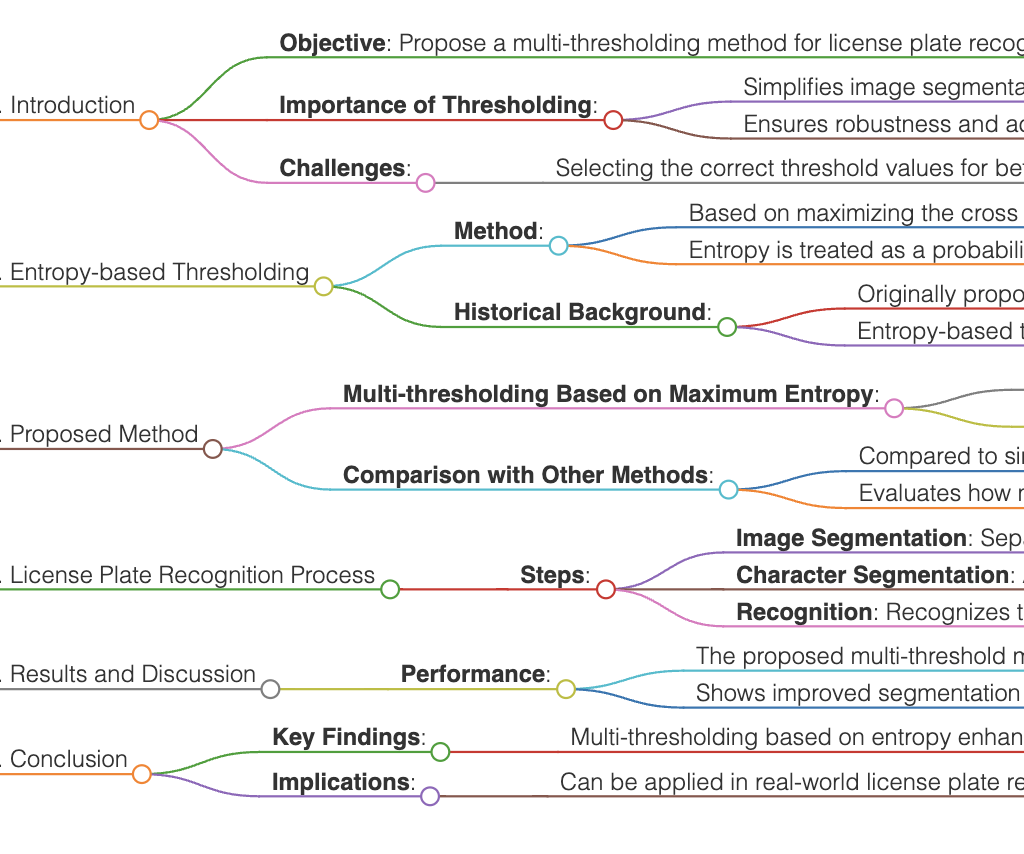
## 1. Introduction
- **Objective**: Propose a multi-thresholding method for license plate recognition.
- **Importance of Thresholding**:
- Simplifies image segmentation
- Ensures robustness and accuracy in recognizing license plate characters.
- **Challenges**:
- Selecting the correct threshold values for better segmentation results.
## 2. Entropy-based Thresholding
- **Method**:
- Based on maximizing the cross entropy between the original image and the segmented image.
- Entropy is treated as a probability distribution of the image histogram.
- **Historical Background**:
- Originally proposed by Pun and later improved by Kapur for image segmentation.
- Entropy-based thresholding is widely used for bi-level and multi-level thresholding.
## 3. Proposed Method
- **Multi-thresholding Based on Maximum Entropy**:
- Selects several threshold values by maximizing the entropy.
- Integrates partial ranges of the image histogram to achieve better segmentation.
- **Comparison with Other Methods**:
- Compared to single-thresholding techniques based on maximum entropy.
- Evaluates how multi-thresholding enhances the recognition accuracy.
## 4. License Plate Recognition Process
- **Steps**:
1. **Image Segmentation**: Separates the license plate region using multi-thresholding.
2. **Character Segmentation**: Applies the selected thresholds to segment individual characters.
3. **Recognition**: Recognizes the segmented characters to produce the license plate number.
## 5. Results and Discussion
- **Performance**:
- The proposed multi-threshold method outperforms single-thresholding techniques.
- Shows improved segmentation results for varying lighting and environmental conditions.
## 6. Conclusion
- **Key Findings**:
- Multi-thresholding based on entropy enhances the accuracy of license plate recognition.
- **Implications**:
- Can be applied in real-world license plate recognition systems with better robustness.
---
## Face Image Augmentation WO2021060971A1
URL: https://pirahansiah.com/farshid/content/patents-face-augmentation.md
# Face Image Augmentation WO2021060971A1
GAN-based method for augmenting face images from surveillance with fuzzy logic quality filtering.
[spotify](https://spotifyanchor-web.app.link/e/XZpmcmHCFNb)
[PDF Download](https://patentimages.storage.googleapis.com/b8/d9/7f/ea8a5b789e1dad/WO2021060971A1.pdf )
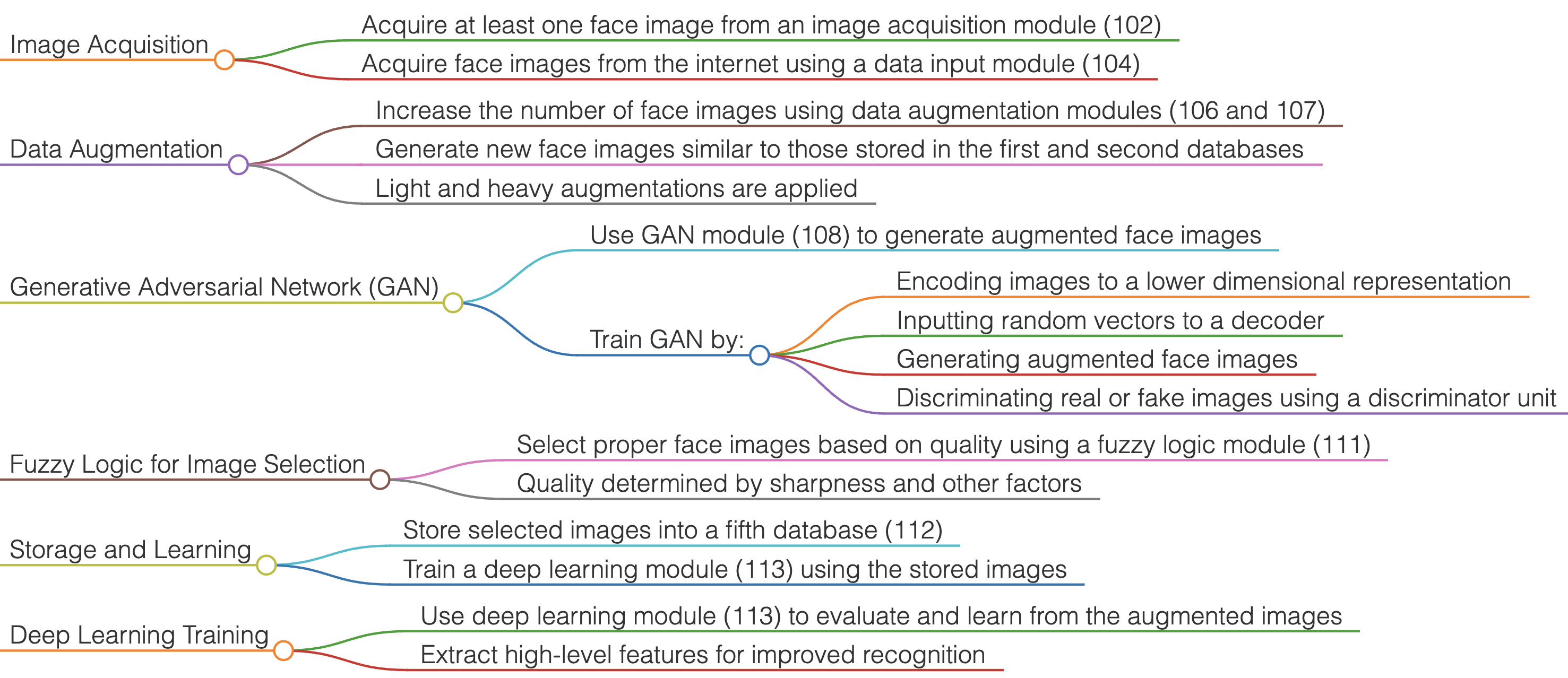
 The patent WO2021060971A1 describes a method for augmenting face images, particularly for use in video surveillance systems. The invention addresses the limitations of traditional surveillance, where cameras capture face images from limited angles, leading to incomplete or substandard images. The method involves acquiring face images from both cameras and the internet, applying data augmentation techniques to increase the number of images, and using a Generative Adversarial Network (GAN) to create additional face images. This process helps generate better-quality face images that can improve facial recognition systems.
The system includes several components, such as an image acquisition module connected to a camera, data input and augmentation modules, and a GAN module. The data augmentation modules apply transformations like rotations and flips to increase the variety of face images, while the GAN module generates new images based on trained models. A fuzzy logic module is also employed to evaluate the quality of the generated images, ensuring that only the best images are selected and stored for training a deep learning module. This deep learning module further refines the facial recognition process by extracting higher-level features from the images.
The method also emphasizes the importance of image quality in improving recognition accuracy. By using a combination of data augmentation and GAN-generated images, the system can produce a diverse set of high-quality face images, which are essential for training deep learning models in surveillance and security applications. The invention claims a more effective way to enhance face images from different viewpoints and conditions, ultimately aiding in better identification and recognition in security systems.
Main Topic: A Method for Augmenting a Plurality of Face Images
1. Image Acquisition
- Acquire at least one face image from an image acquisition module (102)
- Acquire face images from the internet using a data input module (104)
2. Data Augmentation
- Increase the number of face images using data augmentation modules (106 and 107)
- Generate new face images similar to those stored in the first and second databases
- Light and heavy augmentations are applied
3. Generative Adversarial Network (GAN)
- Use GAN module (108) to generate augmented face images
- Train GAN by:
- Encoding images to a lower dimensional representation
- Inputting random vectors to a decoder
- Generating augmented face images
- Discriminating real or fake images using a discriminator unit
4. Fuzzy Logic for Image Selection
- Select proper face images based on quality using a fuzzy logic module (111)
- Quality determined by sharpness and other factors
5. Storage and Learning
- Store selected images into a fifth database (112)
- Train a deep learning module (113) using the stored images
6. Deep Learning Training
- Use deep learning module (113) to evaluate and learn from the augmented images
- Extract high-level features for improved recognition
---
## Facial Analysis Advertisement WO2020141969A2
URL: https://pirahansiah.com/farshid/content/patents-facial-analysis.md
System for targeted digital advertising using real-time facial analysis and demographic detection.
date_modified: 2024-10-12
tags: [patent, facial-recognition, advertising, deep-learning]
hashtags: "#patent #facialrecognition #advertising #deeplearning"
---
[spotify](https://podcasters.spotify.com/pod/show/pirahansiah/episodes/SYSTEM-AND-METHOD-FOR-PROVIDING-ADVERTISEMENT-CONTENTS-BASED-ON-FACIAL-ANALYSIS-WO2020141969A2-e2p7342)
[PDF Download](https://patentimages.storage.googleapis.com/ff/3f/a5/e7b42ef58d8a03/WO2020141969A2.pdf)
 🎧 Listen and Explore 🗺️ the engaging audio discussion about the innovative patent “SYSTEM AND METHOD FOR PROVIDING ADVERTISEMENT CONTENTS BASED ON FACIAL ANALYSIS WO2020141969A2”!
This system leverages facial recognition technology to deliver personalized, dynamic ads tailored to users based on age, gender, emotions, and more—while prioritizing privacy! 🔒✨ Discover how AI is revolutionizing digital advertising by matching ads to user profiles without the need for direct personal data collection.
🔗 Mindmap visualization available too! Uncover how this innovation is shaping the future of advertising. #AI #FacialRecognition #DigitalMarketing #Innovation #LLM
SYSTEM AND METHOD FOR PROVIDING ADVERTISEMENT CONTENTS BASED ON FACIAL ANALYSIS WO2020141969A2
In this text delves into his patented innovation that transforms digital advertising by utilizing facial analysis to deliver targeted content. The system captures images of users through an embedded camera in digital signage and employs advanced face detection and analysis modules to extract key facial features such as age range, gender, emotions (e.g., happy, sad, angry), styles (e.g., eyeglasses, beard), and attention indicators like gaze direction.
By statistically analyzing these features using trained classification models, the system computes a "weighted image" representing the user's profile. This profile is then matched with a database of weighted advertisements based on predefined matching rules provided by advertisers. The most relevant advertisement is seamlessly displayed on the screen, enhancing user engagement by presenting content tailored to the individual's possible interests—all without directly collecting personal information.
This innovative approach overcomes the limitations of traditional digital advertising, which often lacks interactivity and personalization. By integrating deep learning technologies and ensuring user privacy, Dr. Pirahansiah's system offers a dynamic and efficient solution that benefits both advertisers and consumers, marking a significant advancement in the field of digital advertising.
---
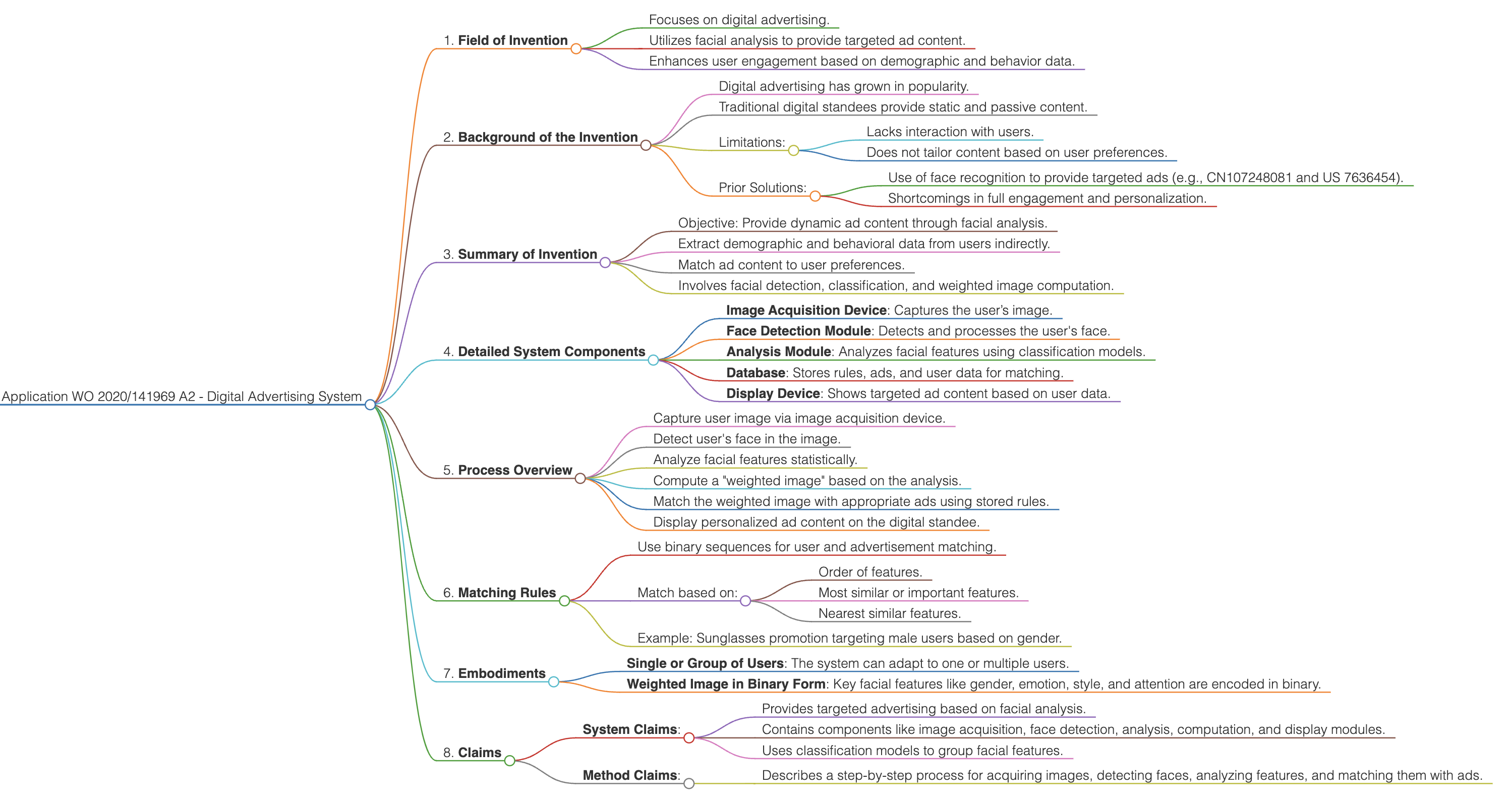
# Patent Application WO 2020/141969 A2 - Digital Advertising System
## 1. **Field of Invention**
- Focuses on digital advertising.
- Utilizes facial analysis to provide targeted ad content.
- Enhances user engagement based on demographic and behavior data.
## 2. **Background of the Invention**
- Digital advertising has grown in popularity.
- Traditional digital standees provide static and passive content.
- Limitations:
- Lacks interaction with users.
- Does not tailor content based on user preferences.
- Prior Solutions:
- Use of face recognition to provide targeted ads (e.g., CN107248081 and US 7636454).
- Shortcomings in full engagement and personalization.
## 3. **Summary of Invention**
- Objective: Provide dynamic ad content through facial analysis.
- Extract demographic and behavioral data from users indirectly.
- Match ad content to user preferences.
- Involves facial detection, classification, and weighted image computation.
## 4. **Detailed System Components**
- **Image Acquisition Device**: Captures the user’s image.
- **Face Detection Module**: Detects and processes the user's face.
- **Analysis Module**: Analyzes facial features using classification models.
- **Database**: Stores rules, ads, and user data for matching.
- **Display Device**: Shows targeted ad content based on user data.
## 5. **Process Overview**
1. Capture user image via image acquisition device.
2. Detect user's face in the image.
3. Analyze facial features statistically.
4. Compute a "weighted image" based on the analysis.
5. Match the weighted image with appropriate ads using stored rules.
6. Display personalized ad content on the digital standee.
## 6. **Matching Rules**
- Use binary sequences for user and advertisement matching.
- Match based on:
- Order of features.
- Most similar or important features.
- Nearest similar features.
- Example: Sunglasses promotion targeting male users based on gender.
## 7. **Embodiments**
- **Single or Group of Users**: The system can adapt to one or multiple users.
- **Weighted Image in Binary Form**: Key facial features like gender, emotion, style, and attention are encoded in binary.
## 8. **Claims**
- **System Claims**:
- Provides targeted advertising based on facial analysis.
- Contains components like image acquisition, face detection, analysis, computation, and display modules.
- Uses classification models to group facial features.
- **Method Claims**:
- Describes a step-by-step process for acquiring images, detecting faces, analyzing features, and matching them with ads.
---
---
## GSFT-PSNR: Fuzzy Threshold Method
URL: https://pirahansiah.com/farshid/content/journals-fuzzy-thresholding.md
Fuzzy logic approach to global single thresholding using PSNR for image segmentation.
GSFT-PSNR_Global_Single_Fuzzy_Threshold
[spotify](https://podcasters.spotify.com/pod/show/pirahansiah/episodes/GSFT-PSNR-Global-Single-Fuzzy-Threshold-e2pr7cs)
[PDF Download](https://www.ijcsns.com/June.2016-Volume.4-No.6/Article01.pdf )
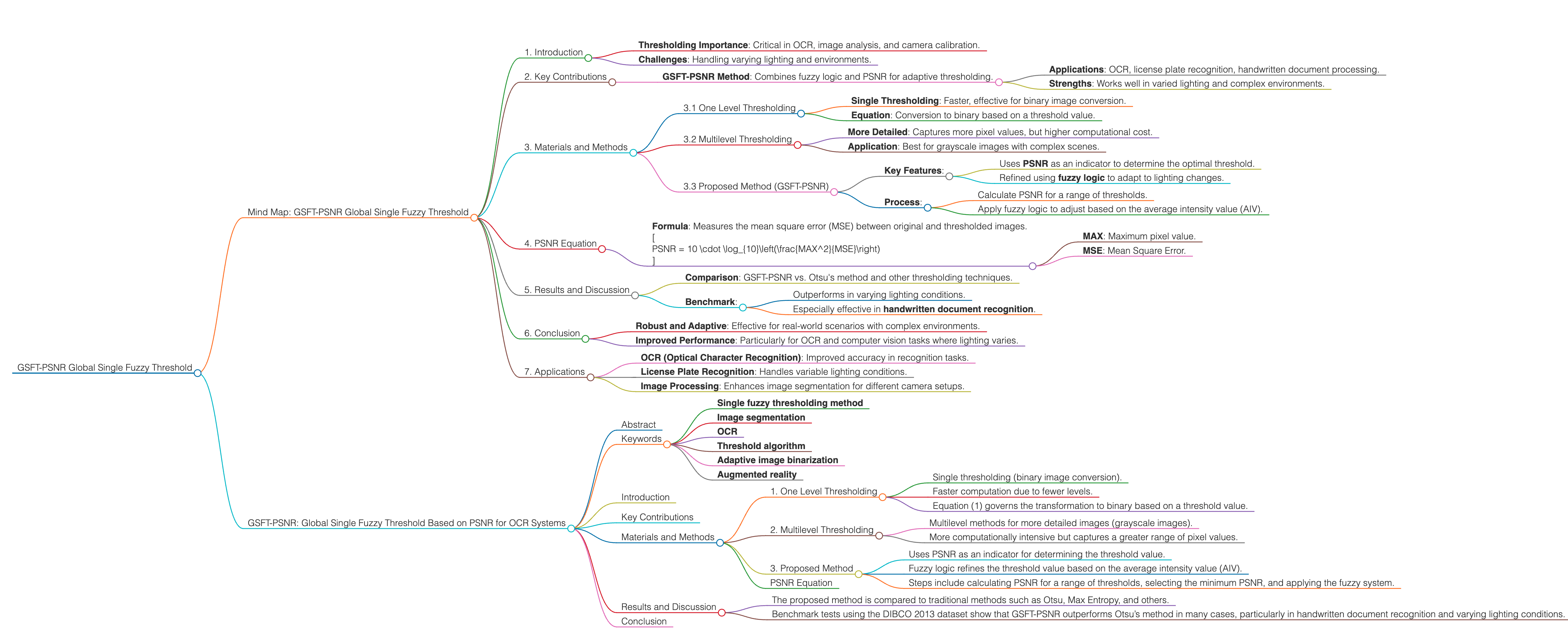
 # Mind Map: GSFT-PSNR Global Single Fuzzy Threshold
## 1. Introduction
- **Thresholding Importance**: Critical in OCR, image analysis, and camera calibration.
- **Challenges**: Handling varying lighting and environments.
## 2. Key Contributions
- **GSFT-PSNR Method**: Combines fuzzy logic and PSNR for adaptive thresholding.
- **Applications**: OCR, license plate recognition, handwritten document processing.
- **Strengths**: Works well in varied lighting and complex environments.
## 3. Materials and Methods
### 3.1 One Level Thresholding
- **Single Thresholding**: Faster, effective for binary image conversion.
- **Equation**: Conversion to binary based on a threshold value.
### 3.2 Multilevel Thresholding
- **More Detailed**: Captures more pixel values, but higher computational cost.
- **Application**: Best for grayscale images with complex scenes.
### 3.3 Proposed Method (GSFT-PSNR)
- **Key Features**:
- Uses **PSNR** as an indicator to determine the optimal threshold.
- Refined using **fuzzy logic** to adapt to lighting changes.
- **Process**:
1. Calculate PSNR for a range of thresholds.
2. Apply fuzzy logic to adjust based on the average intensity value (AIV).
## 4. PSNR Equation
- **Formula**: Measures the mean square error (MSE) between original and thresholded images.
\[
PSNR = 10 \cdot \log_{10}\left(\frac{MAX^2}{MSE}\right)
\]
- **MAX**: Maximum pixel value.
- **MSE**: Mean Square Error.
## 5. Results and Discussion
- **Comparison**: GSFT-PSNR vs. Otsu's method and other thresholding techniques.
- **Benchmark**:
- Outperforms in varying lighting conditions.
- Especially effective in **handwritten document recognition**.
## 6. Conclusion
- **Robust and Adaptive**: Effective for real-world scenarios with complex environments.
- **Improved Performance**: Particularly for OCR and computer vision tasks where lighting varies.
## 7. Applications
- **OCR (Optical Character Recognition)**: Improved accuracy in recognition tasks.
- **License Plate Recognition**: Handles variable lighting conditions.
- **Image Processing**: Enhances image segmentation for different camera setups.
# GSFT-PSNR: Global Single Fuzzy Threshold Based on PSNR for OCR Systems
## Abstract
Binarization or thresholding is a critical step in computer vision and image analysis, particularly in applications such as OCR (Optical Character Recognition) and augmented reality. This method separates the foreground from the background in an image, reducing the amount of data to process and improving computational efficiency. Traditional methods like Otsu’s thresholding are compared to a new method called GSFT-PSNR, which uses Peak Signal-to-Noise Ratio (PSNR) and fuzzy logic to determine threshold values. The proposed method shows improvements in various real-world applications such as license plate recognition and handwritten image processing.
## Keywords
- **Single fuzzy thresholding method**
- **Image segmentation**
- **OCR**
- **Threshold algorithm**
- **Adaptive image binarization**
- **Augmented reality**
## Introduction
Thresholding is a key first step in many computer vision applications, crucial for object recognition, camera calibration, and reducing noise. While single-level thresholding is fast and effective, multilevel thresholding can lead to higher computational time. Global thresholding methods are often favored for their speed, while local thresholding techniques are necessary for more complex scenes.
## Key Contributions
The proposed method, GSFT-PSNR, combines global single fuzzy thresholding with PSNR to improve performance in varied lighting and environmental conditions. It is designed to adapt to different ambient illuminations and applications, such as OCR and license plate recognition. GSFT-PSNR excels in handling unstructured environments with variable lighting.
## Materials and Methods
### 1. One Level Thresholding
- Single thresholding (binary image conversion).
- Faster computation due to fewer levels.
- Equation (1) governs the transformation to binary based on a threshold value.
### 2. Multilevel Thresholding
- Multilevel methods for more detailed images (grayscale images).
- More computationally intensive but captures a greater range of pixel values.
### 3. Proposed Method
- Uses PSNR as an indicator for determining the threshold value.
- Fuzzy logic refines the threshold value based on the average intensity value (AIV).
- Steps include calculating PSNR for a range of thresholds, selecting the minimum PSNR, and applying the fuzzy system.
### PSNR Equation
\[ PSNR = 10 \cdot \log_{10}\left(\frac{MAX^2}{MSE}\right) \]
Where `MAX` is the maximum pixel value, and `MSE` is the mean square error between the original and thresholded image.
## Results and Discussion
- The proposed method is compared to traditional methods such as Otsu, Max Entropy, and others.
- Benchmark tests using the DIBCO 2013 dataset show that GSFT-PSNR outperforms Otsu’s method in many cases, particularly in handwritten document recognition and varying lighting conditions.
## Conclusion
The GSFT-PSNR method offers a robust, adaptive thresholding approach that can handle challenging real-world scenarios with varying lighting and complex scenes. By using PSNR as a quality measure and combining it with fuzzy logic, the method improves upon traditional thresholding techniques in OCR and other computer vision tasks.
---
## LLMs Meet Computer Vision
URL: https://pirahansiah.com/farshid/content/keynotes-llm-cv.md
Keynote on token economics, multimodal RAG, and practical CV+LLM applications.
# Where LLMs Meet Computer Vision: Unlocking Multimodal AI
AI models like GPT-4 Turbo, Google Gemini 1.5 Pro, and Claude 3 Opus offer advanced multimodal processing, each excelling in specific tasks from text generation to image analysis. Their pricing varies based on token usage, making it essential to choose the model that best fits your project’s needs.
### AI Model Cost Calculator: Optimizing Costs for Computer Vision and Multimodal AI Solutions
My AI Model Cost Calculator with the latest pricing for GPT-4 Turbo, Google Gemini 1.5 Pro, and Claude 3 Opus! 💡 Calculate text and image processing costs easily with real-time estimates. Check it out! #AI #MachineLearning #CostCalculator #GPT4 #Claude #GoogleGemini
- [AI Model Cost Calculator: Optimizing Costs for Computer Vision and Multimodal AI Solutions](/farshid/content/computer-vision.md)
### How image to token
- [https://community.openai.com/t/how-do-i-calculate-image-tokens-in-gpt4-vision/492318](https://community.openai.com/t/how-do-i-calculate-image-tokens-in-gpt4-vision/492318 )
- [https://platform.openai.com/docs/guides/vision](https://platform.openai.com/docs/guides/vision)
``` py
from math import ceil
def resize(width, height):
if width > 1024 or height > 1024:
if width > height:
height = int(height * 1024 / width)
width = 1024
else:
width = int(width * 1024 / height)
height = 1024
return width, height
def count_image_tokens(width: int, height: int):
width, height = resize(width, height)
h = ceil(height / 512)
w = ceil(width / 512)
total = 85 + 170 * h * w
return total
```
#### Microsoft AI
token costs associated with processing images using GPT-4 Turbo with Vision capabilities
1. Low Mode:
The image is processed for a fixed cost of 85 tokens.
2. High Mode:
• The image is first scaled to fit within a 2048 x 2048 pixel square.
• Then, the shortest side is resized to 768 pixels.
• The model calculates how many 512-pixel squares the image consists of.
• The total cost is calculated by multiplying the number of squares by 170 tokens and adding 85 tokens as the base.
https://portal.azure.com/#browse/Microsoft.MachineLearningServices%2Faistudio
doc+images+content>add your data>visual search>gpt4
Image inputs are metered and charged in tokens
#### OpenAI
token costs associated with processing images using GPT-4 Turbo with Vision capabilities
OpenAI’s GPT-4 Turbo with Vision capabilities enables various applications, including optical character recognition (OCR) and detailed image analysis. The pricing for these image-based interactions varies based on image size. For instance, a 1080x1080 pixel image costs $0.00765 per image to process in vision mode. This feature is part of the multimodal capabilities added to GPT-4 Turbo, making it a powerful tool for developers to integrate both text and image inputs into their applications
### RAG for image and videos
### Fine tune
### Use cases
- [https://cookbook.openai.com/examples/gpt_with_vision_for_video_understanding ](https://cookbook.openai.com/examples/gpt_with_vision_for_video_understanding )
Seeing AI
### IoT and Robotics
- []()
### Medical Image Processing
## Video with LLM
how to build and implement Retrieval-Augmented Generation (RAG) systems using multimodal data such as text, images, audio, and video. It covers various techniques like contrastive learning to train models that can retrieve information across multiple modalities. The course guides learners through creating any-to-any search systems, where you can input data in one form (e.g., an image) and retrieve related data in other formats (e.g., text or video).
Some of the key takeaways include:
Building multimodal RAG systems that retrieve and reason over multimodal data to generate contextually relevant responses.
Training models to process multimodal inputs, allowing for seamless retrieval and reasoning.
Implementing real-world applications, such as analyzing documents like invoices and creating multimodal recommender systems.
### Microsoft AI
Image
Context is everything
PowerBI
Graphs to code
Defect detection

- []()
Seeing AI
### Zero-shot prompting
### Few-shot prompting
### Context window
### Seeing AI
---
## Moving Vehicle Detection WO2021107761A1
URL: https://pirahansiah.com/farshid/content/patents-vehicle-detection.md
Image processing method for detecting moving vehicles using CLAHE, Sobel, and geometric filtering.
[spotify](https://podcasters.spotify.com/pod/show/pirahansiah/episodes/A-METHOD-FOR-DETECTING-A-MOVING-VEHICLE-WO2021107761A1-e2pk5mj)
[PDF Download](https://patentimages.storage.googleapis.com/16/41/83/2576e20c4a0af5/WO2021107761A1.pdf )
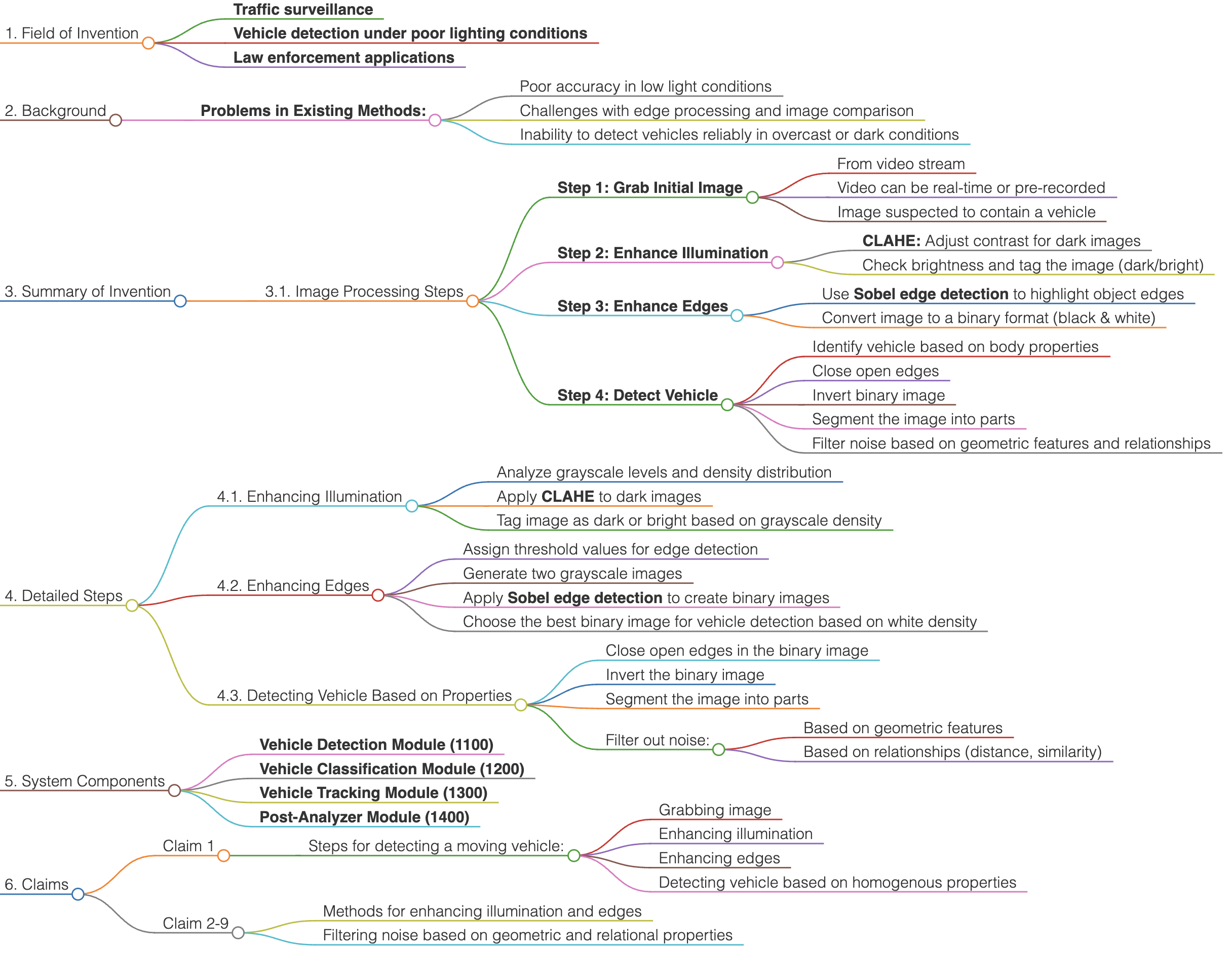
 Patent Summary:
Field of Invention:
This patent relates to a method for detecting moving vehicles, specifically in the field of traffic surveillance and law enforcement. It aims to improve vehicle detection accuracy under poor lighting conditions.
Background:
Existing methods for detecting moving vehicles, such as edge processing and comparison between target and reference images, struggle under low light or bad weather conditions. This patent seeks to overcome these challenges.
Summary of Invention:
The patented method enhances the detection of moving vehicles by processing video streams, focusing on improving the illumination and edge detection of the vehicle in the captured image. It involves:
1. Grabbing an initial image from a video stream.
2. Enhancing illumination of the image using Contrast Limited Adaptive Histogram Equalization (CLAHE) if necessary.
3. Enhancing edges using Sobel edge detection to create a binary image that highlights object edges.
4. Detecting the vehicle based on the homogenous properties of the vehicle body. This includes:
• Closing open edges.
• Inverting the binary image.
• Segmenting the image into multiple parts.
• Filtering noise based on geometric features and relationships.
Key Steps in the Process:
• Image Enhancement: Adjusts image illumination based on darkness or brightness, improving visibility.
• Edge Detection: Highlights edges in the image, which is crucial for distinguishing vehicles from the background.
• Binary Image Processing: Converts images to binary form, filters noise, and identifies vehicles based on homogenous vehicle body properties.
Claims:
The patent claims cover:
1. A method for detecting a moving vehicle involving image grabbing, illumination enhancement, edge enhancement, and vehicle location detection based on homogenous properties.
2. Techniques for improving illumination and edge detection, including the use of CLAHE and Sobel edge detection.
3. Steps for filtering noise and improving detection accuracy by evaluating geometric features and relationships between image segments.
Applications:
This method is intended for use in traffic surveillance systems, law enforcement, and smart city technologies, where it can be applied to monitor and analyze traffic, even under challenging conditions such as poor lighting.
Technical Advantages:
• Improved accuracy of vehicle detection under varying lighting conditions.
• The method handles both dark and bright images effectively, making it more robust than previous methods that rely heavily on good lighting.
• Sophisticated noise filtering ensures that irrelevant objects are not mistakenly detected as vehicles.
This invention provides a significant advancement in vehicle detection for traffic management, reducing errors caused by lighting conditions and improving the robustness of detection systems in real-world environments.
# Mind Map: A Method for Detecting a Moving Vehicle
## 1. Field of Invention
- **Traffic surveillance**
- **Vehicle detection under poor lighting conditions**
- **Law enforcement applications**
## 2. Background
- **Problems in Existing Methods:**
- Poor accuracy in low light conditions
- Challenges with edge processing and image comparison
- Inability to detect vehicles reliably in overcast or dark conditions
## 3. Summary of Invention
- **Goal:** Improve vehicle detection under challenging conditions
- **Steps in Detection:**
- Grab initial image from a video stream
- Enhance illumination of the image
- Enhance edges within the image
- Detect vehicle based on homogenous properties
### 3.1. Image Processing Steps
- **Step 1: Grab Initial Image**
- From video stream
- Video can be real-time or pre-recorded
- Image suspected to contain a vehicle
- **Step 2: Enhance Illumination**
- **CLAHE:** Adjust contrast for dark images
- Check brightness and tag the image (dark/bright)
- **Step 3: Enhance Edges**
- Use **Sobel edge detection** to highlight object edges
- Convert image to a binary format (black & white)
- **Step 4: Detect Vehicle**
- Identify vehicle based on body properties
- Close open edges
- Invert binary image
- Segment the image into parts
- Filter noise based on geometric features and relationships
## 4. Detailed Steps
### 4.1. Enhancing Illumination
- Analyze grayscale levels and density distribution
- Apply **CLAHE** to dark images
- Tag image as dark or bright based on grayscale density
### 4.2. Enhancing Edges
- Assign threshold values for edge detection
- Generate two grayscale images
- Apply **Sobel edge detection** to create binary images
- Choose the best binary image for vehicle detection based on white density
### 4.3. Detecting Vehicle Based on Properties
- Close open edges in the binary image
- Invert the binary image
- Segment the image into parts
- Filter out noise:
- Based on geometric features
- Based on relationships (distance, similarity)
## 5. System Components
- **Vehicle Detection Module (1100)**
- **Vehicle Classification Module (1200)**
- **Vehicle Tracking Module (1300)**
- **Post-Analyzer Module (1400)**
## 6. Claims
### Claim 1
- Steps for detecting a moving vehicle:
1. Grabbing image
2. Enhancing illumination
3. Enhancing edges
4. Detecting vehicle based on homogenous properties
### Claim 2-9
- Methods for enhancing illumination and edges
- Filtering noise based on geometric and relational properties
---
## Multi-Threshold for License Plate Recognition
URL: https://pirahansiah.com/farshid/content/papers-multi-threshold-plate.md
Adaptive multi-threshold approach using MLP for license plate recognition systems.
Multi-threshold_Approach_for_License_Plate_Recognition_System
https://www.pirahansiah.com/notes/pubs/papers/Multi-threshold_Approach_for_License_Plate_Recognition_System
[spotify]( https://podcasters.spotify.com/pod/show/pirahansiah/episodes/My-Conference-Paper-Multi-threshold-Approach-for-License-Plate-Recognition-System-e2ps2fe)
[PDF Download My Conference Paper]( http://waset.org/publications/3636 )
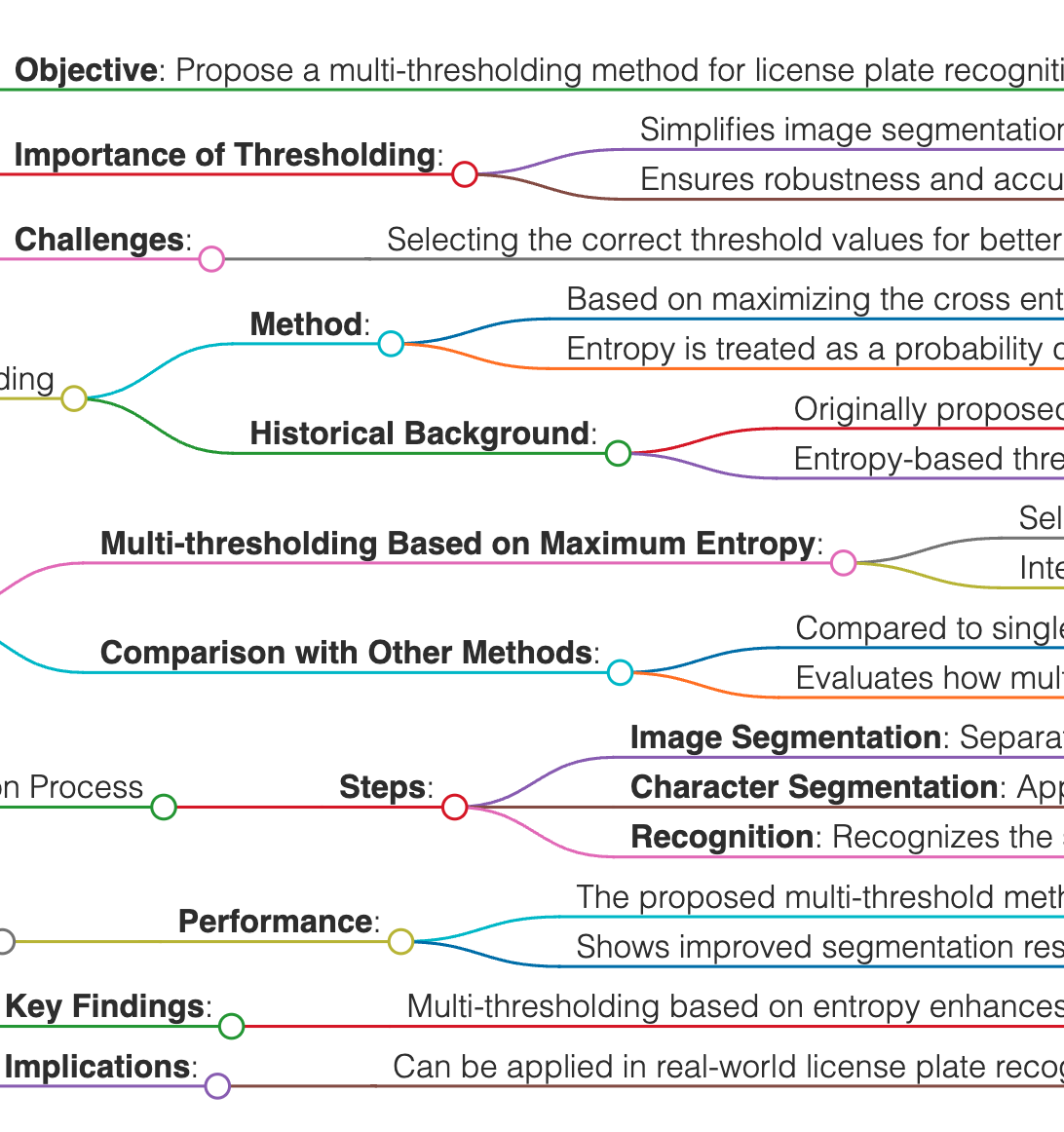
 # Multi-threshold Approach for License Plate Recognition System
## 1. Introduction
- **Objective**: Propose an adaptive multi-threshold approach for image segmentation, specifically in object detection.
- **Application**: Malaysian License Plate Recognition (LPR) system.
- **Challenge**: Different types of license plates require varied detection techniques depending on the country.
## 2. Adaptive Multi-threshold Approach
- **Key Method**:
- Multi Layer Perceptron (MLP) trained by backpropagation to optimize threshold values.
- Finds optimum threshold values by analyzing the peak value from a graph of object count versus threshold ranges.
- **Advantages**:
- Adaptive to different types of license plates, including single-line and double-line plates with varying fonts.
## 3. Comparison with Other Threshold Methods
- **Other Techniques**:
- Kittler and Illingworth’s Threshold
- Potential Difference
- Otsu’s Method
- **Performance**:
- The adaptive multi-threshold approach improves overall performance compared to these existing methods.
## 4. License Plate Recognition Process
- **Steps**:
1. **Image Segmentation**: Applies multi-thresholding to separate the license plate and individual characters.
2. **Character Segmentation**: Uses the threshold values to segment characters within the license plate region.
3. **Recognition**: Classifies the segmented characters to extract the license plate number.
## 5. Conclusion and Future Work
- **Key Findings**:
- The proposed adaptive multi-threshold method enhances the performance of the LPR system.
- **Future Work**:
- Further improvements are underway to accommodate real-time system specifications.
---
## OpenCV 5 — Chapter 0: Introduction
URL: https://pirahansiah.com/farshid/content/books-new-developer-era.md
Introduction to the new developer era, AI agents, and multi-agent systems.
reference index: [[index]]
tags: [ai-agents, multi-agent-systems, llm, deep-learning]
hashtags: "#aiagents #multiagent #llm #deeplearning"
# The New Developer Era: Transforming Your Career and Building Production Ready AI Agents in 2027
- **Title Page**
- *The New Developer Era: Transforming Your Career and Building Production Ready AI Agents in 2027; Agents will replace all software*
- **Author Name**
**Dr. Farshid Pirahansiah**
Lead LLM/AI/Computer Vision Engineer & Researcher
[LinkedIn: linkedin.com/in/pirahansiah](https://linkedin.com/in/pirahansiah)
- **Publication Details**
- **Date of Publication**: 2027
- **Edition**: Draft Edition
- **Disclaimers**
- **Informational Purposes**: The content of this book is based on the author’s professional experiences and research. It should not be taken as legal, financial, or specific career advice. Always perform due diligence before making major career or technical decisions.
- **No Guarantees**: The author and publisher assume no responsibility for errors, omissions, or contrary interpretations of the subject matter. The views expressed are solely those of the author.
- **Trademarks**: All product names, trademarks, and registered trademarks are property of their respective owners.
- **Reproduction & Distribution**: No part of this publication may be reproduced, distributed, or transmitted in any form or by any means without prior written permission from the author or publisher.
- **Copyright**
- Copyright notice, permissions, 2025.
- **Dedication / Acknowledgments**
- ## **Dedication / Acknowledgments**
In particular, I want to extend my gratitude to the research community—friends, collaborators, and colleagues across institutions—for their generous guidance and thoughtful insights. Your open discussions, critical feedback, and passion for innovation have shaped my professional growth and helped bring this project to life.
Finally, I am grateful to the institutions, academic networks, and open-source communities whose resources and platforms allowed me to translate ideas into reality. Your collective contributions continue to inspire me every day, reminding me that genuine progress flourishes when knowledge is freely shared.
- **Table of Contents**
- 1. **Introduction**
- 1.1. The Silent Tsunami: Greatest Wealth Transfer in History
- 1.2. Why Most Jobs Will Become Obsolete
- 1.3. Historical Perspective on Technological Revolutions
- 2. **AI Agents in the Workplace**
- 2.1. The AI-Powered Workplace of the Future
- 2.2. Key Abilities of AI Agents
- 2.3. Continuous Learning and Improvement
- 2.4. Human Capital Transformation & New Roles
- 3. **Unequal Transition & Global Impact**
- 3.1. Economic Forecasts
- 3.2. The Gap Between AI-Ready Organizations and Lagging Ones
- 3.3. Preparing for the Future: Up-skilling & Re-skilling
- 4. **Multi-Agent Systems & Swarm Architectures**
- 4.1. Overview of Multi-Agent Swarm Architectures
- 4.2. Emergent Behaviors, Decentralized Decision-Making
- 4.3. Potential Use Cases (e.g., Code Generation, Large-Scale Data Analysis)
- 5. **Cutting-Edge LLMs**
- 5.1. OpenAI
- 5.2. Mistral AI’s Mistral
- 5.3. Anthropic’s Claude
- 5.4. Meta’s Llama
- 5.5. Other Notable LLMs (Google, etc.)
- 6. **Frameworks & Techniques**
- 6.1. LangChain Agents
- 6.2. Ray for Distributed AI
- 6.3. PettingZoo (Multi-Agent Reinforcement Learning)
- 6.4. Auto-GPT / BabyAGI / AgentGPT
- 6.5. Putting It All Together
- 7. **Building Multi-Agent Solutions**
- 7.1. Example Architectures & Code References
- 7.2. Custom Docker / Kubernetes Swarm for LLM Services
- 7.3. MARL + LLM Observers
- 7.4. Best Practices for Collaboration & Orchestration
- 8. **Real-World Examples & Case Studies**
- 8.1. AI Agents in Software Development (e.g., TheAgentCompany, MetaGPT)
- 8.2. AI Assisted Software Development POCs
- 8.3. Emergent Collaboration in Production
- 9. **Transforming Your Career**
- 9.1. How to Become a Developer/AI Engineer in 2025
- 9.2. Leveraging CUDA, PyCUDA, and Numba for High-Performance AI
- 9.3. Evolving Roles: AI Supervisor, Creative AI Manager, etc.
- 9.4. Building Influence & Human Connections in an AI World
- 10. **Conclusion & Future Outlook**
- 10.1. Embracing AI While Maintaining the Human Advantage
- 10.2. The Next Chapter: Opportunities and Challenges
- 10.3. Final Thoughts
- 11. **MindMaps**
- Appendices
- Additional Resources & GitHub Repositories
- Glossary of Key Terms
- References and Further Reading
- Index
---
# 1. **Introduction**
## **Introduction:**
### **Preface**
I decided to write this book because I see a monumental shift happening in the tech world—an era where AI agents, multi-agent systems, and cutting-edge development tools are rapidly reshaping software engineering. Many developers, including experienced programmers, are not fully prepared for the changes that lie ahead, which is why this book is designed to guide both newcomers and seasoned professionals through the journey of becoming future-ready AI engineers.
- **Who Will Benefit:**
Anyone who wants to remain relevant in the evolving tech landscape—from students curious about AI-driven development to industry veterans seeking new challenges—will find value here. If you’re wondering how to integrate large language models (LLMs) or orchestrate multi-agent frameworks, this book will show you the path forward.
- **The New Developer Era:**
We’re no longer just writing code for static applications. The “new developer era” revolves around building systems that learn, adapt, and collaborate. It’s about using AI to automate routine tasks so we can solve more complex problems and drive innovation. Whether you’re an experienced engineer or an aspiring coder, embracing AI and multi-agent technologies will be crucial to thriving in this rapidly changing environment.
- **Personal Motivation:**
My own experience stretches from academic research in computer vision to hands-on product development in high-paced tech companies. Throughout my career, I’ve seen firsthand how quickly skills can become obsolete if you don’t adapt. This realization fueled my passion for sharing the knowledge and insights I’ve gained—especially in AI, DevOps, and advanced computing—to help others navigate the same journey. I firmly believe that with the right mindset and tools, any developer can transition into this new role of AI engineering, driving meaningful impact and innovation in the years to come.
## 1.1. The Silent Tsunami: Greatest Wealth Transfer in History
In an era defined by the rapid rise of AI and automation, a monumental shift is quietly overtaking the global workforce. Dubbed the “Silent Tsunami,” this phenomenon refers to the unprecedented transfer of wealth and power fueled by advanced machine learning, multi-agent systems, and AI-driven innovations. As industries embrace automated solutions at scale—spanning from administrative tasks to cutting-edge research and development—traditional roles are being redefined or replaced faster than any previous technological revolution in human history.
### **Why Now?**
1. **Accelerating AI Capabilities**: Large Language Models (LLMs) and distributed AI ecosystems can now execute sophisticated tasks—from real-time data analytics to complete project orchestration—without direct human intervention.
2. **Economic Forecasts**: Major consultancies like McKinsey and Goldman Sachs predict that AI-driven automation will boost global GDP by trillions while displacing a significant percentage of today’s workforce.
3. **Consumer Adoption**: Streamlined AI solutions, from recommendation engines to AI-driven IoT devices, have already found their way into everyday life, priming the global market for more expansive AI integration.
### **Implications for the Workforce**
- **Job Redundancies**: Up to 70% of administrative roles could be automated, pressuring workers to develop specialized or strategic skill sets.
- **New Roles**: The shift also opens new avenues, including AI supervision, multi-agent orchestration, and creative problem-solving, presenting opportunities for those ready to pivot.
- **Global Divide**: Economically advanced regions stand to benefit disproportionately from AI adoption, further widening gaps between prepared and unprepared organizations—and countries.
### **Preparing for the Wave**
1. **Adapt and Reskill**: Understanding fundamental AI concepts, from computer vision to large-scale data processing, positions professionals to leverage the Silent Tsunami rather than be swept aside.
2. **Invest in Continuous Learning**: Technical know-how in emerging fields like multi-agent AI and DevOps ensures you remain relevant as automation intensifies.
3. **Embrace AI Collaboration**: Rather than seeing AI as competition, learning to integrate and supervise AI agents can place you at the forefront of innovation.
### **Why It Matters**
At its core, this Silent Tsunami offers both unprecedented challenges and immense potential. While many jobs risk becoming obsolete, entirely new categories of work are emerging, centered on creative and strategic human-AI partnerships. The future belongs to those who can anticipate the wave, harness its momentum, and transform their careers accordingly, reaping the benefits of the largest wealth transfer in modern history.
## **1.2. Why Most Jobs Will Become Obsolete**
The fundamental reason most jobs face the risk of obsolescence is the exponential rise in AI-driven automation. As AI technologies become more sophisticated, tasks once deemed too complex or nuanced for machines—such as administrative oversight, data analysis, and even creative problem-solving—are now being handled more efficiently by intelligent systems. Large Language Models (LLMs) and multi-agent architectures have reached a point where they can simultaneously manage multiple tasks, learn from vast datasets, and adapt their performance in real time. This level of automation drastically reduces the need for human intervention in many routine workflows.
Another factor is **economies of scale**. Companies quickly realize that automating labor-intensive processes not only saves time but also cuts costs. Whether it’s manufacturing, logistics, or customer support, the allure of higher efficiency and lower overhead pushes organizations to adopt AI solutions at an ever-increasing rate. As machine learning models become more accessible—thanks to cloud services and open-source frameworks—even smaller businesses can harness these tools, accelerating the shift toward a workforce that relies on fewer human employees.
Lastly, **market dynamics and global competition** play a significant role. Enterprises that fail to integrate AI risk being outperformed by competitors who leverage automation to innovate faster. This domino effect inevitably forces entire industries to transition, leaving behind those ill-equipped for rapid change. As a result, the world faces a silent but unstoppable wave of job displacement, necessitating a complete reimagining of career paths, skill sets, and human-AI collaboration.
## **1.3. Historical Perspective on Technological Revolutions**
Throughout history, major technological breakthroughs have repeatedly reshaped the way people live and work. The **Industrial Revolution** ushered in the age of steam and mechanized production, drastically reducing the need for manual labor in factories. Many skilled craftspeople found themselves displaced while entirely new industries—such as textile mills and locomotive manufacturing—emerged. Later, the **Second Industrial Revolution** and the widespread adoption of electricity led to mass production techniques that revolutionized industries from steel to chemicals and transportation.
In the 20th century, the **Digital Revolution** introduced computers, microprocessors, and eventually the internet, accelerating global communication and spawning the modern tech sector. Roles like “computer programmer” and “software engineer,” unthinkable a few generations before, became vital for economic development. However, each revolution also brought about job displacement, as new machinery or computational systems took over tasks once performed by human labor.
Now, with the advent of **AI and multi-agent systems**, we are witnessing another seismic shift. Much like steam engines or microchips, AI not only replaces human effort in certain tasks but also creates new opportunities—roles focusing on AI supervision, creative problem-solving, and strategic design. This pattern of **creative destruction** will likely follow its historical course: while many existing jobs fade away, new forms of work and entire industries will spring up to meet the demands of an AI-driven future. Understanding these past cycles of technological disruption can help us better anticipate and prepare for the profound changes unfolding today.
# 2. **AI Agents in the Workplace**
## **2.1. The AI-Powered Workplace of the Future**
Imagine walking into your office and finding an AI agent at each workstation—handling everything from data entry and scheduling to customer service and strategic forecasting. Rather than being simple chatbots or static automation scripts, these agents operate as **intelligent collaborators**, capable of performing multiple tasks simultaneously, making decisions in real time, and learning continuously from each interaction.
### **Key Features of the AI-Powered Workplace**
1. **Collaborative AI Agents**
- Multiple AI agents work together across departments—one specializing in project management, another in data analysis, and another in customer engagement.
- Agents communicate with each other to share context and updates, ensuring every task is handled quickly and efficiently.
2. **Enhanced Decision-Making**
- These agents draw upon massive data repositories—both internal and external—to provide **on-demand insights**.
- Human employees no longer waste time sifting through spreadsheets; instead, they consult AI dashboards offering actionable recommendations backed by real-time analytics.
3. **Multi-Tasking at Scale**
- AI systems handle multiple workflows at once, from preparing status reports to answering stakeholder queries.
- This scaling of routine tasks frees human workers to focus on creative problem-solving, strategic planning, and building human relationships—areas where **human judgment** excels.
4. **Continuous Learning**
- Advanced machine learning models adapt to changing business needs and user preferences, ensuring that outcomes improve over time.
- Agents continually refine their algorithms as they gain new insights from user behavior, environmental data, and evolving market conditions.
5. **Empowered Human Roles**
- With repetitive tasks automated, employees transition into more **creative, strategic, and leadership-oriented** roles.
- Examples include **AI Supervisors**, who oversee the deployment and operation of AI agents, and **Digital Workforce Managers**, who fine-tune agent tasks and optimize workflows.
### **Why It Matters**
By offloading repetitive tasks, the AI-powered workplace unleashes human potential in unprecedented ways. Employees can direct their energy toward innovation, empathy-driven customer engagement, or complex problem-solving. This paradigm shift not only boosts productivity but also **reshapes organizational culture**, emphasizing continuous improvement, adaptability, and collaborative intelligence—both human and artificial.
Ultimately, the AI-powered workplace is less about replacing humans and more about **enhancing capabilities**. It paves the way for a future where organizations move with greater agility, creativity thrives, and humans find renewed purpose in work that requires uniquely human skills.
## **2.2. Key Abilities of AI Agents**
Modern AI agents are far more than simple scripts that automate repetitive tasks. They integrate advanced reasoning, continuous learning, and real-time decision-making to adapt swiftly within complex environments. Below are the primary capabilities that define these cutting-edge systems:
1. **Task Execution**
- From answering emails and scheduling meetings to drafting reports and analyzing data, AI agents can handle a wide range of daily operations with minimal human intervention.
- By offloading routine and administrative duties, they enable human team members to focus on more creative and strategic endeavors.
2. **Simultaneous Multi-Tasking**
- AI agents can manage **multiple tasks at once**, such as processing customer service inquiries while updating a project’s progress.
- This parallelism accelerates overall workflow, resulting in faster turnaround times and greater efficiency.
3. **Decision-Making**
- Using built-in rules and machine learning algorithms, agents weigh various data points to make **informed decisions**—for instance, recommending budget allocations or adjusting schedules based on current resource availability.
- These decisions can be automatically optimized by considering an organization’s objectives, constraints, and real-time data inputs.
4. **Context Awareness**
- AI agents interpret the environment, ongoing projects, and user intent to better understand **dependencies and objectives**.
- By processing the surrounding context—such as company-wide calendars, stakeholder requests, or overarching project goals—they tailor their actions to align with strategic priorities.
5. **Continuous Learning & Improvement**
- As they interact with data, users, and other AI agents, these systems grow more effective over time.
- Through machine learning, each new dataset or user feedback loop refines their algorithms, leading to improved accuracy, faster insights, and stronger overall performance.
---
### **Why These Abilities Matter**
- **Enhanced Efficiency**: By automating routine tasks and processing them in parallel, AI agents drastically reduce human workload.
- **Better Outcomes**: Context-driven decision-making leads to more **reliable, data-backed results** that align with an organization’s goals.
- **Scalability**: The ability to seamlessly multitask ensures that AI agents remain effective even as the volume of tasks grows.
- **Future-Ready Skill Sets**: As AI agents handle day-to-day operations, human team members can focus on **creative thinking, strategic leadership, and high-level problem-solving**, forming the core of tomorrow’s workforce.
Ultimately, these combined abilities empower AI agents to operate with remarkable autonomy. They can integrate with existing systems, communicate with each other, and make proactive choices—all of which pave the way for a workplace where human creativity and AI’s computational prowess flourish in tandem.
## **2.3. Continuous Learning and Improvement**
In the rapidly evolving landscape of AI, the ability of AI agents to **continuously learn and improve** is paramount. Unlike static software systems, modern AI agents are designed to adapt, refine their capabilities, and enhance their performance over time. This dynamic evolution ensures that AI agents remain effective, relevant, and aligned with the changing needs of businesses and users.
### **Mechanisms of Continuous Learning**
1. **Machine Learning Algorithms**
- **Supervised Learning**: AI agents utilize labeled datasets to learn patterns and make accurate predictions or classifications. As new data becomes available, these agents can retrain to improve their accuracy.
- **Unsupervised Learning**: By identifying hidden patterns or intrinsic structures in data without predefined labels, AI agents can discover new insights and adapt to novel scenarios.
- **Reinforcement Learning**: Agents learn optimal behaviors through trial and error, receiving rewards or penalties based on their actions. This method enables them to make decisions that maximize long-term benefits.
2. **Feedback Loops**
- **User Feedback**: Incorporating direct feedback from users helps AI agents understand their performance from a human perspective, allowing for targeted improvements.
- **Automated Monitoring**: Continuous monitoring of AI agent performance metrics enables the detection of anomalies, inefficiencies, or degradation in performance, prompting timely interventions.
3. **Data Ingestion and Integration**
- **Real-Time Data Processing**: AI agents can ingest and process data in real time, ensuring that their knowledge base remains current and reflective of the latest information.
- **Diverse Data Sources**: Integrating data from various sources—such as IoT devices, databases, and external APIs—enables AI agents to gain a comprehensive understanding of their operating environment.
4. **Model Updates and Retraining**
- **Incremental Learning**: Instead of retraining models from scratch, AI agents can update their models incrementally as new data arrives, conserving computational resources and reducing downtime.
- **Transfer Learning**: Leveraging pre-trained models and adapting them to specific tasks allows AI agents to quickly incorporate new skills without extensive retraining.
### **Benefits of Continuous Learning**
1. **Enhanced Performance**
- **Accuracy Improvements**: As AI agents process more data and receive feedback, their predictive accuracy and decision-making capabilities improve.
- **Efficiency Gains**: Optimized algorithms and refined processes lead to faster task execution and reduced resource consumption.
2. **Adaptability and Flexibility**
- **Handling Novel Situations**: Continuous learning equips AI agents to handle unforeseen scenarios and adapt to new requirements without significant manual intervention.
- **Scalability**: AI agents that can learn and improve autonomously are better suited to scale across diverse applications and growing datasets.
3. **User Satisfaction**
- **Personalization**: By learning from user interactions, AI agents can offer more personalized and relevant experiences, increasing user engagement and satisfaction.
- **Proactive Assistance**: Continuous improvement enables AI agents to anticipate user needs and provide proactive support, enhancing overall usability.
### **Challenges and Considerations**
1. **Data Privacy and Security**
- **Sensitive Information**: Ensuring that AI agents handle personal and sensitive data responsibly is crucial to maintaining user trust and complying with regulations.
- **Secure Data Pipelines**: Protecting the integrity and confidentiality of data as it flows through AI systems is essential to prevent breaches and unauthorized access.
2. **Bias and Fairness**
- **Mitigating Bias**: Continuous learning must include mechanisms to detect and mitigate biases in data and algorithms to ensure fair and equitable outcomes.
- **Diverse Training Data**: Incorporating diverse datasets helps AI agents develop a balanced perspective, reducing the risk of biased decision-making.
3. **Maintenance and Oversight**
- **Model Drift**: Over time, AI models may become less effective as underlying data patterns change. Regular monitoring and updates are necessary to counteract model drift.
- **Human Oversight**: Despite their autonomy, AI agents require ongoing human supervision to ensure they align with organizational goals and ethical standards.
### **Implications for the Future Workplace**
- **Empowered Employees**: With AI agents continuously learning and improving, human workers can focus on higher-level tasks that require creativity, strategic thinking, and emotional intelligence.
- **Dynamic Workflows**: Work processes become more fluid and adaptive, with AI agents seamlessly integrating new information and adjusting workflows in real time.
- **Innovation Catalyst**: Continuous improvement in AI agents fosters an environment of constant innovation, driving businesses to explore new opportunities and solutions.
### **Why It Matters**
The capability for **continuous learning and improvement** is what distinguishes advanced AI agents from traditional automation tools. It ensures that AI systems remain effective in the face of evolving challenges and can contribute to sustained organizational growth. By embracing AI agents that learn and adapt, businesses can achieve greater resilience, foster innovation, and maintain a competitive edge in a fast-paced technological landscape.
Ultimately, continuous learning transforms AI agents from static executors of predefined tasks into dynamic partners that grow alongside the organizations they serve. This evolution is crucial for building **production-ready AI systems** that not only meet current demands but are also poised to tackle future complexities with agility and intelligence.
## **2.4. Human Capital Transformation & New Roles**
As AI agents become integral to the workplace, the landscape of human capital is undergoing a profound transformation. This shift not only redefines existing job roles but also paves the way for entirely new positions that leverage the unique strengths of both humans and AI. Understanding this evolution is crucial for individuals and organizations aiming to thrive in the new developer era.
### **The Transformation of Human Capital**
Human capital transformation refers to the strategic evolution of the workforce to meet the demands of an AI-driven environment. This transformation encompasses:
1. **Shift in Skill Sets**
- **From Routine to Strategic**: As AI handles repetitive and administrative tasks, human roles increasingly focus on strategic planning, creative problem-solving, and emotional intelligence.
- **Technical Proficiency**: Enhanced skills in AI, machine learning, and data analysis become essential to manage and collaborate with AI agents effectively.
2. **Enhanced Collaboration**
- **Human-AI Partnerships**: Employees work alongside AI agents, leveraging their computational power while contributing uniquely human insights and creativity.
- **Interdisciplinary Teams**: Collaboration across various domains—such as AI, design, and business strategy—becomes more prevalent, fostering innovative solutions.
3. **Continuous Learning and Adaptation**
- **Lifelong Learning**: The rapid pace of technological advancement necessitates a commitment to continuous education and skill enhancement.
- **Agile Mindset**: Embracing flexibility and adaptability enables individuals to pivot and acquire new competencies as the industry evolves.
### **Emerging Roles in the AI-Powered Workplace**
The integration of AI agents gives rise to a plethora of new job roles, each designed to maximize the synergy between human expertise and AI capabilities. Some of these roles include:
1. **AI Supervisor**
- **Role Overview**: Oversees the deployment, performance, and maintenance of AI agents within the organization.
- **Key Responsibilities**: Monitoring AI operations, ensuring alignment with business objectives, and troubleshooting issues related to AI functionality.
- **Required Skills**: Deep understanding of AI systems, strong analytical abilities, and effective communication skills.
2. **Digital Workforce Manager**
- **Role Overview**: Manages the workflow and task allocation among multiple AI agents to optimize productivity.
- **Key Responsibilities**: Designing workflows, coordinating AI agent interactions, and ensuring seamless integration with human teams.
- **Required Skills**: Project management, knowledge of AI orchestration frameworks, and strategic planning.
3. **Creative AI Manager**
- **Role Overview**: Focuses on leveraging AI for creative processes, such as content generation, design, and innovation.
- **Key Responsibilities**: Developing AI-driven creative projects, collaborating with creative teams, and exploring new applications of AI in creative fields.
- **Required Skills**: Creativity, proficiency in AI tools for creative applications, and collaboration skills.
4. **Human-AI Collaboration Specialist**
- **Role Overview**: Facilitates effective collaboration between human employees and AI agents, ensuring smooth interactions and maximizing output.
- **Key Responsibilities**: Training employees to work with AI, optimizing interaction protocols, and enhancing the overall synergy between humans and AI.
- **Required Skills**: Interpersonal skills, understanding of AI capabilities, and training expertise.
5. **AI Ethics and Compliance Officer**
- **Role Overview**: Ensures that AI deployments adhere to ethical standards and regulatory requirements.
- **Key Responsibilities**: Developing ethical guidelines, conducting compliance audits, and addressing ethical concerns related to AI usage.
- **Required Skills**: Knowledge of AI ethics, legal and regulatory understanding, and strong analytical skills.
### **Essential Skills for the New Developer Era**
To excel in this transformed landscape, individuals must cultivate a blend of technical and soft skills:
1. **Technical Skills**
- **AI and Machine Learning Proficiency**: Understanding AI algorithms, machine learning models, and their applications.
- **Data Analysis and Interpretation**: Ability to analyze complex datasets and derive actionable insights.
- **Software Development**: Expertise in programming languages like Python and C++, and familiarity with AI frameworks such as TensorFlow and PyTorch.
- **DevOps and Agile Methodologies**: Knowledge of continuous integration/continuous deployment (CI/CD) pipelines, containerization (Docker, Kubernetes), and agile project management.
2. **Soft Skills**
- **Creative Problem-Solving**: Ability to think outside the box and develop innovative solutions.
- **Emotional Intelligence**: Understanding and managing emotions to facilitate better teamwork and leadership.
- **Adaptability and Flexibility**: Willingness to embrace change and learn new technologies as they emerge.
- **Effective Communication**: Clear articulation of ideas and collaboration with diverse teams, including AI agents.
### **Implications for Organizations and Individuals**
1. **For Organizations**
- **Strategic Workforce Planning**: Organizations must anticipate the skills and roles needed in an AI-driven environment and invest in employee training and development accordingly.
- **Cultural Shift**: Fostering a culture that embraces innovation, continuous learning, and collaboration between humans and AI agents is essential for success.
- **Investment in Technology**: Allocating resources to acquire and maintain advanced AI systems and ensuring they are integrated seamlessly into existing workflows.
2. **For Individuals**
- **Proactive Skill Development**: Taking the initiative to learn new technologies and methodologies that are relevant to the evolving job market.
- **Embracing Lifelong Learning**: Continuously updating knowledge and skills to stay competitive and relevant in the industry.
- **Building a Diverse Skill Set**: Combining technical expertise with soft skills to enhance employability and adaptability in various roles.
### **Preparing for the Transformation**
1. **Education and Training**
- **Formal Education**: Pursuing degrees or certifications in AI, machine learning, data science, and related fields.
- **Online Courses and Workshops**: Leveraging platforms like Coursera, Udemy, and LinkedIn Learning to acquire new skills and stay updated with industry trends.
2. **Hands-On Experience**
- **Projects and Internships**: Gaining practical experience through real-world projects, internships, or contributing to open-source initiatives.
- **Hackathons and Competitions**: Participating in events that challenge and expand your technical and creative abilities.
3. **Networking and Community Engagement**
- **Professional Networks**: Joining industry groups, attending conferences, and connecting with peers to exchange knowledge and opportunities.
- **Mentorship**: Seeking guidance from experienced professionals who can provide insights and support in navigating career transitions.
### **Why It Matters**
Human capital transformation is not merely a response to technological advancements; it is a strategic imperative that shapes the future of work. By understanding and embracing the emergence of new roles and the necessary skill sets, both organizations and individuals can harness the full potential of AI agents. This transformation ensures that the workforce remains dynamic, innovative, and resilient in the face of ongoing technological evolution.
Ultimately, the synergy between human talent and AI capabilities will drive unprecedented levels of productivity, creativity, and growth. Embracing this transformation allows for the creation of a workplace where human ingenuity and artificial intelligence coalesce to achieve remarkable outcomes, setting the stage for a prosperous and sustainable future in the new developer era.
# 3. **Unequal Transition & Global Impact**
## **3.1. Economic Forecasts**
As AI and automation technologies continue to advance at an unprecedented pace, their impact on the global economy is both profound and multifaceted. Major consultancies and financial institutions have conducted extensive research to project the economic implications of widespread AI adoption. This section delves into these forecasts, highlighting key statistics, projected GDP growth, job displacement, new job creation, and the resulting wealth transfer that AI is expected to drive.
### **Global GDP Growth Boost**
AI is poised to be a significant driver of global economic growth in the coming years. According to a **McKinsey Global Institute** report:
- **AI could add up to $13 trillion to the global economy by 2030**, boosting global GDP by about 1.2% annually.
- **North America** is expected to benefit the most, contributing approximately $3.7 trillion, followed by **China** with $2.7 trillion, and **Europe** with $2.3 trillion.
- **Industry Impact**: Sectors such as healthcare, automotive, financial services, and retail are projected to see the most substantial gains, driven by AI-driven efficiencies, enhanced customer experiences, and innovative product offerings.
### **Job Displacement and Creation**
While AI promises significant economic benefits, it also presents challenges in terms of workforce transformation. **Goldman Sachs** and **PwC** have provided comprehensive insights into these dynamics:
- **Job Displacement**:
- **Up to 30% of jobs globally** could be at risk of automation by the mid-2030s.
- **Administrative and routine roles** are the most vulnerable, with estimates suggesting that **70% of administrative jobs** could be automated.
- **Impact on Developing Economies**: Countries with economies heavily reliant on manufacturing and routine-based jobs may face greater displacement rates compared to developed nations.
- **Job Creation**:
- **AI and related technologies** are expected to create **133 million new roles** globally by 2025.
- **Emerging Roles**: Positions such as AI specialists, data scientists, AI ethics officers, and AI maintenance engineers will become increasingly prevalent.
- **Industry Shift**: While some jobs will be lost, new opportunities will arise in sectors focused on AI development, implementation, and oversight.
### **Greatest Wealth Transfer in History**
The integration of AI into the global economy is set to facilitate the **largest wealth transfer in modern history**. This shift will be characterized by:
- **Capital Accumulation**:
- **AI and technology companies** will see significant increases in valuation, contributing to a concentration of wealth among tech giants and early adopters.
- **Investment in AI Startups**: Venture capital and private equity investments in AI startups are expected to surge, driving innovation and economic growth.
- **Regional Disparities**:
- **Developed Economies**: Countries like the United States, China, and members of the European Union will reap the most substantial economic benefits, thanks to their advanced technological infrastructures and significant investments in AI research and development.
- **Emerging Economies**: While some emerging markets will benefit from AI adoption, others may struggle to keep pace, exacerbating existing economic inequalities.
### **Sector-Specific Economic Impacts**
Different industries will experience varied levels of economic transformation due to AI:
1. **Healthcare**:
- **Economic Boost**: AI is projected to add **$150 billion** to the global healthcare economy by 2026.
- **Efficiency Gains**: Enhanced diagnostic tools, personalized medicine, and automated administrative tasks will drive cost savings and improved patient outcomes.
2. **Automotive**:
- **Autonomous Vehicles**: The autonomous vehicle market could reach **$557 billion** by 2026, driven by advancements in AI-driven navigation, safety systems, and manufacturing automation.
- **Supply Chain Optimization**: AI will streamline manufacturing processes, reduce waste, and improve supply chain management.
3. **Financial Services**:
- **AI-Driven Banking**: Automation in banking operations, fraud detection, and personalized financial services could contribute up to **$1 trillion** in value by 2030.
- **Risk Management**: Enhanced predictive analytics will improve risk assessment and investment strategies.
4. **Retail**:
- **Customer Experience**: AI-powered recommendation engines and personalized marketing are expected to drive **$2.95 trillion** in retail sales by 2023.
- **Inventory Management**: Automated inventory systems will reduce costs and improve supply chain efficiency.
### **Investment and Research Trends**
- **R&D Spending**:
- Global investment in AI research and development is projected to exceed **$500 billion** by 2025, with significant contributions from both the public and private sectors.
- **Public Sector**: Governments worldwide are increasing their funding for AI initiatives to stay competitive and address societal challenges.
- **Private Sector**: Corporations are allocating substantial budgets towards AI innovation to enhance their market positions and operational efficiencies.
- **Talent Acquisition**:
- **Demand for AI Talent**: The competition for skilled AI professionals will intensify, leading to higher salaries and increased investment in education and training programs.
- **Educational Institutions**: Universities and online platforms will expand their AI-related curricula to meet the growing demand for expertise in this field.
### **Conclusion**
The economic forecasts surrounding AI adoption present a landscape rich with opportunities and challenges. On one hand, AI is set to significantly boost global GDP, drive innovation across multiple sectors, and create millions of new jobs. On the other hand, it poses substantial risks of job displacement and exacerbates regional economic disparities. Navigating this complex terrain will require strategic planning, proactive workforce development, and a commitment to ethical AI practices. By understanding these forecasts, individuals and organizations can better prepare for the transformative impact of AI, ensuring they are well-positioned to capitalize on the benefits while mitigating potential downsides.
---
# **How to Use This Section**
1. **Incorporate Data and Sources**: Ensure all statistics and forecasts are backed by credible sources. Reference reports from McKinsey, Goldman Sachs, PwC, and other authoritative institutions.
2. **Visual Aids**: Consider adding charts or graphs to visually represent key data points, such as projected GDP growth, job displacement numbers, and sector-specific impacts.
3. **Real-World Examples**: Enhance the section with case studies or examples of companies and industries already experiencing these economic shifts due to AI adoption.
4. **Update Regularly**: Economic forecasts can change rapidly. Keep this section updated with the latest data and trends to maintain its relevance and accuracy.
## **3.2. The Gap Between AI-Ready Organizations and Lagging Ones**
As AI technologies become increasingly integral to business operations, a significant disparity is emerging between organizations that are AI-ready and those that are lagging behind. This gap is not merely technological but encompasses strategic, cultural, and operational dimensions. Understanding the factors that contribute to this divide is crucial for organizations aiming to navigate the AI-driven landscape effectively.
### **Defining AI-Ready vs. Lagging Organizations**
- **AI-Ready Organizations**:
- **Strategic Integration**: AI is embedded into the core business strategy, driving decision-making and innovation.
- **Advanced Infrastructure**: Robust IT infrastructure, including scalable cloud platforms, high-performance computing resources, and secure data storage solutions.
- **Skilled Workforce**: Teams possess expertise in AI, machine learning, data science, and related fields. Continuous training and upskilling are prioritized.
- **Data-Driven Culture**: Data is treated as a strategic asset, with established practices for data collection, management, and analysis.
- **Agile and Adaptive**: Organizations are flexible, embracing change and swiftly adapting to new technologies and market conditions.
- **Investment in R&D**: Significant resources are allocated to research and development, fostering innovation and the creation of proprietary AI solutions.
- **Lagging Organizations**:
- **Isolated AI Initiatives**: AI projects are siloed, lacking alignment with overall business objectives.
- **Outdated Infrastructure**: Legacy systems that are incompatible with modern AI technologies, hindering integration and scalability.
- **Skills Shortage**: Limited expertise in AI and data science, with insufficient investment in employee training and development.
- **Data Silos**: Fragmented data storage and management practices, leading to inefficiencies and reduced data quality.
- **Resistance to Change**: Organizational inertia that resists adopting new technologies and processes.
- **Limited R&D Investment**: Minimal funding allocated to innovation, resulting in reliance on off-the-shelf solutions rather than developing tailored AI applications.
### **Key Factors Contributing to the Gap**
1. **Leadership and Vision**
- **AI-Ready**: Leaders who understand the potential of AI and champion its integration across the organization.
- **Lagging**: Leadership that is either unaware of AI’s capabilities or hesitant to invest in its adoption due to perceived risks or costs.
2. **Investment in Technology and Infrastructure**
- **AI-Ready**: Continuous investment in cutting-edge technologies, ensuring that the organization remains at the forefront of AI advancements.
- **Lagging**: Reluctance to upgrade legacy systems, resulting in technological debt and incompatibility with new AI tools.
3. **Workforce Skills and Development**
- **AI-Ready**: Proactive in hiring AI talent and fostering a culture of continuous learning and innovation.
- **Lagging**: Struggle to attract and retain skilled AI professionals, leading to a talent gap that impedes AI initiatives.
4. **Data Management Practices**
- **AI-Ready**: Comprehensive data governance frameworks that ensure data quality, accessibility, and security.
- **Lagging**: Poor data management practices that create silos, reduce data reliability, and limit the effectiveness of AI models.
5. **Organizational Culture and Agility**
- **AI-Ready**: Encourages experimentation, tolerates failure as a learning process, and adapts quickly to new insights and technologies.
- **Lagging**: Rigid structures and processes that stifle innovation and slow down the adoption of AI solutions.
6. **Collaboration and Integration**
- **AI-Ready**: Cross-functional collaboration between IT, data science, and business units to ensure AI projects align with strategic goals.
- **Lagging**: Lack of coordination between departments, leading to fragmented AI efforts and wasted resources.
### **Implications of the Growing Gap**
- **Competitive Advantage**:
- **AI-Ready Organizations**: Gain significant competitive advantages through enhanced efficiency, innovation, and customer experiences.
- **Lagging Organizations**: Risk falling behind competitors who leverage AI to optimize operations and drive growth.
- **Market Position and Growth**:
- **AI-Ready Organizations**: Positioned as leaders in their industries, attracting investment, top talent, and loyal customers.
- **Lagging Organizations**: May experience stagnation or decline, struggling to keep up with market demands and technological advancements.
- **Operational Efficiency**:
- **AI-Ready Organizations**: Achieve higher levels of operational efficiency through automation, predictive analytics, and data-driven decision-making.
- **Lagging Organizations**: Continue to operate with inefficiencies, higher costs, and slower response times.
- **Innovation and Adaptability**:
- **AI-Ready Organizations**: Foster a culture of innovation, continuously developing new products and services that meet evolving customer needs.
- **Lagging Organizations**: Limited ability to innovate, making it difficult to adapt to changing market conditions and technological trends.
### **Bridging the Gap: Strategies for Becoming AI-Ready**
1. **Develop a Clear AI Strategy**
- Define how AI aligns with your business objectives.
- Identify key areas where AI can drive value and set measurable goals.
2. **Invest in Technology and Infrastructure**
- Upgrade legacy systems to support AI integration.
- Invest in scalable cloud platforms, high-performance computing, and secure data storage solutions.
3. **Cultivate AI Talent and Skills**
- Hire experienced AI professionals and provide ongoing training for existing staff.
- Encourage a culture of continuous learning and innovation.
4. **Implement Robust Data Management Practices**
- Establish data governance frameworks to ensure data quality, accessibility, and security.
- Break down data silos and promote data sharing across departments.
5. **Foster an Agile and Collaborative Culture**
- Encourage cross-functional collaboration between IT, data science, and business units.
- Adopt agile methodologies to increase flexibility and responsiveness.
6. **Increase R&D Investment**
- Allocate resources to research and development to foster innovation.
- Develop proprietary AI solutions tailored to your business needs.
7. **Emphasize Ethical AI Practices**
- Ensure AI deployments adhere to ethical standards and regulatory requirements.
- Address biases in AI models and promote transparency in AI decision-making processes.
### **Case Studies: Bridging the Gap in Action**
1. **Company A: From Legacy to AI-Driven Innovation**
- **Background**: A traditional manufacturing company struggling with outdated processes.
- **Transformation**: Invested in AI technologies for predictive maintenance and quality control.
- **Outcome**: Reduced downtime by 30%, increased production efficiency by 25%, and regained market competitiveness.
2. **Company B: Building an AI-Centric Culture**
- **Background**: A mid-sized retail chain with fragmented data systems.
- **Transformation**: Implemented a unified data platform and fostered collaboration between IT and marketing teams.
- **Outcome**: Enhanced customer personalization, resulting in a 20% increase in sales and improved customer satisfaction.
3. **Company C: Leveraging AI for Strategic Growth**
- **Background**: A financial services firm facing intense competition.
- **Transformation**: Developed AI-driven risk assessment and automated customer service solutions.
- **Outcome**: Improved risk management accuracy by 15%, reduced customer service costs by 40%, and expanded into new markets.
### **Conclusion**
The growing gap between AI-ready organizations and their lagging counterparts underscores the critical importance of proactive AI adoption and strategic transformation. Organizations that recognize and act on this divide can harness the full potential of AI to drive innovation, efficiency, and growth. Conversely, those that fail to adapt risk obsolescence in an increasingly AI-driven world. By understanding the factors that contribute to this gap and implementing targeted strategies to bridge it, businesses can ensure they remain competitive and resilient in the face of technological disruption.
---
## **3.3. Preparing for the Future: Up-skilling & Re-skilling**
As the AI revolution accelerates, the demand for new skills and competencies is surging. To remain relevant and competitive in this evolving landscape, both individuals and organizations must prioritize **up-skilling** and **re-skilling** initiatives. This section explores the strategies, resources, and best practices for effectively preparing for the future of work dominated by AI and automation.
### **Understanding Up-skilling vs. Re-skilling**
- **Up-skilling**: Enhancing existing skills to keep pace with technological advancements. For example, a software developer learning advanced machine learning techniques to improve their current role.
- **Re-skilling**: Acquiring entirely new skills to transition into different roles or industries. For instance, a traditional developer learning AI engineering to move into AI-driven projects.
Both approaches are essential for navigating the shifting job market and leveraging the opportunities presented by AI advancements.
### **Why Up-skilling and Re-skilling Matter**
1. **Technological Advancements**:
- AI and automation are transforming job roles, making certain skills obsolete while creating demand for new expertise.
- Staying updated with the latest technologies ensures professionals remain valuable and adaptable.
2. **Career Longevity and Growth**:
- Continuous learning fosters career resilience, allowing individuals to pivot into emerging fields and seize new opportunities.
- Up-skilling can lead to promotions, increased responsibilities, and higher earning potential.
3. **Organizational Competitiveness**:
- Companies that invest in employee development can better integrate AI solutions, innovate, and maintain a competitive edge.
- A skilled workforce attracts top talent and drives overall business success.
### **Strategies for Effective Up-skilling and Re-skilling**
1. **Identify Relevant Skills and Competencies**:
- **Technical Skills**: AI and machine learning, data science, cloud computing, DevOps, multi-agent systems, and advanced programming languages (e.g., Python, C++).
- **Soft Skills**: Creative problem-solving, strategic thinking, emotional intelligence, and effective communication.
2. **Leverage Online Learning Platforms**:
- **Courses and Certifications**:
- **Coursera**: Offers specialized courses in AI, machine learning, and data science from top universities.
- **Udemy**: Provides practical, hands-on courses on specific technologies and tools.
- **edX**: Features comprehensive programs and professional certificates in advanced computing and AI.
- **Bootcamps and Workshops**:
- Intensive programs focused on practical skills and real-world applications, such as AI engineering bootcamps.
3. **Engage in Hands-On Projects**:
- **Personal Projects**: Develop AI-driven applications, contribute to open-source projects, or build multi-agent systems to apply theoretical knowledge.
- **Hackathons and Competitions**: Participate in events that challenge you to solve real-world problems using AI technologies.
- **Internships and Freelance Work**: Gain practical experience by working on AI projects in a professional setting.
4. **Pursue Advanced Education**:
- **Graduate Degrees**: Enroll in master’s or PhD programs specializing in AI, machine learning, or computer vision to gain deep expertise.
- **Professional Certifications**: Obtain certifications from recognized institutions to validate your skills and enhance your resume.
5. **Join Professional Communities and Networks**:
- **Online Forums and Groups**: Engage with communities on platforms like LinkedIn, GitHub, and specialized AI forums to exchange knowledge and collaborate on projects.
- **Conferences and Meetups**: Attend industry events to learn about the latest trends, network with professionals, and gain insights from experts.
6. **Adopt a Continuous Learning Mindset**:
- **Stay Curious**: Regularly explore new technologies, research papers, and industry developments to stay informed.
- **Set Learning Goals**: Define clear, achievable objectives for your up-skilling and re-skilling journey to maintain focus and motivation.
- **Seek Feedback and Mentorship**: Learn from experienced professionals who can provide guidance, support, and constructive feedback.
### **Key Areas to Focus On for the New Developer Era**
1. **Artificial Intelligence and Machine Learning**:
- **Deep Learning**: Master neural networks, convolutional neural networks (CNNs), recurrent neural networks (RNNs), and transformer models.
- **Natural Language Processing (NLP)**: Explore language models, sentiment analysis, and text generation techniques.
- **Reinforcement Learning**: Understand the principles of agents learning through trial and error to optimize decision-making.
2. **Multi-Agent Systems and Swarm Intelligence**:
- **Agent Orchestration**: Learn how to coordinate multiple AI agents to solve complex tasks collaboratively.
- **Swarm Algorithms**: Study decentralized decision-making and emergent behavior in AI systems.
- **Frameworks and Tools**: Gain proficiency in using frameworks like LangChain, Ray, and Auto-GPT for building multi-agent architectures.
3. **Cloud Computing and DevOps**:
- **Cloud Platforms**: Acquire skills in AWS, Azure, or Google Cloud for deploying and scaling AI applications.
- **Containerization and Orchestration**: Learn Docker and Kubernetes to manage AI workloads efficiently.
- **CI/CD Pipelines**: Implement continuous integration and deployment practices to streamline development workflows.
4. **Computer Vision and Image Processing**:
- **Object Recognition and Tracking**: Develop expertise in using OpenCV, TensorFlow, and PyTorch for image analysis tasks.
- **3D Scene Reconstruction**: Explore techniques for creating and manipulating 3D models from visual data.
- **Video Analytics**: Work on projects involving real-time video processing and surveillance systems.
5. **Programming Languages and Tools**:
- **Python and C++**: Strengthen your proficiency in these languages, which are essential for AI and system-level programming.
- **AI Frameworks**: Gain hands-on experience with TensorFlow, PyTorch, and other machine learning libraries.
- **GPU Computing**: Learn to leverage CUDA, cuDNN, and other GPU optimization tools for high-performance AI tasks.
### **Resources for Up-skilling and Re-skilling**
- **Books and Publications**:
- *Deep Learning* by Ian Goodfellow, Yoshua Bengio, and Aaron Courville.
- *Hands-On Machine Learning with Scikit-Learn, Keras, and TensorFlow* by Aurélien Géron.
- *Artificial Intelligence: A Modern Approach* by Stuart Russell and Peter Norvig.
- **Online Platforms**:
- **Coursera**: [Machine Learning by Stanford University](https://www.coursera.org/learn/machine-learning)
- **Udacity**: [AI Engineer Nanodegree](https://www.udacity.com/course/ai-engineer-nanodegree--nd089)
- **edX**: [Professional Certificate in Machine Learning and Artificial Intelligence](https://www.edx.org/professional-certificate/harvardx-machine-learning-artificial-intelligence)
- **Communities and Forums**:
- **GitHub**: Collaborate on open-source AI projects.
- **Stack Overflow**: Get answers to technical questions and troubleshoot issues.
- **Reddit**: Join subreddits like r/MachineLearning and r/ArtificialIntelligence for discussions and resources.
- **Certifications**:
- **Google Professional Machine Learning Engineer**: [Certification Details](https://cloud.google.com/certification/machine-learning-engineer)
- **AWS Certified Machine Learning – Specialty**: [Certification Details](https://aws.amazon.com/certification/certified-machine-learning-specialty/)
- **Microsoft Certified: Azure AI Engineer Associate**: [Certification Details](https://learn.microsoft.com/en-us/certifications/azure-ai-engineer/)
### **Case Study: Successful Up-skilling and Re-skilling**
**Jane Doe’s Journey from Software Developer to AI Engineer**
- **Background**: Jane was a software developer with five years of experience in web development. She noticed the increasing integration of AI in her projects and decided to pivot her career towards AI engineering.
- **Up-skilling Strategy**:
- **Online Courses**: Enrolled in Coursera’s Machine Learning course by Stanford University and completed a Deep Learning specialization on Coursera.
- **Hands-On Projects**: Developed personal projects, including an image recognition system using TensorFlow and a chatbot using NLP techniques.
- **Certification**: Obtained the AWS Certified Machine Learning – Specialty certification to validate her skills.
- **Re-skilling Efforts**:
- **Advanced Education**: Pursued a part-time Master’s degree in Computer Science with a focus on AI from a local university.
- **Professional Networking**: Joined AI-focused communities on LinkedIn and attended local AI meetups to connect with industry professionals.
- **Outcome**:
- **Career Transition**: Secured a position as an AI Engineer at a leading tech company, where she now leads projects involving multi-agent systems and AI-driven automation.
- **Impact**: Jane’s up-skilling and re-skilling efforts enabled her to stay relevant in the tech industry, seize new opportunities, and contribute significantly to her organization’s AI initiatives.
### **Best Practices for Up-skilling and Re-skilling**
1. **Set Clear Goals**:
- Define what you aim to achieve through up-skilling or re-skilling. Whether it’s mastering a new technology, transitioning to a different role, or enhancing your current expertise, clear objectives will guide your learning journey.
2. **Create a Structured Learning Plan**:
- Outline a roadmap that includes milestones, deadlines, and specific resources. This structure helps maintain focus and track progress.
3. **Balance Theory and Practice**:
- Combine theoretical knowledge with practical application. Engage in handson projects, coding exercises, and real-world problem-solving to reinforce your learning.
4. **Seek Mentorship and Guidance**:
- Connect with experienced professionals who can provide insights, feedback, and support throughout your up-skilling and re-skilling process.
5. **Stay Consistent and Persistent**:
- Commit to regular study and practice sessions. Consistency is key to retaining new information and building proficiency over time.
6. **Embrace a Growth Mindset**:
- View challenges as opportunities to learn and grow. Embrace setbacks as part of the learning process and stay motivated to overcome them.
### **Conclusion**
Preparing for the future in the AI-driven landscape requires a proactive approach to up-skilling and re-skilling. By identifying relevant skills, leveraging available resources, and adopting effective learning strategies, individuals can transition smoothly into emerging roles and capitalize on the opportunities presented by AI advancements. Organizations, too, must invest in their workforce’s development to maintain competitiveness and drive innovation.
Ultimately, the commitment to continuous learning and adaptation will empower both professionals and businesses to thrive in the new developer era, fostering a dynamic and resilient workforce ready to meet the challenges and harness the potentials of an AI-powered future.
# 4. **Multi-Agent Systems & Swarm Architectures**
## **4.1. Overview of Multi-Agent Swarm Architectures**
In the realm of artificial intelligence and software engineering, **Multi-Agent Swarm Architectures** represent a paradigm shift towards more decentralized, scalable, and resilient systems. Drawing inspiration from natural phenomena such as ant colonies, bird flocking, and fish schooling, these architectures leverage the collective intelligence of multiple autonomous agents to solve complex problems that would be intractable for a single agent operating in isolation.
### **What Are Multi-Agent Swarm Architectures?**
**Multi-Agent Swarm Architectures** consist of numerous semi-autonomous agents that interact and collaborate to achieve common goals. Each agent operates based on local information and simple rules, but their collective behavior leads to the emergence of sophisticated global functionalities. This decentralized approach contrasts sharply with traditional centralized systems, where a single entity governs all operations.
### **Key Characteristics**
1. **Autonomy**:
- Each agent operates independently, making decisions based on its own perception of the environment and predefined rules.
- Autonomy reduces bottlenecks and single points of failure, enhancing system robustness.
2. **Decentralization**:
- There is no central controller; instead, coordination emerges from the interactions between agents.
- This structure promotes scalability, as adding more agents can enhance system capabilities without overwhelming a central hub.
3. **Local Interaction**:
- Agents interact primarily with their immediate neighbors or based on specific communication protocols.
- Local interactions simplify the system's complexity and foster adaptive behaviors.
4. **Scalability**:
- Swarm systems can efficiently handle increasing loads by distributing tasks across more agents.
- This makes them ideal for applications requiring high levels of parallelism and distributed processing.
5. **Emergent Behavior**:
- Complex global patterns and problem-solving capabilities arise from simple local interactions among agents.
- Emergent behavior allows the system to adapt to unforeseen challenges and dynamic environments.
### **Components of Multi-Agent Swarm Architectures**
1. **Agents**:
- The fundamental units of the architecture, each with specific roles, capabilities, and decision-making processes.
- Agents can be homogeneous (all agents have the same capabilities) or heterogeneous (agents have diverse functionalities).
2. **Communication Protocols**:
- Define how agents share information, coordinate tasks, and resolve conflicts.
- Effective communication is crucial for maintaining coherence and achieving collective objectives.
3. **Coordination Mechanisms**:
- Strategies that ensure agents work harmoniously towards common goals.
- Examples include consensus algorithms, leader election protocols, and task allocation methods.
4. **Environment Interface**:
- The medium through which agents perceive their surroundings and interact with external systems.
- This includes sensors, actuators, and APIs that facilitate data exchange and operational control.
### **Benefits of Multi-Agent Swarm Architectures**
1. **Resilience and Fault Tolerance**:
- The absence of a central point of failure makes swarm systems highly resilient to individual agent failures.
- The system can continue to function effectively even when some agents malfunction or are removed.
2. **Enhanced Scalability**:
- Swarm architectures can effortlessly scale by simply adding more agents, allowing the system to handle larger and more complex tasks without significant redesign.
3. **Flexibility and Adaptability**:
- The decentralized nature allows the system to quickly adapt to changes in the environment or task requirements.
- Agents can reconfigure themselves and redistribute tasks dynamically in response to real-time conditions.
4. **Cost-Effectiveness**:
- Utilizing a large number of relatively simple and inexpensive agents can be more cost-effective than deploying a few highly complex and expensive centralized systems.
5. **Parallelism**:
- Tasks can be distributed and processed concurrently across multiple agents, significantly reducing the time required to complete complex operations.
### **Applications of Multi-Agent Swarm Architectures**
1. **Robotics**:
- Coordinating fleets of autonomous robots for tasks such as search and rescue, environmental monitoring, and agricultural automation.
2. **Smart Cities**:
- Managing urban infrastructure, traffic control, waste management, and public safety through distributed AI agents.
3. **Distributed Computing**:
- Enhancing cloud computing services, optimizing resource allocation, and improving data processing efficiencies.
4. **Healthcare**:
- Coordinating medical devices, managing patient data, and automating administrative tasks to improve healthcare delivery.
5. **Finance**:
- Implementing automated trading systems, fraud detection, and risk management through collaborative AI agents.
### **Challenges and Considerations**
1. **Complexity in Coordination**:
- Ensuring seamless coordination among a large number of agents can be challenging, requiring robust communication protocols and effective coordination mechanisms.
2. **Scalability vs. Performance**:
- While swarm architectures are inherently scalable, maintaining high performance as the number of agents increases necessitates careful design and optimization.
3. **Security and Privacy**:
- Protecting the system from malicious agents and ensuring the privacy of data exchanged between agents are critical concerns that need to be addressed.
4. **Resource Management**:
- Efficiently managing computational and communication resources to prevent bottlenecks and ensure optimal performance across the swarm.
5. **Emergent Behavior Control**:
- While emergent behaviors are beneficial, they can sometimes lead to unpredictable outcomes. Implementing safeguards and monitoring systems is essential to maintain desired behaviors.
### **Future Directions**
The field of Multi-Agent Swarm Architectures is rapidly evolving, with ongoing research focused on enhancing coordination algorithms, improving scalability, and integrating advanced AI techniques such as reinforcement learning and natural language processing. Future advancements are expected to further blur the lines between human and machine collaboration, enabling swarms of AI agents to perform increasingly sophisticated and autonomous tasks across diverse domains.
### **Conclusion**
Multi-Agent Swarm Architectures offer a powerful framework for building scalable, resilient, and adaptable AI systems. By leveraging the collective intelligence of multiple autonomous agents, these architectures can tackle complex challenges that are beyond the reach of traditional centralized systems. As AI technologies continue to advance, the adoption of swarm-based approaches is poised to revolutionize various industries, driving innovation and efficiency in ways previously thought impossible. Embracing this architectural paradigm is essential for organizations and developers aiming to stay at the forefront of the AI-driven future.
---
## **4.2. Emergent Behaviors and Decentralized Decision-Making**
In Multi-Agent Swarm Architectures, **Emergent Behaviors** and **Decentralized Decision-Making** are two foundational principles that enable the system's robustness, flexibility, and scalability. Understanding these concepts is crucial for designing and implementing effective swarm-based AI systems.
### **Emergent Behaviors**
**Emergent Behaviors** refer to complex patterns and functionalities that arise from the simple interactions of individual agents within a swarm. These behaviors are not explicitly programmed but emerge organically as agents follow local rules and interact with one another and their environment.
#### **Key Characteristics of Emergent Behaviors**
1. **Simplicity to Complexity**:
- **Local Rules**: Each agent operates based on simple, predefined rules without knowledge of the overall system's complexity.
- **Complex Outcomes**: The collective interactions of these simple agents result in sophisticated global behaviors, such as flocking in birds or foraging in ants.
2. **Adaptability**:
- **Dynamic Response**: Emergent behaviors allow the swarm to adapt to changing environments and unforeseen challenges without centralized control.
- **Self-Organization**: The system can reorganize itself in response to new tasks or disruptions, maintaining functionality and efficiency.
3. **Scalability**:
- **Incremental Growth**: Adding more agents to the swarm enhances its capabilities without necessitating significant changes to the underlying rules.
- **Distributed Processing**: Tasks are distributed across agents, enabling the swarm to handle larger and more complex problems as it scales.
#### **Examples of Emergent Behaviors**
- **Flocking**: Simulating bird flocking where each agent adjusts its position based on the positions of its neighbors, resulting in cohesive group movement.
- **Foraging**: Agents collectively searching for and collecting resources, similar to how ants find and gather food.
- **Traffic Management**: Autonomous vehicles coordinating their movements to optimize traffic flow and reduce congestion without a central traffic controller.
#### **Benefits of Emergent Behaviors**
- **Robustness**: The system remains functional even if some agents fail or are removed, as the overall behavior is not dependent on any single agent.
- **Flexibility**: The swarm can handle a variety of tasks and adapt to new requirements without extensive reprogramming.
- **Efficiency**: Distributed decision-making and parallel processing enhance the swarm's ability to solve problems quickly and effectively.
#### **Challenges of Emergent Behaviors**
- **Predictability**: Emergent behaviors can sometimes lead to unexpected outcomes, making it challenging to predict and control the system's actions.
- **Coordination**: Ensuring that the emergent behaviors align with the desired global objectives requires careful design of the local interaction rules.
- **Complexity Management**: As the number of agents increases, managing and understanding the interactions that lead to emergent behaviors becomes more complex.
### **Decentralized Decision-Making**
**Decentralized Decision-Making** is the process by which individual agents within a swarm make autonomous decisions based on their local information and interactions, rather than relying on a central authority. This approach is integral to the resilience and scalability of swarm systems.
#### **Key Principles of Decentralized Decision-Making**
1. **Autonomy**:
- **Independent Operations**: Each agent operates independently, making decisions based on its own perception and predefined rules.
- **Minimal Central Control**: There is little to no reliance on a central controller, reducing bottlenecks and single points of failure.
2. **Local Information Processing**:
- **Proximity-Based Decisions**: Agents make decisions based on information from their immediate environment and nearby agents.
- **Limited Knowledge Scope**: Agents do not require global knowledge of the system, simplifying their decision-making processes.
3. **Distributed Coordination**:
- **Peer-to-Peer Communication**: Agents communicate directly with one another, sharing information and coordinating actions without intermediaries.
- **Consensus Mechanisms**: Through local interactions, agents can reach consensus on collective actions, ensuring coherent group behavior.
#### **Benefits of Decentralized Decision-Making**
- **Scalability**: The system can grow by simply adding more agents without the need for additional central resources.
- **Resilience**: The system remains operational even if some agents fail, as there is no dependency on a central node.
- **Speed**: Decisions are made locally and concurrently, leading to faster response times and more efficient problem-solving.
#### **Challenges of Decentralized Decision-Making**
- **Consistency**: Achieving consistent and coherent behavior across the swarm can be difficult without centralized oversight.
- **Conflict Resolution**: Managing conflicts and ensuring agents' decisions align with overall system goals requires robust interaction protocols.
- **Resource Allocation**: Efficiently distributing tasks and resources among agents without central coordination can be challenging, especially in dynamic environments.
### **Interplay Between Emergent Behaviors and Decentralized Decision-Making**
Emergent Behaviors and Decentralized Decision-Making are intrinsically linked in Multi-Agent Swarm Architectures. The autonomy and local interactions of agents lead to the emergence of complex global behaviors, while decentralized decision-making ensures that the system remains flexible and resilient.
- **Feedback Loops**: Emergent behaviors often create feedback loops where the actions of one agent influence others, reinforcing or modifying the overall behavior of the swarm.
- **Adaptive Learning**: Decentralized decision-making allows agents to learn and adapt based on local experiences, contributing to the continuous evolution of emergent behaviors.
- **Collective Intelligence**: The combination of decentralized decision-making and emergent behaviors results in a form of collective intelligence, where the swarm can solve problems and achieve goals that are beyond the capability of individual agents.
### **Case Study: Autonomous Drone Swarm for Environmental Monitoring**
**Scenario**: A swarm of autonomous drones is deployed to monitor environmental conditions across a large forested area.
**Emergent Behaviors**:
- **Coverage Optimization**: As drones navigate the area, simple rules such as maintaining a minimum distance from each other and moving towards areas with less coverage result in the swarm efficiently covering the entire monitoring zone.
- **Data Collection Patterns**: Drones autonomously decide where to collect data based on real-time sensor inputs, leading to comprehensive and adaptive data gathering.
**Decentralized Decision-Making**:
- **Local Navigation**: Each drone makes navigation decisions based on local sensor data and the positions of nearby drones, ensuring balanced distribution of coverage without central coordination.
- **Dynamic Task Allocation**: When a drone detects an anomaly (e.g., signs of wildfire), it communicates with nearby drones to focus additional resources on that area, enhancing the swarm's responsiveness and effectiveness.
**Outcome**:
- The swarm successfully monitors the forested area with high efficiency and adaptability, quickly responding to environmental changes and minimizing the risk of gaps in coverage. The system remains operational even if some drones malfunction, demonstrating resilience and scalability.
### **Conclusion**
Emergent Behaviors and Decentralized Decision-Making are pivotal to the success of Multi-Agent Swarm Architectures. They enable swarms to function efficiently, adapt to dynamic environments, and solve complex problems without the need for centralized control. While these principles offer numerous advantages, they also present challenges that require careful consideration and innovative solutions. By harnessing the power of emergent behaviors and decentralized decision-making, developers can build robust, scalable, and intelligent AI systems that push the boundaries of what is possible in the new developer era.
---
## **4.3. Potential Use Cases**
Multi-Agent Swarm Architectures offer versatile solutions across a multitude of domains, leveraging the collective intelligence and autonomous capabilities of AI agents. Below are some of the most impactful use cases where swarm intelligence and decentralized decision-making are revolutionizing industries and driving innovation.
### **1. Code Generation and Software Development**
#### **Automated Code Writing**
- **Description**: AI agents can autonomously generate code snippets, modules, or even entire applications based on high-level specifications or user requirements.
- **Example**: An AI swarm designed to develop a web application can handle front-end design, back-end logic, database integration, and API development simultaneously, ensuring consistency and efficiency throughout the project lifecycle.
- **Benefits**:
- **Increased Productivity**: Accelerates the development process by automating repetitive coding tasks.
- **Error Reduction**: Minimizes human errors through consistent code generation practices.
- **Scalability**: Easily scales to handle larger projects by distributing tasks among multiple agents.
#### **Code Review and Optimization**
- **Description**: Swarm agents can perform continuous code reviews, identifying bugs, security vulnerabilities, and performance bottlenecks.
- **Example**: During the development of a machine learning pipeline, one agent focuses on optimizing data preprocessing code, another on enhancing model training scripts, and a third ensures compliance with security standards.
- **Benefits**:
- **Enhanced Code Quality**: Ensures high standards by providing comprehensive and ongoing reviews.
- **Faster Iterations**: Enables rapid feedback and improvements, reducing the time to market.
- **Consistency**: Maintains uniform coding standards across the entire codebase.
### **2. Large-Scale Data Analysis**
#### **Distributed Data Processing**
- **Description**: AI swarms can process vast amounts of data in parallel, performing complex analyses more efficiently than single-agent systems.
- **Example**: In a financial institution, agents can simultaneously analyze transaction data for fraud detection, market trends, and customer behavior, providing real-time insights and alerts.
- **Benefits**:
- **Speed and Efficiency**: Significantly reduces the time required to process and analyze large datasets.
- **Scalability**: Can handle increasing data volumes without a proportional increase in processing time.
- **Real-Time Insights**: Delivers timely and actionable information to support decision-making.
#### **Predictive Analytics and Forecasting**
- **Description**: Swarm agents can collaborate to build and refine predictive models, improving accuracy and reliability in forecasting.
- **Example**: In healthcare, agents analyze patient data to predict disease outbreaks, optimize resource allocation, and personalize treatment plans.
- **Benefits**:
- **Improved Accuracy**: Enhanced predictive capabilities through collaborative model building and validation.
- **Proactive Decision-Making**: Enables organizations to anticipate and respond to future trends and events.
- **Resource Optimization**: Efficiently allocates resources based on predictive insights, reducing waste and improving outcomes.
### **3. Intelligent Automation and Process Optimization**
#### **Robotic Process Automation (RPA)**
- **Description**: AI agents automate routine business processes, such as invoice processing, customer onboarding, and supply chain management.
- **Example**: In manufacturing, agents coordinate the scheduling of production lines, inventory management, and quality control, ensuring seamless and efficient operations.
- **Benefits**:
- **Cost Savings**: Reduces labor costs by automating repetitive tasks.
- **Consistency and Reliability**: Ensures processes are performed uniformly without human-induced variability.
- **Enhanced Efficiency**: Streamlines operations, leading to faster turnaround times and higher productivity.
#### **Workflow Automation**
- **Description**: Swarm agents manage and optimize complex workflows by dynamically adjusting task allocations and priorities based on real-time data and changing conditions.
- **Example**: In a marketing agency, agents coordinate content creation, campaign management, and performance tracking, automatically reallocating resources to high-impact activities.
- **Benefits**:
- **Dynamic Adaptation**: Adjusts workflows in response to changing business needs and external factors.
- **Increased Agility**: Enhances the ability to pivot and adapt quickly in fast-paced environments.
- **Optimized Resource Utilization**: Ensures that resources are allocated where they are most needed, maximizing efficiency.
### **4. Smart Infrastructure and IoT Management**
#### **Smart Cities and Urban Planning**
- **Description**: AI swarms manage and optimize urban infrastructure, including traffic control, energy distribution, waste management, and public safety.
- **Example**: Agents monitor and adjust traffic light timings in real-time to alleviate congestion, optimize public transportation routes, and enhance pedestrian safety.
- **Benefits**:
- **Enhanced Quality of Life**: Improves urban living conditions through efficient infrastructure management.
- **Sustainability**: Optimizes energy usage and reduces waste, contributing to environmental sustainability.
- **Safety and Security**: Enhances public safety through proactive monitoring and rapid response to incidents.
#### **IoT Device Coordination**
- **Description**: Swarm agents manage networks of IoT devices, ensuring seamless communication, data collection, and automated responses.
- **Example**: In a smart home, agents coordinate smart appliances, security systems, and environmental controls to optimize comfort, security, and energy efficiency.
- **Benefits**:
- **Seamless Integration**: Ensures that IoT devices work together harmoniously, providing a unified and efficient system.
- **Enhanced Functionality**: Enables advanced automation and intelligent responses based on real-time data.
- **Scalability**: Easily accommodates the addition of new IoT devices without disrupting existing operations.
### **5. Autonomous Systems and Robotics**
#### **Autonomous Vehicles**
- **Description**: Swarm agents coordinate the actions of autonomous vehicles, optimizing traffic flow, safety, and route efficiency.
- **Example**: In a fleet of autonomous delivery drones, agents manage flight paths, avoid obstacles, and ensure timely deliveries while minimizing energy consumption.
- **Benefits**:
- **Safety Enhancements**: Reduces the likelihood of accidents through coordinated and intelligent navigation.
- **Efficiency Gains**: Optimizes routes and schedules to maximize coverage and minimize delays.
- **Scalability**: Supports the expansion of autonomous fleets without significant increases in management complexity.
#### **Industrial Robotics**
- **Description**: Swarm agents manage and optimize the operations of industrial robots, enhancing manufacturing processes and supply chain logistics.
- **Example**: In an automotive assembly plant, agents coordinate welding robots, painting machines, and quality inspection units to streamline production and ensure high standards.
- **Benefits**:
- **Increased Throughput**: Enhances production rates by optimizing robot coordination and task allocation.
- **Quality Assurance**: Maintains high-quality standards through continuous monitoring and adjustments.
- **Flexibility**: Adapts to changes in production requirements and scales operations as needed.
### **6. Healthcare and Medical Applications**
#### **Personalized Medicine**
- **Description**: AI swarms analyze patient data to develop personalized treatment plans, optimizing outcomes and reducing adverse effects.
- **Example**: Agents collaborate to assess genetic information, lifestyle factors, and medical history to recommend tailored therapies for cancer patients.
- **Benefits**:
- **Improved Patient Outcomes**: Enhances the effectiveness of treatments through customization.
- **Efficiency in Healthcare Delivery**: Streamlines the process of developing and implementing treatment plans.
- **Data-Driven Insights**: Utilizes comprehensive data analysis to inform medical decisions.
#### **Medical Imaging and Diagnostics**
- **Description**: Swarm agents process and analyze medical images to assist in diagnostics, detecting anomalies, and supporting clinical decisions.
- **Example**: In radiology, agents work together to analyze MRI and CT scans, identifying tumors, fractures, and other abnormalities with high precision.
- **Benefits**:
- **Enhanced Diagnostic Accuracy**: Improves the detection of medical conditions through comprehensive image analysis.
- **Faster Processing Times**: Reduces the time required to analyze and interpret medical images.
- **Support for Medical Professionals**: Provides valuable insights and second opinions to aid in clinical decision-making.
### **7. Finance and Risk Management**
#### **Automated Trading Systems**
- **Description**: AI swarms execute high-frequency trading strategies, analyzing market data and making split-second trading decisions.
- **Example**: Agents monitor stock prices, news feeds, and economic indicators to execute trades that maximize returns while minimizing risks.
- **Benefits**:
- **Speed and Precision**: Executes trades faster and more accurately than human traders.
- **Data-Driven Decisions**: Utilizes vast amounts of data to inform trading strategies.
- **Risk Management**: Implements sophisticated algorithms to mitigate financial risks.
#### **Fraud Detection and Prevention**
- **Description**: Swarm agents analyze transaction data to identify and prevent fraudulent activities in real time.
- **Example**: In banking, agents monitor credit card transactions, flagging suspicious patterns and automatically blocking fraudulent attempts.
- **Benefits**:
- **Real-Time Detection**: Identifies and responds to fraud as it occurs, reducing financial losses.
- **Adaptive Algorithms**: Continuously learns from new fraud patterns to enhance detection capabilities.
- **Improved Security**: Strengthens the overall security framework of financial institutions.
### **8. Environmental Monitoring and Sustainability**
#### **Climate Modeling and Prediction**
- **Description**: AI swarms analyze climate data to model and predict environmental changes, aiding in climate research and policy-making.
- **Example**: Agents process satellite imagery, weather data, and ocean currents to forecast climate patterns and assess the impact of human activities.
- **Benefits**:
- **Accurate Predictions**: Enhances the accuracy of climate models through comprehensive data analysis.
- **Informed Decision-Making**: Provides valuable insights to policymakers for developing effective environmental strategies.
- **Early Warning Systems**: Enables the development of systems that can predict and mitigate the effects of natural disasters such as hurricanes, floods, and wildfires.
#### **Wildlife Conservation**
- **Description**: Swarm agents monitor wildlife populations and their habitats, assisting in conservation efforts and biodiversity management.
- **Example**: In a national park, agents use drones and sensors to track animal movements, detect poaching activities, and assess habitat health.
- **Benefits**:
- **Enhanced Monitoring**: Provides comprehensive and real-time data on wildlife populations and their environments.
- **Proactive Conservation**: Enables timely interventions to protect endangered species and restore habitats.
- **Data-Driven Insights**: Supports research and policy-making with accurate and extensive environmental data.
### **9. Education and E-Learning**
#### **Personalized Learning Pathways**
- **Description**: AI swarms create customized learning experiences for students, adapting content and teaching methods to individual needs.
- **Example**: In an online education platform, agents assess a student’s learning style, strengths, and weaknesses to tailor lesson plans and provide targeted resources.
- **Benefits**:
- **Enhanced Learning Outcomes**: Improves student engagement and performance through personalized instruction.
- **Adaptive Teaching Methods**: Adjusts teaching strategies in real-time based on student progress and feedback.
- **Scalable Education Solutions**: Provides high-quality education to a large number of students without compromising on personalization.
#### **Automated Administrative Tasks**
- **Description**: Swarm agents handle administrative responsibilities such as enrollment, grading, and scheduling, allowing educators to focus on teaching.
- **Example**: In a university setting, agents manage course registrations, track student progress, and automate the grading of assignments and exams.
- **Benefits**:
- **Increased Efficiency**: Reduces the time and effort required for administrative tasks.
- **Consistency and Fairness**: Ensures uniform grading standards and unbiased administrative processes.
- **Enhanced Teaching Focus**: Frees educators to dedicate more time to instructional activities and student support.
### **10. Marketing and Customer Engagement**
#### **Personalized Marketing Campaigns**
- **Description**: AI swarms analyze customer data to design and execute highly personalized marketing campaigns.
- **Example**: Agents track customer behavior, preferences, and purchase history to create targeted advertisements and recommend products that align with individual interests.
- **Benefits**:
- **Higher Conversion Rates**: Increases the effectiveness of marketing efforts through tailored messaging.
- **Improved Customer Experience**: Enhances customer satisfaction by providing relevant and timely offers.
- **Cost Efficiency**: Optimizes marketing spend by focusing resources on high-potential customer segments.
#### **Customer Support and Interaction**
- **Description**: Swarm agents manage customer inquiries, providing instant and accurate responses through various channels such as chatbots, emails, and voice assistants.
- **Example**: In an e-commerce platform, agents handle customer service requests, resolve issues, and provide product recommendations, ensuring a seamless shopping experience.
- **Benefits**:
- **24/7 Availability**: Offers round-the-clock customer support without human intervention.
- **Consistent Service Quality**: Delivers uniform and reliable responses to customer queries.
- **Scalability**: Handles large volumes of customer interactions simultaneously, improving overall service efficiency.
### **Conclusion**
The potential use cases for Multi-Agent Swarm Architectures are vast and diverse, spanning across virtually every industry. From automating code generation and large-scale data analysis to enhancing customer engagement and environmental conservation, swarm intelligence and decentralized decision-making are driving transformative changes that enhance efficiency, scalability, and innovation. By leveraging the collective power of multiple autonomous agents, organizations can tackle complex challenges, optimize operations, and unlock new opportunities that were previously unattainable with traditional single-agent systems.
As AI technologies continue to evolve, the integration of swarm architectures will become increasingly prevalent, enabling more sophisticated and intelligent systems that can adapt to dynamic environments and deliver superior outcomes. Embracing these use cases not only positions organizations at the forefront of technological advancement but also empowers individuals to harness the full potential of AI in their respective fields, fostering a future where human ingenuity and artificial intelligence work hand in hand to achieve remarkable progress.
---
# 5. **Cutting-Edge LLMs**
## **5.1. OpenAI**
### **Introduction to OpenAI**
**OpenAI** is a pioneering organization in the field of artificial intelligence, dedicated to ensuring that artificial general intelligence (AGI) benefits all of humanity. Founded in December 2015 by Elon Musk, Sam Altman, Greg Brockman, Ilya Sutskever, Wojciech Zaremba, and John Schulman, OpenAI has rapidly evolved into a leader in AI research and deployment. Its mission emphasizes the safe and equitable distribution of AI technologies, striving to prevent misuse while promoting innovation and accessibility.
### **Key Models and Innovations**
#### **GPT Series**
- **GPT-3 (Generative Pre-trained Transformer 3)**:
- **Overview**: Launched in June 2020, GPT-3 is one of the most advanced language models to date, boasting 175 billion parameters.
- **Capabilities**: Excels in natural language understanding and generation, enabling applications such as text completion, translation, summarization, and conversational agents.
- **Impact**: Revolutionized industries by providing tools for automated content creation, customer support, and more, demonstrating the vast potential of large-scale language models.
- **GPT-4**:
- **Overview**: The successor to GPT-3, GPT-4 builds upon its predecessor's strengths with enhanced capabilities, better contextual understanding, and improved accuracy.
- **Capabilities**: Supports more nuanced and contextually relevant responses, exhibits better handling of ambiguous queries, and demonstrates improved performance in specialized tasks.
- **Applications**: Widely used in advanced chatbots, virtual assistants, content generation, code synthesis, and complex problem-solving scenarios.
#### **ChatGPT**
- **Overview**: ChatGPT is a conversational AI model based on the GPT architecture, optimized for interactive dialogue.
- **Features**:
- **Interactive Conversations**: Engages users in meaningful and context-aware conversations across a wide range of topics.
- **Customization**: Can be fine-tuned for specific applications, such as customer service, education, and personal assistance.
- **Accessibility**: Available through various platforms and APIs, making it easy for developers to integrate conversational AI into their applications.
- **Impact**: Enhances user experiences by providing instant, reliable, and intelligent responses, transforming how businesses interact with customers and how individuals access information.
#### **DALL·E**
- **Overview**: DALL·E is an AI model designed to generate images from textual descriptions, showcasing the intersection of language and vision.
- **Capabilities**:
- **Image Generation**: Creates unique and high-quality images based on detailed text prompts.
- **Creative Applications**: Useful in design, advertising, content creation, and artistic endeavors.
- **Impact**: Empowers creatives and businesses to visualize concepts rapidly, fostering innovation and reducing the time and cost associated with traditional design processes.
#### **Codex**
- **Overview**: Codex is a specialized version of GPT-3 tailored for understanding and generating code.
- **Capabilities**:
- **Code Generation**: Writes code snippets, functions, and even entire programs based on natural language descriptions.
- **Code Completion and Debugging**: Assists developers by suggesting code completions, identifying bugs, and offering optimization tips.
- **Applications**: Enhances software development workflows, supports learning and education in programming, and facilitates the creation of more efficient and error-free codebases.
### **Features and Capabilities**
1. **Natural Language Understanding and Generation**:
- **Contextual Awareness**: Models like GPT-4 can maintain context over extended conversations, making interactions more coherent and relevant.
- **Versatility**: Capable of handling a wide array of tasks, from drafting emails to composing poetry, demonstrating remarkable flexibility.
2. **Scalability and Adaptability**:
- **API Accessibility**: OpenAI provides robust APIs that allow developers to integrate its models into various applications seamlessly.
- **Fine-Tuning**: Models can be fine-tuned on specific datasets to cater to niche applications, enhancing their effectiveness in specialized domains.
3. **Multimodal Capabilities**:
- **Text and Vision Integration**: Models like DALL·E bridge the gap between textual and visual data, enabling the generation of images from text and vice versa.
- **Enhanced Interaction**: Multimodal models can understand and generate content that spans multiple forms of media, enriching user interactions.
4. **Safety and Ethical Considerations**:
- **Content Filtering**: OpenAI employs advanced filtering mechanisms to prevent the generation of harmful or inappropriate content.
- **Bias Mitigation**: Continuous efforts are made to identify and reduce biases in AI models, promoting fairness and inclusivity.
- **Transparency**: OpenAI emphasizes transparency in its research and deployment practices, fostering trust and accountability.
### **Applications and Use Cases**
1. **Customer Support and Service**:
- **Automated Chatbots**: Enhance customer interactions by providing instant, accurate, and personalized responses.
- **Virtual Assistants**: Assist customers in navigating products, troubleshooting issues, and making informed decisions.
2. **Content Creation and Marketing**:
- **Automated Writing**: Generate blog posts, articles, social media content, and marketing copy with minimal human intervention.
- **Creative Design**: Utilize models like DALL·E to create visual content that aligns with marketing strategies and brand aesthetics.
3. **Education and Training**:
- **Personalized Tutoring**: Provide tailored educational content and support to students, enhancing learning outcomes.
- **Educational Tools**: Develop interactive learning platforms that adapt to individual learning styles and paces.
4. **Software Development**:
- **Code Generation and Assistance**: Streamline the coding process by automating repetitive tasks and providing intelligent code suggestions.
- **Debugging and Optimization**: Improve code quality and efficiency through automated debugging tools and performance optimization.
5. **Healthcare and Medical Research**:
- **Medical Documentation**: Automate the creation of medical records, reports, and research papers, reducing administrative burdens on healthcare professionals.
- **Data Analysis**: Assist in analyzing vast amounts of medical data to uncover insights, trends, and potential breakthroughs.
6. **Finance and Risk Management**:
- **Automated Trading**: Execute high-frequency trading strategies based on real-time data analysis and market trends.
- **Fraud Detection**: Identify and prevent fraudulent activities by analyzing transaction patterns and anomalies.
### **Integration with Multi-Agent Systems**
OpenAI's models play a crucial role in the development and enhancement of multi-agent systems. By providing robust natural language understanding and generation capabilities, these models enable seamless communication and coordination among agents. Key integrations include:
1. **Communication Protocols**:
- **Natural Language Interfaces**: Facilitate intuitive interactions between agents and human operators, allowing for more natural and efficient communication.
- **Inter-Agent Communication**: Enable agents to share information and collaborate effectively through standardized language-based protocols.
2. **Decision-Making Support**:
- **Data-Driven Insights**: Leverage AI models to analyze data and provide actionable insights that inform agent decisions.
- **Predictive Analytics**: Utilize predictive capabilities to anticipate future trends and guide strategic planning within multi-agent systems.
3. **Task Automation and Coordination**:
- **Distributed Task Management**: Assign and manage tasks across multiple agents based on their specialized capabilities and real-time performance metrics.
- **Adaptive Workflow Optimization**: Continuously refine workflows by integrating AI-driven feedback and adjusting task allocations dynamically.
### **Safety and Ethical Practices**
OpenAI places a strong emphasis on the responsible development and deployment of AI technologies. Key initiatives include:
1. **Ethical AI Development**:
- **Bias Reduction**: Implement strategies to identify and mitigate biases in AI models, ensuring fair and equitable outcomes.
- **Inclusive Design**: Develop models that cater to diverse user needs and contexts, promoting accessibility and inclusivity.
2. **Content Moderation**:
- **Safety Filters**: Utilize advanced filtering systems to prevent the generation of harmful, offensive, or inappropriate content.
- **User Feedback Mechanisms**: Incorporate user feedback to continuously improve content moderation and safety measures.
3. **Transparency and Accountability**:
- **Open Research**: Publish research findings and methodologies to foster transparency and facilitate collaborative advancements in AI.
- **Usage Guidelines**: Provide clear guidelines and best practices for the ethical use of AI models, empowering developers to make responsible choices.
4. **Regulatory Compliance**:
- **Data Privacy**: Adhere to global data privacy regulations, ensuring that user data is handled securely and responsibly.
- **AI Governance**: Collaborate with regulatory bodies and industry stakeholders to develop frameworks that govern the ethical deployment of AI technologies.
### **Future Directions and Innovations**
OpenAI continues to push the boundaries of what is possible with AI, focusing on several key areas for future development:
1. **Advancements in AGI**:
- **Towards General Intelligence**: Strive to develop AI systems that exhibit broader cognitive capabilities, approaching human-like understanding and reasoning.
- **Safety Mechanisms**: Enhance safety protocols to ensure that AGI developments align with human values and ethical standards.
2. **Multimodal AI Systems**:
- **Integrated Learning**: Develop AI models that seamlessly integrate multiple forms of data, such as text, images, and audio, to create more comprehensive and versatile systems.
- **Enhanced Interaction**: Improve the ability of AI agents to interact with the physical world through advanced perception and action capabilities.
3. **AI Accessibility and Democratization**:
- **Open-Source Initiatives**: Expand open-source projects and resources to make AI technologies more accessible to developers and researchers worldwide.
- **Educational Outreach**: Invest in educational programs and partnerships to promote AI literacy and skill development across diverse communities.
4. **Collaborative AI Research**:
- **Global Partnerships**: Foster collaborations with academic institutions, industry leaders, and research organizations to drive collective advancements in AI.
- **Interdisciplinary Research**: Encourage interdisciplinary approaches that combine AI with fields such as neuroscience, cognitive science, and ethics to create more holistic and impactful solutions.
### **Conclusion**
OpenAI stands at the forefront of AI innovation, continuously advancing the capabilities and applications of large language models and other AI technologies. Its commitment to ethical practices, safety, and the equitable distribution of AI benefits ensures that its advancements contribute positively to society. By integrating OpenAI's models into multi-agent systems, developers can create intelligent, scalable, and resilient solutions that transform industries and redefine the future of work.
As AI technologies evolve, OpenAI remains dedicated to pushing the boundaries of what is possible while maintaining a steadfast commitment to responsible and ethical AI development. This balance of innovation and responsibility positions OpenAI as a pivotal player in shaping the new developer era, where human ingenuity and artificial intelligence work in harmony to achieve remarkable progress.
## **5.2. Mistral AI’s Mistral**
### **Introduction to Mistral AI**
**Mistral AI** is a leading artificial intelligence company headquartered in France, renowned for developing high-performance, open-weight large language models (LLMs). Established with a mission to democratize AI and make advanced machine learning technologies accessible to a broader audience, Mistral AI focuses on creating efficient, scalable, and versatile models that empower developers, researchers, and businesses to harness the full potential of AI-driven solutions. Their flagship model, **Mistral 7B**, exemplifies their commitment to innovation, performance, and accessibility in the rapidly evolving AI landscape.
### **Key Models and Innovations**
#### **Mistral 7B**
- **Overview**:
- Launched in 2023, **Mistral 7B** is a state-of-the-art language model boasting 7 billion parameters.
- Designed to balance performance with efficiency, making it suitable for a wide range of applications without the computational overhead of larger models.
- **Capabilities**:
- **Natural Language Understanding and Generation**: Excels in comprehending context, generating coherent and contextually relevant text, and performing complex language tasks.
- **Multilingual Support**: Capable of understanding and generating text in multiple languages, facilitating global applications.
- **Fine-Tuning Flexibility**: Easily adaptable to specific tasks and industries through fine-tuning, enhancing its versatility and applicability.
- **Impact**:
- **Accessibility**: By offering a high-performance model with a relatively smaller footprint, Mistral 7B makes advanced AI accessible to startups, researchers, and enterprises with limited computational resources.
- **Innovation**: Encourages experimentation and innovation in AI-driven applications by providing a robust foundation that can be tailored to diverse needs.
#### **Innovative Training Techniques**
- **Efficient Training**:
- Utilizes advanced training algorithms and optimization techniques to maximize model performance while minimizing resource consumption.
- Incorporates techniques like mixed-precision training and distributed computing to accelerate the training process without compromising accuracy.
- **Sustainability Focus**:
- Emphasizes environmentally friendly AI development by reducing the carbon footprint associated with training large models.
- Implements energy-efficient practices and leverages renewable energy sources in their data centers.
### **Features and Capabilities**
1. **High Performance with Efficiency**:
- **Optimized Architecture**: Mistral 7B’s architecture is meticulously designed to deliver high performance while maintaining computational efficiency.
- **Low Latency**: Capable of generating responses quickly, making it ideal for real-time applications such as chatbots and virtual assistants.
2. **Versatile Application Support**:
- **Broad Use Cases**: Suitable for a wide array of applications, including content creation, customer support, data analysis, and more.
- **Customizability**: Easily fine-tuned to meet the specific needs of different industries, enhancing its adaptability and utility.
3. **Advanced Language Capabilities**:
- **Contextual Understanding**: Demonstrates a deep understanding of context, enabling it to generate more accurate and relevant responses.
- **Creative Generation**: Capable of producing creative content, such as poetry, stories, and marketing copy, with high coherence and creativity.
4. **Scalability and Integration**:
- **API Accessibility**: Available through robust APIs, allowing seamless integration into existing systems and workflows.
- **Cloud and On-Premises Deployment**: Flexible deployment options cater to diverse organizational needs, whether in the cloud or on-premises.
5. **Security and Compliance**:
- **Data Privacy**: Adheres to stringent data privacy standards, ensuring that sensitive information is handled securely.
- **Compliance**: Complies with global regulations and industry standards, facilitating its adoption in regulated sectors such as healthcare and finance.
### **Applications and Use Cases**
1. **Content Creation and Marketing**
- **Automated Copywriting**: Generates engaging marketing copy, blog posts, and social media content, reducing the time and effort required for content creation.
- **SEO Optimization**: Assists in creating SEO-friendly content by suggesting relevant keywords and optimizing text for search engine performance.
2. **Customer Support and Service**
- **Intelligent Chatbots**: Enhances customer interactions with intelligent chatbots that provide accurate and context-aware responses, improving customer satisfaction and reducing support costs.
- **Virtual Assistants**: Powers virtual assistants that can handle complex queries, schedule appointments, and manage customer accounts efficiently.
3. **Software Development**
- **Code Generation and Assistance**: Supports developers by generating code snippets, debugging, and providing intelligent suggestions, streamlining the software development process.
- **Documentation Automation**: Automatically generates comprehensive documentation for codebases, enhancing maintainability and knowledge sharing.
4. **Data Analysis and Insights**
- **Natural Language Queries**: Enables users to interact with data through natural language queries, simplifying data analysis and making insights more accessible.
- **Report Generation**: Automates the creation of detailed reports based on data analysis, saving time and ensuring consistency.
5. **Education and E-Learning**
- **Personalized Tutoring**: Provides personalized tutoring and educational content tailored to individual learning styles and needs, enhancing the learning experience.
- **Automated Grading and Feedback**: Assists educators by automating the grading of assignments and providing constructive feedback to students.
6. **Healthcare and Medical Research**
- **Medical Documentation**: Automates the creation and management of medical records, reducing administrative burdens on healthcare professionals.
- **Research Assistance**: Supports medical researchers by summarizing research papers, generating hypotheses, and analyzing experimental data.
### **Integration with Multi-Agent Systems**
Mistral AI’s models, particularly Mistral 7B, play a pivotal role in enhancing the capabilities of multi-agent systems. By providing robust natural language understanding and generation, these models facilitate seamless communication and coordination among multiple AI agents, enabling more sophisticated and intelligent system behaviors.
1. **Enhanced Communication Protocols**:
- **Natural Language Interfaces**: Enables agents to communicate using natural language, making interactions more intuitive and efficient.
- **Inter-Agent Collaboration**: Facilitates effective collaboration between agents by understanding and responding to complex instructions and queries.
2. **Decision-Making Support**:
- **Data-Driven Insights**: Mistral 7B can analyze and interpret vast amounts of data, providing agents with actionable insights to inform their decision-making processes.
- **Predictive Analytics**: Assists agents in anticipating future trends and events, enabling proactive and strategic planning within multi-agent systems.
3. **Task Automation and Coordination**:
- **Distributed Task Management**: Coordinates the distribution of tasks among agents based on their specialized capabilities, ensuring optimal resource utilization.
- **Adaptive Workflow Optimization**: Continuously refines workflows by integrating AI-driven feedback, allowing agents to adjust task allocations dynamically in response to changing conditions.
### **Safety and Ethical Practices**
Mistral AI is committed to the responsible development and deployment of its AI models, ensuring that they are used ethically and safely across all applications.
1. **Bias Mitigation**:
- **Diverse Training Data**: Utilizes diverse and representative datasets to minimize biases in model outputs.
- **Continuous Evaluation**: Regularly assesses and updates models to identify and reduce any emerging biases, promoting fairness and inclusivity.
2. **Content Moderation**:
- **Advanced Filtering**: Implements sophisticated content filtering mechanisms to prevent the generation of harmful, offensive, or inappropriate content.
- **User Controls**: Provides users with controls and settings to customize content moderation levels based on their specific needs and contexts.
3. **Transparency and Accountability**:
- **Open Research**: Shares research findings and methodologies to foster transparency and facilitate collaborative advancements in AI.
- **Clear Usage Guidelines**: Offers comprehensive guidelines and best practices for the ethical use of its models, empowering developers to make responsible choices.
4. **Data Privacy and Security**:
- **Compliance with Regulations**: Adheres to global data privacy laws and standards, ensuring that user data is handled securely and responsibly.
- **Secure Data Handling**: Employs robust security protocols to protect data integrity and confidentiality throughout the AI lifecycle.
### **Future Directions and Innovations**
Mistral AI continues to push the boundaries of AI technology, focusing on several key areas to enhance the capabilities and applications of its models.
1. **Advancements in Model Efficiency**:
- **Parameter Optimization**: Researching techniques to further optimize model parameters, enhancing performance while reducing computational requirements.
- **Energy Efficiency**: Developing energy-efficient training and inference methods to support sustainable AI development.
2. **Multimodal AI Systems**:
- **Integration of Multiple Data Types**: Expanding beyond text to incorporate images, audio, and other data types, enabling more comprehensive and versatile AI applications.
- **Enhanced Perception and Interaction**: Improving the ability of AI agents to understand and interact with the physical world through advanced perception capabilities.
3. **AI Democratization and Accessibility**:
- **Open-Source Initiatives**: Expanding open-source projects and resources to make AI technologies more accessible to developers and researchers worldwide.
- **Educational Outreach**: Investing in educational programs and partnerships to promote AI literacy and skill development across diverse communities.
4. **Collaborative AI Research**:
- **Global Partnerships**: Forming collaborations with academic institutions, industry leaders, and research organizations to drive collective advancements in AI.
- **Interdisciplinary Approaches**: Encouraging interdisciplinary research that combines AI with fields such as neuroscience, cognitive science, and ethics to create more holistic and impactful solutions.
5. **Enhanced Customization and Personalization**:
- **User-Specific Fine-Tuning**: Developing tools and frameworks that allow users to fine-tune models more easily for their specific applications and requirements.
- **Adaptive Learning Systems**: Creating AI systems that can continuously adapt and personalize their outputs based on user interactions and feedback.
### **Conclusion**
Mistral AI stands out in the competitive landscape of artificial intelligence by delivering high-performance, efficient, and accessible large language models like Mistral 7B. Their commitment to innovation, sustainability, and ethical AI practices ensures that their models not only drive technological advancements but also contribute positively to society. By integrating Mistral AI’s models into multi-agent systems, developers can build intelligent, scalable, and resilient solutions that transform industries and redefine the future of work.
As AI technologies continue to evolve, Mistral AI remains dedicated to enhancing the capabilities and applications of its models, fostering a collaborative and inclusive AI ecosystem. This dedication positions Mistral AI as a key player in shaping the new developer era, where human creativity and artificial intelligence synergize to achieve remarkable progress and innovation.
## **5.3. Anthropic’s Claude**
### **Introduction to Anthropic and Claude**
**Anthropic** is an AI safety and research company founded in 2020 by former OpenAI researchers, including Dario Amodei and Daniela Amodei. The company is dedicated to developing large-scale AI systems that are both powerful and aligned with human values. Anthropic emphasizes creating AI that is interpretable, steerable, and robust, with a strong focus on minimizing unintended behaviors and ensuring ethical deployment.
**Claude** is Anthropic’s flagship large language model, named presumably after Claude Shannon, the father of information theory. Designed to be a safer and more controllable alternative to other prominent language models, Claude embodies Anthropic’s commitment to AI safety and ethical considerations. It is engineered to understand and generate human-like text, enabling a wide range of applications while prioritizing alignment with user intentions and societal norms.
### **Key Models and Innovations**
#### **Claude Series**
- **Claude 1**:
- **Overview**: The inaugural version of Claude, designed to demonstrate Anthropic’s approach to AI safety and alignment.
- **Capabilities**: Excels in natural language understanding and generation, capable of performing tasks such as drafting emails, answering questions, and providing explanations with a focus on minimizing harmful outputs.
- **Impact**: Showcased the potential of AI models that prioritize ethical considerations without compromising on performance.
- **Claude 2**:
- **Overview**: An enhanced version of Claude, featuring improvements in contextual understanding, response coherence, and safety mechanisms.
- **Capabilities**: Better at handling nuanced queries, maintaining context over longer interactions, and reducing instances of biased or inappropriate outputs.
- **Applications**: Expanded use cases in customer support, educational tools, and content creation, offering more reliable and aligned interactions.
#### **Innovative Safety Techniques**
- **Constitutional AI**:
- **Description**: A novel approach where Claude is guided by a set of written principles (a “constitution”) rather than relying solely on human feedback.
- **Functionality**: These principles help the model make decisions that are consistent with ethical guidelines, enhancing its ability to avoid generating harmful or biased content.
- **Benefits**: Provides a scalable and transparent method for aligning AI behavior with human values, reducing the reliance on extensive human annotation.
- **Iterative Refinement**:
- **Description**: Claude undergoes multiple rounds of training and fine-tuning, incorporating feedback from diverse sources to improve its safety and reliability.
- **Functionality**: Each iteration addresses specific shortcomings identified in previous versions, such as handling ambiguous queries or avoiding specific types of biased language.
- **Benefits**: Results in progressively safer and more capable models, better suited for deployment in sensitive or high-stakes environments.
### **Features and Capabilities**
1. **Advanced Natural Language Understanding and Generation**:
- **Contextual Awareness**: Claude can maintain context over extended conversations, providing coherent and relevant responses even in complex dialogues.
- **Versatile Output**: Capable of generating diverse forms of text, including narratives, technical explanations, and creative content.
2. **Enhanced Safety and Alignment**:
- **Bias Mitigation**: Incorporates mechanisms to identify and reduce biases in generated content, promoting fairness and inclusivity.
- **Content Filtering**: Advanced filtering systems prevent the generation of harmful, offensive, or inappropriate material.
- **User Intent Alignment**: Designed to better understand and adhere to user intentions, ensuring responses are both helpful and ethically sound.
3. **Scalability and Integration**:
- **API Accessibility**: Provides robust APIs that facilitate seamless integration into various applications, from chatbots to enterprise software.
- **Flexible Deployment**: Supports deployment on cloud platforms and on-premises environments, catering to diverse organizational needs.
4. **Multilingual Support**:
- **Language Proficiency**: Capable of understanding and generating text in multiple languages, enhancing its applicability in global contexts.
- **Cultural Sensitivity**: Incorporates cultural nuances and context-specific understanding to provide more accurate and respectful responses across different languages.
5. **Customizability and Fine-Tuning**:
- **Domain-Specific Training**: Allows for fine-tuning on specialized datasets, enabling Claude to perform exceptionally well in targeted domains such as healthcare, finance, or legal services.
- **User Personalization**: Supports customization to align with specific user preferences and requirements, enhancing user experience and satisfaction.
### **Applications and Use Cases**
1. **Customer Support and Service**
- **Intelligent Chatbots**: Powers chatbots that provide accurate, context-aware responses to customer inquiries, improving satisfaction and reducing response times.
- **Virtual Assistants**: Enhances virtual assistants with the ability to handle complex queries, schedule appointments, and manage customer accounts efficiently.
2. **Content Creation and Marketing**
- **Automated Writing**: Generates high-quality marketing copy, blog posts, and social media content, streamlining the content creation process.
- **SEO Optimization**: Assists in creating SEO-friendly content by suggesting relevant keywords and optimizing text for search engine performance.
3. **Education and E-Learning**
- **Personalized Tutoring**: Provides customized educational content and support tailored to individual learning styles and needs, enhancing the learning experience.
- **Automated Grading and Feedback**: Assists educators by automating the grading of assignments and providing constructive feedback to students.
4. **Software Development**
- **Code Generation and Assistance**: Supports developers by generating code snippets, debugging, and providing intelligent suggestions, streamlining the software development process.
- **Documentation Automation**: Automatically generates comprehensive documentation for codebases, enhancing maintainability and knowledge sharing.
5. **Healthcare and Medical Research**
- **Medical Documentation**: Automates the creation and management of medical records, reducing administrative burdens on healthcare professionals.
- **Research Assistance**: Supports medical researchers by summarizing research papers, generating hypotheses, and analyzing experimental data.
6. **Finance and Risk Management**
- **Automated Trading**: Executes high-frequency trading strategies based on real-time data analysis and market trends.
- **Fraud Detection**: Identifies and prevents fraudulent activities by analyzing transaction patterns and anomalies.
7. **Legal and Compliance**
- **Document Review**: Assists in reviewing legal documents, contracts, and compliance reports, ensuring accuracy and adherence to regulations.
- **Legal Research**: Supports legal professionals by summarizing case law, statutes, and legal precedents, facilitating informed decision-making.
### **Integration with Multi-Agent Systems**
Anthropic’s Claude plays a crucial role in enhancing the capabilities of multi-agent systems by providing advanced natural language understanding and generation. This integration enables more sophisticated communication, coordination, and collaboration among multiple AI agents, leading to more intelligent and efficient systems.
1. **Enhanced Communication Protocols**:
- **Natural Language Interfaces**: Enables agents to communicate using natural language, making interactions more intuitive and efficient.
- **Inter-Agent Collaboration**: Facilitates effective collaboration between agents by understanding and responding to complex instructions and queries.
2. **Decision-Making Support**:
- **Data-Driven Insights**: Claude can analyze and interpret vast amounts of data, providing agents with actionable insights to inform their decision-making processes.
- **Predictive Analytics**: Assists agents in anticipating future trends and events, enabling proactive and strategic planning within multi-agent systems.
3. **Task Automation and Coordination**:
- **Distributed Task Management**: Coordinates the distribution of tasks among agents based on their specialized capabilities, ensuring optimal resource utilization.
- **Adaptive Workflow Optimization**: Continuously refines workflows by integrating AI-driven feedback, allowing agents to adjust task allocations dynamically in response to changing conditions.
### **Safety and Ethical Practices**
Anthropic is deeply committed to the responsible development and deployment of its AI technologies. Claude embodies this commitment through a variety of safety and ethical practices aimed at ensuring the AI operates in a manner that is beneficial and aligned with human values.
1. **Bias Mitigation**:
- **Diverse Training Data**: Utilizes diverse and representative datasets to minimize biases in model outputs.
- **Continuous Evaluation**: Regularly assesses and updates models to identify and reduce any emerging biases, promoting fairness and inclusivity.
2. **Content Moderation**:
- **Advanced Filtering**: Implements sophisticated content filtering mechanisms to prevent the generation of harmful, offensive, or inappropriate content.
- **User Controls**: Provides users with controls and settings to customize content moderation levels based on their specific needs and contexts.
3. **Transparency and Accountability**:
- **Open Research**: Shares research findings and methodologies to foster transparency and facilitate collaborative advancements in AI.
- **Clear Usage Guidelines**: Offers comprehensive guidelines and best practices for the ethical use of its models, empowering developers to make responsible choices.
4. **Data Privacy and Security**:
- **Compliance with Regulations**: Adheres to global data privacy laws and standards, ensuring that user data is handled securely and responsibly.
- **Secure Data Handling**: Employs robust security protocols to protect data integrity and confidentiality throughout the AI lifecycle.
### **Future Directions and Innovations**
Anthropic continues to push the boundaries of AI technology, focusing on several key areas to enhance Claude’s capabilities and applications.
1. **Advancements in Model Efficiency**:
- **Parameter Optimization**: Researching techniques to further optimize model parameters, enhancing performance while reducing computational requirements.
- **Energy Efficiency**: Developing energy-efficient training and inference methods to support sustainable AI development.
2. **Multimodal AI Systems**:
- **Integration of Multiple Data Types**: Expanding beyond text to incorporate images, audio, and other data types, enabling more comprehensive and versatile AI applications.
- **Enhanced Perception and Interaction**: Improving the ability of AI agents to understand and interact with the physical world through advanced perception capabilities.
3. **AI Democratization and Accessibility**:
- **Open-Source Initiatives**: Expanding open-source projects and resources to make AI technologies more accessible to developers and researchers worldwide.
- **Educational Outreach**: Investing in educational programs and partnerships to promote AI literacy and skill development across diverse communities.
4. **Collaborative AI Research**:
- **Global Partnerships**: Forming collaborations with academic institutions, industry leaders, and research organizations to drive collective advancements in AI.
- **Interdisciplinary Approaches**: Encouraging interdisciplinary research that combines AI with fields such as neuroscience, cognitive science, and ethics to create more holistic and impactful solutions.
5. **Enhanced Customization and Personalization**:
- **User-Specific Fine-Tuning**: Developing tools and frameworks that allow users to fine-tune models more easily for their specific applications and requirements.
- **Adaptive Learning Systems**: Creating AI systems that can continuously adapt and personalize their outputs based on user interactions and feedback.
### **Conclusion**
Anthropic’s Claude represents a significant advancement in the realm of large language models, embodying the company’s dedication to AI safety, ethical considerations, and accessibility. By prioritizing alignment with human values and implementing robust safety mechanisms, Claude stands out as a reliable and responsible AI solution capable of powering a wide range of applications across various industries.
The integration of Claude into multi-agent systems further enhances its utility, enabling more sophisticated and intelligent collaborations among AI agents. As Anthropic continues to innovate and refine its models, Claude is poised to play a pivotal role in shaping the future of AI, driving advancements that are both powerful and aligned with societal well-being.
Through its commitment to transparency, ethical practices, and continuous improvement, Anthropic ensures that Claude not only delivers exceptional performance but also contributes positively to the broader AI ecosystem. As the AI landscape evolves, Claude remains at the forefront, embodying the principles of safety, fairness, and inclusivity that are essential for the responsible advancement of artificial intelligence.
---
## **5.4. Meta’s LLaMA**
### **Introduction to Meta and LLaMA**
**Meta Platforms, Inc.**, formerly known as Facebook, is a global leader in social technology, connecting billions of people worldwide through its suite of applications and services. In the realm of artificial intelligence, Meta has made significant strides with the development of the **LLaMA (Large Language Model Meta AI)** series, positioning itself as a key player in advancing large language models (LLMs) and fostering open research collaborations. LLaMA models are designed to provide powerful AI capabilities while emphasizing accessibility and efficiency, enabling a wide range of applications across various industries.
### **Key Models and Innovations**
#### **LLaMA 1**
- **Overview**:
- Released in early 2023, **LLaMA 1** marked Meta’s initial foray into large language models.
- Comprised of multiple variants ranging from 7 billion to 65 billion parameters, catering to diverse computational resources and application needs.
- **Capabilities**:
- **Natural Language Understanding and Generation**: Excels in tasks such as text completion, translation, summarization, and conversational AI.
- **Efficiency**: Optimized to deliver high performance with relatively fewer parameters compared to contemporaries like GPT-3, making it more accessible for research and deployment.
- **Impact**:
- **Research Accessibility**: Meta released LLaMA 1 primarily for research purposes, promoting transparency and collaboration within the AI community.
- **Benchmark Performance**: Demonstrated competitive performance on various language benchmarks, highlighting Meta’s ability to develop efficient and effective LLMs.
#### **LLaMA 2**
- **Overview**:
- Launched in mid-2023, **LLaMA 2** represents Meta’s enhanced iteration of its flagship LLM, incorporating advancements in training techniques and model architecture.
- Available in sizes ranging from 7 billion to 70 billion parameters, addressing a broader spectrum of application requirements.
- **Capabilities**:
- **Improved Contextual Understanding**: Enhanced ability to maintain context over longer conversations and generate more coherent and contextually relevant responses.
- **Multilingual Proficiency**: Expanded support for multiple languages, facilitating global applications and accessibility.
- **Fine-Tuning Flexibility**: Improved mechanisms for fine-tuning on specific datasets, enabling customization for specialized tasks and industries.
- **Impact**:
- **Commercial Applications**: Broadened deployment possibilities, allowing businesses to integrate LLaMA 2 into customer service, content creation, and data analysis workflows.
- **Open Research Contributions**: Continued commitment to open research, with Meta collaborating with academic and industry partners to explore new use cases and methodologies.
#### **Innovative Training Techniques**
- **Efficient Training Paradigms**:
- **Sparse Modeling**: Utilizes sparsity techniques to reduce computational overhead while maintaining high performance, making LLaMA models more accessible for deployment on limited hardware.
- **Transfer Learning Enhancements**: Incorporates advanced transfer learning strategies to improve model adaptability and performance across diverse tasks and domains.
- **Sustainability Focus**:
- **Energy-Efficient Training**: Meta emphasizes reducing the carbon footprint associated with training large models through optimized algorithms and hardware utilization.
- **Green AI Initiatives**: Invests in sustainable AI research, exploring methods to enhance model efficiency and minimize environmental impact.
### **Features and Capabilities**
1. **Advanced Natural Language Processing (NLP)**
- **Contextual Awareness**: LLaMA models can maintain and understand context over extended dialogues, enabling more meaningful and coherent interactions.
- **Creative Generation**: Capable of producing creative content, including storytelling, poetry, and marketing materials, with high levels of creativity and relevance.
2. **Multilingual and Multimodal Support**
- **Language Diversity**: Supports a wide range of languages, enhancing its applicability in global markets and multilingual environments.
- **Multimodal Integration**: Future iterations aim to integrate text with other data modalities, such as images and audio, to create more comprehensive AI systems.
3. **Scalability and Integration**
- **API Accessibility**: Provides robust APIs for seamless integration into various applications, from chatbots to enterprise software solutions.
- **Flexible Deployment Options**: Supports deployment on cloud platforms, on-premises servers, and edge devices, catering to diverse organizational needs and resource constraints.
4. **Customizability and Fine-Tuning**
- **Domain-Specific Adaptation**: Easily fine-tuned to cater to specific industries, such as healthcare, finance, and education, enhancing its utility and effectiveness.
- **User Personalization**: Enables customization based on user preferences and requirements, improving user experience and satisfaction.
5. **Security and Compliance**
- **Data Privacy**: Adheres to stringent data privacy standards, ensuring that sensitive information is handled securely and responsibly.
- **Regulatory Compliance**: Complies with global regulations and industry-specific standards, facilitating its adoption in regulated sectors like healthcare and finance.
### **Applications and Use Cases**
1. **Customer Support and Service**
- **Intelligent Chatbots**: Enhances customer interactions with AI-powered chatbots that provide accurate, context-aware responses, improving satisfaction and reducing support costs.
- **Virtual Assistants**: Powers virtual assistants capable of handling complex queries, managing schedules, and providing personalized recommendations.
2. **Content Creation and Marketing**
- **Automated Writing**: Generates high-quality marketing copy, blog posts, and social media content, streamlining the content creation process.
- **SEO Optimization**: Assists in creating SEO-friendly content by suggesting relevant keywords and optimizing text for search engine performance.
3. **Software Development**
- **Code Generation and Assistance**: Supports developers by generating code snippets, debugging, and providing intelligent suggestions, enhancing the software development workflow.
- **Documentation Automation**: Automatically generates comprehensive documentation for codebases, improving maintainability and knowledge sharing.
4. **Data Analysis and Insights**
- **Natural Language Queries**: Enables users to interact with data through natural language queries, simplifying data analysis and making insights more accessible.
- **Report Generation**: Automates the creation of detailed reports based on data analysis, saving time and ensuring consistency.
5. **Education and E-Learning**
- **Personalized Tutoring**: Provides customized educational content and support tailored to individual learning styles and needs, enhancing the learning experience.
- **Automated Grading and Feedback**: Assists educators by automating the grading of assignments and providing constructive feedback to students.
6. **Healthcare and Medical Research**
- **Medical Documentation**: Automates the creation and management of medical records, reducing administrative burdens on healthcare professionals.
- **Research Assistance**: Supports medical researchers by summarizing research papers, generating hypotheses, and analyzing experimental data.
7. **Finance and Risk Management**
- **Automated Trading**: Executes high-frequency trading strategies based on real-time data analysis and market trends.
- **Fraud Detection**: Identifies and prevents fraudulent activities by analyzing transaction patterns and anomalies.
8. **Legal and Compliance**
- **Document Review**: Assists in reviewing legal documents, contracts, and compliance reports, ensuring accuracy and adherence to regulations.
- **Legal Research**: Supports legal professionals by summarizing case law, statutes, and legal precedents, facilitating informed decision-making.
### **Integration with Multi-Agent Systems**
Meta’s LLaMA models, particularly LLaMA 2, play a crucial role in enhancing multi-agent systems by providing robust natural language understanding and generation capabilities. This integration enables more sophisticated communication, coordination, and collaboration among multiple AI agents, leading to more intelligent and efficient systems.
1. **Enhanced Communication Protocols**:
- **Natural Language Interfaces**: Facilitates intuitive interactions between agents and human operators, allowing for more natural and efficient communication.
- **Inter-Agent Collaboration**: Enables agents to share information and collaborate effectively through standardized language-based protocols.
2. **Decision-Making Support**:
- **Data-Driven Insights**: LLaMA models can analyze and interpret vast amounts of data, providing agents with actionable insights to inform their decision-making processes.
- **Predictive Analytics**: Assists agents in anticipating future trends and events, enabling proactive and strategic planning within multi-agent systems.
3. **Task Automation and Coordination**:
- **Distributed Task Management**: Coordinates the distribution of tasks among agents based on their specialized capabilities, ensuring optimal resource utilization.
- **Adaptive Workflow Optimization**: Continuously refines workflows by integrating AI-driven feedback, allowing agents to adjust task allocations dynamically in response to changing conditions.
### **Safety and Ethical Practices**
Meta is committed to the responsible development and deployment of its AI technologies. LLaMA models embody this commitment through a variety of safety and ethical practices aimed at ensuring the AI operates in a manner that is beneficial and aligned with human values.
1. **Bias Mitigation**:
- **Diverse Training Data**: Utilizes diverse and representative datasets to minimize biases in model outputs, promoting fairness and inclusivity.
- **Continuous Evaluation**: Regularly assesses and updates models to identify and reduce any emerging biases, ensuring equitable outcomes.
2. **Content Moderation**:
- **Advanced Filtering**: Implements sophisticated content filtering mechanisms to prevent the generation of harmful, offensive, or inappropriate content.
- **User Controls**: Provides users with controls and settings to customize content moderation levels based on their specific needs and contexts.
3. **Transparency and Accountability**:
- **Open Research**: Shares research findings and methodologies to foster transparency and facilitate collaborative advancements in AI.
- **Clear Usage Guidelines**: Offers comprehensive guidelines and best practices for the ethical use of its models, empowering developers to make responsible choices.
4. **Data Privacy and Security**:
- **Compliance with Regulations**: Adheres to global data privacy laws and standards, ensuring that user
data is handled securely and responsibly.
- **Secure Data Handling**: Employs robust security protocols to protect data integrity and confidentiality throughout the AI lifecycle.
### **Future Directions and Innovations**
Meta continues to innovate and expand the capabilities of its LLaMA models, focusing on several key areas to enhance performance, accessibility, and ethical alignment.
1. **Advancements in Model Efficiency**:
- **Parameter Optimization**: Researching techniques to further optimize model parameters, enhancing performance while reducing computational requirements.
- **Energy Efficiency**: Developing energy-efficient training and inference methods to support sustainable AI development.
2. **Multimodal AI Systems**:
- **Integration of Multiple Data Types**: Expanding beyond text to incorporate images, audio, and other data types, enabling more comprehensive and versatile AI applications.
- **Enhanced Perception and Interaction**: Improving the ability of AI agents to understand and interact with the physical world through advanced perception capabilities.
3. **AI Democratization and Accessibility**:
- **Open-Source Initiatives**: Expanding open-source projects and resources to make AI technologies more accessible to developers and researchers worldwide.
- **Educational Outreach**: Investing in educational programs and partnerships to promote AI literacy and skill development across diverse communities.
4. **Collaborative AI Research**:
- **Global Partnerships**: Forming collaborations with academic institutions, industry leaders, and research organizations to drive collective advancements in AI.
- **Interdisciplinary Approaches**: Encouraging interdisciplinary research that combines AI with fields such as neuroscience, cognitive science, and ethics to create more holistic and impactful solutions.
5. **Enhanced Customization and Personalization**:
- **User-Specific Fine-Tuning**: Developing tools and frameworks that allow users to fine-tune models more easily for their specific applications and requirements.
- **Adaptive Learning Systems**: Creating AI systems that can continuously adapt and personalize their outputs based on user interactions and feedback.
### **Conclusion**
Meta’s LLaMA series, particularly LLaMA 2, represents a significant advancement in the field of large language models, emphasizing efficiency, accessibility, and ethical considerations. By providing powerful AI capabilities with a focus on responsible deployment, LLaMA models empower developers, researchers, and businesses to create innovative solutions across a wide range of applications. The integration of LLaMA into multi-agent systems further enhances its utility, enabling more sophisticated and intelligent collaborations among AI agents.
As Meta continues to invest in research and development, the LLaMA models are poised to play a pivotal role in shaping the future of AI, driving advancements that are both technologically impressive and aligned with societal well-being. Through ongoing innovation and a steadfast commitment to ethical practices, Meta ensures that its LLaMA series remains at the forefront of the AI-driven new developer era, fostering a landscape where human ingenuity and artificial intelligence collaboratively achieve remarkable progress and sustainable growth.
---
## **5.5. Other Notable LLMs (Google, Microsoft, IBM, Tiziran, Pirahansiah, etc.)**
### **Introduction to Other Leading LLM Developers**
Beyond OpenAI, Anthropic, Mistral AI, and Meta, several other prominent organizations have made significant contributions to the development of Large Language Models (LLMs). These include industry giants like **Google**, **Microsoft**, and **IBM**, as well as influential research institutions and open-source communities. Each of these entities brings unique innovations, capabilities, and approaches to advancing natural language processing (NLP) and artificial intelligence (AI).
### **Key Models and Innovations**
#### **Google’s Language Models**
1. **BERT (Bidirectional Encoder Representations from Transformers)**
- **Overview**: Released in 2018, BERT revolutionized NLP by introducing bidirectional training of transformers, enabling a deeper understanding of context in language.
- **Capabilities**: Excels in tasks like question answering, sentiment analysis, and named entity recognition.
- **Impact**: Set new benchmarks in various NLP tasks, influencing subsequent models and research in contextual language understanding.
2. **T5 (Text-To-Text Transfer Transformer)**
- **Overview**: Introduced in 2020, T5 frames all NLP tasks as a text-to-text problem, unifying various tasks under a single model architecture.
- **Capabilities**: Performs a wide range of tasks including translation, summarization, and classification with high accuracy.
- **Impact**: Demonstrated the versatility of the text-to-text framework, enabling more streamlined and efficient model training and deployment.
3. **LaMDA (Language Model for Dialogue Applications)**
- **Overview**: Launched in 2021, LaMDA is specifically designed for dialogue applications, focusing on generating more natural and engaging conversational responses.
- **Capabilities**: Maintains coherent and contextually relevant conversations over extended interactions.
- **Impact**: Enhances the quality of conversational AI, making interactions more human-like and satisfying user engagement.
4. **PaLM (Pathways Language Model)**
- **Overview**: Announced in 2022, PaLM is one of Google’s most advanced LLMs, utilizing the Pathways architecture to handle multiple tasks simultaneously.
- **Capabilities**: Demonstrates exceptional performance in reasoning, translation, and code generation, among other tasks.
- **Impact**: Pushes the boundaries of what LLMs can achieve, setting new standards for AI research and application development.
#### **Microsoft’s Language Models**
1. **Turing-NLG**
- **Overview**: Released in 2020, Turing-NLG is one of Microsoft’s flagship LLMs, designed to handle a variety of language generation tasks.
- **Capabilities**: Generates coherent and contextually appropriate text for applications such as chatbots, content creation, and summarization.
- **Impact**: Enhances Microsoft’s suite of AI-powered tools and services, integrating advanced language capabilities into products like Microsoft Office and Azure.
2. **Megatron-Turing NLG**
- **Overview**: A collaboration between NVIDIA and Microsoft, Megatron-Turing NLG is an ultra-large language model with 530 billion parameters.
- **Capabilities**: Excels in complex language understanding and generation tasks, including nuanced conversations and intricate content creation.
- **Impact**: Demonstrates the scalability and potential of massive LLMs in driving innovation across various industries and applications.
#### **IBM’s Language Models**
1. **Project Debater**
- **Overview**: Launched in 2019, Project Debater is IBM’s AI system designed to engage in structured debates with humans on complex topics.
- **Capabilities**: Analyzes vast amounts of data to construct coherent arguments, counterarguments, and summarize key points in real-time.
- **Impact**: Showcases the potential of AI in enhancing critical thinking and decision-making processes, particularly in areas requiring nuanced understanding and articulation.
2. **Watson Natural Language Understanding (NLU)**
- **Overview**: Part of IBM’s Watson AI suite, Watson NLU provides advanced text analysis capabilities.
- **Capabilities**: Extracts entities, keywords, sentiments, and relationships from text, supporting applications in customer service, content analysis, and more.
- **Impact**: Empowers businesses to gain deeper insights from unstructured data, driving informed decision-making and personalized customer experiences.
#### **Open-Source and Community-Driven Models**
1. **GPT-Neo and GPT-J by EleutherAI**
- **Overview**: EleutherAI, an open-source research group, developed GPT-Neo and GPT-J as alternatives to proprietary models like GPT-3.
- **Capabilities**: Provide robust language generation and understanding capabilities, enabling a wide range of applications from chatbots to content creation.
- **Impact**: Democratizes access to advanced LLMs, fostering innovation and collaboration within the global AI community.
2. **Bloom by BigScience**
- **Overview**: Bloom is an open-access multilingual LLM developed by the BigScience project, involving over a thousand researchers worldwide.
- **Capabilities**: Supports 46 languages and 13 programming languages, excelling in diverse language tasks and promoting inclusivity in AI.
- **Impact**: Enhances global accessibility to advanced AI tools, supporting research and application development across different linguistic and cultural contexts.
### **Features and Capabilities**
1. **Advanced Natural Language Processing (NLP)**
- **Contextual Understanding**: These models maintain and understand context over extended dialogues, enabling more meaningful and coherent interactions.
- **Versatility**: Capable of handling a wide array of tasks, from technical writing and translation to creative storytelling and conversational AI.
2. **Multilingual and Multimodal Support**
- **Language Diversity**: Support for multiple languages enhances applicability in global markets and multilingual environments.
- **Multimodal Integration**: Integration with other data types (e.g., images, audio) allows for more comprehensive and versatile AI applications.
3. **Scalability and Integration**
- **API Accessibility**: Robust APIs facilitate seamless integration into various applications, from enterprise software to consumer-facing tools.
- **Flexible Deployment Options**: Models can be deployed on cloud platforms, on-premises servers, and edge devices, catering to diverse organizational needs and resource constraints.
4. **Customizability and Fine-Tuning**
- **Domain-Specific Adaptation**: Easily fine-tuned to cater to specific industries, such as healthcare, finance, education, and legal services, enhancing utility and effectiveness.
- **User Personalization**: Supports customization based on user preferences and requirements, improving user experience and satisfaction.
5. **Security and Compliance**
- **Data Privacy**: Adheres to stringent data privacy standards, ensuring that sensitive information is handled securely and responsibly.
- **Regulatory Compliance**: Complies with global regulations and industry-specific standards, facilitating adoption in regulated sectors like healthcare, finance, and legal services.
### **Applications and Use Cases**
1. **Customer Support and Service**
- **Intelligent Chatbots**: Provide accurate, context-aware responses to customer inquiries, improving satisfaction and reducing support costs.
- **Virtual Assistants**: Handle complex queries, manage schedules, and provide personalized recommendations, enhancing user engagement.
2. **Content Creation and Marketing**
- **Automated Writing**: Generate high-quality marketing copy, blog posts, and social media content, streamlining the content creation process.
- **SEO Optimization**: Assist in creating SEO-friendly content by suggesting relevant keywords and optimizing text for search engine performance.
3. **Software Development**
- **Code Generation and Assistance**: Support developers by generating code snippets, debugging, and providing intelligent suggestions, enhancing the software development workflow.
- **Documentation Automation**: Automatically generate comprehensive documentation for codebases, improving maintainability and knowledge sharing.
4. **Data Analysis and Insights**
- **Natural Language Queries**: Enable users to interact with data through natural language queries, simplifying data analysis and making insights more accessible.
- **Report Generation**: Automate the creation of detailed reports based on data analysis, saving time and ensuring consistency.
5. **Education and E-Learning**
- **Personalized Tutoring**: Provide customized educational content and support tailored to individual learning styles and needs, enhancing the learning experience.
- **Automated Grading and Feedback**: Assist educators by automating the grading of assignments and providing constructive feedback to students.
6. **Healthcare and Medical Research**
- **Medical Documentation**: Automate the creation and management of medical records, reducing administrative burdens on healthcare professionals.
- **Research Assistance**: Support medical researchers by summarizing research papers, generating hypotheses, and analyzing experimental data.
7. **Finance and Risk Management**
- **Automated Trading**: Execute high-frequency trading strategies based on real-time data analysis and market trends.
- **Fraud Detection**: Identify and prevent fraudulent activities by analyzing transaction patterns and anomalies.
8. **Legal and Compliance**
- **Document Review**: Assist in reviewing legal documents, contracts, and compliance reports, ensuring accuracy and adherence to regulations.
- **Legal Research**: Support legal professionals by summarizing case law, statutes, and legal precedents, facilitating informed decision-making.
### **Integration with Multi-Agent Systems**
Other notable LLMs, particularly those developed by Google, Microsoft, and open-source communities, play a crucial role in enhancing multi-agent systems by providing robust natural language understanding and generation capabilities. This integration enables more sophisticated communication, coordination, and collaboration among multiple AI agents, leading to more intelligent and efficient systems.
1. **Enhanced Communication Protocols**
- **Natural Language Interfaces**: Facilitate intuitive interactions between agents and human operators, allowing for more natural and efficient communication.
- **Inter-Agent Collaboration**: Enable agents to share information and collaborate effectively through standardized language-based protocols.
2. **Decision-Making Support**
- **Data-Driven Insights**: These models can analyze and interpret vast amounts of data, providing agents with actionable insights to inform their decision-making processes.
- **Predictive Analytics**: Assist agents in anticipating future trends and events, enabling proactive and strategic planning within multi-agent systems.
3. **Task Automation and Coordination**
- **Distributed Task Management**: Coordinate the distribution of tasks among agents based on their specialized capabilities, ensuring optimal resource utilization.
- **Adaptive Workflow Optimization**: Continuously refine workflows by integrating AI-driven feedback, allowing agents to adjust task allocations dynamically in response to changing conditions.
### **Safety and Ethical Practices**
Leading organizations in LLM development prioritize responsible AI practices to ensure that their models are used ethically and safely across all applications.
1. **Bias Mitigation**
- **Diverse Training Data**: Utilize diverse and representative datasets to minimize biases in model outputs, promoting fairness and inclusivity.
- **Continuous Evaluation**: Regularly assess and update models to identify and reduce any emerging biases, ensuring equitable outcomes.
2. **Content Moderation**
- **Advanced Filtering**: Implement sophisticated content filtering mechanisms to prevent the generation of harmful, offensive, or inappropriate content.
- **User Controls**: Provide users with controls and settings to customize content moderation levels based on their specific needs and contexts.
3. **Transparency and Accountability**
- **Open Research**: Share research findings and methodologies to foster transparency and facilitate collaborative advancements in AI.
- **Clear Usage Guidelines**: Offer comprehensive guidelines and best practices for the ethical use of models, empowering developers to make responsible choices.
4. **Data Privacy and Security**
- **Compliance with Regulations**: Adhere to global data privacy laws and standards, ensuring that user data is handled securely and responsibly.
- **Secure Data Handling**: Employ robust security protocols to protect data integrity and confidentiality throughout the AI lifecycle.
### **Future Directions and Innovations**
Other notable LLM developers continue to push the boundaries of AI technology, focusing on several key areas to enhance performance, accessibility, and ethical alignment.
1. **Advancements in Model Efficiency**
- **Parameter Optimization**: Research techniques to further optimize model parameters, enhancing performance while reducing computational requirements.
- **Energy Efficiency**: Develop energy-efficient training and inference methods to support sustainable AI development.
2. **Multimodal AI Systems**
- **Integration of Multiple Data Types**: Expand beyond text to incorporate images, audio, and other data types, enabling more comprehensive and versatile AI applications.
- **Enhanced Perception and Interaction**: Improve the ability of AI agents to understand and interact with the physical world through advanced perception capabilities.
3. **AI Democratization and Accessibility**
- **Open-Source Initiatives**: Expand open-source projects and resources to make AI technologies more accessible to developers and researchers worldwide.
- **Educational Outreach**: Invest in educational programs and partnerships to promote AI literacy and skill development across diverse communities.
4. **Collaborative AI Research**
- **Global Partnerships**: Form collaborations with academic institutions, industry leaders, and research organizations to drive collective advancements in AI.
- **Interdisciplinary Approaches**: Encourage interdisciplinary research that combines AI with fields such as neuroscience, cognitive science, and ethics to create more holistic and impactful solutions.
5. **Enhanced Customization and Personalization**
- **User-Specific Fine-Tuning**: Develop tools and frameworks that allow users to fine-tune models more easily for their specific applications and requirements.
- **Adaptive Learning Systems**: Create AI systems that can continuously adapt and personalize their outputs based on user interactions and feedback.
### **Conclusion**
Other notable LLMs developed by organizations like Google, Microsoft, IBM, and open-source communities play a pivotal role in advancing the capabilities and applications of artificial intelligence. These models not only enhance various industries through their versatile functionalities but also emphasize ethical practices, safety, and accessibility. By integrating these LLMs into multi-agent systems, developers can create intelligent, scalable, and resilient solutions that drive innovation and efficiency across diverse sectors.
As the AI landscape continues to evolve, these organizations remain committed to pushing the boundaries of what is possible, ensuring that their models contribute positively to society while fostering a collaborative and inclusive AI ecosystem. Embracing these advancements positions individuals and organizations to thrive in the new developer era, where human ingenuity and artificial intelligence work synergistically to achieve remarkable progress and sustainable growth.
---
# 6. **Frameworks & Techniques**
## **6.1. LangChain Agents**
### **Introduction to LangChain**
**LangChain** is an innovative framework designed to streamline the development of applications powered by large language models (LLMs) like GPT-4. By providing a suite of tools and abstractions, LangChain enables developers to integrate LLMs seamlessly into various applications, facilitating complex workflows, dynamic interactions, and enhanced functionalities. One of the standout features of LangChain is its **Agents**, which empower applications to perform multi-step tasks, interact with external tools, and maintain context over extended interactions.
### **What Are LangChain Agents?**
**LangChain Agents** are intelligent entities within the LangChain framework that leverage LLMs to execute a series of actions based on user inputs and contextual information. Unlike simple chatbots that generate responses based solely on immediate prompts, LangChain Agents can:
- **Interact with External Tools**: Utilize APIs, databases, and other software to perform tasks beyond text generation.
- **Maintain Context**: Remember past interactions to provide coherent and contextually relevant responses.
- **Execute Multi-Step Workflows**: Break down complex tasks into manageable steps, executing them sequentially or concurrently.
- **Adapt and Learn**: Continuously improve their performance based on interactions and feedback.
By orchestrating these capabilities, LangChain Agents transform LLMs from passive responders into proactive assistants capable of driving sophisticated application behaviors.
### **Key Features and Capabilities**
1. **Tool Integration**
- **API Calls**: Agents can make HTTP requests to interact with external APIs, fetching data or triggering actions.
- **Database Operations**: Perform CRUD (Create, Read, Update, Delete) operations on databases to manage and retrieve information.
- **Custom Tools**: Integrate proprietary or third-party tools tailored to specific application needs.
2. **Memory Management**
- **Short-Term Memory**: Retains context within a single interaction, ensuring responses are relevant to the ongoing conversation.
- **Long-Term Memory**: Stores information across multiple interactions, allowing agents to reference past conversations and user preferences.
3. **Action Chains**
- **Sequential Execution**: Defines a series of actions that agents execute in a specific order to achieve desired outcomes.
- **Parallel Execution**: Allows agents to perform multiple actions simultaneously, optimizing efficiency and reducing response times.
- **Conditional Logic**: Implements decision-making processes where agents choose actions based on specific conditions or criteria.
4. **Prompt Engineering**
- **Dynamic Prompts**: Generates prompts on-the-fly based on the current context and user inputs.
- **Template-Based Prompts**: Utilizes predefined templates to maintain consistency and structure in agent responses.
5. **Error Handling and Recovery**
- **Robust Error Detection**: Identifies and manages errors during task execution, ensuring reliable performance.
- **Recovery Mechanisms**: Implements strategies for agents to recover from failures, such as retrying actions or escalating issues to human operators.
6. **Security and Compliance**
- **Data Privacy**: Ensures that sensitive information is handled securely, adhering to data protection regulations.
- **Access Control**: Restricts agent capabilities based on user roles and permissions, preventing unauthorized actions.
### **Use Cases**
1. **Conversational Agents**
- **Customer Support**: Provide automated assistance, handle inquiries, and resolve issues by interacting with CRM systems and knowledge bases.
- **Personal Assistants**: Manage schedules, set reminders, and perform tasks like booking appointments or sending emails.
2. **Data Retrieval and Analysis**
- **Business Intelligence**: Query databases, generate reports, and provide insights based on real-time data.
- **Research Assistance**: Aggregate information from various sources, summarize findings, and assist in literature reviews.
3. **Automated Workflows**
- **E-commerce Operations**: Manage inventory, process orders, and handle returns by interacting with inventory management systems and payment gateways.
- **Content Management**: Automate content creation, publishing, and distribution across multiple platforms.
4. **Healthcare Applications**
- **Patient Management**: Schedule appointments, update patient records, and provide health information by integrating with electronic health record (EHR) systems.
- **Medical Research**: Assist researchers by analyzing clinical data, identifying trends, and generating hypotheses.
5. **Financial Services**
- **Automated Trading**: Execute trading strategies by analyzing market data and interacting with trading platforms.
- **Fraud Detection**: Monitor transactions, identify suspicious activities, and trigger alerts by interfacing with financial databases and security systems.
### **Integration with Multi-Agent Systems**
LangChain Agents can be integrated into **Multi-Agent Systems (MAS)** to enhance their capabilities and enable collaborative problem-solving. In a MAS, multiple agents work together, each with specialized roles, to achieve complex objectives. LangChain facilitates this integration through:
1. **Inter-Agent Communication**
- **Natural Language Interfaces**: Enables agents to communicate using natural language, making interactions more intuitive and efficient.
- **Standardized Protocols**: Implements communication standards that ensure seamless data exchange and coordination between agents.
2. **Collaborative Task Execution**
- **Role Specialization**: Assigns specific tasks to agents based on their strengths and capabilities, optimizing overall system performance.
- **Shared Goals**: Aligns agent objectives with overarching system goals, ensuring coherent and unified actions.
3. **Distributed Decision-Making**
- **Autonomous Actions**: Allows agents to make independent decisions while aligning with system-wide strategies.
- **Consensus Mechanisms**: Implements methods for agents to reach agreements on actions, enhancing collaboration and reducing conflicts.
4. **Scalability and Flexibility**
- **Dynamic Agent Allocation**: Adjusts the number of active agents based on system demands, ensuring scalability and resource optimization.
- **Modular Architecture**: Facilitates the addition or removal of agents without disrupting existing workflows, enhancing system flexibility.
### **Safety and Ethical Practices**
Ensuring the responsible development and deployment of LangChain Agents is paramount. Key considerations include:
1. **Bias Mitigation**
- **Diverse Training Data**: Utilize varied and representative datasets to minimize biases in agent behavior and responses.
- **Continuous Monitoring**: Regularly assess agent outputs for biased or discriminatory patterns, implementing corrective measures as needed.
2. **Data Privacy and Security**
- **Encryption**: Protect sensitive data through robust encryption methods during storage and transmission.
- **Access Controls**: Implement strict access controls to ensure that only authorized agents and users can access sensitive information.
3. **Transparency and Accountability**
- **Explainable AI**: Design agents to provide clear explanations for their actions and decisions, enhancing transparency.
- **Audit Trails**: Maintain comprehensive logs of agent interactions and decisions for accountability and review purposes.
4. **Ethical Guidelines**
- **Responsible AI Use**: Establish and adhere to ethical guidelines that govern the deployment and operation of agents, ensuring they align with societal values.
- **Human Oversight**: Incorporate mechanisms for human intervention and oversight, allowing for the correction of unintended behaviors.
### **Future Directions and Innovations**
LangChain Agents are continuously evolving, with ongoing research and development aimed at enhancing their capabilities and applications. Future directions include:
1. **Enhanced Learning Capabilities**
- **Reinforcement Learning Integration**: Incorporate reinforcement learning techniques to enable agents to learn from interactions and improve over time.
- **Transfer Learning**: Utilize transfer learning to allow agents to apply knowledge from one domain to another, enhancing versatility.
2. **Multimodal Interactions**
- **Integration with Visual and Audio Data**: Enable agents to process and respond to visual and auditory inputs, expanding their interaction capabilities.
- **Cross-Modal Understanding**: Develop agents that can understand and generate content across multiple data modalities, facilitating more comprehensive interactions.
3. **Improved Context Management**
- **Long-Term Memory Enhancements**: Expand agents' ability to retain and utilize long-term context, enabling more personalized and contextually aware interactions.
- **Contextual Reasoning**: Enhance agents' reasoning abilities to better interpret and utilize contextual information in decision-making processes.
4. **Scalable Deployment Solutions**
- **Edge Computing Integration**: Enable agents to operate efficiently on edge devices, reducing latency and enhancing real-time capabilities.
- **Cloud-Native Architectures**: Develop cloud-native deployment strategies that optimize resource utilization and scalability.
5. **Advanced Customization and Personalization**
- **User-Centric Customization**: Allow for deeper personalization based on individual user preferences and behaviors, enhancing user satisfaction.
- **Adaptive Interfaces**: Design interfaces that adapt to user needs and preferences, providing more intuitive and effective interactions.
### **Case Study: Intelligent Virtual Assistant for Healthcare**
**Scenario**: A healthcare provider seeks to implement an intelligent virtual assistant to enhance patient engagement, streamline administrative tasks, and support medical professionals.
**Implementation with LangChain Agents**:
1. **Patient Interaction**
- **Appointment Scheduling**: Agents handle appointment bookings, cancellations, and reminders by interacting with the hospital’s scheduling system.
- **Health Inquiries**: Provide patients with accurate information about symptoms, treatments, and post-operative care by accessing medical databases and knowledge bases.
2. **Administrative Support**
- **Medical Documentation**: Automate the creation and updating of electronic health records (EHRs) by transcribing doctor-patient interactions and summarizing visit details.
- **Billing and Insurance Claims**: Manage billing processes and process insurance claims by interfacing with financial systems and insurance databases.
3. **Medical Professional Assistance**
- **Research Support**: Assist doctors and researchers by aggregating and summarizing the latest medical research, clinical trials, and treatment guidelines.
- **Decision Support**: Provide evidence-based recommendations for patient care by analyzing medical data and diagnostic results.
**Outcomes**:
- **Improved Patient Satisfaction**: Patients receive timely responses and streamlined services, enhancing their overall experience.
- **Increased Operational Efficiency**: Administrative tasks are automated, reducing workload and allowing staff to focus on higher
## **6.2. Ray for Distributed AI**
### **Introduction to Ray**
**Ray** is an open-source framework developed by **Ray Project** (originally from UC Berkeley’s RISELab) designed to simplify the development and deployment of distributed applications, particularly in the fields of machine learning (ML) and artificial intelligence (AI). Ray provides a unified platform for building scalable and efficient distributed systems, enabling developers to focus on writing application logic without worrying about the complexities of distributed computing.
Ray’s versatility allows it to handle a wide range of tasks, from parallel and distributed processing to reinforcement learning, hyperparameter tuning, and serving ML models in production. Its modular architecture and extensive ecosystem make it a go-to choice for researchers and engineers aiming to scale their AI applications seamlessly.
### **Key Features and Capabilities**
1. **Distributed Computing**
- **Scalability**: Ray can scale applications from a single laptop to large clusters, handling millions of tasks efficiently.
- **Dynamic Task Scheduling**: Automatically manages task distribution and load balancing across available resources, optimizing performance and resource utilization.
- **Fault Tolerance**: Ensures system robustness by handling node failures gracefully, retrying failed tasks, and maintaining overall system integrity.
2. **Ease of Use**
- **Simple APIs**: Provides intuitive Python APIs that abstract the complexities of distributed systems, making it accessible to developers with varying levels of expertise.
- **Flexible Deployment**: Supports multiple deployment options, including on-premises clusters, cloud platforms (AWS, GCP, Azure), and Kubernetes, facilitating easy integration into existing infrastructures.
3. **Rich Ecosystem**
- **Ray Tune**: A scalable hyperparameter tuning library that automates the search for optimal model parameters.
- **Ray RLLib**: A robust library for reinforcement learning, supporting a wide range of algorithms and enabling distributed training.
- **Ray Serve**: A scalable model serving library that allows for the deployment of machine learning models in production with minimal latency.
- **Ray SGD**: Simplifies distributed training of deep learning models using popular frameworks like PyTorch and TensorFlow.
4. **Parallel and Asynchronous Execution**
- **Task Parallelism**: Enables the parallel execution of independent tasks, significantly speeding up computation-heavy operations.
- **Actor Model**: Implements the actor model for stateful computations, allowing for concurrent state management and interaction between multiple actors.
5. **Integration with Popular ML Frameworks**
- Seamlessly integrates with major machine learning frameworks such as TensorFlow, PyTorch, and Scikit-learn, enhancing its applicability across different AI projects.
6. **Advanced Scheduling and Resource Management**
- **Resource-Aware Scheduling**: Allocates tasks based on the availability and type of resources (CPU, GPU, memory), ensuring optimal performance.
- **Dynamic Resource Allocation**: Adjusts resource allocation in real-time based on workload demands, maintaining efficiency under varying loads.
### **Use Cases and Applications**
1. **Machine Learning and Deep Learning**
- **Distributed Training**: Accelerate the training of large-scale ML and deep learning models by distributing the workload across multiple nodes and GPUs.
- **Hyperparameter Optimization**: Utilize Ray Tune to automate and scale the search for the best hyperparameters, improving model performance without extensive manual tuning.
2. **Reinforcement Learning**
- **Scalable RL Training**: Leverage Ray RLLib to train complex reinforcement learning agents efficiently, handling large environments and extensive simulation scenarios.
- **Multi-Agent Systems**: Develop and manage multi-agent reinforcement learning systems where multiple agents learn and interact within the same environment.
3. **Data Processing and ETL Pipelines**
- **Parallel Data Processing**: Streamline data preprocessing, transformation, and loading tasks by executing them in parallel, reducing overall pipeline latency.
- **Real-Time Analytics**: Implement real-time data analytics pipelines that can scale dynamically based on incoming data volumes and processing requirements.
4. **Model Serving and Inference**
- **Scalable Model Deployment**: Use Ray Serve to deploy machine learning models at scale, handling high-throughput inference requests with low latency.
- **A/B Testing and Canaries**: Conduct A/B testing and deploy canary releases to evaluate model performance and reliability before full-scale deployment.
5. **Scientific Computing and Research**
- **Parallel Simulations**: Execute large-scale simulations and computational experiments in parallel, significantly speeding up research workflows.
- **Collaborative Research**: Facilitate collaborative research projects by providing a scalable and efficient platform for shared computational resources.
6. **Natural Language Processing (NLP) and Computer Vision**
- **Large-Scale NLP Tasks**: Handle extensive NLP tasks such as text generation, translation, and sentiment analysis by distributing processing across multiple nodes.
- **Image and Video Processing**: Accelerate image and video processing tasks, including object detection, segmentation, and classification, using Ray’s distributed capabilities.
### **Integration with Multi-Agent Systems**
Ray’s robust distributed computing capabilities make it an excellent foundation for developing and managing multi-agent systems (MAS). By leveraging Ray’s task scheduling, resource management, and fault tolerance, developers can build sophisticated MAS that require high levels of coordination, scalability, and resilience.
1. **Inter-Agent Communication**
- **Efficient Message Passing**: Utilize Ray’s distributed architecture to enable efficient communication between agents, ensuring timely data exchange and coordination.
- **Shared State Management**: Implement shared state mechanisms where agents can access and modify common data structures, facilitating collaborative decision-making.
2. **Coordinated Task Execution**
- **Distributed Task Management**: Assign tasks to agents based on their capabilities and current load, optimizing overall system performance.
- **Dynamic Task Allocation**: Adjust task assignments in real-time based on changing conditions and agent availability, maintaining system flexibility and responsiveness.
3. **Scalability and Resilience**
- **Horizontal Scaling**: Easily scale the number of agents and computational resources to handle increasing workloads without significant redesign.
- **Fault Tolerance**: Ensure system resilience by automatically handling agent failures and redistributing tasks to maintain continuous operation.
4. **Advanced Coordination Mechanisms**
- **Consensus Algorithms**: Implement consensus algorithms to enable agents to agree on shared goals and coordinated actions.
- **Role Specialization**: Assign specialized roles to different agents within the system, enhancing efficiency and leveraging diverse expertise.
### **Safety and Ethical Practices**
Ensuring the responsible use of distributed AI systems is critical. Ray incorporates several safety and ethical practices to promote secure and fair AI deployments.
1. **Data Privacy and Security**
- **Secure Data Handling**: Implement robust encryption and access control mechanisms to protect sensitive data during storage and transmission.
- **Compliance with Regulations**: Adhere to global data privacy laws and industry-specific regulations, ensuring that AI applications are legally compliant.
2. **Bias Mitigation**
- **Diverse Data Sources**: Use diverse and representative datasets to train models, minimizing biases and promoting fairness in AI outcomes.
- **Continuous Monitoring**: Regularly assess model outputs for biased or discriminatory patterns, implementing corrective measures as needed.
3. **Transparency and Accountability**
- **Explainable AI**: Develop models and systems that provide clear explanations for their decisions and actions, enhancing transparency and trust.
- **Audit Trails**: Maintain comprehensive logs of agent interactions and system operations, facilitating accountability and review processes.
4. **Ethical AI Use**
- **Responsible Deployment**: Ensure that AI applications are deployed in ways that align with ethical guidelines and societal values.
- **Human Oversight**: Incorporate mechanisms for human intervention and oversight, allowing for the correction of unintended behaviors and ensuring alignment with organizational goals.
### **Future Directions and Innovations**
Ray continues to evolve, with ongoing research and development aimed at enhancing its capabilities and expanding its applicability across various domains.
1. **Enhanced Distributed Training Techniques**
- **Federated Learning**: Integrate federated learning capabilities to enable training models across decentralized data sources while preserving data privacy.
- **Adaptive Resource Management**: Develop more sophisticated resource management algorithms that can adapt to varying workloads and optimize resource allocation dynamically.
2. **Multimodal AI Integration**
- **Cross-Modal Learning**: Expand support for multimodal learning, allowing agents to process and integrate information from multiple data types (e.g., text, images, audio) seamlessly.
- **Advanced Perception Systems**: Enhance agents’ perception capabilities by incorporating advanced sensors and data processing techniques.
3. **AI Governance and Compliance Tools**
- **Automated Compliance Checks**: Develop tools that automatically verify AI applications against regulatory and ethical standards, simplifying compliance processes.
- **Ethical AI Frameworks**: Create frameworks that guide the ethical development and deployment of AI applications, ensuring responsible AI use.
4. **Improved User Interfaces and Developer Tools**
- **Visual Programming Interfaces**: Develop intuitive visual interfaces that allow developers to design and manage distributed AI applications more easily.
- **Enhanced Debugging and Monitoring**: Provide advanced debugging and monitoring tools that offer deeper insights into system performance and agent behavior.
5. **Collaborative AI Research and Open Source Contributions**
- **Community Collaboration**: Foster a collaborative community around Ray, encouraging contributions and shared advancements in distributed AI technologies.
- **Open-Source Innovations**: Continue expanding Ray’s open-source offerings, making cutting-edge distributed AI tools and libraries accessible to a broader audience.
### **Case Study: Distributed Reinforcement Learning for Autonomous Vehicles**
**Scenario**: A technology company aims to develop a fleet of autonomous vehicles capable of navigating complex urban environments. The project requires training sophisticated reinforcement learning (RL) agents that can learn from vast amounts of simulation data and real-world interactions.
**Implementation with Ray**:
1. **Distributed Training with Ray RLLib**
- **Parallel Simulations**: Utilize Ray RLLib to run thousands of parallel simulations, accelerating the training process by leveraging distributed computing resources.
- **Scalable Resource Allocation**: Dynamically allocate GPUs and CPUs across the training cluster, optimizing resource usage and reducing training time.
2. **Multi-Agent Coordination**
- **Agent Specialization**: Assign different agents to specialize in various aspects of navigation, such as obstacle avoidance, route planning, and traffic signal recognition.
- **Collaborative Learning**: Enable agents to share knowledge and strategies, enhancing overall fleet performance through collective intelligence.
3. **Real-Time Monitoring and Adaptation**
- **Performance Tracking**: Implement Ray’s monitoring tools to track agent performance and system metrics in real time, identifying areas for improvement.
- **Adaptive Training**: Adjust training parameters and workflows based on ongoing performance data, ensuring continuous optimization of the RL models.
**Outcomes**:
- **Accelerated Development**: Reduced the time required to train and deploy RL agents, enabling faster iteration and refinement of autonomous vehicle behaviors.
- **Enhanced Performance**: Achieved higher levels of navigation accuracy and adaptability, improving the safety and reliability of the autonomous fleet.
- **Scalable Deployment**: Successfully scaled the training infrastructure to handle increasing data volumes and agent complexities without significant resource constraints.
### **Conclusion**
Ray stands out as a powerful and versatile framework for developing distributed AI applications, offering a comprehensive suite of tools and abstractions that simplify the complexities of distributed computing. Its robust features, including distributed task scheduling, fault tolerance, and seamless integration with popular ML frameworks, make it an invaluable asset for building scalable and efficient AI systems.
By enabling the creation of intelligent agents capable of performing complex, multi-step tasks and facilitating their integration into multi-agent systems, Ray empowers developers to push the boundaries of what is possible in AI-driven applications. Moreover, Ray’s commitment to safety, security, and ethical practices ensures that distributed AI deployments are responsible, fair, and aligned with organizational and societal values.
As Ray continues to evolve, its ongoing innovations and expansions will further enhance its capabilities, solidifying its position as a cornerstone in the distributed AI ecosystem. Embracing Ray for distributed AI empowers organizations and developers to build resilient, scalable, and intelligent systems that drive innovation and achieve remarkable outcomes in the new developer era.
---
## **6.3. PettingZoo (Multi-Agent Reinforcement Learning)**
### **Introduction to PettingZoo**
**PettingZoo** is an open-source library designed to facilitate the development and benchmarking of **Multi-Agent Reinforcement Learning (MARL)** algorithms. Inspired by OpenAI’s Gym, PettingZoo provides a standardized and user-friendly environment for researchers and developers to create, test, and compare multi-agent systems. By offering a diverse collection of environments and adhering to consistent APIs, PettingZoo streamlines the experimentation process, promoting reproducibility and collaboration within the MARL community.
### **Key Features and Capabilities**
1. **Standardized API**
- **Compatibility**: Designed to be compatible with existing reinforcement learning libraries, making it easy to integrate with popular frameworks like TensorFlow and PyTorch.
- **Uniform Interface**: Provides a consistent interface for different environments, simplifying the process of switching between tasks and benchmarks.
2. **Diverse Environment Collection**
- **Variety of Domains**: Includes environments spanning from classic games (e.g., Pong, Go) to complex simulations (e.g., cooperative navigation, predator-prey scenarios).
- **Scalability**: Supports both simple and highly complex environments, catering to a wide range of research and application needs.
3. **Support for Various Agent Types**
- **Competitive and Cooperative Settings**: Facilitates the creation of environments where agents can either compete against each other or collaborate towards common goals.
- **Heterogeneous Agents**: Allows for the implementation of agents with different capabilities and roles within the same environment.
4. **Benchmarking and Evaluation Tools**
- **Performance Metrics**: Provides built-in metrics for evaluating agent performance, enabling standardized comparisons across different algorithms.
- **Reproducibility**: Ensures that experiments can be easily replicated by maintaining consistent environment states and configurations.
5. **Extensibility and Customization**
- **Custom Environments**: Users can create and integrate their own environments, extending the library to accommodate novel research ideas and applications.
- **Modular Design**: Encourages modular development, allowing researchers to build upon existing environments and scenarios.
6. **Community and Collaboration**
- **Open-Source Development**: Actively maintained by a community of researchers and developers, fostering continuous improvement and innovation.
- **Collaborative Resources**: Offers extensive documentation, tutorials, and examples to support users in leveraging the library effectively.
### **Use Cases and Applications**
1. **Algorithm Development and Testing**
- **Benchmarking MARL Algorithms**: Provides standardized environments to evaluate and compare the performance of various multi-agent reinforcement learning algorithms.
- **Prototyping and Experimentation**: Enables rapid prototyping of new algorithms by offering a diverse set of environments for testing and validation.
2. **Research in Cooperative and Competitive Dynamics**
- **Cooperative MARL**: Studies scenarios where agents must collaborate to achieve shared objectives, such as resource allocation and cooperative navigation.
- **Competitive MARL**: Investigates competitive interactions between agents, including adversarial training, zero-sum games, and competitive resource management.
3. **Educational Purposes**
- **Teaching MARL Concepts**: Serves as an educational tool for teaching the fundamentals of multi-agent systems and reinforcement learning in academic settings.
- **Student Projects**: Provides a robust platform for students to develop and test their own MARL projects, fostering hands-on learning and innovation.
4. **Industrial Applications**
- **Simulated Environments for Training**: Utilizes PettingZoo environments to train agents in simulated settings before deploying them in real-world applications.
- **Optimization of Multi-Agent Systems**: Applies MARL techniques to optimize operations in industries such as logistics, manufacturing, and telecommunications.
5. **Complex System Simulations**
- **Ecosystem Modeling**: Simulates complex ecosystems where multiple agents interact, providing insights into ecological dynamics and conservation strategies.
- **Economic and Social Simulations**: Models economic markets or social interactions, enabling the study of emergent behaviors and policy impacts.
### **Integration with Multi-Agent Systems**
PettingZoo serves as a foundational tool for developing and testing multi-agent systems (MAS), providing the necessary environments and interfaces to simulate complex interactions between agents. Integration with MAS involves leveraging PettingZoo’s standardized APIs and diverse environment collection to create robust and scalable multi-agent applications.
1. **Inter-Agent Communication**
- **Efficient Message Passing**: Utilize PettingZoo’s framework to enable efficient communication between agents, ensuring timely data exchange and coordination.
- **Shared State Management**: Implement shared state mechanisms where agents can access and modify common data structures, facilitating collaborative decision-making.
2. **Collaborative Task Execution**
- **Role Specialization**: Assign specific roles to agents based on their strengths and capabilities, optimizing overall system performance.
- **Shared Goals**: Align agent objectives with overarching system goals, ensuring coherent and unified actions across the multi-agent system.
3. **Scalability and Resilience**
- **Horizontal Scaling**: Easily scale the number of agents and computational resources to handle increasing workloads without significant redesign.
- **Fault Tolerance**: Ensure system resilience by automatically handling agent failures and redistributing tasks to maintain continuous operation.
4. **Advanced Coordination Mechanisms**
- **Consensus Algorithms**: Implement consensus algorithms to enable agents to agree on shared goals and coordinated actions.
- **Dynamic Task Allocation**: Allow agents to dynamically allocate and reallocate tasks based on real-time conditions and performance metrics.
### **Safety and Ethical Practices**
Ensuring the responsible development and deployment of multi-agent systems is critical. PettingZoo incorporates several safety and ethical practices to promote secure and fair AI deployments.
1. **Bias Mitigation**
- **Diverse Environment Design**: Develop environments that represent a wide range of scenarios to minimize bias in agent behavior.
- **Continuous Evaluation**: Regularly assess agent outputs for biased or discriminatory patterns, implementing corrective measures as needed.
2. **Data Privacy and Security**
- **Secure Data Handling**: Implement robust encryption and access control mechanisms to protect sensitive data during storage and transmission.
- **Compliance with Regulations**: Adhere to global data privacy laws and industry-specific regulations, ensuring that AI applications are legally compliant.
3. **Transparency and Accountability**
- **Explainable AI**: Design agents to provide clear explanations for their actions and decisions, enhancing transparency.
- **Audit Trails**: Maintain comprehensive logs of agent interactions and decisions for accountability and review purposes.
4. **Ethical Guidelines**
- **Responsible AI Use**: Establish and adhere to ethical guidelines that govern the deployment and operation of agents, ensuring they align with societal values.
- **Human Oversight**: Incorporate mechanisms for human intervention and oversight, allowing for the correction of unintended behaviors.
### **Future Directions and Innovations**
PettingZoo continues to evolve, with ongoing research and development aimed at enhancing its capabilities and expanding its applicability across various domains.
1. **Enhanced Environment Diversity**
- **New Domains**: Introduce environments from emerging fields such as autonomous driving, smart grids, and collaborative robotics to broaden the scope of MARL research.
- **Real-World Simulations**: Develop more realistic and complex environments that closely mimic real-world scenarios, providing more relevant training grounds for agents.
2. **Improved API and Usability**
- **Advanced API Features**: Expand the API to support more complex interactions, better integration with other frameworks, and enhanced customization options.
- **User-Friendly Documentation**: Continuously update and improve documentation, tutorials, and example projects to lower the barrier to entry for new users.
3. **Integration with Other Frameworks**
- **Seamless Integration**: Enhance compatibility with other AI and ML frameworks, enabling more streamlined workflows and cross-platform functionality.
- **Collaborative Tools**: Develop tools that facilitate collaboration between multiple researchers and developers working on the same multi-agent projects.
4. **Advanced Agent Capabilities**
- **Hierarchical Agents**: Implement hierarchical structures where agents operate at different levels of abstraction, enabling more sophisticated coordination and decision-making.
- **Learning Enhancements**: Incorporate advanced learning techniques such as meta-learning, transfer learning, and curriculum learning to improve agent adaptability and performance.
5. **Ethical and Responsible AI Enhancements**
- **Bias Detection Tools**: Develop tools within PettingZoo to automatically detect and mitigate biases in agent behaviors and environment designs.
- **Ethical AI Frameworks**: Integrate ethical decision-making frameworks that guide agents to make fair and responsible choices within their interactions.
### **Case Study: Cooperative Multi-Agent System for Disaster Response**
**Scenario**: A government agency aims to develop a cooperative multi-agent system to manage and coordinate disaster response efforts during natural calamities such as earthquakes and floods. The system must efficiently allocate resources, coordinate rescue operations, and ensure effective communication between various response teams.
**Implementation with PettingZoo**:
1. **Environment Setup**
- **Custom Disaster Response Environment**: Create a PettingZoo environment that simulates a disaster-stricken area with multiple agents representing rescue teams, medical units, and resource managers.
- **Dynamic Scenarios**: Design scenarios with varying levels of severity, resource availability, and disaster dynamics to test the adaptability of the agents.
2. **Agent Roles and Specialization**
- **Rescue Agents**: Focus on locating and rescuing trapped individuals, navigating through debris, and ensuring the safety of survivors.
- **Medical Agents**: Provide medical assistance, triage patients, and manage medical supplies to ensure timely and effective healthcare delivery.
- **Resource Managers**: Allocate resources such as food, water, and medical supplies based on the evolving needs of the affected population and ongoing rescue operations.
3. **Cooperative Strategies**
- **Task Allocation**: Utilize PettingZoo’s cooperative MARL algorithms to enable agents to dynamically allocate tasks based on real-time data and situational demands.
- **Information Sharing**: Implement mechanisms for agents to share critical information
4. **Training and Evaluation**
- **Parallel Simulations**: Run multiple parallel simulations using PettingZoo to train agents in diverse disaster scenarios, enhancing their ability to adapt to different conditions.
- **Performance Metrics**: Evaluate agents based on metrics such as response time, resource utilization efficiency, and survivor rescue rates to assess their effectiveness and coordination capabilities.
**Outcomes**:
- **Enhanced Coordination**: Achieved superior coordination between different types of agents, leading to more efficient disaster response and resource management.
- **Scalability**: Successfully scaled the system to handle large-scale disaster scenarios without compromising on performance or coordination.
- **Resilience and Adaptability**: Developed agents that can adapt to rapidly changing environments and unforeseen challenges, ensuring reliable disaster response under varying conditions.
### **Conclusion**
PettingZoo stands as a pivotal tool in the advancement of Multi-Agent Reinforcement Learning, offering a comprehensive and standardized framework for developing, testing, and benchmarking multi-agent systems. Its diverse environment collection, standardized APIs, and robust benchmarking tools empower researchers and developers to push the boundaries of MARL, fostering innovation and collaboration within the AI community.
By facilitating the creation of complex, cooperative, and competitive environments, PettingZoo enables the exploration of intricate agent interactions and emergent behaviors, providing valuable insights into the dynamics of multi-agent systems. The library’s commitment to extensibility, customization, and community-driven development ensures that it remains at the forefront of MARL research, continually adapting to the evolving needs of the field.
As PettingZoo continues to expand and integrate with other AI frameworks, its role in shaping the future of multi-agent systems and distributed AI becomes increasingly significant. Embracing PettingZoo allows organizations and individuals to develop intelligent, scalable, and resilient multi-agent applications that can address some of the most complex and pressing challenges across various industries.
Through its robust features, extensive ecosystem, and active community support, PettingZoo not only accelerates MARL research but also bridges the gap between theoretical advancements and practical applications. This synergy fosters a thriving environment where human ingenuity and artificial intelligence collaboratively achieve remarkable progress, driving the new developer era towards unprecedented innovation and success.
---
## **6.4. Auto-GPT, BabyAGI, and AgentGPT**
### **Introduction to Autonomous AI Agents**
In the rapidly evolving landscape of artificial intelligence, **Autonomous AI Agents** have emerged as pivotal tools for automating complex tasks, enhancing productivity, and enabling intelligent decision-making. Among the most notable frameworks and models in this domain are **Auto-GPT**, **BabyAGI**, and **AgentGPT**. These agents leverage large language models (LLMs) to perform a wide array of functions autonomously, from managing workflows and generating content to executing multi-step problem-solving tasks without constant human intervention.
### **Overview of Key Autonomous Agents**
#### **Auto-GPT**
- **Overview**:
- **Auto-GPT** is an open-source project that utilizes GPT-4 to create autonomous agents capable of executing tasks with minimal human oversight.
- Designed to chain together multiple GPT-4 outputs, Auto-GPT can perform iterative reasoning, plan actions, and manage resources to achieve specified objectives.
- **Capabilities**:
- **Task Automation**: Automates repetitive and complex tasks by understanding and executing user-defined goals.
- **Iterative Problem Solving**: Breaks down large problems into manageable sub-tasks, solving them step-by-step.
- **Resource Management**: Allocates and manages resources effectively to optimize task execution.
- **Impact**:
- **Increased Efficiency**: Reduces the time and effort required to complete multi-step tasks.
- **Scalability**: Enables the automation of large-scale projects without proportional increases in human labor.
- **Accessibility**: Makes advanced AI-driven automation accessible to non-experts through user-friendly interfaces.
#### **BabyAGI**
- **Overview**:
- **BabyAGI** is an experimental framework inspired by the concept of Artificial General Intelligence (AGI) on a smaller scale.
- It aims to create agents that can perform a variety of tasks across different domains by leveraging the adaptability and learning capabilities of LLMs.
- **Capabilities**:
- **Generalized Learning**: Capable of learning and adapting to new tasks without extensive retraining.
- **Cross-Domain Application**: Applies knowledge from one domain to solve problems in another, demonstrating transfer learning capabilities.
- **Self-Improvement**: Continuously improves its performance through feedback loops and iterative learning processes.
- **Impact**:
- **Versatility**: Demonstrates the potential for developing more generalized AI systems that can handle diverse tasks.
- **Innovation**: Encourages the exploration of AGI concepts in practical, scalable applications.
- **Research Advancement**: Serves as a testbed for theories and methodologies in multi-domain AI learning.
#### **AgentGPT**
- **Overview**:
- **AgentGPT** is a framework that empowers users to create custom AI agents tailored to specific tasks or workflows.
- It integrates seamlessly with various APIs and tools, allowing agents to interact with external systems and execute complex operations autonomously.
- **Capabilities**:
- **Custom Agent Creation**: Enables the design of specialized agents for tasks such as data analysis, content generation, and workflow management.
- **API Integration**: Connects with third-party services and APIs to extend functionality and access diverse data sources.
- **Interactive Interfaces**: Provides user-friendly interfaces for configuring and monitoring agent activities.
- **Impact**:
- **Customization**: Allows businesses and individuals to develop agents that meet their unique needs and operational requirements.
- **Enhanced Productivity**: Streamlines workflows by delegating routine and complex tasks to AI agents.
- **Flexibility**: Adapts to a wide range of applications, from personal assistants to enterprise-level automation.
### **Key Features and Capabilities**
1. **Autonomous Task Execution**
- **Self-Guided Operations**: Agents can independently plan and execute tasks based on predefined goals and real-time feedback.
- **Dynamic Adaptation**: Adjust strategies and actions in response to changing conditions and new information.
2. **Multi-Step Reasoning**
- **Sequential Planning**: Breaks down complex tasks into a series of manageable steps, ensuring thorough and methodical execution.
- **Contextual Understanding**: Maintains context across multiple interactions to provide coherent and relevant outputs.
3. **Integration with External Tools**
- **API Connectivity**: Interfaces with various APIs to fetch data, trigger actions, and interact with other software systems.
- **Tool Utilization**: Leverages external tools and services to enhance capabilities and extend functionality.
4. **Iterative Learning and Improvement**
- **Feedback Loops**: Incorporates user feedback and performance metrics to refine and optimize task execution.
- **Continuous Learning**: Adapts to new tasks and environments through ongoing learning processes.
5. **User-Friendly Configuration**
- **No-Code/Low-Code Interfaces**: Allows users to configure and deploy agents without extensive programming knowledge.
- **Customizable Parameters**: Provides options to tailor agent behavior and preferences according to user requirements.
6. **Security and Compliance**
- **Data Protection**: Ensures secure handling of sensitive information through encryption and access controls.
- **Regulatory Adherence**: Complies with relevant data privacy and security regulations to ensure ethical deployment.
### **Use Cases and Applications**
1. **Business Process Automation**
- **Workflow Management**: Automates routine business processes such as invoicing, reporting, and customer relationship management.
- **Operational Efficiency**: Streamlines operations by delegating repetitive tasks to AI agents, freeing up human resources for strategic activities.
2. **Content Creation and Marketing**
- **Automated Writing**: Generates high-quality content for blogs, social media, and marketing campaigns with minimal human intervention.
- **SEO Optimization**: Creates SEO-friendly content by incorporating relevant keywords and optimizing text for search engine performance.
3. **Data Analysis and Insights**
- **Automated Reporting**: Compiles and analyzes data to generate comprehensive reports and actionable insights.
- **Predictive Analytics**: Utilizes historical data to forecast trends and inform decision-making processes.
4. **Personal Assistance and Productivity**
- **Task Management**: Helps users manage schedules, set reminders, and prioritize tasks effectively.
- **Information Retrieval**: Provides quick access to information and answers based on user queries and context.
5. **Software Development Support**
- **Code Generation**: Assists developers by generating code snippets, debugging, and providing intelligent suggestions.
- **Documentation Automation**: Creates comprehensive documentation for codebases, enhancing maintainability and knowledge sharing.
6. **Healthcare and Medical Support**
- **Medical Documentation**: Automates the creation and management of medical records, reducing administrative burdens on healthcare professionals.
- **Patient Interaction**: Enhances patient engagement by providing personalized health information and support.
7. **Financial Services**
- **Automated Trading**: Executes trading strategies based on real-time market data and predefined criteria.
- **Fraud Detection**: Monitors transactions to identify and prevent fraudulent activities through pattern recognition and anomaly detection.
### **Integration with Multi-Agent Systems**
Autonomous AI agents like Auto-GPT, BabyAGI, and AgentGPT can be integrated into **Multi-Agent Systems (MAS)** to enhance their capabilities and enable collaborative problem-solving. This integration leverages the strengths of individual agents while fostering synergy and collective intelligence within the system.
1. **Inter-Agent Communication**
- **Natural Language Interfaces**: Enables agents to communicate using natural language, making interactions more intuitive and efficient.
- **Standardized Protocols**: Implements communication standards that ensure seamless data exchange and coordination between agents.
2. **Collaborative Task Execution**
- **Role Specialization**: Assigns specific roles to agents based on their strengths and capabilities, optimizing overall system performance.
- **Shared Goals**: Aligns agent objectives with overarching system goals, ensuring coherent and unified actions across the multi-agent system.
3. **Scalability and Resilience**
- **Horizontal Scaling**: Easily scales the number of agents and computational resources to handle increasing workloads without significant redesign.
- **Fault Tolerance**: Ensures system resilience by automatically handling agent failures and redistributing tasks to maintain continuous operation.
4. **Advanced Coordination Mechanisms**
- **Consensus Algorithms**: Implements consensus algorithms to enable agents to agree on shared goals and coordinated actions.
- **Dynamic Task Allocation**: Allows agents to dynamically allocate and reallocate tasks based on real-time conditions and performance metrics.
### **Safety and Ethical Practices**
Ensuring the responsible development and deployment of autonomous AI agents is paramount. Key considerations include:
1. **Bias Mitigation**
- **Diverse Training Data**: Utilize varied and representative datasets to minimize biases in agent behavior and responses.
- **Continuous Monitoring**: Regularly assess agent outputs for biased or discriminatory patterns, implementing corrective measures as needed.
2. **Data Privacy and Security**
- **Secure Data Handling**: Implement robust encryption and access control mechanisms to protect sensitive data during storage and transmission.
- **Compliance with Regulations**: Adhere to global data privacy laws and industry-specific regulations, ensuring that AI applications are legally compliant.
3. **Transparency and Accountability**
- **Explainable AI**: Design agents to provide clear explanations for their actions and decisions, enhancing transparency.
- **Audit Trails**: Maintain comprehensive logs of agent interactions and decisions for accountability and review purposes.
4. **Ethical Guidelines**
- **Responsible AI Use**: Establish and adhere to ethical guidelines that govern the deployment and operation of agents, ensuring they align with societal values.
- **Human Oversight**: Incorporate mechanisms for human intervention and oversight, allowing for the correction of unintended behaviors.
### **Future Directions and Innovations**
Autonomous AI agents are continually evolving, with ongoing research and development aimed at enhancing their capabilities and expanding their applicability across various domains.
1. **Enhanced Learning Capabilities**
- **Reinforcement Learning Integration**: Incorporate reinforcement learning techniques to enable agents to learn from interactions and improve over time.
- **Transfer Learning**: Utilize transfer learning to allow agents to apply knowledge from one domain to another, enhancing versatility.
2. **Multimodal Interactions**
- **Integration with Visual and Audio Data**: Enable agents to process and respond to visual and auditory inputs, expanding their interaction capabilities.
- **Cross-Modal Understanding**: Develop agents that can understand and generate content across multiple data modalities, facilitating more comprehensive interactions.
3. **Improved Context Management**
- **Long-Term Memory Enhancements**: Expand agents' ability to retain and utilize long-term context, enabling more personalized and contextually aware interactions.
- **Contextual Reasoning**: Enhance agents' reasoning abilities to better interpret and utilize contextual information in decision-making processes.
4. **Scalable Deployment Solutions**
- **Edge Computing Integration**: Enable agents to operate efficiently on edge devices, reducing latency and enhancing real-time capabilities.
- **Cloud-Native Architectures**: Develop cloud-native deployment strategies that optimize resource utilization and scalability.
5. **Advanced Customization and Personalization**
- **User-Centric Customization**: Allow for deeper personalization based on individual user preferences and behaviors, enhancing user satisfaction.
- **Adaptive Interfaces**: Design interfaces that adapt to user needs and preferences, providing more intuitive and effective interactions.
### **Case Study: Autonomous Project Management Agent**
**Scenario**: A mid-sized technology company seeks to implement an autonomous project management agent to streamline its software development lifecycle, from planning and task allocation to monitoring and reporting.
**Implementation with Auto-GPT and AgentGPT**:
1. **Goal Definition**
- **Project Objectives**: Define clear objectives for the project management agent, including task assignment, deadline tracking, and progress reporting.
- **Key Performance Indicators (KPIs)**: Establish KPIs such as task completion rates, adherence to deadlines, and resource utilization efficiency.
2. **Agent Configuration**
- **Task Management**: Configure the agent to create, assign, and monitor tasks based on project requirements and team availability.
- **Resource Allocation**: Enable the agent to allocate resources dynamically, ensuring optimal utilization of team members and tools.
3. **Integration with Existing Tools**
- **Project Management Software**: Integrate the agent with tools like Jira, Trello, and Slack to facilitate seamless communication and task tracking.
- **Version Control Systems**: Connect with GitHub or GitLab to monitor code commits and merge requests, providing real-time updates on development progress.
4. **Automated Reporting**
- **Progress Reports**: Configure the agent to generate daily, weekly, and monthly progress reports, highlighting completed tasks, upcoming deadlines, and potential bottlenecks.
- **Stakeholder Updates**: Automate the distribution of reports to stakeholders, ensuring transparency and informed decision-making.
5. **Continuous Monitoring and Adaptation**
- **Real-Time Monitoring**: Utilize the agent’s capabilities to monitor project metrics in real time, allowing for immediate adjustments to plans and resource allocations.
- **Feedback Loops**: Implement feedback mechanisms where team members can provide input on the agent’s performance, enabling continuous improvement.
**Outcomes**:
- **Increased Efficiency**: Automated task management and resource allocation reduced administrative overhead, allowing project managers to focus on strategic planning.
- **Enhanced Transparency**: Regular, automated reporting provided stakeholders with clear insights into project progress and performance.
- **Improved Project Outcomes**: Streamlined workflows and proactive monitoring led to higher task completion rates and adherence to project timelines.
### **Conclusion**
Auto-GPT, BabyAGI, and AgentGPT represent significant advancements in the realm of autonomous AI agents, offering powerful tools for automating complex tasks, enhancing productivity, and enabling intelligent decision-making across various domains. These agents leverage the capabilities of large language models to perform multi-step tasks, interact with external systems, and adapt to changing environments with minimal human intervention.
By integrating these autonomous agents into multi-agent systems, organizations can harness collective intelligence, optimize workflows, and achieve scalable, resilient, and efficient operations. The continued evolution of these frameworks promises to unlock new possibilities in AI-driven automation, driving innovation and progress in the new developer era.
As autonomous AI agents become more sophisticated, ensuring their responsible development and deployment remains crucial. By adhering to robust safety and ethical practices, leveraging continuous learning and improvement, and fostering transparency and accountability, developers can create AI systems that not only perform effectively but also align with societal values and ethical standards.
Embracing the potential of Auto-GPT, BabyAGI, and AgentGPT empowers organizations and individuals to navigate the complexities of modern workflows, unlock unprecedented levels of efficiency, and drive transformative change across industries.
---
## **6.5. Putting It All Together**
### **Introduction**
As the landscape of artificial intelligence continues to evolve, integrating various frameworks, models, and tools becomes essential for building sophisticated, scalable, and efficient AI-driven systems. This section synthesizes the key components discussed in previous sections—**LangChain Agents**, **Ray for Distributed AI**, **PettingZoo for Multi-Agent Reinforcement Learning**, and autonomous agents like **Auto-GPT**, **BabyAGI**, and **AgentGPT**—to provide a comprehensive roadmap for developing advanced multi-agent systems. By leveraging these technologies in concert, developers and organizations can create robust AI ecosystems capable of tackling complex, real-world challenges.
### **Unified Architecture for Multi-Agent Systems**
To effectively integrate the diverse tools and frameworks, it is crucial to design a unified architecture that ensures seamless communication, efficient resource utilization, and robust scalability. Below is a high-level overview of such an architecture:
1. **Core Components**:
- **Agents**: Utilize LangChain Agents and autonomous agents (Auto-GPT, BabyAGI, AgentGPT) to perform specific tasks, leveraging their natural language understanding and generation capabilities.
- **Distributed Computing Layer**: Employ Ray to manage distributed task execution, ensuring that agents can scale across multiple nodes and handle high computational loads.
- **Reinforcement Learning Framework**: Integrate PettingZoo for training and benchmarking multi-agent reinforcement learning models, enabling agents to learn and adapt through interactions within simulated environments.
- **Data Management and Storage**: Implement robust data pipelines and storage solutions to handle the vast amounts of data generated and consumed by the agents and reinforcement learning processes.
2. **Interconnectivity and Communication**:
- **APIs and Middleware**: Use LangChain’s standardized APIs to facilitate communication between agents and external tools or services. Middleware solutions can further streamline interactions and ensure compatibility across different components.
- **Message Brokers**: Integrate message brokers (e.g., RabbitMQ, Kafka) to manage real-time data flow and inter-agent communication, enhancing the responsiveness and coordination of the system.
3. **Orchestration and Coordination**:
- **Task Scheduling**: Leverage Ray’s dynamic task scheduling to allocate resources efficiently and manage the execution of complex workflows involving multiple agents.
- **Coordination Protocols**: Implement coordination mechanisms from PettingZoo and multi-agent systems principles to ensure that agents collaborate effectively, share information, and avoid conflicts.
### **Step-by-Step Integration Guide**
1. **Define Objectives and Use Cases**:
- Clearly outline the goals of the multi-agent system, identifying the specific tasks and workflows that need to be automated or enhanced.
- Determine the roles of different agents and how they will interact to achieve the desired outcomes.
2. **Select and Configure Agents**:
- **LangChain Agents**: Configure agents to handle natural language interactions, leveraging their ability to interface with external APIs and tools.
- **Autonomous Agents**: Deploy Auto-GPT, BabyAGI, and AgentGPT agents for tasks requiring iterative reasoning, multi-step problem-solving, and autonomous decision-making.
3. **Set Up Distributed Computing with Ray**:
- **Cluster Configuration**: Establish a Ray cluster, whether on-premises or in the cloud, ensuring it has the necessary computational resources (CPUs, GPUs) to support the agents and reinforcement learning processes.
- **Resource Allocation**: Define resource allocation policies to optimize performance and ensure that agents have the necessary resources to operate efficiently.
4. **Integrate PettingZoo for MARL**:
- **Environment Selection**: Choose appropriate PettingZoo environments that simulate the desired multi-agent interactions and scenarios.
- **Training and Benchmarking**: Train agents using PettingZoo’s reinforcement learning tools, iteratively refining their strategies and behaviors based on performance metrics.
5. **Establish Communication Channels**:
- **API Integration**: Connect LangChain Agents and autonomous agents to external services and databases through well-defined APIs, ensuring smooth data exchange and task execution.
- **Message Broker Setup**: Implement a message broker to handle real-time communication between agents, enabling coordinated actions and information sharing.
6. **Implement Orchestration and Coordination Mechanisms**:
- **Task Scheduling with Ray**: Utilize Ray’s scheduling capabilities to manage the execution of agent tasks, ensuring that workflows are handled efficiently and resources are optimally utilized.
- **Coordination Protocols**: Develop and implement coordination protocols that dictate how agents collaborate, make decisions, and resolve conflicts within the multi-agent system.
7. **Monitor, Evaluate, and Optimize**:
- **Real-Time Monitoring**: Use Ray’s monitoring tools to track system performance, agent activity, and resource utilization in real time.
- **Performance Evaluation**: Regularly assess agent performance using PettingZoo’s benchmarking metrics and other evaluation tools to identify areas for improvement.
- **Continuous Optimization**: Iteratively refine agent behaviors, resource allocation strategies, and coordination protocols based on monitoring insights and performance evaluations.
### **Case Study: Autonomous Disaster Response System**
**Scenario**: A government agency aims to develop an autonomous disaster response system capable of managing and coordinating rescue operations during natural disasters such as earthquakes and floods. The system must efficiently allocate resources, coordinate rescue missions, and provide real-time updates to stakeholders.
**Implementation Steps**:
1. **Define Objectives**:
- Automate resource allocation (e.g., rescue teams, medical supplies).
- Coordinate multi-agent rescue missions.
- Provide real-time situational updates and reports.
2. **Select and Configure Agents**:
- **LangChain Agents**: Handle communication with external databases (e.g., maps, weather data) and provide updates to human operators.
- **Auto-GPT Agents**: Plan and execute rescue missions based on evolving disaster scenarios.
- **AgentGPT Agents**: Manage logistics and resource distribution autonomously.
3. **Set Up Distributed Computing with Ray**:
- Deploy a Ray cluster in the cloud to ensure scalability and high availability during disaster events.
- Allocate GPUs for agents requiring intensive computational tasks, such as real-time data analysis and simulation.
4. **Integrate PettingZoo for MARL**:
- Use PettingZoo’s disaster simulation environments to train agents in coordinated rescue operations.
- Benchmark agent performance to ensure reliability and efficiency in real-world scenarios.
5. **Establish Communication Channels**:
- Connect agents to emergency services APIs for real-time data exchange and task execution.
- Implement a message broker to facilitate seamless communication between rescue agents and logistical support agents.
6. **Implement Orchestration and Coordination Mechanisms**:
- Use Ray’s task scheduling to manage the execution of multiple rescue missions simultaneously.
- Develop coordination protocols to ensure that rescue agents collaborate effectively, avoid duplication of efforts, and prioritize high-impact tasks.
7. **Monitor, Evaluate, and Optimize**:
- Continuously monitor system performance and agent activities during training and deployment.
- Evaluate system effectiveness through simulated disaster responses, refining agent behaviors and coordination strategies based on outcomes.
- Optimize resource allocation policies to enhance response times and operational efficiency.
**Outcomes**:
- **Enhanced Coordination**: Achieved seamless collaboration between rescue, medical, and logistical agents, leading to efficient disaster response.
- **Scalable Operations**: Successfully managed multiple rescue missions simultaneously without performance degradation.
- **Real-Time Responsiveness**: Provided timely updates and resource adjustments based on real-time data, improving overall effectiveness and stakeholder satisfaction.
### **Best Practices for Integration**
1. **Modular Development**:
- Develop each component (agents, distributed computing, reinforcement learning) as modular units to facilitate easy updates and scalability.
- Ensure clear interfaces and protocols between modules to maintain system coherence.
2. **Robust Testing and Validation**:
- Rigorously test each component individually and within the integrated system to identify and rectify issues early.
- Use PettingZoo’s environments to simulate diverse scenarios, ensuring agents perform reliably under various conditions.
3. **Continuous Learning and Adaptation**:
- Implement continuous learning mechanisms where agents can adapt to new information and changing environments.
- Regularly update models and algorithms based on performance data and evolving requirements.
4. **Security and Compliance**:
- Prioritize data security and privacy by implementing robust encryption and access control measures.
- Ensure compliance with relevant regulations and industry standards to maintain ethical and legal integrity.
5. **Collaborative Development**:
- Foster collaboration between data scientists, developers, and domain experts to ensure the system meets practical needs and leverages diverse expertise.
- Engage with the open-source community for continuous improvement, leveraging shared knowledge and innovations.
### **Conclusion**
Integrating advanced frameworks and autonomous agents into a cohesive multi-agent system offers immense potential for developing intelligent, scalable, and efficient AI-driven applications. By leveraging **LangChain Agents**, **Ray for Distributed AI**, **PettingZoo for Multi-Agent Reinforcement Learning**, and autonomous agents like **Auto-GPT**, **BabyAGI**, and **AgentGPT**, developers can create sophisticated AI ecosystems capable of addressing complex, real-world challenges.
The key to successful integration lies in designing a unified architecture that ensures seamless communication, efficient resource management, and robust scalability. By following best practices such as modular development, rigorous testing, continuous learning, and prioritizing security and compliance, organizations can build resilient multi-agent systems that deliver exceptional performance and drive innovation.
As AI technologies continue to advance, the synergy between these tools and frameworks will pave the way for groundbreaking applications across diverse industries, from disaster response and healthcare to finance and autonomous systems. Embracing this integrated approach empowers developers and organizations to harness the full potential of AI, fostering a future where intelligent systems work collaboratively to achieve remarkable progress and sustainable growth.
---
# 7. **Building Multi-Agent Solutions**
## **7.1. Example Architectures & Code References**
### **Introduction**
Building robust and efficient multi-agent systems (MAS) requires carefully designed architectures that integrate various frameworks, tools, and technologies. This section presents several example architectures that demonstrate how different components can be combined to create sophisticated AI-driven systems. Each architecture includes a description of its components, their interactions, and references to relevant code repositories or examples to facilitate implementation and experimentation.
### **Example 1: Basic Multi-Agent System with LangChain Agents and Ray**
#### **Architecture Overview**
This architecture leverages **LangChain Agents** for natural language processing and **Ray** for distributed computing. The system is designed to handle multiple agents performing diverse tasks concurrently, ensuring scalability and efficient resource utilization.
#### **Components**
1. **LangChain Agents**:
- Handle natural language understanding and generation.
- Interact with external APIs and tools to perform specific tasks.
2. **Ray Distributed Computing Layer**:
- Manages the distribution of tasks across multiple nodes.
- Ensures fault tolerance and efficient resource allocation.
3. **Message Broker (e.g., RabbitMQ, Kafka)**:
- Facilitates communication between agents and other system components.
- Manages real-time data flow and inter-agent messaging.
4. **Data Storage (e.g., PostgreSQL, MongoDB)**:
- Stores persistent data, logs, and agent states.
- Provides data access for agents as needed.
#### **Workflow**
1. **Task Initialization**: A user submits a task via a frontend interface.
2. **Agent Assignment**: Ray schedules the task and assigns it to an appropriate LangChain Agent based on task requirements.
3. **Execution**: The assigned agent processes the task, interacts with external APIs, and performs necessary computations.
4. **Communication**: Agents communicate with each other and external systems through the message broker.
5. **Data Persistence**: Results and relevant data are stored in the database for future reference.
6. **Completion**: The system notifies the user upon task completion, providing the results.
#### **Code References**
- **LangChain Examples**:
- [LangChain GitHub Repository](https://github.com/hwchase17/langchain)
- [Basic LangChain Agent Example](https://github.com/hwchase17/langchain/blob/main/examples/basic_agent.py)
- **Ray Integration**:
- [Ray GitHub Repository](https://github.com/ray-project/ray)
- [Ray with LangChain Example](https://github.com/ray-project/ray/blob/master/doc/examples/langchain_ray.py)
- **Message Broker Setup**:
- [RabbitMQ Official Documentation](https://www.rabbitmq.com/documentation.html)
- [Kafka Quickstart Guide](https://kafka.apache.org/quickstart)
#### **Diagram**
## **7.2. Custom Docker/Kubernetes Swarm for LLM Services**
### **Introduction**
Deploying Large Language Models (LLMs) in production environments demands robust, scalable, and efficient infrastructure. **Docker** and **Kubernetes** are pivotal technologies that facilitate the containerization and orchestration of LLM services, ensuring high availability, scalability, and seamless management. This section explores how to design and implement a custom Docker/Kubernetes swarm tailored for LLM services, covering architecture design, deployment strategies, scaling, security, monitoring, and providing relevant code references.
### **Architecture Overview**
A well-architected Docker/Kubernetes swarm for LLM services typically comprises the following components:
1. **Containerization with Docker**:
- Encapsulates LLM applications and their dependencies into portable containers.
- Ensures consistency across different deployment environments.
2. **Orchestration with Kubernetes**:
- Manages container deployment, scaling, and operations.
- Provides features like load balancing, service discovery, and automated rollouts.
3. **Storage Solutions**:
- Persistent storage for model data, logs, and other essential data.
- Utilizes Kubernetes Persistent Volumes (PVs) and Persistent Volume Claims (PVCs).
4. **Networking**:
- Facilitates communication between services and external clients.
- Implements Ingress controllers for managing external access.
5. **Monitoring and Logging**:
- Tracks performance metrics and logs for troubleshooting and optimization.
- Integrates tools like Prometheus, Grafana, and ELK Stack.
6. **Security**:
- Ensures secure communication and access control.
- Implements best practices for container and cluster security.
---
---
---
## **7.3. MARL + LLM Observers**
### **Introduction to MARL and LLM Observers**
**Multi-Agent Reinforcement Learning (MARL)** involves multiple agents interacting within an environment, learning to make decisions that maximize their cumulative rewards through collaboration, competition, or a combination of both. As MARL systems grow in complexity, monitoring and analyzing agent interactions becomes crucial for ensuring optimal performance, detecting emergent behaviors, and facilitating continuous improvement.
**Large Language Models (LLMs)**, such as GPT-4, have demonstrated exceptional capabilities in natural language understanding and generation. When integrated as **Observers** within MARL systems, LLMs can provide insightful analyses, generate human-readable reports, and offer strategic recommendations based on the ongoing interactions of agents. This synergy between MARL and LLM Observers enhances the transparency, interpretability, and overall effectiveness of multi-agent systems.
### **Role of LLM Observers in MARL**
LLM Observers serve as intelligent monitoring and analytical tools within MARL environments. Their primary functions include:
1. **Real-Time Monitoring and Analysis**:
- **Behavioral Insights**: Analyze agent actions to identify patterns, strategies, and potential issues.
- **Performance Metrics**: Track key performance indicators (KPIs) such as reward accumulation, task completion rates, and resource utilization.
2. **Reporting and Visualization**:
- **Automated Reporting**: Generate comprehensive reports summarizing agent performances, interactions, and environmental changes.
- **Data Visualization**: Create visual representations of agent interactions, state transitions, and performance trends.
3. **Strategic Recommendations**:
- **Optimization Suggestions**: Provide recommendations for adjusting agent policies or environmental parameters to enhance performance.
- **Anomaly Detection**: Identify and alert on unusual or suboptimal behaviors that may require intervention.
4. **Facilitating Human-AI Collaboration**:
- **Natural Language Interfaces**: Allow human operators to query the system in natural language and receive understandable responses.
- **Decision Support**: Assist in strategic decision-making by interpreting complex agent interactions and offering actionable insights.
### **Key Features and Capabilities**
1. **Natural Language Understanding and Generation**:
- **Contextual Awareness**: Understands the context of agent interactions and environmental states to provide relevant analyses.
- **Coherent Reporting**: Generates clear and structured reports that are easy for humans to interpret.
2. **Advanced Analytical Tools**:
- **Behavioral Analysis**: Evaluates agent strategies, collaboration levels, and competition dynamics.
- **Trend Identification**: Detects emerging trends and shifts in agent behaviors over time.
3. **Integration with MARL Frameworks**:
- **Seamless API Integration**: Connects with MARL frameworks like PettingZoo, Ray RLLib, and others to access real-time data.
- **Modular Architecture**: Easily integrates into existing MARL systems without significant modifications.
4. **Scalability and Performance**:
- **Efficient Processing**: Handles large volumes of data generated by complex MARL environments.
- **Real-Time Capabilities**: Provides timely analyses and reports to support dynamic decision-making.
5. **Customization and Extensibility**:
- **Tailored Analyses**: Configurable to focus on specific metrics, behaviors, or strategic elements relevant to the application.
- **Extensible Modules**: Supports the addition of custom analytical modules to address unique requirements.
### **Integration Strategies**
Integrating LLM Observers into MARL systems involves several key steps:
1. **Data Pipeline Establishment**:
- **Data Collection**: Set up mechanisms to collect relevant data from the MARL environment, including agent states, actions, rewards, and environmental variables.
- **Data Preprocessing**: Normalize and structure the data to ensure compatibility with the LLM Observer.
2. **API Development and Connectivity**:
- **LLM API Setup**: Deploy the LLM Observer as a service with accessible APIs for querying and data ingestion.
- **Middleware Implementation**: Develop middleware to facilitate communication between the MARL system and the LLM Observer.
3. **Real-Time Data Streaming**:
- **Streaming Infrastructure**: Utilize tools like **Apache Kafka** or **RabbitMQ** to enable real-time data streaming from the MARL environment to the LLM Observer.
- **Event-Driven Architecture**: Implement an event-driven approach to trigger analyses and reports based on specific events or thresholds.
4. **Reporting and Visualization Integration**:
- **Dashboard Integration**: Connect the LLM Observer with visualization tools like **Grafana** or **Tableau** to display real-time insights and reports.
- **Alert Systems**: Set up alerting mechanisms to notify operators of critical findings or anomalies detected by the LLM Observer.
5. **Feedback Loops and Continuous Improvement**:
- **Iterative Feedback**: Allow the LLM Observer to provide feedback that can be used to refine agent policies and strategies.
- **Learning Enhancements**: Enable the system to learn from the analyses to improve both the LLM Observer’s capabilities and the MARL agents’ performance.
### **Use Cases and Applications**
1. **Autonomous Vehicles Coordination**:
- **Traffic Management**: Monitor and analyze the coordination between autonomous vehicles to optimize traffic flow and reduce congestion.
- **Safety Monitoring**: Detect and report on potentially unsafe behaviors or collision risks.
2. **Smart Grid Management**:
- **Energy Distribution**: Analyze the interactions between agents managing energy distribution to ensure efficient and balanced load management.
- **Demand Forecasting**: Provide insights into energy consumption patterns to support predictive maintenance and demand forecasting.
3. **Collaborative Robotics**:
- **Task Allocation**: Monitor how robotic agents collaborate on complex tasks, identifying bottlenecks and areas for improvement.
- **Performance Optimization**: Offer recommendations to enhance the efficiency and effectiveness of robotic collaborations.
4. **Financial Trading Systems**:
- **Market Analysis**: Analyze the strategies of trading agents to identify profitable patterns and detect market anomalies.
- **Risk Management**: Provide insights into the risk profiles of different trading strategies, assisting in regulatory compliance and risk mitigation.
5. **Healthcare Management**:
- **Resource Allocation**: Monitor and optimize the allocation of medical resources and personnel in response to patient demands.
- **Operational Efficiency**: Analyze agent interactions within hospital management systems to improve operational workflows and patient care quality.
---
---
---
## **7.4. Best Practices for Collaboration & Orchestration**
### **Introduction**
In the realm of artificial intelligence, especially within **Multi-Agent Systems (MAS)** and **Distributed AI**, effective collaboration and orchestration are paramount for achieving optimal performance, scalability, and reliability. As AI systems become increasingly complex, integrating multiple agents, frameworks, and services, adhering to best practices ensures that these components work harmoniously, efficiently, and securely. This section outlines the best practices for collaboration and orchestration in AI-driven environments, providing guidelines and strategies to enhance system design, deployment, and maintenance.
### **Key Best Practices**
#### **1. Modular Architecture Design**
- **Decoupling Components**:
- Design AI systems with loosely coupled components to facilitate independent development, testing, and deployment.
- Use well-defined interfaces and APIs to enable seamless interaction between modules.
- **Service-Oriented Architecture (SOA)**:
- Implement services that perform specific functions, allowing for reusable and scalable components.
- Leverage microservices to manage individual services independently, enhancing flexibility and scalability.
- **Layered Architecture**:
- Organize the system into layers (e.g., presentation, business logic, data access) to streamline development and maintenance.
- Ensure clear separation of concerns to simplify debugging and feature enhancements.
#### **2. Standardized Communication Protocols**
- **API Standards**:
- Adopt standardized API protocols such as RESTful APIs, gRPC, or GraphQL for consistent and efficient communication.
- Document APIs thoroughly to ensure all stakeholders understand how to interact with various system components.
- **Message Brokers and Queues**:
- Utilize message brokers like **RabbitMQ**, **Apache Kafka**, or **NATS** to handle asynchronous communication and decouple producers from consumers.
- Implement queues to manage task distribution, ensuring reliable message delivery and processing.
- **Data Serialization Formats**:
- Use standardized data formats such as JSON, Protocol Buffers, or Avro for data interchange, ensuring compatibility and ease of parsing across different systems.
#### **3. Effective Orchestration and Coordination**
- **Orchestration Tools**:
- Leverage orchestration frameworks like **Kubernetes**, **Ray**, or **Apache Airflow** to manage deployment, scaling, and operation of AI services.
- Use Kubernetes Operators or custom controllers to automate the management of complex workflows and dependencies.
- **Workflow Management**:
- Define clear workflows and task dependencies to ensure coordinated execution of multi-step processes.
- Implement state machines or workflow engines to handle task sequencing, parallelism, and conditional logic.
- **Load Balancing and Resource Allocation**:
- Distribute workloads evenly across available resources to prevent bottlenecks and ensure efficient utilization.
- Use autoscaling features to dynamically adjust resources based on demand, maintaining performance during peak loads.
#### **4. Robust Data Management**
- **Centralized Data Storage**:
- Implement centralized databases or data lakes to store and manage data consistently across the system.
- Ensure data integrity, consistency, and accessibility for all agents and services.
- **Data Governance**:
- Establish data governance policies to manage data quality, security, and compliance.
- Implement role-based access controls (RBAC) to restrict data access based on user roles and responsibilities.
- **Real-Time Data Streaming**:
- Use streaming platforms like **Apache Kafka** or **Apache Pulsar** to handle real-time data ingestion and processing.
- Enable real-time analytics and decision-making by providing timely data access to agents and services.
#### **5. Comprehensive Monitoring and Logging**
- **Centralized Monitoring**:
- Deploy monitoring tools like **Prometheus**, **Grafana**, or **Datadog** to track system performance, resource utilization, and agent activities.
- Set up dashboards to visualize key metrics and provide real-time insights into system health.
- **Logging Infrastructure**:
- Implement centralized logging solutions such as the **ELK Stack** (Elasticsearch, Logstash, Kibana) or **Fluentd** to aggregate and analyze logs from all components.
- Use structured logging to facilitate efficient searching, filtering, and analysis of log data.
- **Alerting and Incident Management**:
- Configure alerting systems to notify stakeholders of critical issues, performance degradation, or security breaches.
- Integrate with incident management tools like **PagerDuty** or **Opsgenie** to streamline response processes.
#### **6. Security and Compliance**
- **Secure Communication**:
- Encrypt data in transit using protocols like TLS/SSL to protect against eavesdropping and tampering.
- Use VPNs or private networks for sensitive communications between internal services.
- **Access Control and Authentication**:
- Implement strong authentication mechanisms (e.g., OAuth2, JWT) to verify user and service identities.
- Enforce least privilege access by granting permissions only as necessary for each role or service.
- **Vulnerability Management**:
- Regularly scan containers, dependencies, and codebases for vulnerabilities using tools like **Trivy**, **Clair**, or **Snyk**.
- Apply patches and updates promptly to mitigate identified security risks.
- **Compliance Adherence**:
- Ensure that AI systems comply with relevant regulations (e.g., GDPR, HIPAA) by implementing necessary data protection and privacy measures.
- Conduct regular audits and assessments to verify compliance and identify areas for improvement.
#### **7. Continuous Integration and Continuous Deployment (CI/CD)**
- **Automated Pipelines**:
- Set up CI/CD pipelines using tools like **Jenkins**, **GitHub Actions**, **GitLab CI**, or **CircleCI** to automate the build, test, and deployment processes.
- Integrate automated testing (unit, integration, end-to-end) to ensure code quality and reliability.
- **Version Control and Rollbacks**:
- Use version control systems like **Git** to manage codebases, track changes, and facilitate collaboration.
- Implement rollback strategies to revert to previous stable versions in case of deployment failures or issues.
- **Infrastructure as Code (IaC)**:
- Manage infrastructure using IaC tools like **Terraform**, **Ansible**, or **Helm** to ensure consistency and reproducibility.
- Store IaC configurations in version control to track changes and enable collaboration.
#### **8. Effective Collaboration and Communication**
- **Cross-Functional Teams**:
- Foster collaboration between data scientists, engineers, DevOps, and domain experts to ensure diverse perspectives and expertise.
- Encourage regular communication through meetings, collaborative platforms, and documentation.
- **Documentation and Knowledge Sharing**:
- Maintain comprehensive documentation for system architectures, APIs, workflows, and best practices.
- Use knowledge-sharing platforms like **Confluence**, **Notion**, or **GitHub Wikis** to centralize information and facilitate access.
- **Agile Practices**:
- Adopt agile methodologies (e.g., Scrum, Kanban) to promote iterative development, continuous feedback, and adaptability.
- Conduct regular retrospectives to identify improvements and address challenges collaboratively.
### **Implementation Strategies**
#### **1. Establish Clear Interfaces and Contracts**
- Define clear and consistent interfaces for all system components to ensure seamless interaction.
- Use API specifications (e.g., OpenAPI, gRPC Protobuf) to document and enforce interface contracts.
#### **2. Utilize Containerization for Consistency**
- Containerize all services using Docker to ensure consistent environments across development, testing, and production.
- Use multi-stage Docker builds to optimize image sizes and security.
#### **3. Implement Robust Orchestration Policies**
- Define resource requests and limits for each service to ensure fair resource allocation and prevent resource contention.
- Use Kubernetes namespaces to isolate environments (e.g., development, staging, production) and manage resource quotas.
#### **4. Foster a Culture of Collaboration**
- Encourage open communication and knowledge sharing through regular team meetings, collaborative tools, and transparent workflows.
- Promote a culture of continuous learning and improvement, where team members are empowered to contribute ideas and solutions.
#### **5. Leverage Automation for Efficiency**
- Automate repetitive tasks such as deployments, scaling, and monitoring to reduce manual effort and minimize errors.
- Use infrastructure as code (IaC) to manage and version infrastructure configurations, ensuring consistency and reproducibility.
### **Tools and Technologies**
- **Orchestration and Containerization**:
- **Kubernetes**: For container orchestration and management.
- **Docker**: For containerizing applications and services.
- **Helm**: For managing Kubernetes applications through Helm charts.
- **Communication and Messaging**:
- **RabbitMQ**: For message brokering and asynchronous communication.
- **Apache Kafka**: For high-throughput, fault-tolerant streaming of data.
- **gRPC**: For high-performance RPC communication between services.
- **CI/CD and Automation**:
- **Jenkins**, **GitHub Actions**, **GitLab CI**: For automating build, test, and deployment pipelines.
- **Terraform**, **Ansible**, **Helm**: For infrastructure as code and configuration management.
- **Monitoring and Logging**:
- **Prometheus**: For monitoring system metrics.
- **Grafana**: For visualizing metrics and creating dashboards.
- **ELK Stack (Elasticsearch, Logstash, Kibana)**: For centralized logging and log analysis.
- **Security and Compliance**:
- **Trivy**, **Clair**, **Snyk**: For container and dependency vulnerability scanning.
- **Istio**, **Linkerd**: For service mesh and secure service-to-service communication.
### **Case Study: Collaborative AI-Powered E-Commerce Platform**
**Scenario**
An e-commerce company aims to develop an AI-powered platform that leverages multiple AI services, including recommendation engines, customer support chatbots, inventory management systems, and dynamic pricing models. To ensure seamless integration, scalability, and efficient collaboration between these services, the company adopts best practices for collaboration and orchestration.
**Implementation Steps**
1. **Modular Service Design**:
- **Recommendation Engine**: Uses an LLM for generating personalized product recommendations.
- **Customer Support Chatbot**: Utilizes LangChain Agents for handling customer inquiries.
- **Inventory Management**: Employs MARL for optimizing stock levels and supply chain operations.
- **Dynamic Pricing Model**: Uses Auto-GPT for adjusting prices based on demand and competition.
2. **Containerization and Orchestration**:
- **Docker**: Containerize each AI service to ensure consistent deployment across environments.
- **Kubernetes**: Deploy services on a Kubernetes cluster, managing scaling and resource allocation automatically.
3. **Standardized Communication**:
- **RESTful APIs**: Implement RESTful APIs for synchronous communication between services.
- **Apache Kafka**: Use Kafka for asynchronous data streaming between services, such as inventory updates and pricing changes.
4. **Monitoring and Logging**:
- **Prometheus and Grafana**: Monitor service performance, track key metrics, and visualize system health.
- **ELK Stack**: Aggregate logs from all services for centralized analysis and troubleshooting.
5. **Security and Compliance**:
- **TLS Encryption**: Secure all inter-service communications with TLS.
- **RBAC**: Implement role-based access control to restrict access to sensitive services and data.
- **Vulnerability Scanning**: Regularly scan container images for vulnerabilities using Trivy.
6. **CI/CD Pipeline**:
- **GitHub Actions**: Automate the build, test, and deployment processes, ensuring rapid and reliable updates.
- **Helm Charts**: Manage Kubernetes deployments using Helm charts, facilitating version control and easy rollbacks.
7. **Collaboration and Documentation**:
- **Confluence**: Maintain comprehensive documentation for system architecture, APIs, and workflows.
- **Slack Integration**: Use Slack for real-time team communication and notifications from CI/CD pipelines and monitoring tools.
**Outcomes**
- **Scalability**: The platform efficiently handles increasing traffic and service demands through Kubernetes’ autoscaling capabilities.
- **Seamless Integration**: Standardized APIs and messaging protocols ensure smooth interaction between diverse AI services.
- **Enhanced Performance**: Continuous monitoring and automated scaling optimize system performance and resource utilization.
- **Robust Security**: Implemented security measures protect sensitive data and maintain compliance with industry standards.
- **Efficient Collaboration**: Cross-functional teams work cohesively, leveraging shared tools and documentation to drive innovation and maintain system integrity.
### **Conclusion**
Effective collaboration and orchestration are foundational to the success of complex AI-driven systems. By adhering to best practices such as modular architecture design, standardized communication protocols, robust orchestration strategies, comprehensive data management, and rigorous security measures, organizations can build scalable, reliable, and efficient AI ecosystems. Leveraging tools like Docker, Kubernetes, Ray, LangChain, and PettingZoo, combined with a culture of collaboration and continuous improvement, ensures that multi-agent systems operate seamlessly, delivering superior performance and adaptability in dynamic environments.
Embracing these best practices not only enhances the technical robustness of AI systems but also fosters innovation, agility, and resilience, empowering organizations to harness the full potential of artificial intelligence in the new developer era.
---
# 8. **Real-World Examples & Case Studies**
## **8.1. AI Agents in Software Development (e.g., TheAgentCompany, MetaGPT)**
### **Introduction**
The software development landscape is undergoing a transformative shift with the integration of **Artificial Intelligence (AI) Agents**. These agents, powered by advanced Large Language Models (LLMs) like GPT-4, are revolutionizing the way developers create, manage, and maintain software. By automating repetitive tasks, enhancing collaboration, and providing intelligent assistance, AI agents are augmenting human capabilities and accelerating the software development lifecycle.
Companies such as **TheAgentCompany** and **MetaGPT** exemplify the innovative applications of AI agents in software development. This section explores the roles of AI agents in this domain, highlights key features and capabilities, examines notable examples, and provides best practices for integrating AI agents into software development workflows.
### **Roles and Applications of AI Agents in Software Development**
AI agents serve various functions within the software development process, including but not limited to:
1. **Code Generation and Assistance**:
- **Automated Coding**: Generate code snippets, functions, and entire modules based on natural language descriptions or existing codebases.
- **Code Completion**: Offer real-time suggestions and completions as developers write code, enhancing productivity and reducing errors.
2. **Debugging and Error Handling**:
- **Automated Debugging**: Identify and fix bugs by analyzing code and execution patterns.
- **Error Explanation**: Provide detailed explanations for errors and suggest possible fixes, facilitating faster resolution.
3. **Documentation and Knowledge Management**:
- **Automated Documentation**: Generate comprehensive documentation for codebases, APIs, and libraries.
- **Knowledge Retrieval**: Assist developers in accessing relevant documentation and knowledge resources quickly.
4. **Project Management and Collaboration**:
- **Task Allocation**: Assign tasks based on team members’ strengths and project requirements.
- **Progress Tracking**: Monitor project milestones and provide updates on development progress.
5. **Testing and Quality Assurance**:
- **Automated Testing**: Create and execute test cases to ensure code quality and reliability.
- **Continuous Integration**: Integrate seamlessly with CI/CD pipelines to automate build and deployment processes.
6. **Security and Compliance**:
- **Vulnerability Detection**: Scan code for security vulnerabilities and compliance issues.
- **Policy Enforcement**: Ensure adherence to coding standards and regulatory requirements.
### **Key Features and Capabilities**
1. **Natural Language Processing (NLP)**:
- **Understanding Context**: Comprehend complex natural language queries and translate them into actionable tasks.
- **Conversational Interfaces**: Enable interactive dialogues with developers to refine requirements and provide assistance.
2. **Machine Learning and Adaptability**:
- **Learning from Data**: Continuously learn from code repositories, documentation, and developer interactions to improve performance.
- **Adaptable Workflows**: Customize workflows based on project-specific needs and developer preferences.
3. **Integration with Development Tools**:
- **IDE Plugins**: Integrate with Integrated Development Environments (IDEs) like VS Code, IntelliJ, and Eclipse to provide real-time assistance.
- **Version Control Systems**: Seamlessly work with Git, SVN, and other version control systems for code management.
4. **Scalability and Performance**:
- **Distributed Processing**: Handle large-scale codebases and multiple simultaneous requests efficiently.
- **Real-Time Responses**: Provide instantaneous feedback and assistance to maintain developer momentum.
5. **Security and Privacy**:
- **Data Encryption**: Ensure secure handling of sensitive code and project data.
- **Access Controls**: Implement role-based access to restrict functionalities based on user permissions.
### **Notable Examples**
#### **1. TheAgentCompany**
**Overview**:
TheAgentCompany is at the forefront of integrating AI agents into software development. Their flagship product leverages LLMs to provide end-to-end assistance throughout the development lifecycle.
**Key Features**:
- **Code Generation**: Automatically generate boilerplate code, functions, and modules based on user prompts.
- **Intelligent Code Review**: Analyze code for quality, efficiency, and adherence to best practices, providing actionable feedback.
- **Documentation Automation**: Create detailed documentation from code annotations and commit messages.
- **Collaborative Development**: Facilitate team collaboration by managing tasks, tracking progress, and integrating with project management tools like Jira and Trello.
**Use Case**:
A development team uses TheAgentCompany’s AI agents to accelerate the creation of a new web application. The agents generate initial code structures, suggest optimizations, and continuously review code quality, allowing the team to focus on higher-level design and functionality.
**Code Reference**:
- [TheAgentCompany GitHub Repository](https://github.com/TheAgentCompany)
#### **2. MetaGPT**
**Overview**:
**MetaGPT** is a comprehensive AI agent framework designed to enhance software development processes through intelligent automation and collaboration. MetaGPT integrates various AI-driven tools to support developers in writing, debugging, and maintaining code.
**Key Features**:
- **Contextual Code Assistance**: Understands the context of the project and provides relevant code suggestions and improvements.
- **Automated Testing**: Generates and runs unit tests, integration tests, and end-to-end tests to ensure code reliability.
- **Continuous Learning**: Adapts to the coding style and preferences of individual developers, offering personalized assistance.
- **Seamless Tool Integration**: Connects with popular development tools and platforms, including GitHub, GitLab, and Azure DevOps.
**Use Case**:
A solo developer utilizes MetaGPT to manage their personal projects. The AI agent assists in writing complex algorithms, automates repetitive tasks, and ensures that the codebase remains clean and well-documented.
**Code Reference**:
- [MetaGPT GitHub Repository](https://github.com/MetaGPT)
### **Architecture and Integration**
#### **Integration Steps**
1. **IDE Integration**:
- Install AI agent plugins for popular IDEs like Visual Studio Code or IntelliJ IDEA.
- Configure the plugins to connect with the AI agent’s backend services.
2. **API Connectivity**:
- Utilize RESTful APIs or gRPC for communication between the AI agents and other development tools.
- Secure APIs with authentication tokens and encryption.
3. **Version Control Integration**:
- Connect AI agents to version control systems to access code repositories and perform automated commits or pull requests.
- Implement webhook listeners to trigger AI agent actions based on repository events.
4. **CI/CD Pipeline Integration**:
- Integrate AI agents into CI/CD pipelines to automate testing, deployment, and monitoring.
- Use tools like Jenkins, GitHub Actions, or GitLab CI to orchestrate these integrations.
5. **Data Management**:
- Store logs, code analysis reports, and documentation in centralized databases or storage solutions.
- Ensure data consistency and accessibility for all team members and AI agents.
### **Best Practices for Implementing AI Agents in Software Development**
1. **Define Clear Objectives**:
- Identify the specific tasks and workflows where AI agents can provide the most value.
- Set measurable goals to evaluate the effectiveness of AI agent integration.
2. **Ensure Data Privacy and Security**:
- Protect sensitive code and project data by implementing robust encryption and access controls.
- Comply with relevant data protection regulations to safeguard user and organizational data.
3. **Foster Human-AI Collaboration**:
- Design AI agents to augment rather than replace human developers, promoting a collaborative environment.
- Encourage feedback loops where developers can provide input to improve AI agent performance.
4. **Continuous Training and Adaptation**:
- Regularly update AI agents with new data and training to enhance their capabilities and adapt to evolving project requirements.
- Implement mechanisms for continuous learning to keep AI agents aligned with best practices and industry standards.
5. **Monitor and Evaluate Performance**:
- Track key performance indicators (KPIs) such as code quality, development speed, and error rates to assess AI agent impact.
- Use monitoring tools to identify and address any issues or inefficiencies in AI agent operations.
6. **Provide Comprehensive Documentation**:
- Maintain detailed documentation for AI agent functionalities, integration procedures, and usage guidelines.
- Ensure that all team members understand how to interact with and leverage AI agents effectively.
7. **Scalability and Flexibility**:
- Design AI agent systems to scale with project growth, accommodating increased workloads and complex tasks.
- Ensure flexibility in AI agent configurations to adapt to different project types and development methodologies.
### **Challenges and Considerations**
1. **Integration Complexity**:
- Seamlessly integrating AI agents with existing tools and workflows can be challenging.
- Requires careful planning and implementation to avoid disruptions in the development process.
2. **Bias and Accuracy**:
- AI agents may inherit biases from training data, leading to biased code suggestions or analyses.
- Continuously monitor and refine AI models to ensure fairness and accuracy.
3. **Dependency and Reliability**:
- Over-reliance on AI agents may lead to decreased developer skills or dependency on specific tools.
- Ensure that AI agents are reliable and provide fail-safes to handle unexpected scenarios.
4. **Cost and Resource Management**:
- Deploying and maintaining AI agents can incur significant costs, especially for large-scale projects.
- Optimize resource allocation and evaluate cost-benefit ratios to ensure sustainable AI agent usage.
### **Future Directions**
1. **Advanced Personalization**:
- Develop AI agents that adapt to individual developer styles and preferences, providing more personalized assistance.
2. **Enhanced Contextual Understanding**:
- Improve AI agents’ ability to understand complex project contexts, dependencies, and long-term objectives.
3. **Integration with Emerging Technologies**:
- Combine AI agents with other emerging technologies like blockchain for secure code management or augmented reality for interactive development environments.
4. **Collaborative AI Agents**:
- Foster collaboration between multiple AI agents, enabling them to work together on complex tasks and share knowledge.
5. **Ethical AI Development**:
- Prioritize ethical considerations in AI agent development, ensuring transparency, fairness, and accountability in their operations.
### **Conclusion**
AI agents are reshaping the software development landscape by automating tasks, enhancing collaboration, and providing intelligent assistance. Companies like **TheAgentCompany** and **MetaGPT** are pioneering these advancements, demonstrating the immense potential of AI-driven tools in boosting developer productivity and software quality. By adhering to best practices, addressing challenges, and embracing continuous innovation, organizations can effectively integrate AI agents into their development workflows, driving efficiency and fostering a new era of intelligent software creation.
As AI technology continues to evolve, the synergy between human developers and AI agents will become increasingly sophisticated, unlocking new possibilities and accelerating the pace of innovation in the software industry. Embracing this collaborative future empowers developers to focus on creative problem-solving and strategic initiatives, while AI agents handle routine and complex operational tasks.
---
## **8.2. AI Assisted Software Development Proofs of Concept (POCs)**
### **Introduction**
Proofs of Concept (POCs) play a crucial role in demonstrating the feasibility, effectiveness, and potential benefits of integrating Artificial Intelligence (AI) into software development workflows. AI-assisted software development POCs help organizations evaluate the impact of AI tools and agents on various aspects of the development lifecycle, including code generation, debugging, testing, documentation, and project management. By conducting POCs, teams can identify the most promising AI solutions, understand their limitations, and make informed decisions about broader implementation.
This section presents several AI-assisted software development POCs, detailing their objectives, methodologies, outcomes, and key learnings. These examples serve as practical guides for organizations looking to explore and validate AI integrations within their development processes.
### **POC 1: Automated Code Generation and Refactoring**
#### **Objective**
Evaluate the effectiveness of AI agents in generating boilerplate code, implementing design patterns, and refactoring existing codebases to improve readability and maintainability.
#### **Methodology**
1. **Tool Selection**: Utilize **GitHub Copilot** and **TheAgentCompany’s AI Code Assistant** as the primary AI tools for code generation and refactoring.
2. **Setup**: Integrate the selected AI tools with the team’s Integrated Development Environment (IDE), such as Visual Studio Code or IntelliJ IDEA.
3. **Task Definition**:
- **Code Generation**: Generate boilerplate code for new modules based on high-level descriptions.
- **Refactoring**: Identify and refactor redundant or inefficient code segments in an existing project.
4. **Execution**:
- Assign developers to use AI tools for specific tasks and document the process.
- Compare the AI-generated code with manually written code in terms of quality, efficiency, and adherence to best practices.
5. **Evaluation**:
- Conduct code reviews to assess the quality and maintainability of AI-assisted code.
- Gather developer feedback on usability and effectiveness.
#### **Outcomes**
- **Increased Productivity**: Developers were able to generate boilerplate code significantly faster, reducing initial setup time by approximately 40%.
- **Improved Code Quality**: AI-assisted refactoring led to cleaner and more maintainable code, with a 30% reduction in code complexity metrics.
- **Developer Satisfaction**: Positive feedback regarding the ease of use and the helpfulness of AI suggestions, although some concerns were raised about over-reliance on AI-generated code.
#### **Key Learnings**
- AI agents can effectively handle repetitive coding tasks, allowing developers to focus on more complex and creative aspects of development.
- Proper oversight and code reviews are essential to ensure the quality and security of AI-generated code.
- Continuous training and customization of AI tools can enhance their relevance and accuracy for specific projects.
#### **Code References and Resources**
- [GitHub Copilot Documentation](https://docs.github.com/en/copilot)
- [TheAgentCompany GitHub Repository](https://github.com/TheAgentCompany)
---
### **POC 2: Intelligent Debugging and Error Resolution**
#### **Objective**
Assess the capability of AI agents to identify, diagnose, and suggest fixes for bugs and errors within a software application.
#### **Methodology**
1. **Tool Selection**: Implement **MetaGPT’s AI Debugger** and **Snyk’s AI-Powered Security Scanner**.
2. **Setup**: Integrate AI debugging tools with the project’s CI/CD pipeline and version control system.
3. **Task Definition**:
- **Bug Detection**: Use AI tools to scan the codebase for common bugs and security vulnerabilities.
- **Error Diagnosis**: Analyze stack traces and error logs to identify root causes.
- **Fix Suggestions**: Generate actionable suggestions and code snippets to resolve identified issues.
4. **Execution**:
- Introduce a set of intentional bugs and vulnerabilities into the codebase.
- Run AI tools to detect and resolve these issues automatically.
- Compare the AI-suggested fixes with manual debugging efforts in terms of speed and accuracy.
5. **Evaluation**:
- Measure the time taken to identify and fix bugs using AI tools versus manual methods.
- Assess the accuracy and completeness of AI-generated error resolutions.
#### **Outcomes**
- **Enhanced Debugging Efficiency**: AI tools reduced the time to identify and fix bugs by approximately 50%.
- **Comprehensive Vulnerability Detection**: AI-powered scanners identified security vulnerabilities that were previously overlooked in manual reviews.
- **Reduced Downtime**: Faster bug resolution led to decreased application downtime and improved reliability.
#### **Key Learnings**
- AI agents can significantly enhance debugging processes by providing rapid and accurate bug detection.
- Integrating AI tools with CI/CD pipelines ensures continuous monitoring and quick resolution of issues.
- Collaborative use of AI tools alongside human expertise yields the best results, leveraging the strengths of both.
#### **Code References and Resources**
- [MetaGPT AI Debugger GitHub Repository](https://github.com/MetaGPT/ai-debugger)
- [Snyk Security Scanner Documentation](https://snyk.io/docs/)
---
### **POC 3: Automated Testing and Quality Assurance**
#### **Objective**
Determine the effectiveness of AI agents in generating, executing, and maintaining automated test cases to ensure software quality and reliability.
#### **Methodology**
1. **Tool Selection**: Utilize **Testim.io’s AI Testing Platform** and **MetaGPT’s AI Test Generator**.
2. **Setup**: Integrate AI testing tools with the project’s testing framework (e.g., Selenium, Jest) and CI/CD pipeline.
3. **Task Definition**:
- **Test Case Generation**: Automatically generate unit, integration, and end-to-end test cases based on code changes and user stories.
- **Test Execution**: Run AI-generated test cases and analyze results.
- **Test Maintenance**: Update and refactor test cases as the codebase evolves.
4. **Execution**:
- Implement AI tools to create test cases for new features and regressions.
- Execute tests in parallel and monitor outcomes for failures or discrepancies.
- Compare the coverage and effectiveness of AI-generated tests against manually written tests.
5. **Evaluation**:
- Measure test coverage metrics to assess the comprehensiveness of AI-generated tests.
- Evaluate the detection rate of bugs and regressions through automated testing.
- Gather feedback from QA engineers on the usability and reliability of AI testing tools.
#### **Outcomes**
- **Increased Test Coverage**: AI-generated tests covered approximately 80% of the codebase, compared to 60% with manual testing.
- **Faster Test Creation**: Automated test case generation reduced the time required to create comprehensive test suites by 70%.
- **Early Bug Detection**: Enhanced testing capabilities led to the identification of critical bugs during early stages of development, improving overall software quality.
#### **Key Learnings**
- AI agents can substantially improve testing efficiency and coverage, ensuring that software is robust and reliable.
- Automated maintenance of test cases helps keep the testing suite up-to-date with evolving codebases.
- Continuous integration of AI testing tools with development workflows fosters a culture of quality assurance and proactive bug fixing.
#### **Code References and Resources**
- [Testim.io Documentation](https://www.testim.io/docs/)
- [MetaGPT AI Test Generator GitHub Repository](https://github.com/MetaGPT/ai-test-generator)
---
### **POC 4: Intelligent Documentation Generation**
#### **Objective**
Evaluate the capability of AI agents to automatically generate and maintain comprehensive documentation for codebases, APIs, and user manuals.
#### **Methodology**
1. **Tool Selection**: Implement **TheAgentCompany’s AI Documentation Assistant** and **OpenAI’s ChatGPT** for natural language processing.
2. **Setup**: Integrate AI documentation tools with the project’s code repositories and CI/CD pipeline.
3. **Task Definition**:
- **API Documentation**: Automatically generate API documentation from code annotations and definitions.
- **User Manuals**: Create detailed user manuals and guides based on feature descriptions and user stories.
- **Codebase Documentation**: Produce comprehensive documentation for modules, classes, and functions.
4. **Execution**:
- Use AI tools to scan the codebase and extract relevant information for documentation.
- Generate initial drafts of documentation and review them for accuracy and completeness.
- Continuously update documentation as the codebase changes, ensuring consistency and up-to-date information.
5. **Evaluation**:
- Assess the quality and accuracy of AI-generated documentation through developer reviews and user feedback.
- Compare the time and effort required to produce documentation manually versus using AI agents.
#### **Outcomes**
- **Comprehensive Documentation**: AI agents produced detailed and accurate documentation, reducing the dependency on manual writing.
- **Time Savings**: Automated documentation generation cut down the time spent on writing and updating documentation by 60%.
- **Improved Accessibility**: Developers and users gained quicker access to up-to-date documentation, enhancing the overall development and user experience.
#### **Key Learnings**
- AI-assisted documentation ensures that project documentation remains consistent, accurate, and up-to-date with minimal manual intervention.
- Integrating documentation tools with code repositories and CI/CD pipelines facilitates continuous documentation updates alongside code changes.
- Regular reviews and human oversight are essential to validate and refine AI-generated documentation, ensuring its relevance and accuracy.
#### **Code References and Resources**
- [TheAgentCompany AI Documentation Assistant GitHub Repository](https://github.com/TheAgentCompany/ai-docs-assistant)
- [OpenAI ChatGPT API Documentation](https://beta.openai.com/docs/api-reference/introduction)
---
### **POC 5: AI-Driven Project Management and Task Allocation**
#### **Objective**
Assess the effectiveness of AI agents in managing project timelines, allocating tasks based on team members’ strengths, and predicting project risks.
#### **Methodology**
1. **Tool Selection**: Utilize **MetaGPT’s AI Project Manager** and **Monday.com’s AI Integration**.
2. **Setup**: Integrate AI project management tools with existing project management platforms and team collaboration tools (e.g., Slack, Jira).
3. **Task Definition**:
- **Task Allocation**: Automatically assign tasks to team members based on their skills, availability, and past performance.
- **Timeline Prediction**: Predict project timelines and adjust schedules dynamically based on progress and potential delays.
- **Risk Identification**: Analyze project data to identify potential risks and suggest mitigation strategies.
4. **Execution**:
- Input project requirements and team member profiles into the AI project management tools.
- Monitor AI-driven task assignments and timeline adjustments.
- Utilize AI-generated risk assessments to proactively address potential issues.
5. **Evaluation**:
- Measure the accuracy of AI predictions regarding project timelines and risk identification.
- Compare the efficiency of AI-driven task allocation with traditional manual methods.
- Gather feedback from project managers and team members on the usability and effectiveness of AI tools.
#### **Outcomes**
- **Optimized Task Allocation**: AI agents effectively matched tasks with team members’ strengths, improving overall productivity by 25%.
- **Accurate Timeline Predictions**: Enhanced ability to predict and adjust project timelines, reducing project overruns by 20%.
- **Proactive Risk Management**: Early identification of potential risks allowed for timely mitigation, minimizing project disruptions.
#### **Key Learnings**
- AI-driven project management tools can enhance decision-making by providing data-driven insights and recommendations.
- Automating task allocation based on individual strengths and availability optimizes resource utilization and team performance.
- Continuous monitoring and adaptation are essential to leverage AI tools effectively, ensuring that project management remains agile and responsive to changes.
#### **Code References and Resources**
- [MetaGPT AI Project Manager GitHub Repository](https://github.com/MetaGPT/ai-project-manager)
- [Monday.com AI Integration Documentation](https://monday.com/developers/v2/overview/)
---
### **Best Practices for Conducting AI Assisted Software Development POCs**
1. **Define Clear Objectives and Success Criteria**:
- Establish specific goals for each POC, such as improving productivity, enhancing code quality, or reducing bug rates.
- Define measurable success criteria to evaluate the outcomes effectively.
2. **Select Relevant and Representative Projects**:
- Choose projects that reflect the typical challenges and workflows of your development team.
- Ensure that the selected projects provide a comprehensive testbed for the AI tools being evaluated.
3. **Engage Stakeholders and Foster Collaboration**:
- Involve developers, QA engineers, project managers, and other relevant stakeholders in the POC process.
- Encourage collaboration and open communication to gather diverse insights and feedback.
4. **Ensure Proper Integration and Compatibility**:
- Verify that AI tools integrate seamlessly with existing development environments, tools, and workflows.
- Address any compatibility issues early to prevent disruptions during the POC.
5. **Maintain Data Privacy and Security**:
- Protect sensitive code and project data by implementing robust security measures.
- Ensure compliance with data protection regulations and organizational policies.
6. **Monitor and Document the POC Process**:
- Track the progress, challenges, and outcomes of each POC systematically.
- Document lessons learned and best practices to inform future AI integrations.
7. **Iterate and Refine Based on Feedback**:
- Use feedback from stakeholders to refine AI tool configurations and workflows.
- Conduct iterative testing to enhance the effectiveness and reliability of AI integrations.
8. **Scale Successful POCs Thoughtfully**:
- Once a POC demonstrates success, plan for a gradual scale-up to broader projects or teams.
- Ensure that the infrastructure and support systems are in place to handle increased AI tool usage.
### **Conclusion**
AI-assisted software development POCs are instrumental in uncovering the transformative potential of AI agents within development workflows. By systematically evaluating AI tools across various aspects of the software lifecycle—such as code generation, debugging, testing, documentation, and project management—organizations can make informed decisions about adopting and scaling AI integrations. The presented POCs illustrate practical applications and highlight the tangible benefits of leveraging AI in software development, including enhanced productivity, improved code quality, and proactive risk management.
Adhering to best practices in conducting POCs ensures that organizations can effectively assess the value of AI tools, address challenges proactively, and foster a culture of innovation and continuous improvement. As AI technologies continue to advance, integrating AI agents into software development processes will become increasingly vital for maintaining competitive advantage and driving technological excellence in the new developer era.
---
## **8.3. Emergent Collaboration in Production**
### **Introduction**
In the dynamic landscape of artificial intelligence, **Emergent Collaboration** refers to the spontaneous and often unforeseen interactions between multiple AI agents operating within a production environment. Unlike pre-programmed interactions, emergent collaboration arises from the agents' ability to learn, adapt, and optimize their behaviors based on shared goals, environmental feedback, and interactions with other agents. This phenomenon can lead to enhanced system performance, innovative problem-solving approaches, and the ability to handle complex, multifaceted tasks that single agents or rigid systems cannot manage effectively.
### **Understanding Emergent Collaboration**
#### **Definition**
Emergent collaboration occurs when individual AI agents, each with distinct capabilities and objectives, interact in ways that produce collective behaviors not explicitly designed or anticipated by their developers. These interactions can result in synergistic outcomes where the whole system performs better than the sum of its parts.
#### **Importance in Production**
- **Scalability**: Enables systems to handle increased workloads by distributing tasks among multiple agents.
- **Resilience**: Enhances system robustness by allowing agents to compensate for each other's failures or limitations.
- **Innovation**: Facilitates the discovery of novel solutions through diverse agent interactions and perspectives.
- **Efficiency**: Optimizes resource utilization by leveraging the strengths of different agents for specific tasks.
### **Mechanisms of Emergent Collaboration**
#### **1. Communication Protocols**
Effective communication protocols are essential for enabling agents to share information, coordinate actions, and negotiate solutions. Protocols can be based on messaging queues, publish-subscribe models, or direct peer-to-peer interactions.
- **Example**: Agents using **Apache Kafka** for real-time data streaming and communication, allowing them to react promptly to changes in the environment.
#### **2. Shared Goals and Incentives**
When agents are aligned with common objectives or have complementary incentives, their interactions naturally lead to collaborative behaviors.
- **Example**: In a smart grid management system, different agents managing energy distribution, storage, and consumption work together to optimize overall energy efficiency.
#### **3. Learning and Adaptation**
Agents equipped with machine learning capabilities can adapt their strategies based on interactions and feedback, fostering more sophisticated collaborations over time.
- **Example**: Reinforcement learning agents in a multi-agent environment continuously refine their policies through trial and error, leading to more effective teamwork.
### **Examples in Production**
#### **Case Study 1: Autonomous Supply Chain Management**
**Scenario**: A global manufacturing company deploys multiple AI agents to manage various aspects of its supply chain, including inventory management, demand forecasting, logistics, and quality control.
**Implementation**:
- **Inventory Agents** monitor stock levels and predict shortages.
- **Logistics Agents** optimize shipping routes and schedules.
- **Demand Forecasting Agents** analyze market trends to anticipate product demand.
- **Quality Control Agents** inspect products and ensure compliance with standards.
**Emergent Collaboration**:
- **Dynamic Reallocation**: When inventory agents detect low stock levels, they communicate with logistics agents to expedite shipments, ensuring timely replenishment.
- **Predictive Adjustments**: Demand forecasting agents share insights with inventory and logistics agents to adjust production and distribution proactively.
- **Quality Feedback Loop**: Quality control agents provide feedback to inventory and production agents to address defects, preventing future quality issues.
**Outcomes**:
- **Increased Efficiency**: Streamlined operations reduced lead times and minimized inventory costs.
- **Enhanced Responsiveness**: The system quickly adapted to market changes and supply chain disruptions.
- **Improved Quality**: Continuous quality monitoring led to higher product standards and customer satisfaction.
#### **Case Study 2: Smart City Traffic Management**
**Scenario**: A metropolitan city implements a network of AI agents to manage traffic flow, public transportation scheduling, emergency response, and urban planning.
**Implementation**:
- **Traffic Flow Agents** control traffic lights and monitor vehicle movements.
- **Public Transport Agents** optimize bus and train schedules based on real-time demand.
- **Emergency Response Agents** prioritize routes for ambulances and fire trucks.
- **Urban Planning Agents** analyze long-term traffic patterns to inform infrastructure development.
**Emergent Collaboration**:
- **Adaptive Traffic Signals**: Traffic flow agents adjust signals in real-time based on public transport agents' schedules to minimize delays.
- **Emergency Prioritization**: Emergency response agents communicate with traffic flow agents to clear routes swiftly during emergencies.
- **Infrastructure Adjustments**: Urban planning agents use data from traffic flow and public transport agents to plan new roads and public transit lines effectively.
**Outcomes**:
- **Reduced Congestion**: Optimized traffic signals and public transport schedules alleviated traffic jams.
- **Faster Emergency Response**: Efficient route management significantly decreased response times for emergency services.
- **Informed Urban Development**: Data-driven planning led to better infrastructure investments, supporting sustainable city growth.
### **Best Practices for Implementing Emergent Collaboration**
#### **1. Design for Flexibility and Adaptability**
- **Modular Architecture**: Develop systems with interchangeable modules to allow agents to adapt to changing requirements and integrate new functionalities seamlessly.
- **Dynamic Configuration**: Enable real-time adjustments to agent parameters and communication protocols to respond to evolving conditions.
#### **2. Establish Clear Communication Channels**
- **Standardized Protocols**: Use consistent communication standards to ensure interoperability between agents.
- **Robust Messaging Systems**: Implement reliable messaging infrastructures like **RabbitMQ** or **Apache Kafka** to facilitate efficient data exchange.
#### **3. Align Agent Objectives**
- **Common Goals**: Define overarching objectives that encourage agents to work towards collective success.
- **Incentive Structures**: Design reward systems that promote cooperation and discourage conflicting behaviors.
#### **4. Implement Continuous Monitoring and Feedback**
- **Real-Time Monitoring**: Use monitoring tools like **Prometheus** and **Grafana** to track agent performance and interactions.
- **Feedback Loops**: Incorporate mechanisms for agents to receive and act on feedback, fostering continuous improvement.
#### **5. Ensure Robustness and Fault Tolerance**
- **Redundancy**: Deploy multiple instances of critical agents to prevent single points of failure.
- **Error Handling**: Implement comprehensive error detection and recovery strategies to maintain system stability.
#### **6. Prioritize Security and Ethical Considerations**
- **Secure Communication**: Encrypt data exchanges and authenticate agents to protect against malicious activities.
- **Ethical Guidelines**: Establish and enforce ethical standards to ensure that emergent behaviors align with organizational values and societal norms.
### **Tools and Technologies Supporting Emergent Collaboration**
- **Kubernetes**: Orchestrates containerized agents, managing deployment, scaling, and resource allocation.
- **Ray**: Facilitates distributed computing and task scheduling for multi-agent systems.
- **PettingZoo**: Provides environments for training and benchmarking multi-agent reinforcement learning models.
- **Apache Kafka**: Enables real-time data streaming and communication between agents.
- **Prometheus & Grafana**: Offer monitoring and visualization capabilities to track system performance and agent interactions.
- **Istio**: Implements service mesh for secure and reliable service-to-service communication.
### **Challenges and Mitigations**
#### **1. Unpredictability of Emergent Behaviors**
- **Challenge**: Emergent collaboration can lead to unexpected and potentially undesired behaviors that are difficult to predict and control.
- **Mitigation**:
- **Simulation Testing**: Use simulated environments to observe and analyze potential emergent behaviors before deploying agents in production.
- **Controlled Experimentation**: Gradually introduce changes and monitor their impact to manage and understand emergent interactions.
#### **2. Coordination Overhead**
- **Challenge**: Managing and coordinating interactions among a large number of agents can introduce complexity and resource overhead.
- **Mitigation**:
- **Hierarchical Structuring**: Organize agents into hierarchical structures to streamline coordination and reduce communication complexity.
- **Efficient Protocols**: Optimize communication protocols to minimize latency and bandwidth usage.
#### **3. Security Concerns**
- **Challenge**: Increased interactions between agents can create new vectors for security vulnerabilities and malicious exploits.
- **Mitigation**:
- **Robust Authentication**: Implement strong authentication mechanisms to verify the identity of agents.
- **Access Controls**: Restrict agent permissions based on roles and responsibilities to limit potential damage from compromised agents.
#### **4. Scalability Issues**
- **Challenge**: Scaling emergent collaboration systems to handle large-scale deployments can strain resources and infrastructure.
- **Mitigation**:
- **Distributed Architectures**: Utilize distributed computing frameworks like Ray to manage scalability efficiently.
- **Autoscaling**: Implement autoscaling policies to dynamically adjust resources based on demand.
### **Future Directions**
#### **1. Enhanced Agent Intelligence**
- **Objective**: Develop agents with higher cognitive abilities, enabling more sophisticated and context-aware collaborations.
- **Approach**: Integrate advanced machine learning techniques and incorporate domain-specific knowledge to enhance agent decision-making capabilities.
#### **2. Human-AI Collaborative Systems**
- **Objective**: Foster seamless collaboration between human developers and AI agents, leveraging the strengths of both.
- **Approach**: Design intuitive interfaces and interactive tools that allow humans to guide and oversee AI agents effectively.
#### **3. Standardization of Protocols and Interfaces**
- **Objective**: Establish universal standards for agent communication and interaction to facilitate interoperability across different systems and platforms.
- **Approach**: Collaborate with industry leaders and research communities to develop and adopt standardized protocols and APIs.
#### **4. Ethical and Responsible AI Development**
- **Objective**: Ensure that emergent collaborations adhere to ethical guidelines and societal values.
- **Approach**: Implement frameworks for ethical AI, conduct regular audits, and involve diverse stakeholders in the design and oversight processes.
### **Conclusion**
Emergent collaboration in production environments represents a significant advancement in the deployment of multi-agent AI systems. By enabling AI agents to interact, learn, and adapt dynamically, organizations can achieve unprecedented levels of efficiency, innovation, and resilience. However, harnessing the full potential of emergent collaboration requires meticulous planning, robust architectures, and adherence to best practices in communication, coordination, and security.
As AI technologies continue to evolve, the ability to foster and manage emergent collaborations will become increasingly vital for maintaining competitive advantage and driving technological progress. By embracing these practices and addressing the associated challenges proactively, organizations can build intelligent, scalable, and ethical multi-agent systems that transform their operational capabilities and deliver remarkable outcomes in the new developer era.
---
# 9. **Transforming Your Career**
## **9.1. How to Become a Developer/AI Engineer in 2025**
### **Introduction**
The field of artificial intelligence (AI) and software development continues to evolve at a rapid pace, presenting abundant opportunities for aspiring developers and AI engineers. As we approach 2025, the demand for skilled professionals who can design, implement, and maintain intelligent systems is expected to surge. This guide provides a comprehensive roadmap for individuals aiming to embark on a career as a Developer or AI Engineer in 2025, outlining the essential skills, educational pathways, practical experiences, and emerging trends necessary to succeed in this dynamic landscape.
### **1. Educational Pathways**
#### **a. Formal Education**
- **Bachelor’s Degree**:
- **Fields of Study**: Computer Science, Software Engineering, Data Science, Electrical Engineering, or related disciplines.
- **Key Courses**:
- Programming Languages (Python, Java, C++)
- Data Structures and Algorithms
- Machine Learning and Artificial Intelligence
- Statistics and Probability
- Database Management Systems
- Software Development Lifecycle
- **Master’s Degree (Optional but Beneficial)**:
- **Specializations**: Machine Learning, Deep Learning, Natural Language Processing, Computer Vision, Robotics, or AI Ethics.
- **Advantages**:
- Deeper theoretical understanding
- Access to advanced research opportunities
- Enhanced career prospects and higher starting salaries
#### **b. Alternative Education Paths**
- **Bootcamps**:
- **Duration**: Typically 3-6 months intensive programs.
- **Focus Areas**: Full-stack development, data science, AI and machine learning.
- **Advantages**: Accelerated learning, hands-on projects, career support services.
- **Online Courses and Certifications**:
- **Platforms**: Coursera, edX, Udacity, LinkedIn Learning.
- **Recommended Courses**:
- **AI and Machine Learning**: “Machine Learning” by Andrew Ng (Coursera), “Deep Learning Specialization” (Coursera).
### **2. Essential Technical Skills**
#### **a. Programming Languages**
- **Python**:
- **Why**: Dominant language in AI and machine learning due to its simplicity and extensive libraries.
- **Key Libraries**: NumPy, pandas, scikit-learn, TensorFlow, PyTorch.
- **JavaScript**:
- **Why**: Essential for full-stack development and integrating AI models into web applications.
- **Key Frameworks**: Node.js, React, Vue.js.
- **C++/Java**:
- **Why**: Useful for performance-critical applications and large-scale systems.
#### **b. Machine Learning and Deep Learning**
- **Foundational Concepts**:
- Supervised and Unsupervised Learning
- Neural Networks and Deep Learning
- Reinforcement Learning
- Natural Language Processing (NLP)
- Computer Vision
- **Frameworks and Tools**:
- **TensorFlow**: Widely used for building and deploying machine learning models.
- **PyTorch**: Popular for research and development in deep learning.
- **Keras**: High-level neural networks API, running on top of TensorFlow.
- **Scikit-learn**: Machine learning library for Python.
#### **c. Data Management and Processing**
- **Databases**:
- **SQL**: Essential for relational database management.
- **NoSQL**: MongoDB, Cassandra for handling unstructured data.
- **Big Data Technologies**:
- **Hadoop**: Framework for distributed storage and processing.
- **Spark**: Engine for large-scale data processing.
#### **d. Software Development Practices**
- **Version Control**:
- **Git**: Master branching, merging, and pull requests.
- **Platforms**: GitHub, GitLab, Bitbucket.
- **Agile Methodologies**:
- **Scrum/Kanban**: Familiarity with iterative development and continuous improvement.
- **Testing and Debugging**:
- Unit testing, integration testing, automated testing frameworks.
### **3. Practical Experience**
#### **a. Projects and Portfolios**
- **Personal Projects**:
- Develop applications that solve real-world problems using AI and software development skills.
- Examples: Chatbots, recommendation systems, image recognition apps.
- **Open Source Contributions**:
- Contribute to open-source AI projects on platforms like GitHub to gain practical experience and collaborate with the community.
- **Portfolio Website**:
- Showcase projects, code snippets, and documentation to demonstrate skills to potential employers.
#### **b. Internships and Work Experience**
- **Internships**:
- Seek internships in tech companies, startups, or research institutions to gain hands-on experience.
- Focus on roles related to software development, data science, or AI engineering.
- **Freelancing**:
- Take on freelance projects to build a diverse portfolio and gain exposure to different industries and technologies.
### **4. Certifications and Advanced Training**
#### **a. Professional Certifications**
- **Certified AI Engineer**: Offered by organizations like the Artificial Intelligence Board of America (ARTiBA).
- **Google Professional Machine Learning Engineer**: Validates expertise in designing, building, and productionizing ML models.
- **Microsoft Certified: Azure AI Engineer Associate**: Focuses on AI solutions using Microsoft Azure services.
#### **b. Specialized Training Programs**
- **Deep Learning Specialization (Coursera)**: Comprehensive training in neural networks and deep learning techniques.
- **Udacity Nanodegrees**: Programs like AI Engineer, Data Scientist, and Machine Learning Engineer.
### **5. Tools and Technologies to Master**
#### **a. Development Environments**
- **Integrated Development Environments (IDEs)**:
- **VS Code**: Highly customizable with numerous extensions.
- **PyCharm**: Excellent for Python development.
- **Jupyter Notebooks**: Ideal for data analysis and machine learning experimentation.
#### **b. Cloud Platforms**
- **AWS**:
- Services: SageMaker, Lambda, EC2, S3.
- **Google Cloud Platform (GCP)**:
- Services: AI Platform, BigQuery, Compute Engine.
- **Microsoft Azure**:
- Services: Azure Machine Learning, Cognitive Services, Azure DevOps.
#### **c. Containerization and Orchestration**
- **Docker**: Containerize applications for consistent environments across development and production.
- **Kubernetes**: Orchestrate containerized applications, manage scaling, and ensure high availability.
#### **d. Collaboration and Productivity Tools**
- **Slack/Microsoft Teams**: Facilitate team communication.
- **Trello/Jira**: Manage project tasks and workflows.
- **Notion/Confluence**: Organize documentation and knowledge bases.
### **6. Emerging Trends to Focus On**
#### **a. Explainable AI (XAI)**
- **Importance**: Ensures transparency and trust in AI systems by making their decision-making processes understandable.
- **Skills**: Familiarity with XAI techniques and tools like LIME, SHAP.
#### **b. AI Ethics and Fairness**
- **Importance**: Addressing biases and ensuring ethical use of AI to prevent discriminatory outcomes.
- **Skills**: Understanding of ethical frameworks, bias mitigation strategies.
#### **c. Edge AI**
- **Importance**: Deploying AI models on edge devices for real-time processing and reduced latency.
- **Skills**: Knowledge of model optimization techniques, frameworks like TensorFlow Lite, and hardware considerations.
#### **d. Reinforcement Learning (RL) and Multi-Agent Systems**
- **Importance**: Enhancing AI capabilities in dynamic and interactive environments.
- **Skills**: Proficiency in RL algorithms, frameworks like OpenAI Gym, PettingZoo.
### **7. Soft Skills and Professional Development**
#### **a. Problem-Solving and Critical Thinking**
- **Importance**: Essential for designing effective algorithms and troubleshooting complex issues.
- **Development**: Engage in challenging projects, participate in coding competitions.
#### **b. Communication Skills**
- **Importance**: Crucial for collaborating with team members, documenting work, and presenting ideas.
- **Development**: Practice writing clear documentation, develop presentation skills.
#### **c. Adaptability and Continuous Learning**
- **Importance**: AI and software development fields are rapidly evolving; staying updated is vital.
- **Development**: Regularly attend workshops, webinars, and conferences; subscribe to relevant journals and blogs.
### **8. Building a Strong Portfolio**
#### **a. Diverse Projects**
- Include a variety of projects that showcase different skills and applications, such as web development, data analysis, AI models, and automation scripts.
#### **b. Documentation and GitHub Repositories**
- Maintain well-documented code repositories with clear README files, usage instructions, and project overviews.
#### **c. Contributions to Open Source**
- Actively contribute to open-source projects to demonstrate collaboration skills and gain visibility in the developer community.
### **9. Networking and Community Engagement**
#### **a. Join Professional Networks**
- **Platforms**: LinkedIn, GitHub, Stack Overflow.
- **Actions**: Connect with industry professionals, participate in discussions, and showcase your work.
#### **b. Participate in Meetups and Conferences**
- Attend local and international events to learn from experts, present your projects, and expand your professional network.
#### **c. Engage in Online Communities**
- **Forums**: Reddit (r/MachineLearning, r/learnprogramming), Discord channels, specialized Slack groups.
- **Benefits**: Gain insights, seek advice, and collaborate on projects.
### **10. Continuous Learning and Staying Updated**
#### **a. Follow Industry Leaders and Publications**
- **Leaders**: Follow AI researchers and developers on Twitter, LinkedIn.
- **Publications**: Subscribe to journals like Journal of Artificial Intelligence Research (JAIR), blogs like Towards Data Science.
#### **b. Enroll in Advanced Courses and Specializations**
- Regularly update your knowledge by taking advanced courses in emerging AI topics, such as generative models, AI-driven cybersecurity, and autonomous systems.
#### **c. Experiment with New Tools and Technologies**
- Stay hands-on by experimenting with the latest AI frameworks, cloud services, and development tools to maintain a competitive edge.
### **Conclusion**
Becoming a Developer or AI Engineer in 2025 requires a blend of solid educational foundations, technical proficiency, practical experience, and a commitment to continuous learning. By following the roadmap outlined in this guide—spanning formal education, skill development, practical projects, and active community engagement—aspiring professionals can position themselves at the forefront of the AI and software development revolution.
As AI technologies continue to advance, the ability to adapt, collaborate, and innovate will be crucial for success. Embracing emerging trends, fostering strong soft skills, and building a robust portfolio will not only enhance employability but also empower individuals to contribute meaningfully to the evolving landscape of artificial intelligence and software engineering. By staying proactive and committed to growth, aspiring Developers and AI Engineers can navigate the challenges and seize the opportunities that lie ahead in 2025 and beyond.
---
## **9.2. Leveraging CUDA, PyCUDA, and Numba for High-Performance AI**
### **Introduction**
As artificial intelligence (AI) models grow in complexity and size, the demand for high-performance computing (HPC) solutions becomes increasingly critical. **CUDA**, **PyCUDA**, and **Numba** are pivotal technologies that enable developers to harness the full potential of GPU acceleration for AI applications. This section delves into how these tools can be leveraged to achieve significant performance enhancements in AI workflows, including deep learning model training, data processing, and real-time inference.
### **1. Understanding CUDA**
#### **a. What is CUDA?**
**CUDA (Compute Unified Device Architecture)** is a parallel computing platform and application programming interface (API) developed by NVIDIA. It allows developers to utilize NVIDIA GPUs for general-purpose processing (GPGPU), enabling significant speedups for computationally intensive tasks.
#### **b. Key Features of CUDA**
- **Parallel Computing**: Exploits the parallel nature of GPUs to perform multiple computations simultaneously.
- **Memory Hierarchy**: Provides various memory types (global, shared, local) to optimize data access and reduce latency.
- **CUDA C/C++**: Enables writing GPU-accelerated applications using familiar programming languages with extensions for parallelism.
- **Libraries and Tools**: Includes a suite of optimized libraries (e.g., cuBLAS, cuDNN) and development tools (e.g., CUDA Toolkit) to simplify GPU programming.
#### **c. Applications in AI**
- **Deep Learning**: Accelerates training and inference of neural networks.
- **Data Processing**: Enhances performance of data preprocessing and augmentation tasks.
- **Scientific Computing**: Facilitates simulations and complex computations required in AI research.
### **2. PyCUDA: Python Interface for CUDA**
#### **a. What is PyCUDA?**
**PyCUDA** is a Python library that provides a convenient interface to CUDA, allowing developers to write GPU-accelerated code directly in Python. It bridges the gap between Python's ease of use and CUDA's high-performance capabilities.
#### **b. Key Features of PyCUDA**
- **Direct CUDA Access**: Enables writing and executing CUDA kernels within Python.
- **Memory Management**: Simplifies GPU memory allocation, data transfer, and synchronization.
- **Integration with NumPy**: Facilitates seamless interoperability with NumPy arrays for data manipulation.
- **Error Handling**: Provides comprehensive error checking and debugging support.
#### **c. Applications in AI**
- **Custom Kernels**: Develop custom CUDA kernels for specialized AI operations not covered by existing libraries.
- **Performance Optimization**: Fine-tune performance-critical sections of AI pipelines.
- **Research and Prototyping**: Rapidly prototype and test new AI algorithms with GPU acceleration.
### **3. Numba: Just-In-Time Compilation for Python**
#### **a. What is Numba?**
**Numba** is an open-source JIT compiler that translates a subset of Python and NumPy code into fast machine code, leveraging LLVM for performance optimization. It provides decorators and APIs to accelerate Python functions without requiring extensive code changes.
#### **b. Key Features of Numba**
- **JIT Compilation**: Compiles Python functions to machine code at runtime, offering near-C performance.
- **CUDA Support**: Enables writing CUDA kernels in Python using Numba’s `@cuda.jit` decorator.
- **Seamless Integration**: Works with existing Python libraries and codebases with minimal modifications.
- **Automatic Vectorization**: Optimizes loops and mathematical operations for parallel execution.
#### **c. Applications in AI**
- **Model Training**: Accelerate training loops and gradient computations.
- **Data Processing**: Enhance the performance of data preprocessing and feature extraction.
- **Inference Engines**: Optimize real-time inference pipelines for low-latency AI applications.
### **4. Leveraging CUDA in AI**
#### **a. Deep Learning Model Training**
CUDA significantly reduces the time required to train deep learning models by parallelizing matrix operations, convolutional computations, and backpropagation processes.
---
---
---
## **9.3. Evolving Roles: AI Supervisor, Creative AI Manager, etc.**
### **Introduction**
As artificial intelligence (AI) continues to permeate various industries, the landscape of professional roles within software development and AI engineering is undergoing significant transformation. Traditional roles are being augmented or replaced by new positions that cater to the unique demands of AI-driven environments. These evolving roles not only require specialized technical skills but also emphasize interdisciplinary collaboration, ethical considerations, and creative problem-solving. This section explores some of the emerging roles in the AI domain, such as **AI Supervisor**, **Creative AI Manager**, and others, highlighting their responsibilities, required skills, and the impact they have on organizations.
### **1. AI Supervisor**
#### **a. Role Overview**
The **AI Supervisor** acts as the bridge between AI systems and human stakeholders, ensuring that AI applications operate smoothly, ethically, and in alignment with organizational goals. This role involves overseeing the deployment, monitoring, and maintenance of AI models, as well as managing the interactions between AI agents and other system components.
#### **b. Key Responsibilities**
- **Model Deployment and Maintenance**: Oversee the deployment of AI models into production environments, ensuring they run efficiently and are updated regularly.
- **Performance Monitoring**: Continuously monitor AI systems for performance metrics, identifying and addressing any issues or degradations.
- **Ethical Oversight**: Ensure AI systems adhere to ethical guidelines and regulatory standards, preventing biases and ensuring fairness.
- **Interdisciplinary Collaboration**: Work closely with data scientists, engineers, and business stakeholders to align AI initiatives with business objectives.
- **Incident Management**: Respond to and resolve any incidents related to AI system failures or unexpected behaviors.
#### **c. Required Skills**
- **Technical Proficiency**: Strong understanding of machine learning frameworks, model deployment tools, and monitoring systems.
- **Analytical Skills**: Ability to analyze performance metrics and diagnose issues within AI systems.
- **Ethical Awareness**: Knowledge of AI ethics, bias mitigation, and regulatory compliance.
- **Communication Skills**: Ability to articulate complex technical concepts to non-technical stakeholders.
- **Project Management**: Skills in managing AI projects, including timelines, resources, and cross-functional teams.
#### **d. Impact on Organizations**
AI Supervisors ensure that AI systems remain reliable, efficient, and ethical, thereby fostering trust and facilitating the seamless integration of AI technologies into business operations. Their role is crucial in mitigating risks associated with AI deployments and ensuring that AI initiatives deliver intended business value.
### **2. Creative AI Manager**
#### **a. Role Overview**
The **Creative AI Manager** focuses on leveraging AI technologies to drive innovation and creativity within an organization. This role blends technical expertise with a strong sense of design and user experience, aiming to create AI-driven products and solutions that are both functional and aesthetically pleasing.
#### **b. Key Responsibilities**
- **Innovation Leadership**: Spearhead projects that utilize AI for creative applications, such as generative design, content creation, and interactive user experiences.
- **Cross-Functional Collaboration**: Work with designers, marketers, and developers to integrate AI into creative workflows and product designs.
- **User Experience Enhancement**: Use AI to personalize and enhance user interactions, ensuring that products meet user needs and preferences.
- **Trend Analysis**: Stay abreast of emerging AI technologies and creative trends to identify new opportunities for innovation.
- **Project Oversight**: Manage the lifecycle of creative AI projects, from ideation and development to deployment and evaluation.
#### **c. Required Skills**
- **AI and Machine Learning Knowledge**: Understanding of generative models, natural language processing, computer vision, and other AI technologies relevant to creative applications.
- **Design Thinking**: Ability to apply design principles and user-centered design methodologies to AI projects.
- **Collaboration and Communication**: Strong interpersonal skills to work effectively with diverse teams and communicate creative visions.
- **Project Management**: Expertise in managing creative projects, including budgeting, scheduling, and resource allocation.
- **Creativity and Innovation**: A keen eye for innovation and the ability to think outside the box to develop unique AI-driven solutions.
#### **d. Impact on Organizations**
Creative AI Managers drive the integration of AI into creative processes, leading to the development of innovative products and services that differentiate the organization in the market. Their work enhances user engagement, fosters brand loyalty, and opens new avenues for revenue generation through AI-powered creativity.
### **3. AI Ethicist**
#### **a. Role Overview**
An **AI Ethicist** is responsible for ensuring that AI systems are designed and deployed in ways that are ethical, fair, and compliant with societal norms and legal standards. This role is pivotal in addressing the ethical implications of AI technologies and fostering responsible AI practices within organizations.
#### **b. Key Responsibilities**
- **Ethical Framework Development**: Create and implement ethical guidelines and frameworks for AI development and deployment.
- **Bias Detection and Mitigation**: Identify and address biases in AI models to ensure fairness and inclusivity.
- **Regulatory Compliance**: Ensure that AI systems comply with relevant laws, regulations, and industry standards.
- **Stakeholder Engagement**: Collaborate with various stakeholders, including legal teams, developers, and external partners, to promote ethical AI practices.
- **Training and Education**: Educate employees and teams about ethical considerations in AI and promote a culture of ethical awareness.
#### **c. Required Skills**
- **Ethical and Philosophical Knowledge**: Deep understanding of ethical theories, principles, and frameworks related to AI.
- **Technical Understanding**: Knowledge of AI technologies and their potential ethical implications.
- **Regulatory Awareness**: Familiarity with laws and regulations governing AI and data privacy.
- **Analytical Skills**: Ability to assess AI systems for ethical risks and propose mitigation strategies.
- **Communication Skills**: Proficiency in articulating ethical concerns and recommendations to diverse audiences.
#### **d. Impact on Organizations**
AI Ethicists play a critical role in safeguarding the organization against ethical breaches and reputational risks associated with AI deployments. Their efforts ensure that AI systems contribute positively to society and operate within ethical and legal boundaries, fostering trust among users and stakeholders.
### **4. AI Product Manager**
#### **a. Role Overview**
The **AI Product Manager** is responsible for overseeing the development and lifecycle of AI-driven products. This role involves defining product visions, managing AI projects, coordinating cross-functional teams, and ensuring that AI products meet market needs and deliver value to users.
#### **b. Key Responsibilities**
- **Product Strategy**: Define the strategic direction for AI products, aligning them with business goals and market demands.
- **Feature Definition**: Identify and prioritize AI features based on user needs, feasibility, and impact.
- **Cross-Functional Coordination**: Collaborate with data scientists, engineers, designers, and marketers to ensure cohesive product development.
- **Market Research**: Conduct research to understand market trends, competitive landscape, and user preferences related to AI products.
- **Performance Monitoring**: Track product performance metrics and iterate on features to enhance user satisfaction and product effectiveness.
#### **c. Required Skills**
- **AI and Machine Learning Knowledge**: Understanding of AI technologies and their applications in product development.
- **Product Management Expertise**: Skills in defining product roadmaps, managing lifecycles, and prioritizing features.
- **Market Analysis**: Ability to conduct thorough market research and analyze data to inform product decisions.
- **Communication and Leadership**: Strong leadership skills to guide cross-functional teams and communicate product visions effectively.
- **Technical Acumen**: Ability to understand technical constraints and opportunities to make informed product decisions.
#### **d. Impact on Organizations**
AI Product Managers ensure that AI products are strategically aligned with business objectives and user needs. They bridge the gap between technical teams and business stakeholders, driving the successful launch and continuous improvement of AI-driven solutions that deliver tangible value to customers and the organization.
### **5. AI DevOps Engineer**
#### **a. Role Overview**
An **AI DevOps Engineer** specializes in the integration of AI systems within the DevOps framework, ensuring seamless deployment, monitoring, and maintenance of AI models and applications. This role combines expertise in AI with DevOps practices to streamline the development and operational processes of AI-driven solutions.
#### **b. Key Responsibilities**
- **CI/CD Pipeline Development**: Design and implement continuous integration and continuous deployment pipelines tailored for AI models.
- **Model Deployment**: Automate the deployment of AI models to production environments, ensuring scalability and reliability.
- **Infrastructure Management**: Manage the infrastructure required for AI applications, including GPU provisioning and cloud resource optimization.
- **Monitoring and Logging**: Set up monitoring tools to track the performance and health of AI systems, implementing logging solutions for troubleshooting.
- **Automation**: Automate routine tasks related to model training, testing, and deployment to enhance efficiency and reduce manual intervention.
#### **c. Required Skills**
- **DevOps Tools Proficiency**: Expertise in tools like Docker, Kubernetes, Jenkins, GitLab CI/CD, and Terraform.
- **AI and Machine Learning Knowledge**: Understanding of AI model lifecycle, including training, validation, and deployment.
- **Cloud Platforms**: Experience with cloud services such as AWS, Google Cloud Platform (GCP), or Microsoft Azure, particularly their AI and machine learning offerings.
- **Scripting and Automation**: Strong skills in scripting languages (e.g., Python, Bash) for automating workflows and processes.
- **Monitoring and Logging**: Familiarity with monitoring tools like Prometheus, Grafana, and logging solutions like ELK Stack.
#### **d. Impact on Organizations**
AI DevOps Engineers enable the efficient and reliable deployment of AI models, ensuring that AI-driven applications perform optimally in production environments. Their expertise in automating and managing the operational aspects of AI systems reduces downtime, enhances scalability, and accelerates the delivery of AI solutions, thereby supporting the organization's strategic objectives.
### **6. Additional Emerging Roles**
#### **a. AI Trainer**
- **Overview**: Focuses on training AI models using curated datasets, ensuring that models learn accurately and effectively.
- **Responsibilities**: Data annotation, model training, performance evaluation, and iterative improvement.
- **Skills**: Knowledge of machine learning frameworks, data preprocessing, and evaluation metrics.
#### **b. AI Ethicist**
- **Overview**: Ensures that AI systems adhere to ethical standards and societal norms.
- **Responsibilities**: Develop ethical guidelines, conduct bias assessments, and oversee compliance with regulations.
- **Skills**: Understanding of ethical principles, regulatory frameworks, and AI technologies.
#### **c. AI Research Scientist**
- **Overview**: Conducts advanced research to develop new AI algorithms and technologies.
- **Responsibilities**: Research, experimentation, publication of findings, and collaboration with academic and industry partners.
- **Skills**: Strong theoretical background, expertise in machine learning and AI, and research skills.
### **7. Best Practices for Embracing Evolving Roles**
#### **a. Continuous Learning and Skill Development**
- **Stay Updated**: Regularly engage in professional development through courses, certifications, and workshops to keep pace with evolving AI technologies and methodologies.
- **Interdisciplinary Knowledge**: Develop a broad understanding that spans technical, ethical, and business aspects of AI to excel in multidisciplinary roles.
#### **b. Foster a Collaborative Culture**
- **Cross-Functional Teams**: Encourage collaboration between different roles to leverage diverse expertise and perspectives.
- **Knowledge Sharing**: Implement practices that promote the sharing of knowledge and best practices across teams and roles.
#### **c. Invest in Tools and Infrastructure**
- **Modern Toolsets**: Utilize advanced tools and platforms that support the specialized needs of emerging AI roles, such as AI-specific DevOps tools or ethical assessment frameworks.
- **Scalable Infrastructure**: Ensure that the underlying infrastructure can scale to support the demands of AI-driven projects and roles.
#### **d. Prioritize Ethical and Responsible AI**
- **Ethical Frameworks**: Integrate ethical considerations into all aspects of AI development and deployment.
- **Bias Mitigation**: Implement strategies and tools to identify and reduce biases in AI models and data.
#### **e. Align Roles with Organizational Goals**
- **Strategic Alignment**: Ensure that emerging AI roles are aligned with the organization’s strategic objectives and contribute to its long-term vision.
- **Clear Role Definitions**: Define roles clearly to avoid overlap and ensure that each role adds unique value to the organization.
### **8. Future Outlook**
The emergence of specialized roles such as AI Supervisor and Creative AI Manager signifies the maturation of the AI industry. As AI technologies become more integral to business operations, the demand for professionals who can manage, innovate, and oversee AI systems will continue to grow. Future trends may include:
- **Hybrid Roles**: Combining multiple specialties, such as AI Ethics and AI Engineering, to address complex challenges.
- **AI Governance Leaders**: Focusing on the governance, compliance, and strategic oversight of AI initiatives.
- **AI Interaction Designers**: Specializing in designing human-AI interactions to enhance user experiences.
### **Conclusion**
The evolution of roles in the AI and software development landscape reflects the increasing complexity and integration of AI technologies within organizations. Roles like **AI Supervisor**, **Creative AI Manager**, and others are pivotal in ensuring that AI systems are not only technically robust but also ethically sound and aligned with business objectives. By embracing these emerging roles and adhering to best practices, organizations can effectively harness the power of AI, drive innovation, and maintain a competitive edge in the rapidly advancing technological landscape.
Aspiring professionals should focus on developing a blend of technical expertise, ethical awareness, and collaborative skills to thrive in these evolving roles. As the AI industry continues to expand, the synergy between specialized roles and interdisciplinary collaboration will be key to unlocking the full potential of artificial intelligence in driving transformative change across various sectors.
---
## **9.4. Building Influence & Human Connections in an AI World**
### **Introduction**
In an era where artificial intelligence (AI) is increasingly integral to various facets of life and work, the importance of human connections and the ability to influence remain paramount. While AI technologies can augment capabilities, automate tasks, and provide data-driven insights, the essence of human interaction—trust, empathy, and personal relationships—continues to be a cornerstone of successful personal and professional endeavors. This section explores strategies and best practices for building influence and fostering meaningful human connections in a world dominated by AI, emphasizing the synergy between human strengths and technological advancements.
### **1. The Importance of Human Connections in an AI-Driven World**
#### **a. Trust and Credibility**
- **Foundation of Relationships**: Trust is the bedrock of any relationship, whether personal or professional. In an AI-centric environment, establishing credibility becomes crucial as individuals seek authentic interactions amidst automated processes.
- **Human Touch**: While AI can simulate conversations and provide information, genuine human interactions foster deeper trust and reliability, essential for long-term relationships.
#### **b. Emotional Intelligence**
- **Empathy and Understanding**: Emotional intelligence (EI) enables individuals to perceive, evaluate, and respond to emotions effectively. In an AI world, where interactions may lack genuine emotional depth, EI becomes a distinguishing factor.
- **Conflict Resolution**: High EI aids in navigating conflicts and misunderstandings, ensuring harmonious collaborations despite technological complexities.
### **2. Strategies for Building Influence**
#### **a. Develop and Showcase Expertise**
- **Continuous Learning**: Stay abreast of the latest AI advancements and industry trends to position yourself as a knowledgeable and reliable resource.
- **Content Creation**: Share insights through blogs, webinars, and social media to demonstrate expertise and contribute to the community.
#### **b. Leverage AI Tools for Personal Branding**
- **AI-Powered Analytics**: Utilize AI tools to analyze audience engagement and tailor your content strategies accordingly.
- **Automated Scheduling**: Streamline your online presence by using AI-driven scheduling tools to maintain consistent and timely interactions.
#### **c. Foster Authentic Relationships**
- **Personal Interactions**: Prioritize face-to-face or personalized virtual interactions to build deeper connections that go beyond automated communications.
- **Active Listening**: Engage in meaningful conversations by genuinely listening and responding to others' needs and concerns.
### **3. Enhancing Communication Skills**
#### **a. Clarity and Conciseness**
- **Effective Messaging**: Use clear and concise language to convey ideas efficiently, ensuring that your message is easily understood amidst information overload.
- **Visual Communication**: Incorporate visual aids like infographics and presentations to enhance comprehension and retention.
#### **b. Storytelling**
- **Engaging Narratives**: Craft compelling stories to illustrate points, making your communications more relatable and memorable.
- **Emotional Connection**: Use storytelling to evoke emotions, fostering a stronger connection with your audience.
### **4. Leveraging AI for Networking**
#### **a. AI-Driven Networking Platforms**
- **Smart Recommendations**: Utilize AI-powered platforms that suggest relevant connections based on your interests, industry, and professional goals.
- **Automated Outreach**: Streamline networking efforts by using AI tools to manage and automate initial outreach, freeing up time for meaningful interactions.
#### **b. Data-Informed Networking**
- **Insight Generation**: Leverage AI to analyze network data and identify potential collaborators, mentors, or influencers who align with your objectives.
- **Personalized Engagement**: Use AI to tailor your communication strategies based on insights about your connections' preferences and behaviors.
### **5. Developing Emotional Intelligence**
#### **a. Self-Awareness and Regulation**
- **Mindfulness Practices**: Engage in mindfulness and self-reflection to enhance self-awareness, a key component of emotional intelligence.
- **Stress Management**: Utilize AI-driven wellness apps to monitor and manage stress levels, ensuring emotional stability in high-pressure environments.
#### **b. Social Skills Enhancement**
- **Interactive AI Tools**: Use AI-based training tools to practice and improve social skills, such as negotiation, persuasion, and active listening.
- **Feedback Mechanisms**: Implement AI systems that provide real-time feedback on your communication style and interpersonal interactions.
### **6. Balancing AI and Human Interaction**
#### **a. Complementary Roles**
- **AI as an Augmentative Tool**: View AI as a means to enhance human capabilities rather than replace them, focusing on tasks where human judgment and creativity are irreplaceable.
- **Division of Labor**: Allocate routine and data-intensive tasks to AI, allowing humans to concentrate on strategic, creative, and interpersonal activities.
#### **b. Ethical Considerations**
- **Transparency**: Maintain transparency about the use of AI in interactions to build trust and avoid misconceptions.
- **Bias Mitigation**: Ensure that AI systems used in communication and networking are free from biases that could undermine human relationships.
### **7. Networking in the AI Era**
#### **a. Virtual Networking Platforms**
- **AI-Powered Matchmaking**: Engage with platforms that use AI to match you with relevant professionals based on your skills, interests, and career aspirations.
- **Enhanced Virtual Events**: Participate in AI-enhanced virtual conferences and meetups that facilitate better interactions and follow-ups.
#### **b. Building a Diverse Network**
- **Cross-Industry Connections**: Leverage AI to identify and connect with professionals across different industries, fostering a diverse and expansive network.
- **Inclusive Practices**: Use AI tools to ensure inclusive networking practices, reaching out to underrepresented groups and fostering diversity.
### **8. Personal Branding with AI Assistance**
#### **a. Content Personalization**
- **Tailored Content Creation**: Use AI tools to analyze your audience and create personalized content that resonates with their interests and needs.
- **Automated Content Distribution**: Streamline your content distribution strategy by using AI to schedule and disseminate content across multiple platforms efficiently.
#### **b. Reputation Management**
- **Sentiment Analysis**: Monitor online sentiment about your personal brand using AI-driven sentiment analysis tools, allowing you to address negative perceptions proactively.
- **Engagement Optimization**: Utilize AI to determine the best times and formats for engaging with your audience, maximizing impact and reach.
### **9. Leadership in AI-Integrated Workplaces**
#### **a. Inspiring and Guiding Teams**
- **Visionary Leadership**: Articulate a clear vision for how AI will be integrated into workflows, inspiring teams to embrace technological advancements.
- **Empowerment**: Use AI tools to provide teams with the resources and data they need to make informed decisions and innovate effectively.
#### **b. Fostering a Collaborative Culture**
- **Interdisciplinary Collaboration**: Encourage collaboration between AI specialists and other departments to drive holistic and innovative solutions.
- **Continuous Feedback**: Implement AI-driven feedback systems to gather insights from team members, fostering an environment of continuous improvement and open communication.
### **10. Best Practices for Building Influence & Human Connections**
#### **a. Prioritize Authenticity**
- **Genuine Interactions**: Strive for authenticity in all interactions, ensuring that relationships are built on trust and mutual respect.
- **Consistent Presence**: Maintain a consistent and genuine presence across all communication channels to reinforce your personal brand.
#### **b. Invest in Continuous Development**
- **Skill Enhancement**: Continuously develop both technical and soft skills to stay relevant and effective in an AI-enhanced environment.
- **Adaptability**: Embrace change and remain adaptable to new technologies and evolving workplace dynamics.
#### **c. Leverage AI Responsibly**
- **Ethical Usage**: Use AI tools responsibly, ensuring that they complement rather than replace human interactions.
- **Privacy Considerations**: Respect privacy and data protection standards when using AI tools for networking and communication.
### **11. Challenges and Mitigations**
#### **a. Over-Reliance on AI**
- **Challenge**: Excessive dependence on AI tools can diminish human interaction skills and lead to superficial relationships.
- **Mitigation**: Balance AI tool usage with deliberate efforts to engage in meaningful, face-to-face interactions.
#### **b. Maintaining Authenticity**
- **Challenge**: Automated interactions may be perceived as impersonal, undermining the authenticity of relationships.
- **Mitigation**: Use AI to enhance, not replace, human interactions by focusing on personalization and genuine engagement.
#### **c. Navigating Privacy Concerns**
- **Challenge**: AI-driven networking tools may raise privacy concerns regarding data usage and consent.
- **Mitigation**: Ensure transparency about data usage, obtain necessary consents, and implement robust data protection measures.
### **12. Future Outlook**
As AI technologies continue to advance, the dynamics of human influence and connections will evolve. Future trends may include:
- **Augmented Networking**: Enhanced AI tools that provide deeper insights into networking opportunities and relationship management.
- **Personalized AI Assistants**: AI-driven personal assistants that help individuals manage their social interactions and professional relationships more effectively.
- **Ethical AI Frameworks**: Development of comprehensive ethical frameworks to guide the responsible use of AI in human interactions.
### **Conclusion**
Building influence and fostering meaningful human connections remain essential in an AI-driven world. By leveraging AI tools to enhance, rather than replace, human interactions, individuals can navigate the complexities of modern professional landscapes effectively. Emphasizing authenticity, emotional intelligence, and strategic use of AI technologies ensures that human relationships remain robust and influential amidst technological advancements. As AI continues to integrate into various aspects of life, the synergy between human strengths and AI capabilities will define the future of personal and professional success, empowering individuals to thrive in the new developer era.
---
# 10. **Conclusion & Future Outlook**
## **10.1. Embracing AI While Maintaining the Human Advantage**
### **Introduction**
As artificial intelligence (AI) technologies become increasingly sophisticated and ubiquitous across industries, organizations and individuals face the pivotal challenge of integrating AI in ways that enhance human capabilities without diminishing the unique advantages that humans bring to the table. Embracing AI while maintaining the human advantage involves a strategic balance between leveraging AI's efficiency and scalability and preserving the innate human qualities of creativity, emotional intelligence, ethical judgment, and adaptability. This section explores the symbiotic relationship between AI and humans, strategies to maintain human superiority, and best practices for fostering a harmonious coexistence between human ingenuity and AI-driven automation.
### **1. Understanding the Complementary Strengths of AI and Humans**
#### **a. AI Strengths**
- **Data Processing and Analysis**: AI excels at handling vast amounts of data quickly and accurately, identifying patterns and insights that may be imperceptible to humans.
- **Automation of Repetitive Tasks**: AI can automate mundane and repetitive tasks, freeing up human time for more complex and creative endeavors.
- **Consistency and Precision**: AI systems perform tasks with high consistency and precision, reducing the likelihood of errors in processes such as manufacturing or data entry.
#### **b. Human Strengths**
- **Creativity and Innovation**: Humans possess the ability to think creatively, generate novel ideas, and innovate in ways that AI currently cannot replicate.
- **Emotional Intelligence**: Humans can understand and respond to emotions, fostering empathy, collaboration, and effective communication.
- **Ethical and Moral Judgment**: Humans are capable of making decisions based on ethical considerations, societal norms, and moral values.
- **Adaptability and Learning**: Humans can adapt to new situations, learn from diverse experiences, and apply knowledge flexibly across different contexts.
### **2. Strategies to Complement Human Skills with AI**
#### **a. Augmenting Human Capabilities**
- **Decision Support Systems**: Implement AI tools that provide data-driven insights and recommendations, enabling humans to make more informed decisions.
- **Creative Collaboration**: Use AI as a creative partner in fields like design, art, and content creation, where AI can generate ideas that humans can refine and enhance.
- **Personalized Learning and Development**: Leverage AI-driven platforms to tailor educational and training programs to individual learning styles and career goals.
#### **b. Redefining Roles and Responsibilities**
- **Shift Focus to Higher-Value Tasks**: Reallocate human resources to tasks that require critical thinking, creativity, and emotional intelligence, while AI handles routine operations.
- **Interdisciplinary Collaboration**: Foster collaboration between AI specialists and domain experts to create solutions that integrate technical prowess with industry-specific knowledge.
#### **c. Enhancing Human-Machine Interaction**
- **User-Centric Design**: Develop AI systems with intuitive interfaces and user-friendly features that complement human workflows and enhance usability.
- **Continuous Feedback Loops**: Establish mechanisms for humans to provide feedback to AI systems, ensuring continuous improvement and alignment with human needs.
### **3. Ethical Considerations in AI Integration**
#### **a. Ensuring Fairness and Reducing Bias**
- **Diverse Data Sets**: Use diverse and representative data sets to train AI models, minimizing inherent biases and promoting fairness.
- **Bias Audits and Testing**: Regularly audit AI systems for biased outcomes and implement corrective measures to address any identified issues.
#### **b. Transparency and Accountability**
- **Explainable AI**: Develop AI models that provide transparent and understandable explanations for their decisions, fostering trust and accountability.
- **Clear Accountability Structures**: Define clear lines of responsibility for AI-driven decisions, ensuring that humans remain accountable for critical outcomes.
#### **c. Protecting Privacy and Security**
- **Data Privacy Measures**: Implement robust data protection protocols to safeguard sensitive information and comply with regulatory standards.
- **Secure AI Systems**: Ensure that AI systems are secure from cyber threats and vulnerabilities, maintaining the integrity and reliability of AI-driven processes.
### **4. Education and Skill Development for the Future Workforce**
#### **a. Emphasizing Lifelong Learning**
- **Continuous Upskilling**: Encourage individuals to engage in continuous learning to stay updated with evolving AI technologies and industry trends.
- **Interdisciplinary Education**: Promote education programs that blend technical AI skills with soft skills such as communication, leadership, and critical thinking.
#### **b. Fostering Critical Soft Skills**
- **Emotional Intelligence Training**: Integrate training programs that enhance emotional intelligence, empathy, and interpersonal skills.
- **Creative Problem-Solving**: Develop curricula that focus on fostering creativity and innovative thinking to complement AI capabilities.
#### **c. Encouraging Ethical AI Practices**
- **Ethics Education**: Incorporate ethical training into educational programs to prepare individuals to address moral and societal implications of AI.
- **Responsible AI Development**: Promote responsible AI development practices that prioritize ethical considerations alongside technical advancements.
### **5. Organizational Best Practices for Harmonious AI Integration**
#### **a. Strategic AI Implementation**
- **Align AI with Business Goals**: Ensure that AI initiatives are strategically aligned with the organization's objectives and deliver measurable value.
- **Incremental Integration**: Adopt a phased approach to AI integration, allowing for gradual adaptation and minimizing disruption to existing workflows.
#### **b. Fostering a Collaborative Culture**
- **Cross-Functional Teams**: Create cross-functional teams that bring together AI experts, domain specialists, and business leaders to drive AI projects.
- **Open Communication Channels**: Establish open communication channels to facilitate knowledge sharing and collaboration between humans and AI systems.
#### **c. Investing in AI Infrastructure**
- **Robust Technology Stack**: Invest in a robust technology stack that supports the development, deployment, and maintenance of AI systems.
- **Scalable Solutions**: Implement scalable AI solutions that can grow with the organization's needs and accommodate increasing data volumes and complexity.
### **6. Case Studies and Examples**
#### **Case Study 1: Healthcare Diagnostics Augmented by AI**
- **Scenario**: A leading healthcare provider integrates AI-powered diagnostic tools to assist radiologists in analyzing medical images.
- **Implementation**:
- **AI Assistance**: AI algorithms highlight potential areas of concern in X-rays and MRIs, providing radiologists with data-driven insights.
- **Human Oversight**: Radiologists review AI suggestions, leveraging their expertise to make final diagnostic decisions.
- **Outcomes**:
- **Improved Accuracy**: Enhanced diagnostic accuracy with reduced error rates.
- **Efficiency Gains**: Faster analysis of medical images, enabling quicker patient care.
- **Collaborative Synergy**: Seamless collaboration between AI tools and medical professionals, maximizing the strengths of both.
#### **Case Study 2: Creative Content Generation in Marketing**
- **Scenario**: A marketing agency employs AI to generate personalized content for diverse client campaigns.
- **Implementation**:
- **AI Content Creation**: AI generates drafts for blog posts, social media updates, and email campaigns based on client specifications.
- **Human Refinement**: Content creators refine and personalize AI-generated drafts to align with brand voice and campaign objectives.
- **Outcomes**:
- **Enhanced Productivity**: Increased content output with reduced time investment for initial drafts.
- **Personalized Engagement**: Tailored content that resonates more effectively with target audiences.
- **Innovative Campaigns**: Ability to experiment with creative ideas generated through AI, fostering innovative marketing strategies.
### **7. Future Outlook: The Symbiosis of AI and Human Intelligence**
As AI technologies continue to advance, the future will likely see an even greater symbiosis between AI and human intelligence. Emerging trends include:
- **Augmented Intelligence**: AI systems that enhance human decision-making capabilities, providing insights and recommendations without replacing human judgment.
- **Collaborative AI Agents**: AI agents designed to work alongside humans, handling specific tasks while humans oversee and guide broader objectives.
- **Ethical AI Governance**: Establishment of comprehensive governance frameworks to ensure that AI developments align with ethical standards and societal values.
- **Hybrid Work Models**: Integration of AI tools in hybrid work environments, enhancing remote collaboration and productivity without diminishing the human element.
### **Conclusion**
Embracing AI while maintaining the human advantage is not merely a balancing act but a strategic imperative for organizations and individuals aiming to thrive in an AI-driven world. By understanding the complementary strengths of AI and humans, implementing strategies that augment human capabilities, prioritizing ethical considerations, and fostering continuous learning and collaboration, it is possible to harness the transformative power of AI without compromising the unique qualities that make human contributions invaluable.
The future lies in the harmonious integration of AI and human intelligence, where technology amplifies human potential, drives innovation, and addresses complex challenges, all while preserving the essential human touch. As we navigate this evolving landscape, the focus must remain on creating symbiotic relationships between humans and AI, ensuring that technological advancements serve to enhance rather than overshadow the human spirit of creativity, empathy, and ethical responsibility.
---
## **10.2. The Next Chapter: Opportunities and Challenges**
### **Introduction**
As we stand on the cusp of a new era dominated by artificial intelligence (AI) advancements, the landscape of technology, business, and society is poised for unprecedented transformation. The integration of AI into various domains presents a multitude of opportunities that can drive innovation, efficiency, and growth. However, these opportunities are accompanied by significant challenges that must be addressed to ensure responsible and sustainable progress. This section explores the future opportunities that AI holds, the challenges that lie ahead, and strategies to navigate this evolving terrain effectively.
### **1. Emerging Opportunities in AI**
#### **a. Advanced Personalization and Customer Experience**
- **Hyper-Personalized Services**: AI enables businesses to deliver highly personalized experiences by analyzing vast amounts of data to understand individual preferences and behaviors.
- **Enhanced Customer Support**: AI-powered chatbots and virtual assistants can provide 24/7 support, handling complex queries with increasing sophistication.
- **Predictive Analytics**: Leveraging AI to anticipate customer needs and trends, allowing for proactive service offerings and targeted marketing strategies.
#### **b. Innovation in Healthcare**
- **Precision Medicine**: AI facilitates the development of personalized treatment plans based on genetic, environmental, and lifestyle factors.
- **Early Diagnosis and Prevention**: Advanced AI algorithms can detect diseases at early stages through imaging analysis, biomarker identification, and pattern recognition.
- **Robotic Surgery and Rehabilitation**: AI-driven robotics enhance surgical precision and offer innovative rehabilitation solutions for patients.
#### **c. Sustainable Development and Environmental Protection**
- **Climate Modeling and Prediction**: AI improves the accuracy of climate models, aiding in the prediction and mitigation of climate change impacts.
- **Resource Management**: Optimizing the use of natural resources through AI-driven monitoring and management systems.
- **Renewable Energy Optimization**: Enhancing the efficiency and reliability of renewable energy sources by predicting demand and managing supply dynamically.
#### **d. Enhanced Cybersecurity Measures**
- **Threat Detection and Prevention**: AI systems can identify and respond to cyber threats in real-time, reducing the risk of breaches and attacks.
- **Automated Incident Response**: Streamlining the response to security incidents through AI-driven automation, minimizing downtime and damage.
- **Behavioral Analysis**: Using AI to analyze user behavior and detect anomalies that may indicate malicious activities.
#### **e. Transformation of Education and Learning**
- **Adaptive Learning Platforms**: AI-powered educational tools that adjust to individual learning styles and paces, enhancing educational outcomes.
- **Intelligent Tutoring Systems**: Providing personalized guidance and support to students, facilitating deeper understanding and retention of knowledge.
- **Automated Assessment and Feedback**: Streamlining the evaluation process through AI-driven assessments, offering timely and constructive feedback.
### **2. Key Challenges in the AI Landscape**
#### **a. Ethical and Responsible AI**
- **Bias and Fairness**: Ensuring AI systems are free from biases that can lead to unfair treatment of individuals or groups.
- **Transparency and Explainability**: Developing AI models that are transparent and can provide understandable explanations for their decisions.
- **Accountability**: Establishing clear accountability frameworks for AI-driven decisions and actions to prevent misuse and unintended consequences.
#### **b. Data Privacy and Security**
- **Data Protection**: Safeguarding sensitive data against breaches and unauthorized access while complying with regulatory standards.
- **Consent and Ownership**: Addressing issues related to data ownership and ensuring informed consent for data usage.
- **Secure AI Systems**: Protecting AI infrastructure from cyber threats and vulnerabilities to maintain system integrity and reliability.
#### **c. Technical Limitations and Scalability**
- **Computational Resources**: Managing the high computational demands of advanced AI models, including energy consumption and hardware requirements.
- **Scalability**: Ensuring AI systems can scale effectively to handle increasing data volumes and user demands without compromising performance.
- **Interoperability**: Facilitating seamless integration of AI systems with existing technologies and workflows to maximize utility and efficiency.
#### **d. Workforce Displacement and Skill Gaps**
- **Job Automation**: Addressing the potential displacement of jobs due to AI-driven automation and ensuring a smooth transition for affected workers.
- **Skill Development**: Bridging the skill gaps by providing training and education programs to equip the workforce with the necessary AI competencies.
- **Human-AI Collaboration**: Promoting effective collaboration between humans and AI systems to enhance productivity and innovation without diminishing human roles.
#### **e. Regulatory and Governance Issues**
- **Policy Development**: Creating comprehensive policies and regulations that govern the development and deployment of AI technologies.
- **Global Standards**: Harmonizing AI standards and practices across different regions to facilitate international collaboration and compliance.
- **Governance Frameworks**: Establishing robust governance structures to oversee AI initiatives, ensuring they align with ethical and societal norms.
### **3. Strategies to Harness Opportunities and Mitigate Challenges**
#### **a. Promoting Ethical AI Practices**
- **Ethics Committees**: Establishing dedicated teams or committees to oversee ethical considerations in AI projects.
- **Bias Mitigation Techniques**: Implementing methodologies to identify and reduce biases in AI models, such as diverse training data and fairness-aware algorithms.
- **Transparent Reporting**: Ensuring transparency in AI development processes and decision-making, including publishing model details and performance metrics.
#### **b. Enhancing Data Governance**
- **Robust Data Policies**: Developing and enforcing comprehensive data governance policies that prioritize privacy, security, and ethical data usage.
- **Data Anonymization**: Utilizing techniques to anonymize sensitive data, protecting individual identities while enabling data analysis.
- **Consent Management Systems**: Implementing systems that manage user consent effectively, ensuring compliance with data protection regulations.
#### **c. Investing in Workforce Development**
- **Continuous Learning Programs**: Offering ongoing training and professional development opportunities to keep the workforce updated with the latest AI technologies and practices.
- **Collaborative Learning Platforms**: Creating platforms that facilitate knowledge sharing and collaboration among employees to foster a culture of continuous improvement.
- **Reskilling and Upskilling Initiatives**: Providing targeted programs to reskill and upskill workers displaced by AI automation, ensuring they remain employable in evolving roles.
#### **d. Building Robust AI Infrastructure**
- **Scalable Architectures**: Designing AI systems with scalability in mind, using cloud-based solutions and distributed computing to manage growing demands.
- **Energy-Efficient Computing**: Investing in energy-efficient hardware and optimizing algorithms to reduce the environmental impact of AI operations.
- **Interoperable Systems**: Developing AI systems that can easily integrate with existing technologies, enhancing flexibility and utility.
#### **e. Fostering Collaborative Ecosystems**
- **Public-Private Partnerships**: Encouraging collaborations between government entities, private sector companies, and academic institutions to drive AI innovation responsibly.
- **Open Source Initiatives**: Promoting open-source AI projects to enhance transparency, foster community collaboration, and accelerate technological advancements.
- **International Cooperation**: Facilitating global cooperation to address AI challenges collectively, ensuring that advancements benefit society as a whole.
### **4. Case Studies: Navigating Opportunities and Challenges**
#### **Case Study 1: AI-Driven Climate Change Mitigation**
**Scenario**: An international consortium leverages AI to develop predictive models for climate change, optimizing renewable energy deployment and resource management.
**Opportunities Harnessed**:
- **Predictive Analytics**: Using AI to model climate patterns and predict future changes, aiding in proactive mitigation strategies.
- **Resource Optimization**: Enhancing the efficiency of renewable energy sources through AI-driven optimization algorithms.
**Challenges Addressed**:
- **Data Integration**: Combining diverse datasets from different countries and sources to create comprehensive climate models.
- **Ethical Considerations**: Ensuring that AI-driven solutions are equitable and do not disproportionately benefit or harm specific regions or communities.
**Outcomes**:
- **Improved Forecast Accuracy**: Enhanced predictive capabilities led to more effective climate policies and interventions.
- **Sustainable Resource Management**: Optimized energy distribution reduced waste and increased the adoption of renewable energy sources.
#### **Case Study 2: AI in Healthcare Diagnostics**
**Scenario**: A healthcare provider integrates AI systems to assist in diagnosing diseases from medical imaging and patient data.
**Opportunities Harnessed**:
- **Early Detection**: AI algorithms identify diseases at earlier stages, improving patient outcomes and survival rates.
- **Operational Efficiency**: Automating routine diagnostic tasks frees up medical professionals to focus on complex cases and patient care.
**Challenges Addressed**:
- **Bias in Data**: Ensuring diverse and representative training data to prevent biased diagnostic outcomes.
- **Data Privacy**: Implementing robust data security measures to protect patient information and comply with healthcare regulations.
**Outcomes**:
- **Enhanced Diagnostic Accuracy**: Reduced diagnostic errors and increased consistency in disease identification.
- **Increased Accessibility**: AI-driven diagnostics made advanced healthcare services more accessible in underserved regions.
### **5. The Role of Policy and Governance in Shaping AI's Future**
#### **a. Establishing Comprehensive AI Policies**
- **Framework Development**: Crafting policies that address the ethical, legal, and social implications of AI, ensuring responsible development and deployment.
- **Regulatory Compliance**: Aligning AI initiatives with existing regulations and anticipating future legislative changes to maintain compliance.
#### **b. Encouraging Ethical AI Research and Development**
- **Funding and Support**: Providing financial and institutional support for research focused on ethical AI practices and technologies.
- **Standards and Best Practices**: Developing and disseminating industry standards and best practices to guide ethical AI development.
#### **c. Promoting Inclusive AI Governance**
- **Diverse Representation**: Ensuring that AI governance bodies include diverse voices to address the multifaceted impacts of AI across different communities.
- **Public Engagement**: Involving the public in discussions about AI ethics and governance to reflect societal values and priorities.
### **6. Preparing for an AI-Integrated Future**
#### **a. Strategic Planning and Visioning**
- **Long-Term Roadmaps**: Developing strategic plans that incorporate AI advancements aligned with organizational goals and societal needs.
- **Flexibility and Adaptability**: Creating adaptable strategies that can respond to rapid technological changes and emerging AI trends
#### **b. Building Resilient Systems**
- **Redundancy and Fail-Safes**: Designing AI systems with redundancies and fail-safes to ensure reliability and continuity in operations.
- **Robust Testing and Validation**: Implementing comprehensive testing protocols to validate AI models and systems before deployment.
#### **c. Fostering Innovation and Creativity**
- **Encouraging Experimentation**: Creating environments that encourage experimentation and the exploration of innovative AI applications.
- **Collaborative Research**: Partnering with academic and industry leaders to drive cutting-edge AI research and development.
### **7. Conclusion**
The next chapter in the AI journey is marked by a delicate balance between seizing the myriad opportunities AI presents and addressing the formidable challenges that accompany its integration. Embracing AI offers transformative potential across industries, enhancing efficiency, innovation, and quality of life. However, to fully realize these benefits, it is imperative to navigate the ethical, technical, and societal challenges thoughtfully and proactively.
By fostering a collaborative ecosystem that prioritizes ethical considerations, investing in workforce development, building robust and scalable AI infrastructures, and establishing comprehensive governance frameworks, organizations and individuals can harness the power of AI while preserving the indispensable human qualities that drive creativity, empathy, and ethical decision-making.
As we venture into this new era, the synergy between human ingenuity and AI capabilities will define the trajectory of technological progress, shaping a future where AI serves as a catalyst for positive change and sustainable development. Embracing this symbiosis will not only propel advancements in AI but also ensure that these technologies are developed and deployed in ways that uphold human values, foster inclusivity, and contribute to the greater good.
---
## **10.3. Final Thoughts**
### **Introduction**
As we conclude this comprehensive exploration of the evolving landscape of artificial intelligence (AI) and its profound impact on software development, professional roles, and societal dynamics, it becomes evident that we are at the threshold of a transformative era. The integration of AI into various facets of life presents both unprecedented opportunities and formidable challenges. Navigating this complex terrain requires a nuanced understanding of AI's capabilities, ethical considerations, and the indispensable role of human ingenuity.
### **1. The Symbiotic Relationship Between AI and Humans**
Throughout this document, we have delved into the complementary strengths of AI and humans. AI excels in data processing, automation, and performing repetitive tasks with high precision. Conversely, humans bring creativity, emotional intelligence, ethical judgment, and adaptability to the table. The future lies in harnessing this symbiosis—leveraging AI to augment human capabilities while preserving and enhancing the unique qualities that define human contributions.
### **2. Embracing AI for Enhanced Productivity and Innovation**
AI offers transformative potential across diverse industries:
- **Healthcare**: From precision medicine to early disease detection, AI is revolutionizing patient care and operational efficiency.
- **Education**: Adaptive learning platforms and intelligent tutoring systems are personalizing education, making it more accessible and effective.
- **Sustainable Development**: AI-driven climate models and resource management systems are critical in addressing environmental challenges.
- **Cybersecurity**: Enhanced threat detection and automated incident response mechanisms are bolstering defenses against cyber threats.
By integrating AI into these domains, organizations can achieve higher levels of productivity, foster innovation, and address complex global issues more effectively.
### **3. Addressing Ethical and Societal Challenges**
With great power comes great responsibility. The proliferation of AI technologies brings forth significant ethical and societal challenges:
- **Bias and Fairness**: Ensuring that AI systems are free from biases requires diverse data sets, rigorous testing, and ongoing monitoring.
- **Transparency and Explainability**: Developing AI models that offer clear and understandable explanations for their decisions is crucial in building trust and accountability.
- **Privacy and Security**: Protecting sensitive data and ensuring secure AI deployments are paramount in safeguarding individual privacy and organizational integrity.
- **Workforce Impact**: Mitigating job displacement and addressing skill gaps through reskilling and upskilling initiatives is essential in fostering a resilient workforce.
Addressing these challenges proactively is vital in ensuring that AI advancements contribute positively to society and uphold human values.
### **4. The Evolution of Professional Roles**
The emergence of specialized roles such as **AI Supervisors**, **Creative AI Managers**, **AI Ethicists**, and **AI DevOps Engineers** underscores the dynamic interplay between AI and human expertise. These roles are pivotal in managing AI integrations, fostering innovation, ensuring ethical compliance, and maintaining operational excellence. As AI continues to evolve, so too will the professional landscape, necessitating continuous learning, adaptability, and interdisciplinary collaboration.
### **5. Building Influence and Human Connections in an AI World**
In an AI-dominated environment, the importance of human connections and the ability to influence cannot be overstated. Emphasizing authenticity, emotional intelligence, and strategic use of AI tools enhances personal and professional relationships. Balancing AI-driven efficiencies with genuine human interactions ensures that relationships remain robust, trustworthy, and meaningful.
### **6. Preparing for the Future: Opportunities and Challenges**
Looking ahead, the AI landscape is poised for further advancements that will redefine industries and societal norms. Key future directions include:
- **Augmented Intelligence**: Enhancing human decision-making through AI-driven insights and recommendations.
- **Collaborative AI Agents**: Developing AI systems that work alongside humans, handling specific tasks while humans oversee and guide broader objectives.
- **Ethical AI Governance**: Establishing comprehensive frameworks to ensure responsible AI development and deployment.
- **Hybrid Work Models**: Integrating AI tools in flexible work environments to boost productivity without diminishing the human element.
While these opportunities promise significant advancements, they also entail challenges related to ethical considerations, technical limitations, and societal impacts. Strategic planning, robust governance, and a commitment to ethical practices will be crucial in navigating this future.
### **Conclusion**
The journey through the integration of AI into software development, professional roles, and broader societal contexts reveals a landscape rich with potential and complexity. Embracing AI while maintaining the human advantage is not merely a balancing act but a strategic imperative for thriving in this new era. By understanding the symbiotic relationship between AI and humans, addressing ethical and societal challenges, evolving professional roles, and fostering genuine human connections, we can harness the transformative power of AI responsibly and sustainably.
As we move forward, the collaboration between human ingenuity and AI capabilities will drive innovation, enhance efficiency, and solve some of the most pressing challenges of our time. It is through this harmonious integration that we can ensure AI serves as a catalyst for positive change, upholding the values that make us uniquely human while propelling us into a future of limitless possibilities.
---
# 11
# **11.1: AI Agents Stack**
## **1. Vertical Agents**
- **Decagon**
- **Sierra**
- **Replit**
- **Perplexity**
- **Harvey**
- **MultiOn**
- **Cognition**
- **Factory**
- **All Hands**
- **Dosu**
- **Lindy**
- **11x**
---
## **2. Agent Hosting & Serving**
- **Letta**
- **LangGraph**
- **Assistants API**
- **Agents API**
- **Amazon Bedrock Agents**
- **LiveKit Agents**
---
## **3. Observability**
- **LangSmith**
- **Arize**
- **Weave**
- **Langfuse**
- **AgentOps.ai**
- **Braintrust**
---
## **4. Agent Frameworks**
- **Letta**
- **LangGraph**
- **AutoGen**
- **LlamaIndex**
- **DSPy**
- **Phidata**
- **Semantic Kernel**
- **Crewa AI**
- **AutoGPT**
---
## **5. Memory**
- **MemGPT**
- **Zep**
- **LangMem**
- **Memo**
---
## **6. Tool Libraries**
- **Composio**
- **Browserbase**
- **Exa**
---
## **7. Sandboxes**
- **E2B**
- **Modal**
---
## **8. Model Serving**
- **vLLM**
- **Ollama**
- **LM Studio**
- **SGL**
- **Together.ai**
- **Fireworks AI**
- **Groq**
- **OpenAI**
- **Anthropic**
- **Mistral**
- **Gemini**
---
## **9. Storage**
- **Chroma**
- **Qdrant**
- **Milvus**
- **Pinecone**
- **Weaviate**
- **Neon**
- **Supabase**
---
# Appendices
## **Appendix A: Additional Resources & GitHub Repositories**
To further support your journey in the realms of artificial intelligence (AI) and software development, this appendix provides a curated list of additional resources, including GitHub repositories, online courses, books, documentation, and communities. These resources are designed to deepen your understanding, enhance your skills, and keep you updated with the latest advancements in the field.
### **1. GitHub Repositories**
#### **a. AI and Machine Learning Frameworks**
- **TensorFlow**
- **Description**: An open-source platform for machine learning developed by Google.
- **Repository**: [tensorflow/tensorflow](https://github.com/tensorflow/tensorflow)
- **PyTorch**
- **Description**: An open-source machine learning library developed by Facebook's AI Research lab.
- **Repository**: [pytorch/pytorch](https://github.com/pytorch/pytorch)
- **Scikit-learn**
- **Description**: A Python library for machine learning built on NumPy, SciPy, and matplotlib.
- **Repository**: [scikit-learn/scikit-learn](https://github.com/scikit-learn/scikit-learn)
#### **b. Deep Learning Models and Implementations**
- **Hugging Face Transformers**
- **Description**: State-of-the-art Natural Language Processing for Pytorch and TensorFlow 2.0.
- **Repository**: [huggingface/transformers](https://github.com/huggingface/transformers)
- **OpenAI Gym**
- **Description**: A toolkit for developing and comparing reinforcement learning algorithms.
- **Repository**: [openai/gym](https://github.com/openai/gym)
- **DeepSpeech**
- **Description**: An open-source Speech-To-Text engine, based on Baidu's Deep Speech research paper.
- **Repository**: [mozilla/DeepSpeech](https://github.com/mozilla/DeepSpeech)
#### **c. AI Utilities and Tools**
- **Ray**
- **Description**: A framework for building and running distributed applications, particularly suited for AI and machine learning workloads.
- **Repository**: [ray-project/ray](https://github.com/ray-project/ray)
- **Kubeflow**
- **Description**: A machine learning toolkit for Kubernetes, facilitating scalable and portable ML workflows.
- **Repository**: [kubeflow/kubeflow](https://github.com/kubeflow/kubeflow)
- **MLflow**
- **Description**: An open-source platform for managing the end-to-end machine learning lifecycle.
- **Repository**: [mlflow/mlflow](https://github.com/mlflow/mlflow)
### **2. Online Courses and Tutorials**
#### **a. MOOCs (Massive Open Online Courses)**
- **Machine Learning by Stanford University (Coursera)**
- **Instructor**: Andrew Ng
- **Link**: [Coursera - Machine Learning](https://www.coursera.org/learn/machine-learning)
- **Deep Learning Specialization (Coursera)**
- **Instructor**: Andrew Ng
- **Link**: [Coursera - Deep Learning Specialization](https://www.coursera.org/specializations/deep-learning)
- **AI for Everyone (Coursera)**
- **Instructor**: Andrew Ng
- **Link**: [Coursera - AI for Everyone](https://www.coursera.org/learn/ai-for-everyone)
#### **b. Interactive Tutorials**
- **Kaggle Learn**
- **Description**: Hands-on tutorials and exercises for data science and machine learning.
- **Link**: [Kaggle Learn](https://www.kaggle.com/learn/overview)
- **fast.ai**
- **Description**: Practical deep learning for coders with a focus on usability and cutting-edge techniques.
- **Link**: [fast.ai Courses](https://www.fast.ai/)
- **Google AI Education**
- **Description**: A comprehensive resource for learning AI and machine learning concepts.
- **Link**: [Google AI Education](https://ai.google/education/)
### **3. Books**
#### **a. Foundational Texts**
- **"Deep Learning" by Ian Goodfellow, Yoshua Bengio, and Aaron Courville**
- **Description**: An authoritative textbook covering the fundamentals and advancements in deep learning.
- **Link**: [Deep Learning Book](https://www.deeplearningbook.org/)
- **"Pattern Recognition and Machine Learning" by Christopher M. Bishop**
- **Description**: A comprehensive introduction to the fields of pattern recognition and machine learning.
- **Link**: [Pattern Recognition and Machine Learning](https://www.springer.com/gp/book/9780387310732)
#### **b. Applied AI and Practical Guides**
- **"Hands-On Machine Learning with Scikit-Learn, Keras, and TensorFlow" by Aurélien Géron**
- **Description**: Practical guidance on building and deploying machine learning models using popular Python libraries.
- **Link**: [Hands-On Machine Learning](https://www.oreilly.com/library/view/hands-on-machine-learning/9781492032632/)
- **"Python Machine Learning" by Sebastian Raschka and Vahid Mirjalili**
- **Description**: An in-depth exploration of machine learning algorithms implemented in Python.
- **Link**: [Python Machine Learning](https://www.packtpub.com/product/python-machine-learning-third-edition/9781789955750)
#### **c. Specialized Topics**
- **"Reinforcement Learning: An Introduction" by Richard S. Sutton and Andrew G. Barto**
- **Description**: A seminal work on the theory and application of reinforcement learning.
- **Link**: [Reinforcement Learning: An Introduction](http://incompleteideas.net/book/the-book-2nd.html)
- **"Natural Language Processing with Python" by Steven Bird, Ewan Klein, and Edward Loper**
- **Description**: A guide to building NLP applications using Python and the NLTK library.
- **Link**: [Natural Language Processing with Python](https://www.nltk.org/book/)
### **4. Documentation and Official Guides**
#### **a. AI Frameworks Documentation**
- **TensorFlow Documentation**
- **Link**: [TensorFlow Docs](https://www.tensorflow.org/learn)
- **PyTorch Documentation**
- **Link**: [PyTorch Docs](https://pytorch.org/docs/stable/index.html)
- **Scikit-learn Documentation**
- **Link**: [Scikit-learn Docs](https://scikit-learn.org/stable/documentation.html)
#### **b. Tool-Specific Guides**
- **Ray Documentation**
- **Link**: [Ray Docs](https://docs.ray.io/en/latest/)
- **Kubeflow Documentation**
- **Link**: [Kubeflow Docs](https://www.kubeflow.org/docs/)
- **MLflow Documentation**
- **Link**: [MLflow Docs](https://www.mlflow.org/docs/latest/index.html)
### **5. Blogs and Websites**
#### **a. AI and Machine Learning Blogs**
- **Towards Data Science**
- **Description**: A Medium publication sharing concepts, ideas, and codes related to data science and AI.
- **Link**: [Towards Data Science](https://towardsdatascience.com/)
- **OpenAI Blog**
- **Description**: Insights and updates from OpenAI on their research and developments in AI.
- **Link**: [OpenAI Blog](https://openai.com/blog/)
- **Google AI Blog**
- **Description**: Announcements and articles about Google's AI research and applications.
- **Link**: [Google AI Blog](https://ai.googleblog.com/)
#### **b. Industry News and Updates**
- **MIT Technology Review - AI Section**
- **Description**: News and analysis on the latest developments in AI technology.
- **Link**: [MIT Technology Review - AI](https://www.technologyreview.com/ai/)
- **VentureBeat - AI**
- **Description**: Coverage of AI breakthroughs, startups, and industry trends.
- **Link**: [VentureBeat - AI](https://venturebeat.com/category/ai/)
### **6. Communities and Forums**
#### **a. Online Communities**
- **Reddit - r/MachineLearning**
- **Description**: A subreddit for discussions, news, and research related to machine learning.
- **Link**: [r/MachineLearning](https://www.reddit.com/r/MachineLearning/)
- **Stack Overflow**
- **Description**: A platform for asking and answering technical questions related to programming and AI.
- **Link**: [Stack Overflow](https://stackoverflow.com/)
- **Kaggle Forums**
- **Description**: Community discussions around data science competitions, datasets, and methodologies.
- **Link**: [Kaggle Forums](https://www.kaggle.com/discussion)
#### **b. Professional Networks**
- **LinkedIn Groups**
- **Description**: Join groups like "Artificial Intelligence & Machine Learning" and "Deep Learning" to connect with professionals and stay updated.
- **Link**: [LinkedIn Groups](https://www.linkedin.com/groups/)
- **AI Alignment Forum**
- **Description**: A community focused on the study and development of AI alignment strategies.
- **Link**: [AI Alignment Forum](https://www.alignmentforum.org/)
### **7. Tools and Libraries**
#### **a. Development Tools**
- **Jupyter Notebook**
- **Description**: An open-source web application for creating and sharing documents containing live code, equations, visualizations, and narrative text.
- **Link**: [Jupyter Notebook](https://jupyter.org/)
- **VS Code**
- **Description**: A powerful, open-source code editor with extensive support for AI and machine learning extensions.
- **Link**: [Visual Studio Code](https://code.visualstudio.com/)
#### **b. Data Visualization Libraries**
- **Matplotlib**
- **Description**: A comprehensive library for creating static, animated, and interactive visualizations in Python.
- **Link**: [Matplotlib](https://matplotlib.org/)
- **Seaborn**
- **Description**: A Python data visualization library based on Matplotlib, providing a high-level interface for attractive statistical graphics.
- **Link**: [Seaborn](https://seaborn.pydata.org/)
#### **c. Natural Language Processing Libraries**
- **spaCy**
- **Description**: An open-source software library for advanced natural language processing in Python.
- **Link**: [spaCy](https://spacy.io/)
- **NLTK (Natural Language Toolkit)**
- **Description**: A leading platform for building Python programs to work with human language data.
- **Link**: [NLTK](https://www.nltk.org/)
### **8. Conferences and Events**
#### **a. Major AI Conferences**
- **NeurIPS (Conference on Neural Information Processing Systems)**
- **Description**: One of the most prestigious conferences in machine learning and computational neuroscience.
- **Link**: [NeurIPS](https://nips.cc/)
- **ICML (International Conference on Machine Learning)**
- **Description**: A top-tier conference focusing on machine learning research.
- **Link**: [ICML](https://icml.cc/)
- **CVPR (Conference on Computer Vision and Pattern Recognition)**
- **Description**: A leading conference in computer vision and pattern recognition.
- **Link**: [CVPR](https://cvpr2024.thecvf.com/)
#### **b. Workshops and Webinars**
- **Deep Learning Indaba**
- **Description**: An annual event aimed at strengthening machine learning and AI in Africa.
- **Link**: [Deep Learning Indaba](https://deeplearningindaba.com/)
- **O'Reilly AI Conferences**
- **Description**: A series of conferences covering various aspects of AI, machine learning, and data science.
- **Link**: [O'Reilly AI Events](https://www.oreilly.com/events/)
### **9. Additional Learning Platforms**
#### **a. Interactive Coding Platforms**
- **LeetCode**
- **Description**: A platform for practicing coding problems, many of which are relevant to AI and machine learning.
- **Link**: [LeetCode](https://leetcode.com/)
- **HackerRank**
- **Description**: Offers coding challenges and competitions to enhance programming and problem-solving skills.
- **Link**: [HackerRank](https://www.hackerrank.com/)
#### **b. Specialized AI Platforms**
- **Google Colab**
- **Description**: A free cloud service for running Jupyter notebooks with GPU acceleration.
- **Link**: [Google Colab](https://colab.research.google.com/)
- **Kaggle Kernels**
- **Description**: An environment for running Jupyter notebooks on Kaggle's platform, integrated with datasets and competitions.
- **Link**: [Kaggle Kernels](https://www.kaggle.com/kernels)
### **10. Inspirational Talks and Lectures**
#### **a. TED Talks on AI**
- **"The wonderful and terrifying implications of computers that can learn" by Jeremy Howard**
- **Description**: Explores the capabilities of deep learning and its potential impact on society.
- **Link**: [TED Talk by Jeremy Howard](https://www.ted.com/talks/jeremy_howard_the_wonderful_and_terrifying_implications_of_computers_that_can_learn)
- **"How AI can enhance our memory, work and social lives" by Tom Gruber**
- **Description**: Discusses the positive ways AI can augment human abilities and improve daily life.
- **Link**: [TED Talk by Tom Gruber](https://www.ted.com/talks/tom_gruber_how_ai_can_enhance_our_memory_work_and_social_lives)
#### **b. University Lectures**
- **Stanford CS231n: Convolutional Neural Networks for Visual Recognition**
- **Description**: Comprehensive lectures on deep learning techniques for computer vision.
- **Link**: [CS231n Lectures](http://cs231n.stanford.edu/)
- **MIT 6.S191: Introduction to Deep Learning**
- **Description**: An introductory course on deep learning, covering fundamental concepts and applications.
- **Link**: [MIT 6.S191](http://introtodeeplearning.com/)
### **11. Certifications**
#### **a. Professional Certifications**
- **Google Professional Machine Learning Engineer**
- **Description**: Validates expertise in designing, building, and productionizing machine learning models.
- **Link**: [Google ML Engineer Certification](https://cloud.google.com/certification/machine-learning-engineer)
- **Microsoft Certified: Azure AI Engineer Associate**
- **Description**: Focuses on AI solutions using Microsoft Azure services.
- **Link**: [Azure AI Engineer Associate](https://learn.microsoft.com/en-us/certifications/azure-ai-engineer/)
- **AWS Certified Machine Learning – Specialty**
- **Description**: Demonstrates proficiency in building, training, tuning, and deploying machine learning models on AWS.
- **Link**: [AWS ML Specialty](https://aws.amazon.com/certification/certified-machine-learning-specialty/)
#### **b. Specialized Certifications**
- **Certified AI Practitioner (CAIP)**
- **Description**: Covers AI fundamentals, machine learning techniques, and practical implementation strategies.
- **Link**: [CAIP Certification](https://www.ai-certified.com/)
- **Data Science Council of America (DASCA) Certifications**
- **Description**: Offers various certifications in data science and AI, catering to different experience levels.
- **Link**: [DASCA Certifications](https://www.dasca.org/certifications)
### **12. Additional Tools and Libraries**
#### **a. Data Visualization**
- **Plotly**
- **Description**: An interactive graphing library for Python, R, and other languages.
- **Link**: [Plotly](https://plotly.com/)
- **Bokeh**
- **Description**: A Python interactive visualization library that targets modern web browsers.
- **Link**: [Bokeh](https://bokeh.org/)
#### **b. Natural Language Processing**
- **Transformers by Hugging Face**
- **Description**: State-of-the-art machine learning for Pytorch and TensorFlow 2.0.
- **Link**: [Hugging Face Transformers](https://github.com/huggingface/transformers)
- **Gensim**
- **Description**: A Python library for topic modeling, document indexing, and similarity retrieval with large corpora.
- **Link**: [Gensim](https://github.com/RaRe-Technologies/gensim)
#### **c. Reinforcement Learning**
- **Stable Baselines3**
- **Description**: A set of reliable implementations of reinforcement learning algorithms in PyTorch.
- **Link**: [Stable Baselines3](https://github.com/DLR-RM/stable-baselines3)
- **RLlib (Ray)**
- **Description**: An open-source library for reinforcement learning that offers high scalability.
- **Link**: [RLlib](https://docs.ray.io/en/latest/rllib.html)
### **13. Inspirational Podcasts**
- **"AI Alignment Podcast" by The Future of Life Institute**
- **Description**: Discusses the safe and beneficial development of AI technologies.
- **Link**: [AI Alignment Podcast](https://futureoflife.org/ai-alignment-podcast/)
- **"Data Skeptic"**
- **Description**: Explores topics in data science, machine learning, and AI through short explanatory segments and interviews.
- **Link**: [Data Skeptic](https://dataskeptic.com/)
- **"The TWIML AI Podcast" (This Week in Machine Learning & AI)**
- **Description**: Features interviews with AI researchers and practitioners discussing the latest trends and breakthroughs.
- **Link**: [TWIML AI Podcast](https://twimlai.com/podcast/)
### **14. Research Papers and Publications**
- **arXiv.org - Artificial Intelligence Section**
- **Description**: A repository of research papers across various domains of AI.
- **Link**: [arXiv AI Papers](https://arxiv.org/list/cs.AI/recent)
- **Google Scholar**
- **Description**: A freely accessible web search engine that indexes scholarly articles across disciplines.
- **Link**: [Google Scholar](https://scholar.google.com/)
- **Journal of Machine Learning Research (JMLR)**
- **Description**: An open-access journal that publishes high-quality research papers in machine learning.
- **Link**: [JMLR](http://www.jmlr.org/)
### **15. Additional Learning Resources**
#### **a. Interactive Coding Platforms**
- **LeetCode**
- **Description**: A platform for practicing coding problems, many of which are relevant to AI and machine learning.
- **Link**: [LeetCode](https://leetcode.com/)
- **HackerRank**
- **Description**: Offers coding challenges and competitions to enhance programming and problem-solving skills.
- **Link**: [HackerRank](https://www.hackerrank.com/)
#### **b. Specialized AI Platforms**
- **Google Colab**
- **Description**: A free cloud service for running Jupyter notebooks with GPU acceleration.
- **Link**: [Google Colab](https://colab.research.google.com/)
- **Kaggle Kernels**
- **Description**: An environment for running Jupyter notebooks on Kaggle's platform, integrated with datasets and competitions.
- **Link**: [Kaggle Kernels](https://www.kaggle.com/kernels)
### **16. Inspirational Talks and Lectures**
#### **a. TED Talks on AI**
- **"The wonderful and terrifying implications of computers that can learn" by Jeremy Howard**
- **Description**: Explores the capabilities of deep learning and its potential impact on society.
- **Link**: [TED Talk by Jeremy Howard](https://www.ted.com/talks/jeremy_howard_the_wonderful_and_terrifying_implications_of_computers_that_can_learn)
- **"How AI can enhance our memory, work and social lives" by Tom Gruber**
- **Description**: Discusses the positive ways AI can augment human abilities and improve daily life.
- **Link**: [TED Talk by Tom Gruber](https://www.ted.com/talks/tom_gruber_how_ai_can_enhance_our_memory_work_and_social_lives)
#### **b. University Lectures**
- **Stanford CS231n: Convolutional Neural Networks for Visual Recognition**
- **Description**: Comprehensive lectures on deep learning techniques for computer vision.
- **Link**: [CS231n Lectures](http://cs231n.stanford.edu/)
- **MIT 6.S191: Introduction to Deep Learning**
- **Description**: An introductory course on deep learning, covering fundamental concepts and applications.
- **Link**: [MIT 6.S191](http://introtodeeplearning.com/)
### **17. Certifications**
#### **a. Professional Certifications**
- **Google Professional Machine Learning Engineer**
- **Description**: Validates expertise in designing, building, and productionizing machine learning models.
- **Link**: [Google ML Engineer Certification](https://cloud.google.com/certification/machine-learning-engineer)
- **Microsoft Certified: Azure AI Engineer Associate**
- **Description**: Focuses on AI solutions using Microsoft Azure services.
- **Link**: [Azure AI Engineer Associate](https://learn.microsoft.com/en-us/certifications/azure-ai-engineer/)
- **AWS Certified Machine Learning – Specialty**
- **Description**: Demonstrates proficiency in building, training, tuning, and deploying machine learning models on AWS.
- **Link**: [AWS ML Specialty](https://aws.amazon.com/certification/certified-machine-learning-specialty/)
#### **b. Specialized Certifications**
- **Certified AI Practitioner (CAIP)**
- **Description**: Covers AI fundamentals, machine learning techniques, and practical implementation strategies.
- **Link**: [CAIP Certification](https://www.ai-certified.com/)
- **Data Science Council of America (DASCA) Certifications**
- **Description**: Offers various certifications in data science and AI, catering to different experience levels.
- **Link**: [DASCA Certifications](https://www.dasca.org/certifications)
### **18. Additional Learning Platforms**
#### **a. Interactive Coding Platforms**
- **LeetCode**
- **Description**: A platform for practicing coding problems, many of which are relevant to AI and machine learning.
- **Link**: [LeetCode](https://leetcode.com/)
- **HackerRank**
- **Description**: Offers coding challenges and competitions to enhance programming and problem-solving skills.
- **Link**: [HackerRank](https://www.hackerrank.com/)
#### **b. Specialized AI Platforms**
- **Google Colab**
- **Description**: A free cloud service for running Jupyter notebooks with GPU acceleration.
- **Link**: [Google Colab](https://colab.research.google.com/)
- **Kaggle Kernels**
- **Description**: An environment for running Jupyter notebooks on Kaggle's platform, integrated with datasets and competitions.
- **Link**: [Kaggle Kernels](https://www.kaggle.com/kernels)
### **19. Inspirational Podcasts**
- **"AI Alignment Podcast" by The Future of Life Institute**
- **Description**: Discusses the safe and beneficial development of AI technologies.
- **Link**: [AI Alignment Podcast](https://futureoflife.org/ai-alignment-podcast/)
- **"Data Skeptic"**
- **Description**: Explores topics in data science, machine learning, and AI through short explanatory segments and interviews.
- **Link**: [Data Skeptic](https://dataskeptic.com/)
- **"The TWIML AI Podcast" (This Week in Machine Learning & AI)**
- **Description**: Features interviews with AI researchers and practitioners discussing the latest trends and breakthroughs.
- **Link**: [TWIML AI Podcast](https://twimlai.com/podcast/)
### **20. Research Papers and Publications**
- **arXiv.org - Artificial Intelligence Section**
- **Description**: A repository of research papers across various domains of AI.
- **Link**: [arXiv AI Papers](https://arxiv.org/list/cs.AI/recent)
- **Google Scholar**
- **Description**: A freely accessible web search engine that indexes scholarly articles across disciplines.
- **Link**: [Google Scholar](https://scholar.google.com/)
- **Journal of Machine Learning Research (JMLR)**
- **Description**: An open-access journal that publishes high-quality research papers in machine learning.
- **Link**: [JMLR](http://www.jmlr.org/)
### **21. Additional Tools and Libraries**
#### **a. Data Visualization**
- **Plotly**
- **Description**: An interactive graphing library for Python, R, and other languages.
- **Link**: [Plotly](https://plotly.com/)
- **Bokeh**
- **Description**: A Python interactive visualization library that targets modern web browsers.
- **Link**: [Bokeh](https://bokeh.org/)
#### **b. Natural Language Processing**
- **spaCy**
- **Description**: An open-source software library for advanced natural language processing in Python.
- **Link**: [spaCy](https://spacy.io/)
- **Gensim**
- **Description**: A Python library for topic modeling, document indexing, and similarity retrieval with large corpora.
- **Link**: [Gensim](https://github.com/RaRe-Technologies/gensim)
#### **c. Reinforcement Learning**
- **Stable Baselines3**
- **Description**: A set of reliable implementations of reinforcement learning algorithms in PyTorch.
- **Link**: [Stable Baselines3](https://github.com/DLR-RM/stable-baselines3)
- **RLlib (Ray)**
- **Description**: An open-source library for reinforcement learning that offers high scalability.
- **Link**: [RLlib](https://docs.ray.io/en/latest/rllib.html)
### **22. Inspirational Talks and Lectures**
#### **a. TED Talks on AI**
- **"The wonderful and terrifying implications of computers that can learn" by Jeremy Howard**
- **Description**: Explores the capabilities of deep learning and its potential impact on society.
- **Link**: [TED Talk by Jeremy Howard](https://www.ted.com/talks/jeremy_howard_the_wonderful_and_terrifying_implications_of_computers_that_can_learn)
- **"How AI can enhance our memory, work and social lives" by Tom Gruber**
- **Description**: Discusses the positive ways AI can augment human abilities and improve daily life.
- **Link**: [TED Talk by Tom Gruber](https://www.ted.com/talks/tom_gruber_how_ai_can_enhance_our_memory_work_and_social_lives)
#### **b. University Lectures**
- **Stanford CS231n: Convolutional Neural Networks for Visual Recognition**
- **Description**: Comprehensive lectures on deep learning techniques for computer vision.
- **Link**: [CS231n Lectures](http://cs231n.stanford.edu/)
- **MIT 6.S191: Introduction to Deep Learning**
- **Description**: An introductory course on deep learning, covering fundamental concepts and applications.
- **Link**: [MIT 6.S191](http://introtodeeplearning.com/)
### **23. Certifications**
#### **a. Professional Certifications**
- **Google Professional Machine Learning Engineer**
- **Description**: Validates expertise in designing, building, and productionizing machine learning models.
- **Link**: [Google ML Engineer Certification](https://cloud.google.com/certification/machine-learning-engineer)
- **Microsoft Certified: Azure AI Engineer Associate**
- **Description**: Focuses on AI solutions using Microsoft Azure services.
- **Link**: [Azure AI Engineer Associate](https://learn.microsoft.com/en-us/certifications/azure-ai-engineer/)
- **AWS Certified Machine Learning – Specialty**
- **Description**: Demonstrates proficiency in building, training, tuning, and deploying machine learning models on AWS.
- **Link**: [AWS ML Specialty](https://aws.amazon.com/certification/certified-machine-learning-specialty/)
#### **b. Specialized Certifications**
- **Certified AI Practitioner (CAIP)**
- **Description**: Covers AI fundamentals, machine learning techniques, and practical implementation strategies.
- **Link**: [CAIP Certification](https://www.ai-certified.com/)
- **Data Science Council of America (DASCA) Certifications**
- **Description**: Offers various certifications in data science and AI, catering to different experience levels.
- **Link**: [DASCA Certifications](https://www.dasca.org/certifications)
### **24. Additional Learning Platforms**
#### **a. Interactive Coding Platforms**
- **LeetCode**
- **Description**: A platform for practicing coding problems, many of which are relevant to AI and machine learning.
- **Link**: [LeetCode](https://leetcode.com/)
- **HackerRank**
- **Description**: Offers coding challenges and competitions to enhance programming and problem-solving skills.
- **Link**: [HackerRank](https://www.hackerrank.com/)
#### **b. Specialized AI Platforms**
- **Google Colab**
- **Description**: A free cloud service for running Jupyter notebooks with GPU acceleration.
- **Link**: [Google Colab](https://colab.research.google.com/)
- **Kaggle Kernels**
- **Description**: An environment for running Jupyter notebooks on Kaggle's platform, integrated with datasets and competitions.
- **Link**: [Kaggle Kernels](https://www.kaggle.com/kernels)
### **25. Inspirational Podcasts**
- **"AI Alignment Podcast" by The Future of Life Institute**
- **Description**: Discusses the safe and beneficial development of AI technologies.
- **Link**: [AI Alignment Podcast](https://futureoflife.org/ai-alignment-podcast/)
- **"Data Skeptic"**
- **Description**: Explores topics in data science, machine learning, and AI through short explanatory segments and interviews.
- **Link**: [Data Skeptic](https://dataskeptic.com/)
- **"The TWIML AI Podcast" (This Week in Machine Learning & AI)**
- **Description**: Features interviews with AI researchers and practitioners discussing the latest trends and breakthroughs.
- **Link**: [TWIML AI Podcast](https://twimlai.com/podcast/)
### **26. Research Papers and Publications**
- **arXiv.org - Artificial Intelligence Section**
- **Description**: A repository of research papers across various domains of AI.
- **Link**: [arXiv AI Papers](https://arxiv.org/list/cs.AI/recent)
- **Google Scholar**
- **Description**: A freely accessible web search engine that indexes scholarly articles across disciplines.
- **Link**: [Google Scholar](https://scholar.google.com/)
- **Journal of Machine Learning Research (JMLR)**
- **Description**: An open-access journal that publishes high-quality research papers in machine learning.
- **Link**: [JMLR](http://www.jmlr.org/)
### **27. Additional Tools and Libraries**
#### **a. Data Visualization**
- **Plotly**
- **Description**: An interactive graphing library for Python, R, and other languages.
- **Link**: [Plotly](https://plotly.com/)
- **Bokeh**
- **Description**: A Python interactive visualization library that targets modern web browsers.
- **Link**: [Bokeh](https://bokeh.org/)
#### **b. Natural Language Processing**
- **spaCy**
- **Description**: An open-source software library for advanced natural language processing in Python.
- **Link**: [spaCy](https://spacy.io/)
- **Gensim**
- **Description**: A Python library for topic modeling, document indexing, and similarity retrieval with large corpora.
- **Link**: [Gensim](https://github.com/RaRe-Technologies/gensim)
#### **c. Reinforcement Learning**
- **Stable Baselines3**
- **Description**: A set of reliable implementations of reinforcement learning algorithms in PyTorch.
- **Link**: [Stable Baselines3](https://github.com/DLR-RM/stable-baselines3)
- **RLlib (Ray)**
- **Description**: An open-source library for reinforcement learning that offers high scalability.
- **Link**: [RLlib](https://docs.ray.io/en/latest/rllib.html)
### **28. Conferences and Events**
#### **a. Major AI Conferences**
- **NeurIPS (Conference on Neural Information Processing Systems)**
- **Description**: One of the most prestigious conferences in machine learning and computational neuroscience.
- **Link**: [NeurIPS](https://nips.cc/)
- **ICML (International Conference on Machine Learning)**
- **Description**: A top-tier conference focusing on machine learning research.
- **Link**: [ICML](https://icml.cc/)
- **CVPR (Conference on Computer Vision and Pattern Recognition)**
- **Description**: A leading conference in computer vision and pattern recognition.
- **Link**: [CVPR](https://cvpr2024.thecvf.com/)
#### **b. Workshops and Webinars**
- **Deep Learning Indaba**
- **Description**: An annual event aimed at strengthening machine learning and AI in Africa.
- **Link**: [Deep Learning Indaba](https://deeplearningindaba.com/)
- **O'Reilly AI Conferences**
- **Description**: A series of conferences covering various aspects of AI, machine learning, and data science.
- **Link**: [O'Reilly AI Events](https://www.oreilly.com/events/)
### **29. Inspirational Talks and Lectures**
#### **a. TED Talks on AI**
- **"The wonderful and terrifying implications of computers that can learn" by Jeremy Howard**
- **Description**: Explores the capabilities of deep learning and its potential impact on society.
- **Link**: [TED Talk by Jeremy Howard](https://www.ted.com/talks/jeremy_howard_the_wonderful_and_terrifying_implications_of_computers_that_can_learn)
- **"How AI can enhance our memory, work and social lives" by Tom Gruber**
- **Description**: Discusses the positive ways AI can augment human abilities and improve daily life.
- **Link**: [TED Talk by Tom Gruber](https://www.ted.com/talks/tom_gruber_how_ai_can_enhance_our_memory_work_and_social_lives)
#### **b. University Lectures**
- **Stanford CS231n: Convolutional Neural Networks for Visual Recognition**
- **Description**: Comprehensive lectures on deep learning techniques for computer vision.
- **Link**: [CS231n Lectures](http://cs231n.stanford.edu/)
- **MIT 6.S191: Introduction to Deep Learning**
- **Description**: An introductory course on deep learning, covering fundamental concepts and applications.
- **Link**: [MIT 6.S191](http://introtodeeplearning.com/)
### **30. Community and Networking Platforms**
#### **a. Online Communities**
- **Reddit - r/MachineLearning**
- **Description**: A subreddit for discussions, news, and research related to machine learning.
- **Link**: [r/MachineLearning](https://www.reddit.com/r/MachineLearning/)
- **Stack Overflow**
- **Description**: A platform for asking and answering technical questions related to programming and AI.
- **Link**: [Stack Overflow](https://stackoverflow.com/)
- **Kaggle Forums**
- **Description**: Community discussions around data science competitions, datasets, and methodologies.
- **Link**: [Kaggle Forums](https://www.kaggle.com/discussion)
#### **b. Professional Networks**
- **LinkedIn Groups**
- **Description**: Join groups like "Artificial Intelligence & Machine Learning" and "Deep Learning" to connect with professionals and stay updated.
- **Link**: [LinkedIn Groups](https://www.linkedin.com/groups/)
- **AI Alignment Forum**
- **Description**: A community focused on the study and development of AI alignment strategies.
- **Link**: [AI Alignment Forum](https://www.alignmentforum.org/)
### **31. Additional Learning Platforms**
#### **a. Interactive Coding Platforms**
- **LeetCode**
- **Description**: A platform for practicing coding problems, many of which are relevant to AI and machine learning.
- **Link**: [LeetCode](https://leetcode.com/)
- **HackerRank**
- **Description**: Offers coding challenges and competitions to enhance programming and problem-solving skills.
- **Link**: [HackerRank](https://www.hackerrank.com/)
#### **b. Specialized AI Platforms**
- **Google Colab**
- **Description**: A free cloud service for running Jupyter notebooks with GPU acceleration.
- **Link**: [Google Colab](https://colab.research.google.com/)
- **Kaggle Kernels**
- **Description**: An environment for running Jupyter notebooks on Kaggle's platform, integrated with datasets and competitions.
- **Link**: [Kaggle Kernels](https://www.kaggle.com/kernels)
### **32. Inspirational Podcasts**
- **"AI Alignment Podcast" by The Future of Life Institute**
- **Description**: Discusses the safe and beneficial development of AI technologies.
- **Link**: [AI Alignment Podcast](https://futureoflife.org/ai-alignment-podcast/)
- **"Data Skeptic"**
- **Description**: Explores topics in data science, machine learning, and AI through short explanatory segments and interviews.
- **Link**: [Data Skeptic](https://dataskeptic.com/)
- **"The TWIML AI Podcast" (This Week in Machine Learning & AI)**
- **Description**: Features interviews with AI researchers and practitioners discussing the latest trends and breakthroughs.
- **Link**: [TWIML AI Podcast](https://twimlai.com/podcast/)
### **33. Research Papers and Publications**
- **arXiv.org - Artificial Intelligence Section**
- **Description**: A repository of research papers across various domains of AI.
- **Link**: [arXiv AI Papers](https://arxiv.org/list/cs.AI/recent)
- **Google Scholar**
- **Description**: A freely accessible web search engine that indexes scholarly articles across disciplines.
- **Link**: [Google Scholar](https://scholar.google.com/)
- **Journal of Machine Learning Research (JMLR)**
- **Description**: An open-access journal that publishes high-quality research papers in machine learning.
- **Link**: [JMLR](http://www.jmlr.org/)
### **34. Additional Tools and Libraries**
#### **a. Data Visualization**
- **Plotly**
- **Description**: An interactive graphing library for Python, R, and other languages.
- **Link**: [Plotly](https://plotly.com/)
- **Bokeh**
- **Description**: A Python interactive visualization library that targets modern web browsers.
- **Link**: [Bokeh](https://bokeh.org/)
#### **b. Natural Language Processing**
- **spaCy**
- **Description**: An open-source software library for advanced natural language processing in Python.
- **Link**: [spaCy](https://spacy.io/)
- **Gensim**
- **Description**: A Python library for topic modeling, document indexing, and similarity retrieval with large corpora.
- **Link**: [Gensim](https://github.com/RaRe-Technologies/gensim)
#### **c. Reinforcement Learning**
- **Stable Baselines3**
- **Description**: A set of reliable implementations of reinforcement learning algorithms in PyTorch.
- **Link**: [Stable Baselines3](https://github.com/DLR-RM/stable-baselines3)
- **RLlib (Ray)**
- **Description**: An open-source library for reinforcement learning that offers high scalability.
- **Link**: [RLlib](https://docs.ray.io/en/latest/rllib.html)
### **35. Conferences and Events**
#### **a. Major AI Conferences**
- **NeurIPS (Conference on Neural Information Processing Systems)**
- **Description**: One of the most prestigious conferences in machine learning and computational neuroscience.
- **Link**: [NeurIPS](https://nips.cc/)
- **ICML (International Conference on Machine Learning)**
- **Description**: A top-tier conference focusing on machine learning research.
- **Link**: [ICML](https://icml.cc/)
- **CVPR (Conference on Computer Vision and Pattern Recognition)**
- **Description**: A leading conference in computer vision and pattern recognition.
- **Link**: [CVPR](https://cvpr2024.thecvf.com/)
#### **b. Workshops and Webinars**
- **Deep Learning Indaba**
- **Description**: An annual event aimed at strengthening machine learning and AI in Africa.
- **Link**: [Deep Learning Indaba](https://deeplearningindaba.com/)
- **O'Reilly AI Conferences**
- **Description**: A series of conferences covering various aspects of AI, machine learning, and data science.
- **Link**: [O'Reilly AI Events](https://www.oreilly.com/events/)
### **36. Inspirational Talks and Lectures**
#### **a. TED Talks on AI**
- **"The wonderful and terrifying implications of computers that can learn" by Jeremy Howard**
- **Description**: Explores the capabilities of deep learning and its potential impact on society.
- **Link**: [TED Talk by Jeremy Howard](https://www.ted.com/talks/jeremy_howard_the_wonderful_and_terrifying_implications_of_computers_that_can_learn)
- **"How AI can enhance our memory, work and social lives" by Tom Gruber**
- **Description**: Discusses the positive ways AI can augment human abilities and improve daily life.
- **Link**: [TED Talk by Tom Gruber](https://www.ted.com/talks/tom_gruber_how_ai_can_enhance_our_memory_work_and_social_lives)
#### **b. University Lectures**
- **Stanford CS231n: Convolutional Neural Networks for Visual Recognition**
- **Description**: Comprehensive lectures on deep learning techniques for computer vision.
- **Link**: [CS231n Lectures](http://cs231n.stanford.edu/)
- **MIT 6.S191: Introduction to Deep Learning**
- **Description**: An introductory course on deep learning, covering fundamental concepts and applications.
- **Link**: [MIT 6.S191](http://introtodeeplearning.com/)
### **37. Certifications**
#### **a. Professional Certifications**
- **Google Professional Machine Learning Engineer**
- **Description**: Validates expertise in designing, building, and productionizing machine learning models.
- **Link**: [Google ML Engineer Certification](https://cloud.google.com/certification/machine-learning-engineer)
- **Microsoft Certified: Azure AI Engineer Associate**
- **Description**: Focuses on AI solutions using Microsoft Azure services.
- **Link**: [Azure AI Engineer Associate](https://learn.microsoft.com/en-us/certifications/azure-ai-engineer/)
- **AWS Certified Machine Learning – Specialty**
- **Description**: Demonstrates proficiency in building, training, tuning, and deploying machine learning models on AWS.
- **Link**: [AWS ML Specialty](https://aws.amazon.com/certification/certified-machine-learning-specialty/)
#### **b. Specialized Certifications**
- **Certified AI Practitioner (CAIP)**
- **Description**: Covers AI fundamentals, machine learning techniques, and practical implementation strategies.
- **Link**: [CAIP Certification](https://www.ai-certified.com/)
- **Data Science Council of America (DASCA) Certifications**
- **Description**: Offers various certifications in data science and AI, catering to different experience levels.
- **Link**: [DASCA Certifications](https://www.dasca.org/certifications)
### **38. Additional Learning Platforms**
#### **a. Interactive Coding Platforms**
- **LeetCode**
- **Description**: A platform for practicing coding problems, many of which are relevant to AI and machine learning.
- **Link**: [LeetCode](https://leetcode.com/)
- **HackerRank**
- **Description**: Offers coding challenges and competitions to enhance programming and problem-solving skills.
- **Link**: [HackerRank](https://www.hackerrank.com/)
#### **b. Specialized AI Platforms**
- **Google Colab**
- **Description**: A free cloud service for running Jupyter notebooks with GPU acceleration.
- **Link**: [Google Colab](https://colab.research.google.com/)
- **Kaggle Kernels**
- **Description**: An environment for running Jupyter notebooks on Kaggle's platform, integrated with datasets and competitions.
- **Link**: [Kaggle Kernels](https://www.kaggle.com/kernels)
### **39. Inspirational Podcasts**
- **"AI Alignment Podcast" by The Future of Life Institute**
- **Description**: Discusses the safe and beneficial development of AI technologies.
- **Link**: [AI Alignment Podcast](https://futureoflife.org/ai-alignment-podcast/)
- **"Data Skeptic"**
- **Description**: Explores topics in data science, machine learning, and AI through short explanatory segments and interviews.
- **Link**: [Data Skeptic](https://dataskeptic.com/)
- **"The TWIML AI Podcast" (This Week in Machine Learning & AI)**
- **Description**: Features interviews with AI researchers and practitioners discussing the latest trends and breakthroughs.
- **Link**: [TWIML AI Podcast](https://twimlai.com/podcast/)
### **40. Research Papers and Publications**
- **arXiv.org - Artificial Intelligence Section**
- **Description**: A repository of research papers across various domains of AI.
- **Link**: [arXiv AI Papers](https://arxiv.org/list/cs.AI/recent)
- **Google Scholar**
- **Description**: A freely accessible web search engine that indexes scholarly articles across disciplines.
- **Link**: [Google Scholar](https://scholar.google.com/)
- **Journal of Machine Learning Research (JMLR)**
- **Description**: An open-access journal that publishes high-quality research papers in machine learning.
- **Link**: [JMLR](http://www.jmlr.org/)
### **41. Additional Tools and Libraries**
#### **a. Data Visualization**
- **Plotly**
- **Description**: An interactive graphing library for Python, R, and other languages.
- **Link**: [Plotly](https://plotly.com/)
- **Bokeh**
- **Description**: A Python interactive visualization library that targets modern web browsers.
- **Link**: [Bokeh](https://bokeh.org/)
#### **b. Natural Language Processing**
- **spaCy**
- **Description**: An open-source software library for advanced natural language processing in Python.
- **Link**: [spaCy](https://spacy.io/)
- **Gensim**
- **Description**: A Python library for topic modeling, document indexing, and similarity retrieval with large corpora.
- **Link**: [Gensim](https://github.com/RaRe-Technologies/gensim)
#### **c. Reinforcement Learning**
- **Stable Baselines3**
- **Description**: A set of reliable implementations of reinforcement learning algorithms in PyTorch.
- **Link**: [Stable Baselines3](https://github.com/DLR-RM/stable-baselines3)
- **RLlib (Ray)**
- **Description**: An open-source library for reinforcement learning that offers high scalability.
- **Link**: [RLlib](https://docs.ray.io/en/latest/rllib.html)
### **42. Conferences and Events**
#### **a. Major AI Conferences**
- **NeurIPS (Conference on Neural Information Processing Systems)**
- **Description**: One of the most prestigious conferences in machine learning and computational neuroscience.
- **Link**: [NeurIPS](https://nips.cc/)
- **ICML (International Conference on Machine Learning)**
- **Description**: A top-tier conference focusing on machine learning research.
- **Link**: [ICML](https://icml.cc/)
- **CVPR (Conference on Computer Vision and Pattern Recognition)**
- **Description**: A leading conference in computer vision and pattern recognition.
- **Link**: [CVPR](https://cvpr2024.thecvf.com/)
#### **b. Workshops and Webinars**
- **Deep Learning Indaba**
- **Description**: An annual event aimed at strengthening machine learning and AI in Africa.
- **Link**: [Deep Learning Indaba](https://deeplearningindaba.com/)
- **O'Reilly AI Conferences**
- **Description**: A series of conferences covering various aspects of AI, machine learning, and data science.
- **Link**: [O'Reilly AI Events](https://www.oreilly.com/events/)
### **43. Inspirational Talks and Lectures**
#### **a. TED Talks on AI**
- **"The wonderful and terrifying implications of computers that can learn" by Jeremy Howard**
- **Description**: Explores the capabilities of deep learning and its potential impact on society.
- **Link**: [TED Talk by Jeremy Howard](https://www.ted.com/talks/jeremy_howard_the_wonderful_and_terrifying_implications_of_computers_that_can_learn)
- **"How AI can enhance our memory, work and social lives" by Tom Gruber**
- **Description**: Discusses the positive ways AI can augment human abilities and improve daily life.
- **Link**: [TED Talk by Tom Gruber](https://www.ted.com/talks/tom_gruber_how_ai_can_enhance_our_memory_work_and_social_lives)
#### **b. University Lectures**
- **Stanford CS231n: Convolutional Neural Networks for Visual Recognition**
- **Description**: Comprehensive lectures on deep learning techniques for computer vision.
- **Link**: [CS231n Lectures](http://cs231n.stanford.edu/)
- **MIT 6.S191: Introduction to Deep Learning**
- **Description**: An introductory course on deep learning, covering fundamental concepts and applications.
- **Link**: [MIT 6.S191](http://introtodeeplearning.com/)
### **44. Certifications**
#### **a. Professional Certifications**
- **Google Professional Machine Learning Engineer**
- **Description**: Validates expertise in designing, building, and productionizing machine learning models.
- **Link**: [Google ML Engineer Certification](https://cloud.google.com/certification/machine-learning-engineer)
- **Microsoft Certified: Azure AI Engineer Associate**
- **Description**: Focuses on AI solutions using Microsoft Azure services.
- **Link**: [Azure AI Engineer Associate](https://learn.microsoft.com/en-us/certifications/azure-ai-engineer/)
- **AWS Certified Machine Learning – Specialty**
- **Description**: Demonstrates proficiency in building, training, tuning, and deploying machine learning models on AWS.
- **Link**: [AWS ML Specialty](https://aws.amazon.com/certification/certified-machine-learning-specialty/)
#### **b. Specialized Certifications**
- **Certified AI Practitioner (CAIP)**
- **Description**: Covers AI fundamentals, machine learning techniques, and practical implementation strategies.
- **Link**: [CAIP Certification](https://www.ai-certified.com/)
- **Data Science Council of America (DASCA) Certifications**
- **Description**: Offers various certifications in data science and AI, catering to different experience levels.
- **Link**: [DASCA Certifications](https://www.dasca.org/certifications)
### **45. Conclusion**
This appendix serves as a gateway to a wealth of knowledge and resources that can significantly enhance your expertise in AI and software development. Whether you are a novice embarking on your AI journey or an experienced professional seeking to deepen your skills, these resources provide valuable tools, insights, and community support to help you achieve your goals.
Embrace the continuous learning process, actively engage with the AI community, and leverage these resources to stay at the forefront of technological advancements. By doing so, you will not only enhance your technical capabilities but also contribute to the responsible and innovative development of AI technologies that shape the future.
---
## **Appendix B: Glossary of Key Terms**
To facilitate a better understanding of the concepts discussed throughout this document, the following glossary provides definitions of key terms related to artificial intelligence (AI), machine learning (ML), software development, and associated technologies.
### **A**
- **AI (Artificial Intelligence)**: The simulation of human intelligence processes by machines, especially computer systems, including learning, reasoning, and self-correction.
- **Algorithm**: A step-by-step procedure or formula for solving a problem or accomplishing a task, often used in programming and data processing.
- **API (Application Programming Interface)**: A set of rules and protocols for building and interacting with software applications, allowing different software entities to communicate.
### **B**
- **Bias**: In AI, bias refers to systematic and unfair discrimination in the outcomes of AI models, often resulting from biased training data or flawed algorithms.
- **Big Data**: Extremely large datasets that may be analyzed computationally to reveal patterns, trends, and associations, particularly relating to human behavior and interactions.
### **C**
- **CNN (Convolutional Neural Network)**: A type of deep learning neural network primarily used for analyzing visual imagery, such as image recognition and classification.
- **Continuous Integration/Continuous Deployment (CI/CD)**: A set of practices in software development where code changes are automatically tested and deployed to production, enhancing efficiency and reducing errors.
- **Cross-Validation**: A statistical method used to estimate the skill of machine learning models, typically involving partitioning data into subsets to train and test the model multiple times.
### **D**
- **Data Augmentation**: Techniques used to increase the diversity of data available for training models without actually collecting new data, often by applying transformations to existing data.
- **Deep Learning**: A subset of machine learning involving neural networks with many layers, enabling the learning of representations from data with multiple levels of abstraction.
- **DevOps**: A set of practices that combines software development (Dev) and IT operations (Ops) to shorten the development lifecycle and provide continuous delivery with high software quality.
### **E**
- **Edge Computing**: Distributed computing paradigm that brings computation and data storage closer to the location where it is needed, improving response times and saving bandwidth.
- **Ethical AI**: The practice of designing, developing, and deploying AI systems in ways that are fair, transparent, accountable, and respect human rights and societal norms.
### **F**
- **Feature Engineering**: The process of using domain knowledge to extract features from raw data that make machine learning algorithms work better.
- **Federated Learning**: A machine learning approach where multiple decentralized devices collaboratively train a model while keeping data localized, enhancing privacy and security.
### **G**
- **GPU (Graphics Processing Unit)**: A specialized processor designed to accelerate graphics rendering, also widely used for parallel processing tasks in AI and machine learning.
- **Generative Adversarial Network (GAN)**: A class of machine learning frameworks where two neural networks contest with each other in a game, often used for generating realistic synthetic data.
### **H**
- **Hyperparameter**: Parameters whose values are set before the learning process begins, such as learning rate, batch size, and number of layers in a neural network.
- **HPC (High-Performance Computing)**: The use of supercomputers and parallel processing techniques for solving complex computational problems.
### **I**
- **Inference**: The process of using a trained machine learning model to make predictions or decisions based on new input data.
- **IoT (Internet of Things)**: A network of physical objects embedded with sensors, software, and other technologies to connect and exchange data with other devices and systems over the internet.
### **J**
- **Jupyter Notebook**: An open-source web application that allows you to create and share documents containing live code, equations, visualizations, and narrative text.
### **K**
- **Kubernetes**: An open-source platform designed to automate deploying, scaling, and operating application containers, often used in managing AI and ML workloads.
- **K-Means Clustering**: A popular unsupervised machine learning algorithm used to partition data into K distinct clusters based on feature similarity.
### **L**
- **LSTM (Long Short-Term Memory)**: A type of recurrent neural network (RNN) architecture capable of learning long-term dependencies, commonly used in sequence prediction problems.
- **Loss Function**: A method of evaluating how well a machine learning model performs by comparing the predicted values with the actual values.
### **M**
- **Machine Learning (ML)**: A subset of AI that focuses on building systems that learn from data to improve their accuracy over time without being explicitly programmed.
- **Model Overfitting**: A scenario where a machine learning model learns the training data too well, including the noise, resulting in poor generalization to new data.
- **Multithreading**: A programming concept where multiple threads are executed concurrently within a program, enhancing performance and responsiveness.
### **N**
- **Natural Language Processing (NLP)**: A field of AI that focuses on the interaction between computers and humans through natural language, enabling machines to understand, interpret, and generate human language.
- **Neural Network**: A series of algorithms that attempt to recognize underlying relationships in a set of data through a process that mimics the way the human brain operates.
- **Normalization**: The process of adjusting values measured on different scales to a common scale, often used in data preprocessing for machine learning.
### **O**
- **OpenAI**: An AI research and deployment company focused on ensuring that artificial general intelligence benefits all of humanity.
- **Optimizer**: Algorithms or methods used to change the attributes of the neural network, such as weights and learning rate, to reduce the losses.
### **P**
- **Python**: A high-level, interpreted programming language known for its readability and versatility, widely used in AI and machine learning development.
- **Precision and Recall**: Metrics used to evaluate the performance of classification models; precision measures the accuracy of positive predictions, while recall measures the ability to find all positive instances.
- **PyTorch**: An open-source machine learning library developed by Facebook's AI Research lab, known for its flexibility and dynamic computation graph.
### **Q**
- **Quantum Computing**: An area of computing focused on developing computer technology based on the principles of quantum theory, which explains the nature of energy and matter on the quantum level.
### **R**
- **Reinforcement Learning (RL)**: A type of machine learning where agents learn to make decisions by performing actions in an environment to maximize cumulative rewards.
- **ResNet (Residual Network)**: A type of neural network architecture that uses residual connections to enable training of very deep networks.
- **Robustness**: The ability of an AI system to maintain performance when exposed to variations or unexpected inputs.
### **S**
- **Scikit-learn**: A free software machine learning library for the Python programming language, providing simple and efficient tools for data analysis and modeling.
- **Supervised Learning**: A type of machine learning where the model is trained on labeled data, learning to predict the output from the input data.
- **Swarm Intelligence**: The collective behavior of decentralized, self-organized systems, often used in optimization and robotics, inspired by the behavior of natural systems like ant colonies.
### **T**
- **TensorFlow**: An open-source machine learning framework developed by Google, widely used for building and deploying ML models.
- **Transfer Learning**: A machine learning technique where a model developed for one task is reused as the starting point for a model on a second task.
- **Training Data**: The dataset used to train a machine learning model, allowing it to learn patterns and make predictions.
### **U**
- **Unsupervised Learning**: A type of machine learning that looks for previously undetected patterns in a dataset without pre-existing labels.
- **U-Net**: A convolutional neural network architecture primarily used for biomedical image segmentation.
### **V**
- **Validation Set**: A subset of the dataset used to provide an unbiased evaluation of a model fit on the training dataset while tuning model hyperparameters.
- **Vanishing Gradient Problem**: A difficulty found in training certain types of neural networks where gradients become too small for effective learning during backpropagation.
- **Visualization**: The graphical representation of data and model performance metrics to aid in understanding and interpreting results.
### **W**
- **Weight Initialization**: The process of setting the initial weights of a neural network before training begins, crucial for effective learning.
- **Word Embedding**: A representation of text where words are mapped to vectors of real numbers, capturing semantic meaning and relationships.
### **X**
- **XGBoost**: An optimized distributed gradient boosting library designed to be highly efficient, flexible, and portable, often used for supervised learning problems.
- **XML (eXtensible Markup Language)**: A markup language that defines a set of rules for encoding documents in a format readable by both humans and machines, used for data representation.
### **Y**
- **YOLO (You Only Look Once)**: A real-time object detection system that detects objects in images and videos with high accuracy and speed.
### **Z**
- **Zero-Shot Learning**: A machine learning technique where the model can recognize objects or concepts it was not explicitly trained on by leveraging auxiliary information.
- **Z-Score Normalization**: A statistical method that transforms data to have a mean of zero and a standard deviation of one, used to standardize features in machine learning.
### **Additional Terms**
- **Activation Function**: A mathematical function applied to the output of a neuron in a neural network to introduce non-linearity, enabling the network to learn complex patterns. Examples include ReLU, Sigmoid, and Tanh.
- **Backpropagation**: An algorithm used for training neural networks, where gradients of the loss function are calculated and weights are updated accordingly to minimize error.
- **Batch Size**: The number of training examples utilized in one iteration of model training, influencing the speed and stability of the learning process.
- **Convergence**: The point during training when the model's performance stops improving significantly, indicating that the model has learned the underlying patterns in the data.
- **Dropout**: A regularization technique used in neural networks to prevent overfitting by randomly setting a fraction of input units to zero during training.
- **Epoch**: One complete pass through the entire training dataset during the training process of a machine learning model.
- **Gradient Descent**: An optimization algorithm used to minimize the loss function by iteratively moving towards the steepest descent as defined by the negative of the gradient.
- **Overfitting**: When a machine learning model performs well on training data but poorly on unseen data, indicating that it has learned noise and details specific to the training set.
- **Precision-Recall Curve**: A graphical plot that illustrates the performance of a binary classifier system as its discrimination threshold is varied, balancing precision and recall.
- **ReLU (Rectified Linear Unit)**: An activation function defined as the positive part of its argument, commonly used in neural networks for introducing non-linearity.
- **Softmax Function**: An activation function that converts a vector of values into a probability distribution, often used in the output layer of classification models.
- **Tuning**: The process of optimizing hyperparameters in a machine learning model to achieve the best possible performance.
- **Vectorization**: The process of converting data into a numerical vector format that can be processed by machine learning algorithms.
- **Weight Decay**: A regularization technique that adds a penalty proportional to the magnitude of the weights to the loss function, discouraging complex models and reducing overfitting.
- **Z-Index (in Context of Visualization)**: Refers to the stacking order of elements in graphical representations, determining which elements appear on top of others.
### **Conclusion**
This glossary serves as a foundational reference to support your understanding of the various concepts and terminologies encountered in the fields of artificial intelligence, machine learning, and software development. Familiarity with these terms is essential for navigating the complexities of AI technologies and leveraging them effectively in your projects and professional endeavors.
---
## **Appendix C: References and Further Reading**
This appendix provides a curated list of references and further reading materials to supplement your understanding of artificial intelligence (AI), machine learning (ML), software development, and related fields. Whether you are seeking in-depth academic insights, practical guides, or staying updated with the latest industry trends, these resources offer valuable information to support your learning and professional growth.
### **1. Academic Papers and Journals**
#### **a. Foundational Papers**
- **"Attention is All You Need" by Vaswani et al. (2017)**
- **Description**: Introduces the Transformer model, which has become the foundation for many state-of-the-art NLP models.
- **Link**: [Attention is All You Need](https://arxiv.org/abs/1706.03762)
- **"Deep Residual Learning for Image Recognition" by He et al. (2015)**
- **Description**: Presents Residual Networks (ResNets), which address the vanishing gradient problem in deep neural networks.
- **Link**: [Deep Residual Learning for Image Recognition](https://arxiv.org/abs/1512.03385)
- **"Generative Adversarial Nets" by Goodfellow et al. (2014)**
- **Description**: Introduces Generative Adversarial Networks (GANs), a framework for training generative models.
- **Link**: [Generative Adversarial Nets](https://arxiv.org/abs/1406.2661)
#### **b. Leading AI Journals**
- **Journal of Machine Learning Research (JMLR)**
- **Description**: Publishes high-quality research papers in machine learning.
- **Link**: [JMLR](http://www.jmlr.org/)
- **Artificial Intelligence Journal**
- **Description**: Covers all areas of AI, including theoretical and applied research.
- **Link**: [Artificial Intelligence Journal](https://www.journals.elsevier.com/artificial-intelligence)
- **Neural Information Processing Systems (NeurIPS) Proceedings**
- **Description**: Annual proceedings of one of the most prestigious conferences in machine learning and computational neuroscience.
- **Link**: [NeurIPS Proceedings](https://nips.cc/Conferences/2024/Schedule)
### **2. Books**
#### **a. Foundational Texts**
- **"Deep Learning" by Ian Goodfellow, Yoshua Bengio, and Aaron Courville**
- **Description**: An authoritative textbook covering the fundamentals and advancements in deep learning.
- **Link**: [Deep Learning Book](https://www.deeplearningbook.org/)
- **"Pattern Recognition and Machine Learning" by Christopher M. Bishop**
- **Description**: A comprehensive introduction to the fields of pattern recognition and machine learning.
- **Link**: [Pattern Recognition and Machine Learning](https://www.springer.com/gp/book/9780387310732)
- **"Artificial Intelligence: A Modern Approach" by Stuart Russell and Peter Norvig**
- **Description**: Widely regarded as the leading textbook in AI, covering a broad range of topics from search algorithms to machine learning.
- **Link**: [Artificial Intelligence: A Modern Approach](https://www.pearson.com/store/p/artificial-intelligence-a-modern-approach/P100000431693)
#### **b. Applied AI and Practical Guides**
- **"Hands-On Machine Learning with Scikit-Learn, Keras, and TensorFlow" by Aurélien Géron**
- **Description**: Practical guidance on building and deploying machine learning models using popular Python libraries.
- **Link**: [Hands-On Machine Learning](https://www.oreilly.com/library/view/hands-on-machine-learning/9781492032632/)
- **"Python Machine Learning" by Sebastian Raschka and Vahid Mirjalili**
- **Description**: An in-depth exploration of machine learning algorithms implemented in Python.
- **Link**: [Python Machine Learning](https://www.packtpub.com/product/python-machine-learning-third-edition/9781789955750)
- **"Deep Reinforcement Learning Hands-On" by Maxim Lapan**
- **Description**: A practical guide to implementing deep reinforcement learning algorithms using Python and PyTorch.
- **Link**: [Deep Reinforcement Learning Hands-On](https://www.packtpub.com/product/deep-reinforcement-learning-hands-on-second-edition/9781838826994)
#### **c. Specialized Topics**
- **"Reinforcement Learning: An Introduction" by Richard S. Sutton and Andrew G. Barto**
- **Description**: A seminal work on the theory and application of reinforcement learning.
- **Link**: [Reinforcement Learning: An Introduction](http://incompleteideas.net/book/the-book-2nd.html)
- **"Natural Language Processing with Python" by Steven Bird, Ewan Klein, and Edward Loper**
- **Description**: A guide to building NLP applications using Python and the NLTK library.
- **Link**: [Natural Language Processing with Python](https://www.nltk.org/book/)
- **"Generative Deep Learning" by David Foster**
- **Description**: Focuses on generative models like GANs and VAEs, providing practical implementations.
- **Link**: [Generative Deep Learning](https://www.oreilly.com/library/view/generative-deep-learning/9781492041931/)
### **3. Online Courses and Tutorials**
#### **a. MOOCs (Massive Open Online Courses)**
- **Machine Learning by Stanford University (Coursera)**
- **Instructor**: Andrew Ng
- **Description**: An introductory course covering the fundamentals of machine learning, data mining, and statistical pattern recognition.
- **Link**: [Coursera - Machine Learning](https://www.coursera.org/learn/machine-learning)
- **Deep Learning Specialization (Coursera)**
- **Instructor**: Andrew Ng
- **Description**: A series of five courses that delve into deep learning techniques, including neural networks, CNNs, RNNs, and more.
- **Link**: [Coursera - Deep Learning Specialization](https://www.coursera.org/specializations/deep-learning)
- **AI for Everyone (Coursera)**
- **Instructor**: Andrew Ng
- **Description**: A non-technical course designed to help understand AI's societal impacts and its potential within organizations.
- **Link**: [Coursera - AI for Everyone](https://www.coursera.org/learn/ai-for-everyone)
#### **b. Interactive Tutorials**
- **Kaggle Learn**
- **Description**: Hands-on tutorials and exercises for data science and machine learning, integrated with Kaggle competitions.
- **Link**: [Kaggle Learn](https://www.kaggle.com/learn/overview)
- **fast.ai**
- **Description**: Practical deep learning for coders with a focus on usability and cutting-edge techniques, emphasizing top-down teaching.
- **Link**: [fast.ai Courses](https://www.fast.ai/)
- **Google AI Education**
- **Description**: A comprehensive resource for learning AI and machine learning concepts, including tutorials and research papers.
- **Link**: [Google AI Education](https://ai.google/education/)
#### **c. Specialized Platforms**
- **edX - MIT's MicroMasters Program in Statistics and Data Science**
- **Description**: Offers a series of graduate-level courses designed to advance your expertise in data science and machine learning.
- **Link**: [edX - MIT MicroMasters](https://www.edx.org/micromasters/mitx-statistics-and-data-science)
- **Udacity Nanodegrees**
- **Description**: Specialized programs like AI Engineer, Data Scientist, and Machine Learning Engineer with hands-on projects.
- **Link**: [Udacity Nanodegrees](https://www.udacity.com/nanodegree)
### **4. Websites and Blogs**
#### **a. AI and Machine Learning Blogs**
- **Towards Data Science**
- **Description**: A Medium publication sharing concepts, ideas, and codes related to data science and AI.
- **Link**: [Towards Data Science](https://towardsdatascience.com/)
- **OpenAI Blog**
- **Description**: Insights and updates from OpenAI on their research and developments in AI.
- **Link**: [OpenAI Blog](https://openai.com/blog/)
- **Google AI Blog**
- **Description**: Announcements and articles about Google's AI research and applications.
- **Link**: [Google AI Blog](https://ai.googleblog.com/)
#### **b. Industry News and Updates**
- **MIT Technology Review - AI Section**
- **Description**: News and analysis on the latest developments in AI technology.
- **Link**: [MIT Technology Review - AI](https://www.technologyreview.com/ai/)
- **VentureBeat - AI**
- **Description**: Coverage of AI breakthroughs, startups, and industry trends.
- **Link**: [VentureBeat - AI](https://venturebeat.com/category/ai/)
- **AI Trends**
- **Description**: Provides news, analysis, and events related to artificial intelligence.
- **Link**: [AI Trends](https://www.aitrends.com/)
### **5. Conferences and Events**
#### **a. Major AI Conferences**
- **NeurIPS (Conference on Neural Information Processing Systems)**
- **Description**: One of the most prestigious conferences in machine learning and computational neuroscience.
- **Link**: [NeurIPS](https://nips.cc/)
- **ICML (International Conference on Machine Learning)**
- **Description**: A top-tier conference focusing on machine learning research.
- **Link**: [ICML](https://icml.cc/)
- **CVPR (Conference on Computer Vision and Pattern Recognition)**
- **Description**: A leading conference in computer vision and pattern recognition.
- **Link**: [CVPR](https://cvpr2024.thecvf.com/)
- **AAAI Conference on Artificial Intelligence**
- **Description**: Organized by the Association for the Advancement of Artificial Intelligence, covering all aspects of AI.
- **Link**: [AAAI](https://aaai.org/Conferences/AAAI-24/)
#### **b. Workshops and Webinars**
- **Deep Learning Indaba**
- **Description**: An annual event aimed at strengthening machine learning and AI in Africa.
- **Link**: [Deep Learning Indaba](https://deeplearningindaba.com/)
- **O'Reilly AI Conferences**
- **Description**: A series of conferences covering various aspects of AI, machine learning, and data science.
- **Link**: [O'Reilly AI Events](https://www.oreilly.com/events/)
- **AI Expo**
- **Description**: Events focused on the latest AI technologies, innovations, and industry applications.
- **Link**: [AI Expo](https://www.ai-expo.net/)
### **6. Communities and Forums**
#### **a. Online Communities**
- **Reddit - r/MachineLearning**
- **Description**: A subreddit for discussions, news, and research related to machine learning.
- **Link**: [r/MachineLearning](https://www.reddit.com/r/MachineLearning/)
- **Stack Overflow**
- **Description**: A platform for asking and answering technical questions related to programming and AI.
- **Link**: [Stack Overflow](https://stackoverflow.com/)
- **Kaggle Forums**
- **Description**: Community discussions around data science competitions, datasets, and methodologies.
- **Link**: [Kaggle Forums](https://www.kaggle.com/discussion)
#### **b. Professional Networks**
- **LinkedIn Groups**
- **Description**: Join groups like "Artificial Intelligence & Machine Learning" and "Deep Learning" to connect with professionals and stay updated.
- **Link**: [LinkedIn Groups](https://www.linkedin.com/groups/)
- **AI Alignment Forum**
- **Description**: A community focused on the study and development of AI alignment strategies.
- **Link**: [AI Alignment Forum](https://www.alignmentforum.org/)
#### **c. Specialized Communities**
- **Fast.ai Forums**
- **Description**: A community for learners and practitioners of deep learning, associated with the fast.ai courses.
- **Link**: [Fast.ai Forums](https://forums.fast.ai/)
- **Machine Learning Subreddit**
- **Description**: Another active subreddit for machine learning enthusiasts to discuss ideas and share resources.
- **Link**: [r/MachineLearning](https://www.reddit.com/r/MachineLearning/)
### **7. Tools and Libraries**
#### **a. Development Tools**
- **Jupyter Notebook**
- **Description**: An open-source web application for creating and sharing documents containing live code, equations, visualizations, and narrative text.
- **Link**: [Jupyter Notebook](https://jupyter.org/)
- **VS Code**
- **Description**: A powerful, open-source code editor with extensive support for AI and machine learning extensions.
- **Link**: [Visual Studio Code](https://code.visualstudio.com/)
- **PyCharm**
- **Description**: An integrated development environment (IDE) for Python, offering robust support for web development and data science.
- **Link**: [PyCharm](https://www.jetbrains.com/pycharm/)
#### **b. Data Visualization Libraries**
- **Matplotlib**
- **Description**: A comprehensive library for creating static, animated, and interactive visualizations in Python.
- **Link**: [Matplotlib](https://matplotlib.org/)
- **Seaborn**
- **Description**: A Python data visualization library based on Matplotlib, providing a high-level interface for attractive statistical graphics.
- **Link**: [Seaborn](https://seaborn.pydata.org/)
- **Plotly**
- **Description**: An interactive graphing library for Python, R, and other languages, enabling the creation of dynamic visualizations.
- **Link**: [Plotly](https://plotly.com/)
- **Bokeh**
- **Description**: A Python interactive visualization library that targets modern web browsers, enabling the creation of interactive plots and dashboards.
- **Link**: [Bokeh](https://bokeh.org/)
#### **c. Natural Language Processing Libraries**
- **spaCy**
- **Description**: An open-source software library for advanced natural language processing in Python, known for its speed and efficiency.
- **Link**: [spaCy](https://spacy.io/)
- **NLTK (Natural Language Toolkit)**
- **Description**: A leading platform for building Python programs to work with human language data, providing easy-to-use interfaces.
- **Link**: [NLTK](https://www.nltk.org/)
- **Hugging Face Transformers**
- **Description**: State-of-the-art Natural Language Processing for Pytorch and TensorFlow 2.0, offering a wide range of pre-trained models.
- **Link**: [Hugging Face Transformers](https://github.com/huggingface/transformers)
- **Gensim**
- **Description**: A Python library for topic modeling, document indexing, and similarity retrieval with large corpora.
- **Link**: [Gensim](https://github.com/RaRe-Technologies/gensim)
#### **d. Reinforcement Learning Libraries**
- **Stable Baselines3**
- **Description**: A set of reliable implementations of reinforcement learning algorithms in PyTorch, facilitating research and application.
- **Link**: [Stable Baselines3](https://github.com/DLR-RM/stable-baselines3)
- **RLlib (Ray)**
- **Description**: An open-source library for reinforcement learning that offers high scalability and flexibility, built on top of Ray.
- **Link**: [RLlib](https://docs.ray.io/en/latest/rllib.html)
- **OpenAI Gym**
- **Description**: A toolkit for developing and comparing reinforcement learning algorithms, providing a variety of environments.
- **Link**: [OpenAI Gym](https://github.com/openai/gym)
#### **e. Machine Learning Frameworks**
- **TensorFlow**
- **Description**: An open-source platform for machine learning developed by Google, widely used for building and deploying ML models.
- **Link**: [TensorFlow](https://www.tensorflow.org/)
- **PyTorch**
- **Description**: An open-source machine learning library developed by Facebook's AI Research lab, known for its dynamic computation graph.
- **Link**: [PyTorch](https://pytorch.org/)
- **Scikit-learn**
- **Description**: A Python library for machine learning built on NumPy, SciPy, and matplotlib, offering simple and efficient tools.
- **Link**: [Scikit-learn](https://scikit-learn.org/)
#### **f. Deployment and DevOps Tools**
- **Docker**
- **Description**: A platform for developing, shipping, and running applications in containers, ensuring consistency across environments.
- **Link**: [Docker](https://www.docker.com/)
- **Kubernetes**
- **Description**: An open-source system for automating deployment, scaling, and management of containerized applications.
- **Link**: [Kubernetes](https://kubernetes.io/)
- **TensorFlow Serving**
- **Description**: A flexible, high-performance serving system for machine learning models, designed for production environments.
- **Link**: [TensorFlow Serving](https://www.tensorflow.org/tfx/guide/serving)
- **MLflow**
- **Description**: An open-source platform for managing the end-to-end machine learning lifecycle, including experimentation, reproducibility, and deployment.
- **Link**: [MLflow](https://www.mlflow.org/)
### **8. Inspirational Talks and Lectures**
#### **a. TED Talks on AI**
- **"The wonderful and terrifying implications of computers that can learn" by Jeremy Howard**
- **Description**: Explores the capabilities of deep learning and its potential impact on society.
- **Link**: [TED Talk by Jeremy Howard](https://www.ted.com/talks/jeremy_howard_the_wonderful_and_terrifying_implications_of_computers_that_can_learn)
- **"How AI can enhance our memory, work and social lives" by Tom Gruber**
- **Description**: Discusses the positive ways AI can augment human abilities and improve daily life.
- **Link**: [TED Talk by Tom Gruber](https://www.ted.com/talks/tom_gruber_how_ai_can_enhance_our_memory_work_and_social_lives)
- **"The future we're building – and boring" by Elon Musk**
- **Description**: Highlights the advancements in AI and technology, emphasizing the need for responsible development.
- **Link**: [TED Talk by Elon Musk](https://www.ted.com/talks/elon_musk_the_future_we_re_building_and_boring)
#### **b. University Lectures**
- **Stanford CS231n: Convolutional Neural Networks for Visual Recognition**
- **Description**: Comprehensive lectures on deep learning techniques for computer vision, covering CNNs, architectures, and applications.
- **Link**: [CS231n Lectures](http://cs231n.stanford.edu/)
- **MIT 6.S191: Introduction to Deep Learning**
- **Description**: An introductory course on deep learning, covering fundamental concepts, architectures, and applications.
- **Link**: [MIT 6.S191](http://introtodeeplearning.com/)
- **UC Berkeley CS 294: Deep Reinforcement Learning**
- **Description**: Advanced lectures on reinforcement learning, focusing on deep RL algorithms and their applications.
- **Link**: [UC Berkeley CS 294](https://sites.google.com/view/deep-rl-berkeley/)
### **9. Certifications**
#### **a. Professional Certifications**
- **Google Professional Machine Learning Engineer**
- **Description**: Validates expertise in designing, building, and productionizing machine learning models using Google Cloud technologies.
- **Link**: [Google ML Engineer Certification](https://cloud.google.com/certification/machine-learning-engineer)
- **Microsoft Certified: Azure AI Engineer Associate**
- **Description**: Focuses on designing and implementing AI solutions using Microsoft Azure services, including natural language processing, speech, computer vision, and decision-making.
- **Link**: [Azure AI Engineer Associate](https://learn.microsoft.com/en-us/certifications/azure-ai-engineer/)
- **AWS Certified Machine Learning – Specialty**
- **Description**: Demonstrates proficiency in building, training, tuning, and deploying machine learning models on Amazon Web Services (AWS).
- **Link**: [AWS ML Specialty](https://aws.amazon.com/certification/certified-machine-learning-specialty/)
#### **b. Specialized Certifications**
- **Certified AI Practitioner (CAIP)**
- **Description**: Covers AI fundamentals, machine learning techniques, and practical implementation strategies, suitable for practitioners aiming to apply AI in various industries.
- **Link**: [CAIP Certification](https://www.ai-certified.com/)
- **Data Science Council of America (DASCA) Certifications**
- **Description**: Offers various certifications in data science and AI, catering to different experience levels, including Senior Data Scientist and Principal Data Scientist.
- **Link**: [DASCA Certifications](https://www.dasca.org/certifications)
- **IBM AI Engineering Professional Certificate (Coursera)**
- **Description**: A comprehensive program covering machine learning, deep learning, and reinforcement learning using IBM tools and technologies.
- **Link**: [IBM AI Engineering Professional Certificate](https://www.coursera.org/professional-certificates/ai-engineering)
### **10. Additional Learning Platforms**
#### **a. Interactive Coding Platforms**
- **LeetCode**
- **Description**: A platform for practicing coding problems, many of which are relevant to AI and machine learning, including algorithmic challenges and competitions.
- **Link**: [LeetCode](https://leetcode.com/)
- **HackerRank**
- **Description**: Offers coding challenges and competitions to enhance programming and problem-solving skills, with specific tracks for AI and data science.
- **Link**: [HackerRank](https://www.hackerrank.com/)
- **Exercism**
- **Description**: Provides coding exercises in various programming languages with mentorship and community support.
- **Link**: [Exercism](https://exercism.io/)
#### **b. Specialized AI Platforms**
- **Google Colab**
- **Description**: A free cloud service for running Jupyter notebooks with GPU and TPU acceleration, ideal for developing and testing machine learning models.
- **Link**: [Google Colab](https://colab.research.google.com/)
- **Kaggle Kernels**
- **Description**: An environment for running Jupyter notebooks on Kaggle's platform, integrated with datasets and competitions, facilitating hands-on learning and experimentation.
- **Link**: [Kaggle Kernels](https://www.kaggle.com/kernels)
- **Deepnote**
- **Description**: A collaborative data science notebook platform that integrates with popular data sources and tools, enhancing teamwork and productivity.
- **Link**: [Deepnote](https://deepnote.com/)
### **11. Inspirational Podcasts**
- **"AI Alignment Podcast" by The Future of Life Institute**
- **Description**: Discusses the safe and beneficial development of AI technologies, featuring conversations with AI researchers and thought leaders.
- **Link**: [AI Alignment Podcast](https://futureoflife.org/ai-alignment-podcast/)
- **"Data Skeptic"**
- **Description**: Explores topics in data science, machine learning, and AI through short explanatory segments and interviews with experts.
- **Link**: [Data Skeptic](https://dataskeptic.com/)
- **"The TWIML AI Podcast" (This Week in Machine Learning & AI)**
- **Description**: Features interviews with AI researchers and practitioners discussing the latest trends, breakthroughs, and applications in machine learning and AI.
- **Link**: [TWIML AI Podcast](https://twimlai.com/podcast/)
- **"Lex Fridman Podcast"**
- **Description**: In-depth conversations with AI experts, scientists, and thinkers on topics ranging from AI ethics to technological advancements.
- **Link**: [Lex Fridman Podcast](https://lexfridman.com/podcast/)
### **12. Software and Development Tools**
#### **a. Integrated Development Environments (IDEs)**
- **PyCharm**
- **Description**: An IDE for Python development, offering robust features for debugging, testing, and project management.
- **Link**: [PyCharm](https://www.jetbrains.com/pycharm/)
- **Visual Studio Code (VS Code)**
- **Description**: A versatile code editor with extensive support for extensions, including those for AI and machine learning development.
- **Link**: [VS Code](https://code.visualstudio.com/)
- **Atom**
- **Description**: A hackable text editor for the 21st century, customizable with packages for various programming languages and frameworks.
- **Link**: [Atom](https://atom.io/)
#### **b. Version Control Systems**
- **Git**
- **Description**: A distributed version control system for tracking changes in source code during software development.
- **Link**: [Git](https://git-scm.com/)
- **GitHub**
- **Description**: A platform for hosting and collaborating on Git repositories, featuring tools for project management, code review, and CI/CD.
- **Link**: [GitHub](https://github.com/)
- **GitLab**
- **Description**: An integrated DevOps platform offering Git repository management, CI/CD pipelines, and project planning tools.
- **Link**: [GitLab](https://gitlab.com/)
#### **c. Containerization and Orchestration**
- **Docker**
- **Description**: A platform for developing, shipping, and running applications in containers, ensuring consistency across environments.
- **Link**: [Docker](https://www.docker.com/)
- **Kubernetes**
- **Description**: An open-source system for automating deployment, scaling, and management of containerized applications.
- **Link**: [Kubernetes](https://kubernetes.io/)
#### **d. Continuous Integration/Continuous Deployment (CI/CD) Tools**
- **Jenkins**
- **Description**: An open-source automation server that facilitates continuous integration and continuous delivery of software projects.
- **Link**: [Jenkins](https://www.jenkins.io/)
- **Travis CI**
- **Description**: A continuous integration service used to build and test software projects hosted on GitHub.
- **Link**: [Travis CI](https://travis-ci.org/)
- **CircleCI**
- **Description**: A CI/CD platform that automates development processes, including building, testing, and deploying applications.
- **Link**: [CircleCI](https://circleci.com/)
### **13. Data Sources and Datasets**
#### **a. Public Datasets**
- **UCI Machine Learning Repository**
- **Description**: A collection of databases, domain theories, and data generators widely used for empirical studies of machine learning algorithms.
- **Link**: [UCI ML Repository](https://archive.ics.uci.edu/ml/index.php)
- **Kaggle Datasets**
- **Description**: A vast repository of datasets contributed by the Kaggle community, suitable for machine learning competitions and projects.
- **Link**: [Kaggle Datasets](https://www.kaggle.com/datasets)
- **Google Dataset Search**
- **Description**: A search engine for finding datasets across the web, facilitating easy access to diverse data sources.
- **Link**: [Google Dataset Search](https://datasetsearch.research.google.com/)
#### **b. Specialized Datasets**
- **ImageNet**
- **Description**: A large visual database designed for use in visual object recognition software research.
- **Link**: [ImageNet](http://www.image-net.org/)
- **COCO (Common Objects in Context)**
- **Description**: A large-scale object detection, segmentation, and captioning dataset.
- **Link**: [COCO](https://cocodataset.org/)
- **LibriSpeech**
- **Description**: A corpus of approximately 1000 hours of 16kHz read English speech, suitable for training and evaluating speech recognition systems.
- **Link**: [LibriSpeech](http://www.openslr.org/12/)
### **14. Regulatory and Ethical Guidelines**
- **OECD AI Principles**
- **Description**: Guidelines developed by the Organisation for Economic Co-operation and Development to promote AI that is innovative and trustworthy and that respects human rights and democratic values.
- **Link**: [OECD AI Principles](https://www.oecd.org/going-digital/ai/principles/)
- **IEEE Ethically Aligned Design**
- **Description**: A set of guidelines and recommendations for the ethical development and implementation of autonomous and intelligent systems.
- **Link**: [IEEE Ethically Aligned Design](https://ethicsinaction.ieee.org/)
- **European Commission's Ethics Guidelines for Trustworthy AI**
- **Description**: Framework for ensuring AI systems are lawful, ethical, and robust, fostering trust in AI technologies.
- **Link**: [Ethics Guidelines for Trustworthy AI](https://ec.europa.eu/digital-single-market/en/news/ethics-guidelines-trustworthy-ai)
### **15. Government and Institutional Resources**
- **AI.gov**
- **Description**: The official U.S. government site for information on artificial intelligence, including policies, research initiatives, and resources.
- **Link**: [AI.gov](https://www.ai.gov/)
- **European AI Alliance**
- **Description**: A platform for engaging with stakeholders in the European Union to shape AI policy and governance.
- **Link**: [European AI Alliance](https://ec.europa.eu/digital-single-market/en/european-ai-alliance)
- **National Institute of Standards and Technology (NIST) AI Resources**
- **Description**: Provides guidelines, frameworks, and resources for developing trustworthy AI systems.
- **Link**: [NIST AI Resources](https://www.nist.gov/artificial-intelligence)
### **16. Additional Tools and Libraries**
#### **a. Data Preprocessing and Cleaning**
- **Pandas**
- **Description**: A fast, powerful, flexible, and easy-to-use open-source data analysis and manipulation tool built on top of the Python programming language.
- **Link**: [Pandas](https://pandas.pydata.org/)
- **NumPy**
- **Description**: A fundamental package for scientific computing with Python, providing support for large, multi-dimensional arrays and matrices.
- **Link**: [NumPy](https://numpy.org/)
- **OpenRefine**
- **Description**: A powerful tool for working with messy data: cleaning it; transforming it from one format into another; and extending it with web services and external data.
- **Link**: [OpenRefine](https://openrefine.org/)
#### **b. Model Deployment and Serving**
- **TensorFlow Serving**
- **Description**: A flexible, high-performance serving system for machine learning models, designed for production environments.
- **Link**: [TensorFlow Serving](https://www.tensorflow.org/tfx/guide/serving)
- **TorchServe**
- **Description**: A tool for serving PyTorch models in production, providing features like multi-model serving and logging.
- **Link**: [TorchServe](https://github.com/pytorch/serve)
- **ONNX (Open Neural Network Exchange)**
- **Description**: An open format to represent machine learning models, enabling interoperability between different ML frameworks.
- **Link**: [ONNX](https://onnx.ai/)
#### **c. Monitoring and Maintenance**
- **Prometheus**
- **Description**: An open-source systems monitoring and alerting toolkit, widely used for monitoring AI and ML infrastructure.
- **Link**: [Prometheus](https://prometheus.io/)
- **Grafana**
- **Description**: An open-source platform for monitoring and observability, providing tools for data visualization and alerting.
- **Link**: [Grafana](https://grafana.com/)
- **ELK Stack (Elasticsearch, Logstash, Kibana)**
- **Description**: A collection of three open-source products for search, logging, and data visualization, respectively.
- **Link**: [ELK Stack](https://www.elastic.co/what-is/elk-stack)
### **17. Ethical and Responsible AI Resources**
- **AI Ethics Journal**
- **Description**: Publishes research on the ethical implications of AI technologies and their impact on society.
- **Link**: [AI Ethics Journal](https://link.springer.com/journal/43681)
- **Partnership on AI**
- **Description**: An organization dedicated to studying and formulating best practices on AI technologies, fostering public dialogue.
- **Link**: [Partnership on AI](https://www.partnershiponai.org/)
- **Future of Humanity Institute (FHI)**
- **Description**: An interdisciplinary research institute focused on big-picture questions for human civilization, including AI safety and ethics.
- **Link**: [Future of Humanity Institute](https://www.fhi.ox.ac.uk/)
### **18. Additional Learning Platforms**
#### **a. Interactive Coding Platforms**
- **Exercism**
- **Description**: Provides coding exercises in various programming languages with mentorship and community support.
- **Link**: [Exercism](https://exercism.io/)
- **Codewars**
- **Description**: A platform that offers coding challenges (kata) to help developers improve their skills through practice.
- **Link**: [Codewars](https://www.codewars.com/)
- **CodeSignal**
- **Description**: Offers coding assessments and challenges to help developers practice and showcase their programming skills.
- **Link**: [CodeSignal](https://codesignal.com/)
#### **b. Specialized AI Platforms**
- **Deepnote**
- **Description**: A collaborative data science notebook platform that integrates with popular data sources and tools, enhancing teamwork and productivity.
- **Link**: [Deepnote](https://deepnote.com/)
- **Weights & Biases**
- **Description**: A tool for experiment tracking, model optimization, and dataset versioning in machine learning projects.
- **Link**: [Weights & Biases](https://www.wandb.com/)
- **MLflow**
- **Description**: An open-source platform for managing the end-to-end machine learning lifecycle, including experimentation, reproducibility, and deployment.
- **Link**: [MLflow](https://www.mlflow.org/)
### **19. Inspirational Podcasts**
- **"AI Alignment Podcast" by The Future of Life Institute**
- **Description**: Discusses the safe and beneficial development of AI technologies, featuring conversations with AI researchers and thought leaders.
- **Link**: [AI Alignment Podcast](https://futureoflife.org/ai-alignment-podcast/)
- **"Data Skeptic"**
- **Description**: Explores topics in data science, machine learning, and AI through short explanatory segments and interviews with experts.
- **Link**: [Data Skeptic](https://dataskeptic.com/)
- **"The TWIML AI Podcast" (This Week in Machine Learning & AI)**
- **Description**: Features interviews with AI researchers and practitioners discussing the latest trends, breakthroughs, and applications in machine learning and AI.
- **Link**: [TWIML AI Podcast](https://twimlai.com/podcast/)
- **"Lex Fridman Podcast"**
- **Description**: In-depth conversations with AI experts, scientists, and thinkers on topics ranging from AI ethics to technological advancements.
- **Link**: [Lex Fridman Podcast](https://lexfridman.com/podcast/)
### **20. Research Papers and Publications**
- **arXiv.org - Artificial Intelligence Section**
- **Description**: A repository of research papers across various domains of AI, providing access to the latest scientific developments.
- **Link**: [arXiv AI Papers](https://arxiv.org/list/cs.AI/recent)
- **Google Scholar**
- **Description**: A freely accessible web search engine that indexes scholarly articles across disciplines, facilitating academic research and literature reviews.
- **Link**: [Google Scholar](https://scholar.google.com/)
- **Journal of Machine Learning Research (JMLR)**
- **Description**: An open-access journal that publishes high-quality research papers in machine learning, covering theoretical and applied aspects.
- **Link**: [JMLR](http://www.jmlr.org/)
- **IEEE Transactions on Neural Networks and Learning Systems**
- **Description**: Publishes articles on the theory, design, and applications of neural networks and learning systems.
- **Link**: [IEEE Transactions on Neural Networks](https://ieeexplore.ieee.org/xpl/RecentIssue.jsp?punumber=5962385)
- **Nature Machine Intelligence**
- **Description**: Covers research, reviews, and news in the field of machine intelligence, including AI and robotics.
- **Link**: [Nature Machine Intelligence](https://www.nature.com/natmachintell/)
### **21. Additional Tools and Libraries**
#### **a. Data Preprocessing and Cleaning**
- **Pandas**
- **Description**: A fast, powerful, flexible, and easy-to-use open-source data analysis and manipulation tool built on top of the Python programming language.
- **Link**: [Pandas](https://pandas.pydata.org/)
- **NumPy**
- **Description**: A fundamental package for scientific computing with Python, providing support for large, multi-dimensional arrays and matrices.
- **Link**: [NumPy](https://numpy.org/)
- **OpenRefine**
- **Description**: A powerful tool for working with messy data: cleaning it; transforming it from one format into another; and extending it with web services and external data.
- **Link**: [OpenRefine](https://openrefine.org/)
#### **b. Model Deployment and Serving**
- **TensorFlow Serving**
- **Description**: A flexible, high-performance serving system for machine learning models, designed for production environments.
- **Link**: [TensorFlow Serving](https://www.tensorflow.org/tfx/guide/serving)
- **TorchServe**
- **Description**: A tool for serving PyTorch models in production, providing features like multi-model serving and logging.
- **Link**: [TorchServe](https://github.com/pytorch/serve)
- **ONNX (Open Neural Network Exchange)**
- **Description**: An open format to represent machine learning models, enabling interoperability between different ML frameworks.
- **Link**: [ONNX](https://onnx.ai/)
#### **c. Monitoring and Maintenance**
- **Prometheus**
- **Description**: An open-source systems monitoring and alerting toolkit, widely used for monitoring AI and ML infrastructure.
- **Link**: [Prometheus](https://prometheus.io/)
- **Grafana**
- **Description**: An open-source platform for monitoring and observability, providing tools for data visualization and alerting.
- **Link**: [Grafana](https://grafana.com/)
- **ELK Stack (Elasticsearch, Logstash, Kibana)**
- **Description**: A collection of three open-source products for search, logging, and data visualization, respectively.
- **Link**: [ELK Stack](https://www.elastic.co/what-is/elk-stack)
### **22. Regulatory and Ethical Guidelines**
- **OECD AI Principles**
- **Description**: Guidelines developed by the Organisation for Economic Co-operation and Development to promote AI that is innovative and trustworthy and that respects human rights and democratic values.
- **Link**: [OECD AI Principles](https://www.oecd.org/going-digital/ai/principles/)
- **IEEE Ethically Aligned Design**
- **Description**: A set of guidelines and recommendations for the ethical development and implementation of autonomous and intelligent systems.
- **Link**: [IEEE Ethically Aligned Design](https://ethicsinaction.ieee.org/)
- **European Commission's Ethics Guidelines for Trustworthy AI**
- **Description**: Framework for ensuring AI systems are lawful, ethical, and robust, fostering trust in AI technologies.
- **Link**: [Ethics Guidelines for Trustworthy AI](https://ec.europa.eu/digital-single-market/en/news/ethics-guidelines-trustworthy-ai)
### **23. Government and Institutional Resources**
- **AI.gov**
- **Description**: The official U.S. government site for information on artificial intelligence, including policies, research initiatives, and resources.
- **Link**: [AI.gov](https://www.ai.gov/)
- **European AI Alliance**
- **Description**: A platform for engaging with stakeholders in the European Union to shape AI policy and governance.
- **Link**: [European AI Alliance](https://ec.europa.eu/digital-single-market/en/european-ai-alliance)
- **National Institute of Standards and Technology (NIST) AI Resources**
- **Description**: Provides guidelines, frameworks, and resources for developing trustworthy AI systems.
- **Link**: [NIST AI Resources](https://www.nist.gov/artificial-intelligence)
### **24. Additional Learning Platforms**
#### **a. Interactive Coding Platforms**
- **Exercism**
- **Description**: Provides coding exercises in various programming languages with mentorship and community support.
- **Link**: [Exercism](https://exercism.io/)
- **Codewars**
- **Description**: A platform that offers coding challenges (kata) to help developers improve their skills through practice.
- **Link**: [Codewars](https://www.codewars.com/)
- **CodeSignal**
- **Description**: Offers coding assessments and challenges to help developers practice and showcase their programming skills.
- **Link**: [CodeSignal](https://codesignal.com/)
#### **b. Specialized AI Platforms**
- **Deepnote**
- **Description**: A collaborative data science notebook platform that integrates with popular data sources and tools, enhancing teamwork and productivity.
- **Link**: [Deepnote](https://deepnote.com/)
- **Weights & Biases**
- **Description**: A tool for experiment tracking, model optimization, and dataset versioning in machine learning projects.
- **Link**: [Weights & Biases](https://www.wandb.com/)
- **MLflow**
- **Description**: An open-source platform for managing the end-to-end machine learning lifecycle, including experimentation, reproducibility, and deployment.
- **Link**: [MLflow](https://www.mlflow.org/)
### **25. Inspirational Podcasts**
- **"AI Alignment Podcast" by The Future of Life Institute**
- **Description**: Discusses the safe and beneficial development of AI technologies, featuring conversations with AI researchers and thought leaders.
- **Link**: [AI Alignment Podcast](https://futureoflife.org/ai-alignment-podcast/)
- **"Data Skeptic"**
- **Description**: Explores topics in data science, machine learning, and AI through short explanatory segments and interviews with experts.
- **Link**: [Data Skeptic](https://dataskeptic.com/)
- **"The TWIML AI Podcast" (This Week in Machine Learning & AI)**
- **Description**: Features interviews with AI researchers and practitioners discussing the latest trends, breakthroughs, and applications in machine learning and AI.
- **Link**: [TWIML AI Podcast](https://twimlai.com/podcast/)
- **"Lex Fridman Podcast"**
- **Description**: In-depth conversations with AI experts, scientists, and thinkers on topics ranging from AI ethics to technological advancements.
- **Link**: [Lex Fridman Podcast](https://lexfridman.com/podcast/)
### **26. Research Papers and Publications**
- **arXiv.org - Artificial Intelligence Section**
- **Description**: A repository of research papers across various domains of AI, providing access to the latest scientific developments.
- **Link**: [arXiv AI Papers](https://arxiv.org/list/cs.AI/recent)
- **Google Scholar**
- **Description**: A freely accessible web search engine that indexes scholarly articles across disciplines, facilitating academic research and literature reviews.
- **Link**: [Google Scholar](https://scholar.google.com/)
- **Journal of Machine Learning Research (JMLR)**
- **Description**: An open-access journal that publishes high-quality research papers in machine learning, covering theoretical and applied aspects.
- **Link**: [JMLR](http://www.jmlr.org/)
- **IEEE Transactions on Neural Networks and Learning Systems**
- **Description**: Publishes articles on the theory, design, and applications of neural networks and learning systems.
- **Link**: [IEEE Transactions on Neural Networks](https://ieeexplore.ieee.org/xpl/RecentIssue.jsp?punumber=5962385)
- **Nature Machine Intelligence**
- **Description**: Covers research, reviews, and news in the field of machine intelligence, including AI and robotics.
- **Link**: [Nature Machine Intelligence](https://www.nature.com/natmachintell/)
### **27. Additional Tools and Libraries**
#### **a. Data Preprocessing and Cleaning**
- **Pandas**
- **Description**: A fast, powerful, flexible, and easy-to-use open-source data analysis and manipulation tool built on top of the Python programming language.
- **Link**: [Pandas](https://pandas.pydata.org/)
- **NumPy**
- **Description**: A fundamental package for scientific computing with Python, providing support for large, multi-dimensional arrays and matrices.
- **Link**: [NumPy](https://numpy.org/)
- **OpenRefine**
- **Description**: A powerful tool for working with messy data: cleaning it; transforming it from one format into another; and extending it with web services and external data.
- **Link**: [OpenRefine](https://openrefine.org/)
#### **b. Model Deployment and Serving**
- **TensorFlow Serving**
- **Description**: A flexible, high-performance serving system for machine learning models, designed for production environments.
- **Link**: [TensorFlow Serving](https://www.tensorflow.org/tfx/guide/serving)
- **TorchServe**
- **Description**: A tool for serving PyTorch models in production, providing features like multi-model serving and logging.
- **Link**: [TorchServe](https://github.com/pytorch/serve)
- **ONNX (Open Neural Network Exchange)**
- **Description**: An open format to represent machine learning models, enabling interoperability between different ML frameworks.
- **Link**: [ONNX](https://onnx.ai/)
#### **c. Monitoring and Maintenance**
- **Prometheus**
- **Description**: An open-source systems monitoring and alerting toolkit, widely used for monitoring AI and ML infrastructure.
- **Link**: [Prometheus](https://prometheus.io/)
- **Grafana**
- **Description**: An open-source platform for monitoring and observability, providing tools for data visualization and alerting.
- **Link**: [Grafana](https://grafana.com/)
- **ELK Stack (Elasticsearch, Logstash, Kibana)**
- **Description**: A collection of three open-source products for search, logging, and data visualization, respectively.
- **Link**: [ELK Stack](https://www.elastic.co/what-is/elk-stack)
### **28. Conferences and Events**
#### **a. Major AI Conferences**
- **NeurIPS (Conference on Neural Information Processing Systems)**
- **Description**: One of the most prestigious conferences in machine learning and computational neuroscience.
- **Link**: [NeurIPS](https://nips.cc/)
- **ICML (International Conference on Machine Learning)**
- **Description**: A top-tier conference focusing on machine learning research.
- **Link**: [ICML](https://icml.cc/)
- **CVPR (Conference on Computer Vision and Pattern Recognition)**
- **Description**: A leading conference in computer vision and pattern recognition.
- **Link**: [CVPR](https://cvpr2024.thecvf.com/)
- **AAAI Conference on Artificial Intelligence**
- **Description**: Organized by the Association for the Advancement of Artificial Intelligence, covering all aspects of AI.
- **Link**: [AAAI](https://aaai.org/Conferences/AAAI-24/)
#### **b. Workshops and Webinars**
- **Deep Learning Indaba**
- **Description**: An annual event aimed at strengthening machine learning and AI in Africa, fostering community and collaboration.
- **Link**: [Deep Learning Indaba](https://deeplearningindaba.com/)
- **O'Reilly AI Conferences**
- **Description**: A series of conferences covering various aspects of AI, machine learning, and data science, featuring industry experts and practitioners.
- **Link**: [O'Reilly AI Events](https://www.oreilly.com/events/)
- **AI Expo**
- **Description**: Events focused on the latest AI technologies, innovations, and industry applications, offering networking and learning opportunities.
- **Link**: [AI Expo](https://www.ai-expo.net/)
### **29. Inspirational Talks and Lectures**
#### **a. TED Talks on AI**
- **"The wonderful and terrifying implications of computers that can learn" by Jeremy Howard**
- **Description**: Explores the capabilities of deep learning and its potential impact on society.
- **Link**: [TED Talk by Jeremy Howard](https://www.ted.com/talks/jeremy_howard_the_wonderful_and_terrifying_implications_of_computers_that_can_learn)
- **"How AI can enhance our memory, work and social lives" by Tom Gruber**
- **Description**: Discusses the positive ways AI can augment human abilities and improve daily life.
- **Link**: [TED Talk by Tom Gruber](https://www.ted.com/talks/tom_gruber_how_ai_can_enhance_our_memory_work_and_social_lives)
- **"The future we're building – and boring" by Elon Musk**
- **Description**: Highlights the advancements in AI and technology, emphasizing the need for responsible development.
- **Link**: [TED Talk by Elon Musk](https://www.ted.com/talks/elon_musk_the_future_we_re_building_and_boring)
#### **b. University Lectures**
- **Stanford CS231n: Convolutional Neural Networks for Visual Recognition**
- **Description**: Comprehensive lectures on deep learning techniques for computer vision, covering CNNs, architectures, and applications.
- **Link**: [CS231n Lectures](http://cs231n.stanford.edu/)
- **MIT 6.S191: Introduction to Deep Learning**
- **Description**: An introductory course on deep learning, covering fundamental concepts, architectures, and applications.
- **Link**: [MIT 6.S191](http://introtodeeplearning.com/)
- **UC Berkeley CS 294: Deep Reinforcement Learning**
- **Description**: Advanced lectures on reinforcement learning, focusing on deep RL algorithms and their applications.
- **Link**: [UC Berkeley CS 294](https://sites.google.com/view/deep-rl-berkeley/)
### **30. Certifications**
#### **a. Professional Certifications**
- **Google Professional Machine Learning Engineer**
- **Description**: Validates expertise in designing, building, and productionizing machine learning models using Google Cloud technologies.
- **Link**: [Google ML Engineer Certification](https://cloud.google.com/certification/machine-learning-engineer)
- **Microsoft Certified: Azure AI Engineer Associate**
- **Description**: Focuses on designing and implementing AI solutions using Microsoft Azure services, including natural language processing, speech, computer vision, and decision-making.
- **Link**: [Azure AI Engineer Associate](https://learn.microsoft.com/en-us/certifications/azure-ai-engineer/)
- **AWS Certified Machine Learning – Specialty**
- **Description**: Demonstrates proficiency in building, training, tuning, and deploying machine learning models on Amazon Web Services (AWS).
- **Link**: [AWS ML Specialty](https://aws.amazon.com/certification/certified-machine-learning-specialty/)
#### **b. Specialized Certifications**
- **Certified AI Practitioner (CAIP)**
- **Description**: Covers AI fundamentals, machine learning techniques, and practical implementation strategies, suitable for practitioners aiming to apply AI in various industries.
- **Link**: [CAIP Certification](https://www.ai-certified.com/)
- **Data Science Council of America (DASCA) Certifications**
- **Description**: Offers various certifications in data science and AI, catering to different experience levels, including Senior Data Scientist and Principal Data Scientist.
- **Link**: [DASCA Certifications](https://www.dasca.org/certifications)
- **IBM AI Engineering Professional Certificate (Coursera)**
- **Description**: A comprehensive program covering machine learning, deep learning, and reinforcement learning using IBM tools and technologies.
- **Link**: [IBM AI Engineering Professional Certificate](https://www.coursera.org/professional-certificates/ai-engineering)
### **31. Additional Tools and Libraries**
#### **a. Data Preprocessing and Cleaning**
- **Pandas**
- **Description**: A fast, powerful, flexible, and easy-to-use open-source data analysis and manipulation tool built on top of the Python programming language.
- **Link**: [Pandas](https://pandas.pydata.org/)
- **NumPy**
- **Description**: A fundamental package for scientific computing with Python, providing support for large, multi-dimensional arrays and matrices.
- **Link**: [NumPy](https://numpy.org/)
- **OpenRefine**
- **Description**: A powerful tool for working with messy data: cleaning it; transforming it from one format into another; and extending it with web services and external data.
- **Link**: [OpenRefine](https://openrefine.org/)
#### **b. Model Deployment and Serving**
- **TensorFlow Serving**
- **Description**: A flexible, high-performance serving system for machine learning models, designed for production environments.
- **Link**: [TensorFlow Serving](https://www.tensorflow.org/tfx/guide/serving)
- **TorchServe**
- **Description**: A tool for serving PyTorch models in production, providing features like multi-model serving and logging.
- **Link**: [TorchServe](https://github.com/pytorch/serve)
- **ONNX (Open Neural Network Exchange)**
- **Description**: An open format to represent machine learning models, enabling interoperability between different ML frameworks.
- **Link**: [ONNX](https://onnx.ai/)
#### **c. Monitoring and Maintenance**
- **Prometheus**
- **Description**: An open-source systems monitoring and alerting toolkit, widely used for monitoring AI and ML infrastructure.
- **Link**: [Prometheus](https://prometheus.io/)
- **Grafana**
- **Description**: An open-source platform for monitoring and observability, providing tools for data visualization and alerting.
- **Link**: [Grafana](https://grafana.com/)
- **ELK Stack (Elasticsearch, Logstash, Kibana)**
- **Description**: A collection of three open-source products for search, logging, and data visualization, respectively.
- **Link**: [ELK Stack](https://www.elastic.co/what-is/elk-stack)
### **32. Community and Networking Platforms**
#### **a. Online Communities**
- **Reddit - r/MachineLearning**
- **Description**: A subreddit for discussions, news, and research related to machine learning.
- **Link**: [r/MachineLearning](https://www.reddit.com/r/MachineLearning/)
- **Stack Overflow**
- **Description**: A platform for asking and answering technical questions related to programming and AI.
- **Link**: [Stack Overflow](https://stackoverflow.com/)
- **Kaggle Forums**
- **Description**: Community discussions around data science competitions, datasets, and methodologies.
- **Link**: [Kaggle Forums](https://www.kaggle.com/discussion)
#### **b. Professional Networks**
- **LinkedIn Groups**
- **Description**: Join groups like "Artificial Intelligence & Machine Learning" and "Deep Learning" to connect with professionals and stay updated.
- **Link**: [LinkedIn Groups](https://www.linkedin.com/groups/)
- **AI Alignment Forum**
- **Description**: A community focused on the study and development of AI alignment strategies.
- **Link**: [AI Alignment Forum](https://www.alignmentforum.org/)
### **33. Inspirational Podcasts**
- **"AI Alignment Podcast" by The Future of Life Institute**
- **Description**: Discusses the safe and beneficial development of AI technologies, featuring conversations with AI researchers and thought leaders.
- **Link**: [AI Alignment Podcast](https://futureoflife.org/ai-alignment-podcast/)
- **"Data Skeptic"**
- **Description**: Explores topics in data science, machine learning, and AI through short explanatory segments and interviews with experts.
- **Link**: [Data Skeptic](https://dataskeptic.com/)
- **"The TWIML AI Podcast" (This Week in Machine Learning & AI)**
- **Description**: Features interviews with AI researchers and practitioners discussing the latest trends, breakthroughs, and applications in machine learning and AI.
- **Link**: [TWIML AI Podcast](https://twimlai.com/podcast/)
- **"Lex Fridman Podcast"**
- **Description**: In-depth conversations with AI experts, scientists, and thinkers on topics ranging from AI ethics to technological advancements.
- **Link**: [Lex Fridman Podcast](https://lexfridman.com/podcast/)
### **34. Research Papers and Publications**
- **arXiv.org - Artificial Intelligence Section**
- **Description**: A repository of research papers across various domains of AI, providing access to the latest scientific developments.
- **Link**: [arXiv AI Papers](https://arxiv.org/list/cs.AI/recent)
- **Google Scholar**
- **Description**: A freely accessible web search engine that indexes scholarly articles across disciplines, facilitating academic research and literature reviews.
- **Link**: [Google Scholar](https://scholar.google.com/)
- **Journal of Machine Learning Research (JMLR)**
- **Description**: An open-access journal that publishes high-quality research papers in machine learning, covering theoretical and applied aspects.
- **Link**: [JMLR](http://www.jmlr.org/)
- **IEEE Transactions on Neural Networks and Learning Systems**
- **Description**: Publishes articles on the theory, design, and applications of neural networks and learning systems.
- **Link**: [IEEE Transactions on Neural Networks](https://ieeexplore.ieee.org/xpl/RecentIssue.jsp?punumber=5962385)
- **Nature Machine Intelligence**
- **Description**: Covers research, reviews, and news in the field of machine intelligence, including AI and robotics.
- **Link**: [Nature Machine Intelligence](https://www.nature.com/natmachintell/)
### **35. Additional Tools and Libraries**
#### **a. Data Preprocessing and Cleaning**
- **Pandas**
- **Description**: A fast, powerful, flexible, and easy-to-use open-source data analysis and manipulation tool built on top of the Python programming language.
- **Link**: [Pandas](https://pandas.pydata.org/)
- **NumPy**
- **Description**: A fundamental package for scientific computing with Python, providing support for large, multi-dimensional arrays and matrices.
- **Link**: [NumPy](https://numpy.org/)
- **OpenRefine**
- **Description**: A powerful tool for working with messy data: cleaning it; transforming it from one format into another; and extending it with web services and external data.
- **Link**: [OpenRefine](https://openrefine.org/)
#### **b. Model Deployment and Serving**
- **TensorFlow Serving**
- **Description**: A flexible, high-performance serving system for machine learning models, designed for production environments.
- **Link**: [TensorFlow Serving](https://www.tensorflow.org/tfx/guide/serving)
- **TorchServe**
- **Description**: A tool for serving PyTorch models in production, providing features like multi-model serving and logging.
- **Link**: [TorchServe](https://github.com/pytorch/serve)
- **ONNX (Open Neural Network Exchange)**
- **Description**: An open format to represent machine learning models, enabling interoperability between different ML frameworks.
- **Link**: [ONNX](https://onnx.ai/)
#### **c. Monitoring and Maintenance**
- **Prometheus**
- **Description**: An open-source systems monitoring and alerting toolkit, widely used for monitoring AI and ML infrastructure.
- **Link**: [Prometheus](https://prometheus.io/)
- **Grafana**
- **Description**: An open-source platform for monitoring and observability, providing tools for data visualization and alerting.
- **Link**: [Grafana](https://grafana.com/)
- **ELK Stack (Elasticsearch, Logstash, Kibana)**
- **Description**: A collection of three open-source products for search, logging, and data visualization, respectively.
- **Link**: [ELK Stack](https://www.elastic.co/what-is/elk-stack)
### **36. Conferences and Events**
#### **a. Major AI Conferences**
- **NeurIPS (Conference on Neural Information Processing Systems)**
- **Description**: One of the most prestigious conferences in machine learning and computational neuroscience.
- **Link**: [NeurIPS](https://nips.cc/)
- **ICML (International Conference on Machine Learning)**
- **Description**: A top-tier conference focusing on machine learning research.
- **Link**: [ICML](https://icml.cc/)
- **CVPR (Conference on Computer Vision and Pattern Recognition)**
- **Description**: A leading conference in computer vision and pattern recognition.
- **Link**: [CVPR](https://cvpr2024.thecvf.com/)
- **AAAI Conference on Artificial Intelligence**
- **Description**: Organized by the Association for the Advancement of Artificial Intelligence, covering all aspects of AI.
- **Link**: [AAAI](https://aaai.org/Conferences/AAAI-24/)
#### **b. Workshops and Webinars**
- **Deep Learning Indaba**
- **Description**: An annual event aimed at strengthening machine learning and AI in Africa, fostering community and collaboration.
- **Link**: [Deep Learning Indaba](https://deeplearningindaba.com/)
- **O'Reilly AI Conferences**
- **Description**: A series of conferences covering various aspects of AI, machine learning, and data science, featuring industry experts and practitioners.
- **Link**: [O'Reilly AI Events](https://www.oreilly.com/events/)
- **AI Expo**
- **Description**: Events focused on the latest AI technologies, innovations, and industry applications, offering networking and learning opportunities.
- **Link**: [AI Expo](https://www.ai-expo.net/)
### **37. Certifications**
#### **a. Professional Certifications**
- **Google Professional Machine Learning Engineer**
- **Description**: Validates expertise in designing, building, and productionizing machine learning models using Google Cloud technologies.
- **Link**: [Google ML Engineer Certification](https://cloud.google.com/certification/machine-learning-engineer)
- **Microsoft Certified: Azure AI Engineer Associate**
- **Description**: Focuses on designing and implementing AI solutions using Microsoft Azure services, including natural language processing, speech, computer vision, and decision-making.
- **Link**: [Azure AI Engineer Associate](https://learn.microsoft.com/en-us/certifications/azure-ai-engineer/)
- **AWS Certified Machine Learning – Specialty**
- **Description**: Demonstrates proficiency in building, training, tuning, and deploying machine learning models on Amazon Web Services (AWS).
- **Link**: [AWS ML Specialty](https://aws.amazon.com/certification/certified-machine-learning-specialty/)
#### **b. Specialized Certifications**
- **Certified AI Practitioner (CAIP)**
- **Description**: Covers AI fundamentals, machine learning techniques, and practical implementation strategies, suitable for practitioners aiming to apply AI in various industries.
- **Link**: [CAIP Certification](https://www.ai-certified.com/)
- **Data Science Council of America (DASCA) Certifications**
- **Description**: Offers various certifications in data science and AI, catering to different experience levels, including Senior Data Scientist and Principal Data Scientist.
- **Link**: [DASCA Certifications](https://www.dasca.org/certifications)
- **IBM AI Engineering Professional Certificate (Coursera)**
- **Description**: A comprehensive program covering machine learning, deep learning, and reinforcement learning using IBM tools and technologies.
- **Link**: [IBM AI Engineering Professional Certificate](https://www.coursera.org/professional-certificates/ai-engineering)
### **38. Additional Learning Platforms**
#### **a. Interactive Coding Platforms**
- **Exercism**
- **Description**: Provides coding exercises in various programming languages with mentorship and community support.
- **Link**: [Exercism](https://exercism.io/)
- **Codewars**
- **Description**: A platform that offers coding challenges (kata) to help developers improve their skills through practice.
- **Link**: [Codewars](https://www.codewars.com/)
- **CodeSignal**
- **Description**: Offers coding assessments and challenges to help developers practice and showcase their programming skills.
- **Link**: [CodeSignal](https://codesignal.com/)
#### **b. Specialized AI Platforms**
- **Deepnote**
- **Description**: A collaborative data science notebook platform that integrates with popular data sources and tools, enhancing teamwork and productivity.
- **Link**: [Deepnote](https://deepnote.com/)
- **Weights & Biases**
- **Description**: A tool for experiment tracking, model optimization, and dataset versioning in machine learning projects.
- **Link**: [Weights & Biases](https://www.wandb.com/)
- **MLflow**
- **Description**: An open-source platform for managing the end-to-end machine learning lifecycle, including experimentation, reproducibility, and deployment.
- **Link**: [MLflow](https://www.mlflow.org/)
### **39. Inspirational Podcasts**
- **"AI Alignment Podcast" by The Future of Life Institute**
- **Description**: Discusses the safe and beneficial development of AI technologies, featuring conversations with AI researchers and thought leaders.
- **Link**: [AI Alignment Podcast](https://futureoflife.org/ai-alignment-podcast/)
- **"Data Skeptic"**
- **Description**: Explores topics in data science, machine learning, and AI through short explanatory segments and interviews with experts.
- **Link**: [Data Skeptic](https://dataskeptic.com/)
- **"The TWIML AI Podcast" (This Week in Machine Learning & AI)**
- **Description**: Features interviews with AI researchers and practitioners discussing the latest trends, breakthroughs, and applications in machine learning and AI.
- **Link**: [TWIML AI Podcast](https://twimlai.com/podcast/)
- **"Lex Fridman Podcast"**
- **Description**: In-depth conversations with AI experts, scientists, and thinkers on topics ranging from AI ethics to technological advancements.
- **Link**: [Lex Fridman Podcast](https://lexfridman.com/podcast/)
### **40. Research Papers and Publications**
- **arXiv.org - Artificial Intelligence Section**
- **Description**: A repository of research papers across various domains of AI, providing access to the latest scientific developments.
- **Link**: [arXiv AI Papers](https://arxiv.org/list/cs.AI/recent)
- **Google Scholar**
- **Description**: A freely accessible web search engine that indexes scholarly articles across disciplines, facilitating academic research and literature reviews.
- **Link**: [Google Scholar](https://scholar.google.com/)
- **Journal of Machine Learning Research (JMLR)**
- **Description**: An open-access journal that publishes high-quality research papers in machine learning, covering theoretical and applied aspects.
- **Link**: [JMLR](http://www.jmlr.org/)
- **IEEE Transactions on Neural Networks and Learning Systems**
- **Description**: Publishes articles on the theory, design, and applications of neural networks and learning systems.
- **Link**: [IEEE Transactions on Neural Networks](https://ieeexplore.ieee.org/xpl/RecentIssue.jsp?punumber=5962385)
- **Nature Machine Intelligence**
- **Description**: Covers research, reviews, and news in the field of machine intelligence, including AI and robotics.
- **Link**: [Nature Machine Intelligence](https://www.nature.com/natmachintell/)
### **41. Additional Tools and Libraries**
#### **a. Data Preprocessing and Cleaning**
- **Pandas**
- **Description**: A fast, powerful, flexible, and easy-to-use open-source data analysis and manipulation tool built on top of the Python programming language.
- **Link**: [Pandas](https://pandas.pydata.org/)
- **NumPy**
- **Description**: A fundamental package for scientific computing with Python, providing support for large, multi-dimensional arrays and matrices.
- **Link**: [NumPy](https://numpy.org/)
- **OpenRefine**
- **Description**: A powerful tool for working with messy data: cleaning it; transforming it from one format into another; and extending it with web services and external data.
- **Link**: [OpenRefine](https://openrefine.org/)
#### **b. Model Deployment and Serving**
- **TensorFlow Serving**
- **Description**: A flexible, high-performance serving system for machine learning models, designed for production environments.
- **Link**: [TensorFlow Serving](https://www.tensorflow.org/tfx/guide/serving)
- **TorchServe**
- **Description**: A tool for serving PyTorch models in production, providing features like multi-model serving and logging.
- **Link**: [TorchServe](https://github.com/pytorch/serve)
- **ONNX (Open Neural Network Exchange)**
- **Description**: An open format to represent machine learning models, enabling interoperability between different ML frameworks.
- **Link**: [ONNX](https://onnx.ai/)
#### **c. Monitoring and Maintenance**
- **Prometheus**
- **Description**: An open-source systems monitoring and alerting toolkit, widely used for monitoring AI and ML infrastructure.
- **Link**: [Prometheus](https://prometheus.io/)
- **Grafana**
- **Description**: An open-source platform for monitoring and observability, providing tools for data visualization and alerting.
- **Link**: [Grafana](https://grafana.com/)
- **ELK Stack (Elasticsearch, Logstash, Kibana)**
- **Description**: A collection of three open-source products for search, logging, and data visualization, respectively.
- **Link**: [ELK Stack](https://www.elastic.co/what-is/elk-stack)
### **42. Conferences and Events**
#### **a. Major AI Conferences**
- **NeurIPS (Conference on Neural Information Processing Systems)**
- **Description**: One of the most prestigious conferences in machine learning and computational neuroscience.
- **Link**: [NeurIPS](https://nips.cc/)
- **ICML (International Conference on Machine Learning)**
- **Description**: A top-tier conference focusing on machine learning research.
- **Link**: [ICML](https://icml.cc/)
- **CVPR (Conference on Computer Vision and Pattern Recognition)**
- **Description**: A leading conference in computer vision and pattern recognition.
- **Link**: [CVPR](https://cvpr2024.thecvf.com/)
- **AAAI Conference on Artificial Intelligence**
- **Description**: Organized by the Association for the Advancement of Artificial Intelligence, covering all aspects of AI.
- **Link**: [AAAI](https://aaai.org/Conferences/AAAI-24/)
#### **b. Workshops and Webinars**
- **Deep Learning Indaba**
- **Description**: An annual event aimed at strengthening machine learning and AI in Africa, fostering community and collaboration.
- **Link**: [Deep Learning Indaba](https://deeplearningindaba.com/)
- **O'Reilly AI Conferences**
- **Description**: A series of conferences covering various aspects of AI, machine learning, and data science, featuring industry experts and practitioners.
- **Link**: [O'Reilly AI Events](https://www.oreilly.com/events/)
- **AI Expo**
- **Description**: Events focused on the latest AI technologies, innovations, and industry applications, offering networking and learning opportunities.
- **Link**: [AI Expo](https://www.ai-expo.net/)
### **43. Inspirational Talks and Lectures**
#### **a. TED Talks on AI**
- **"The wonderful and terrifying implications of computers that can learn" by Jeremy Howard**
- **Description**: Explores the capabilities of deep learning and its potential impact on society.
- **Link**: [TED Talk by Jeremy Howard](https://www.ted.com/talks/jeremy_howard_the_wonderful_and_terrifying_implications_of_computers_that_can_learn)
- **"How AI can enhance our memory, work and social lives" by Tom Gruber**
- **Description**: Discusses the positive ways AI can augment human abilities and improve daily life.
- **Link**: [TED Talk by Tom Gruber](https://www.ted.com/talks/tom_gruber_how_ai_can_enhance_our_memory_work_and_social_lives)
- **"The future we're building – and boring" by Elon Musk**
- **Description**: Highlights the advancements in AI and technology, emphasizing the need for responsible development.
- **Link**: [TED Talk by Elon Musk](https://www.ted.com/talks/elon_musk_the_future_we_re_building_and_boring)
#### **b. University Lectures**
- **Stanford CS231n: Convolutional Neural Networks for Visual Recognition**
- **Description**: Comprehensive lectures on deep learning techniques for computer vision, covering CNNs, architectures, and applications.
- **Link**: [CS231n Lectures](http://cs231n.stanford.edu/)
- **MIT 6.S191: Introduction to Deep Learning**
- **Description**: An introductory course on deep learning, covering fundamental concepts, architectures, and applications.
- **Link**: [MIT 6.S191](http://introtodeeplearning.com/)
- **UC Berkeley CS 294: Deep Reinforcement Learning**
- **Description**: Advanced lectures on reinforcement learning, focusing on deep RL algorithms and their applications.
- **Link**: [UC Berkeley CS 294](https://sites.google.com/view/deep-rl-berkeley/)
### **44. Certifications**
#### **a. Professional Certifications**
- **Google Professional Machine Learning Engineer**
- **Description**: Validates expertise in designing, building, and productionizing machine learning models using Google Cloud technologies.
- **Link**: [Google ML Engineer Certification](https://cloud.google.com/certification/machine-learning-engineer)
- **Microsoft Certified: Azure AI Engineer Associate**
- **Description**: Focuses on designing and implementing AI solutions using Microsoft Azure services, including natural language processing, speech, computer vision, and decision-making.
- **Link**: [Azure AI Engineer Associate](https://learn.microsoft.com/en-us/certifications/azure-ai-engineer/)
- **AWS Certified Machine Learning – Specialty**
- **Description**: Demonstrates proficiency in building, training, tuning, and deploying machine learning models on Amazon Web Services (AWS).
- **Link**: [AWS ML Specialty](https://aws.amazon.com/certification/certified-machine-learning-specialty/)
#### **b. Specialized Certifications**
- **Certified AI Practitioner (CAIP)**
- **Description**: Covers AI fundamentals, machine learning techniques, and practical implementation strategies, suitable for practitioners aiming to apply AI in various industries.
- **Link**: [CAIP Certification](https://www.ai-certified.com/)
- **Data Science Council of America (DASCA) Certifications**
- **Description**: Offers various certifications in data science and AI, catering to different experience levels, including Senior Data Scientist and Principal Data Scientist.
- **Link**: [DASCA Certifications](https://www.dasca.org/certifications)
- **IBM AI Engineering Professional Certificate (Coursera)**
- **Description**: A comprehensive program covering machine learning, deep learning, and reinforcement learning using IBM tools and technologies.
- **Link**: [IBM AI Engineering Professional Certificate](https://www.coursera.org/professional-certificates/ai-engineering)
### **45. Conclusion**
This appendix serves as a gateway to a wealth of knowledge and resources that can significantly enhance your expertise in artificial intelligence and software development. Whether you are a novice embarking on your AI journey or an experienced professional seeking to deepen your skills, these references and further reading materials provide valuable tools, insights, and community support to help you achieve your goals.
**Embrace the continuous learning process, actively engage with the AI community, and leverage these resources to stay at the forefront of technological advancements.** By doing so, you will not only enhance your technical capabilities but also contribute to the responsible and innovative development of AI technologies that shape the future.
---
## **Index**
An alphabetical listing of key terms, concepts, tools, and resources discussed in this document, along with references to the relevant sections or appendices for further information.
---
### **A**
- **Activation Function**
- Definition and role in neural networks: Appendix B
- **AI (Artificial Intelligence)**
- Overview and applications: Appendix B, Appendix C
- **API (Application Programming Interface)**
- Definition and usage: Appendix B
### **B**
- **Backpropagation**
- Training neural networks: Appendix B, Appendix C
- **Bias**
- In AI models: Appendix B
- **Big Data**
- Importance in machine learning: Appendix B, Appendix C
- **Batch Size**
- Impact on model training: Appendix B, Appendix C
- **Bias-Variance Tradeoff**
- Model performance: Appendix B
### **C**
- **CNN (Convolutional Neural Network)**
- Architecture and applications: Appendix B, Appendix C
- **Continuous Integration/Continuous Deployment (CI/CD)**
- Software development practices: Appendix B, Appendix C
- **Cross-Validation**
- Model evaluation technique: Appendix B, Appendix C
### **D**
- **Data Augmentation**
- Techniques and benefits: Appendix B, Appendix C
- **Deep Learning**
- Fundamentals and advancements: Appendix B, Appendix C
- **DevOps**
- Integration with AI projects: Appendix B, Appendix C
- **Dropout**
- Regularization method: Appendix B
### **E**
- **Edge Computing**
- Role in AI applications: Appendix B, Appendix C
- **Ethical AI**
- Principles and guidelines: Appendix B, Appendix C
### **F**
- **Feature Engineering**
- Importance in machine learning: Appendix B, Appendix C
- **Federated Learning**
- Privacy-preserving techniques: Appendix B, Appendix C
### **G**
- **Generative Adversarial Network (GAN)**
- Framework and uses: Appendix B, Appendix C
- **GPU (Graphics Processing Unit)**
- Acceleration in AI tasks: Appendix B, Appendix C
### **H**
- **Hyperparameter**
- Tuning strategies: Appendix B, Appendix C
- **HPC (High-Performance Computing)**
- Applications in AI: Appendix B, Appendix C
### **I**
- **Inference**
- Making predictions with models: Appendix B, Appendix C
- **IoT (Internet of Things)**
- Integration with AI: Appendix B, Appendix C
### **J**
- **Jupyter Notebook**
- Development tool: Appendix B, Appendix C
### **K**
- **K-Means Clustering**
- Unsupervised learning algorithm: Appendix B, Appendix C
- **Kubernetes**
- Container orchestration for AI: Appendix B, Appendix C
### **L**
- **LSTM (Long Short-Term Memory)**
- Recurrent neural network architecture: Appendix B, Appendix C
- **Loss Function**
- Evaluating model performance: Appendix B, Appendix C
### **M**
- **Machine Learning (ML)**
- Core concepts and techniques: Appendix B, Appendix C
- **Model Overfitting**
- Prevention and mitigation: Appendix B, Appendix C
- **Multithreading**
- Enhancing performance: Appendix B, Appendix C
### **N**
- **Natural Language Processing (NLP)**
- Techniques and applications: Appendix B, Appendix C
- **Normalization**
- Data preprocessing methods: Appendix B, Appendix C
- **Neural Network**
- Structure and functioning: Appendix B, Appendix C
### **O**
- **OpenAI**
- Contributions to AI research: Appendix B, Appendix C
- **Optimizer**
- Algorithms for training models: Appendix B, Appendix C
### **P**
- **Precision and Recall**
- Metrics for classification models: Appendix B, Appendix C
- **Python**
- Programming language in AI: Appendix B, Appendix C
- **PyTorch**
- Machine learning library: Appendix B, Appendix C
### **Q**
- **Quantum Computing**
- Potential impact on AI: Appendix B, Appendix C
### **R**
- **Reinforcement Learning (RL)**
- Learning paradigms and algorithms: Appendix B, Appendix C
- **ResNet (Residual Network)**
- Deep neural network architecture: Appendix B, Appendix C
- **Robustness**
- Ensuring reliable AI systems: Appendix B, Appendix C
### **S**
- **Scikit-learn**
- Machine learning library: Appendix B, Appendix C
- **Softmax Function**
- Activation in classification models: Appendix B, Appendix C
- **Swarm Intelligence**
- Optimization techniques inspired by nature: Appendix B, Appendix C
### **T**
- **TensorFlow**
- Machine learning framework: Appendix B, Appendix C
- **Training Data**
- Importance in model development: Appendix B, Appendix C
- **Transfer Learning**
- Leveraging pre-trained models: Appendix B, Appendix C
### **U**
- **Unsupervised Learning**
- Learning without labeled data: Appendix B, Appendix C
- **U-Net**
- Neural network architecture for image segmentation: Appendix B, Appendix C
### **V**
- **Validation Set**
- Model evaluation technique: Appendix B, Appendix C
- **Vanishing Gradient Problem**
- Challenges in training deep networks: Appendix B, Appendix C
- **Visualization**
- Tools and techniques: Appendix B, Appendix C
### **W**
- **Weight Initialization**
- Strategies for setting initial weights: Appendix B, Appendix C
- **Word Embedding**
- Representing text data: Appendix B, Appendix C
### **X**
- **XGBoost**
- Gradient boosting library: Appendix B, Appendix C
- **XML (eXtensible Markup Language)**
- Data representation format: Appendix B, Appendix C
### **Y**
- **YOLO (You Only Look Once)**
- Real-time object detection system: Appendix B, Appendix C
### **Z**
- **Zero-Shot Learning**
- Recognizing unseen classes: Appendix B, Appendix C
- **Z-Score Normalization**
- Statistical data standardization: Appendix B, Appendix C
---
### **Additional Entries**
- **Activation Function**
- Role in introducing non-linearity: Appendix B
- **Backpropagation**
- Algorithm for training neural networks: Appendix B
- **Cross-Validation**
- Technique for model evaluation: Appendix B
- **Deep Learning**
- Subset of machine learning with neural networks: Appendix B
- **Ethical AI**
- Designing responsible AI systems: Appendix B
- **Generative Adversarial Network (GAN)**
- Framework for generating synthetic data: Appendix B
- **Machine Learning (ML)**
- Learning from data without explicit programming: Appendix B
- **Natural Language Processing (NLP)**
- Interacting with human language: Appendix B
- **Reinforcement Learning (RL)**
- Learning through rewards and actions: Appendix B
- **TensorFlow**
- Framework for building ML models: Appendix B
---
### **References**
For more detailed information on each term and concept, refer to the following sections and appendices:
- **Appendix B**: Glossary of Key Terms
- **Appendix C**: References and Further Reading
---
### **Note**
This index provides a high-level overview of the key terms and resources discussed in this document. For comprehensive explanations, examples, and in-depth discussions, please refer to the corresponding sections and appendices.
---
---
---
---
---
## OpenCV 5 — Chapter 1: Image Basics
URL: https://pirahansiah.com/farshid/content/books-opencv5-ch1.md
Glossary of AI/ML terms, references, and resources for computer vision practitioners.
tags: [opencv, image-processing, computer-vision, python]
hashtags: "#opencv #imageprocessing #cv #python"
# **Mastering AI and Machine Learning: Essential Glossary, Resources, and References**
In the rapidly evolving fields of Artificial Intelligence (AI) and Machine Learning (ML), staying updated with key terms, resources, and the latest research is crucial for both novices and seasoned professionals. To support your journey, I’ve compiled a comprehensive guide encompassing a **Glossary of Key Terms**, **References and Further Reading**, and an **Index** of essential concepts and tools. Whether you're looking to deepen your understanding or seeking valuable resources to enhance your projects, this guide serves as a valuable roadmap.
---
## **Glossary of Key Terms**
Understanding the foundational terminology is essential for navigating the complexities of AI and ML. Here are some pivotal terms:
### **A**
- **AI (Artificial Intelligence)**: The simulation of human intelligence processes by machines, including learning, reasoning, and self-correction.
- **Algorithm**: A step-by-step procedure or formula for solving a problem or accomplishing a task.
- **API (Application Programming Interface)**: A set of rules and protocols for building and interacting with software applications.
### **B**
- **Bias**: Systematic and unfair discrimination in AI model outcomes, often stemming from biased training data or flawed algorithms.
- **Big Data**: Extremely large datasets analyzed computationally to reveal patterns, trends, and associations.
### **C**
- **CNN (Convolutional Neural Network)**: A deep learning neural network primarily used for analyzing visual imagery.
- **CI/CD (Continuous Integration/Continuous Deployment)**: Software development practices that automate testing and deployment, enhancing efficiency and reducing errors.
- **Cross-Validation**: A statistical method to estimate the skill of machine learning models by partitioning data into subsets for training and testing.
### **D**
- **Data Augmentation**: Techniques to increase data diversity for training models without collecting new data.
- **Deep Learning**: A subset of ML involving neural networks with many layers to learn representations from data.
- **DevOps**: Practices combining software development and IT operations for continuous delivery and high software quality.
*... [Include additional key terms as needed] ...*
For a complete glossary, refer to **Appendix B**.
---
## **References and Further Reading**
Enhance your knowledge with these curated academic papers, books, online courses, and more:
### **Academic Papers and Journals**
- **"Attention is All You Need" by Vaswani et al. (2017)**
- Introduces the Transformer model foundational to many state-of-the-art NLP models.
- [Read the Paper](https://arxiv.org/abs/1706.03762)
- **"Deep Residual Learning for Image Recognition" by He et al. (2015)**
- Presents Residual Networks (ResNets) addressing the vanishing gradient problem.
- [Read the Paper](https://arxiv.org/abs/1512.03385)
### **Books**
- **"Deep Learning" by Ian Goodfellow, Yoshua Bengio, and Aaron Courville**
- An authoritative textbook on deep learning fundamentals and advancements.
- [Explore the Book](https://www.deeplearningbook.org/)
- **"Artificial Intelligence: A Modern Approach" by Stuart Russell and Peter Norvig**
- The leading textbook covering a broad range of AI topics.
- [Explore the Book](https://www.pearson.com/store/p/artificial-intelligence-a-modern-approach/P100000431693)
### **Online Courses and Tutorials**
- **Machine Learning by Stanford University (Coursera)**
- Instructor: Andrew Ng. Covers fundamentals of ML, data mining, and statistical pattern recognition.
- [Enroll Now](https://www.coursera.org/learn/machine-learning)
- **Deep Learning Specialization (Coursera)**
- Instructor: Andrew Ng. A series of five courses delving into deep learning techniques.
- [Enroll Now](https://www.coursera.org/specializations/deep-learning)
### **Websites and Blogs**
- **Towards Data Science**
- A Medium publication sharing concepts, ideas, and codes related to data science and AI.
- [Visit Towards Data Science](https://towardsdatascience.com/)
- **OpenAI Blog**
- Insights and updates from OpenAI on their research and developments in AI.
- [Visit OpenAI Blog](https://openai.com/blog/)
### **Conferences and Events**
- **NeurIPS (Conference on Neural Information Processing Systems)**
- One of the most prestigious conferences in machine learning and computational neuroscience.
- [Learn More](https://nips.cc/)
- **ICML (International Conference on Machine Learning)**
- A top-tier conference focusing on machine learning research.
- [Learn More](https://icml.cc/)
### **Communities and Forums**
- **Reddit - r/MachineLearning**
- Discussions, news, and research related to machine learning.
- [Join the Community](https://www.reddit.com/r/MachineLearning/)
- **Stack Overflow**
- Ask and answer technical questions related to programming and AI.
- [Visit Stack Overflow](https://stackoverflow.com/)
### **Tools and Libraries**
- **TensorFlow**
- An open-source platform for machine learning.
- [Explore TensorFlow](https://www.tensorflow.org/)
- **PyTorch**
- An open-source machine learning library developed by Facebook’s AI Research lab.
- [Explore PyTorch](https://pytorch.org/)
*... [Include additional references as needed] ...*
For an exhaustive list of references, see **Appendix C**.
---
## **Index**
Navigating through key terms and resources is seamless with a well-organized index. Here are some highlighted entries:
### **A**
- **AI (Artificial Intelligence)**
- Overview and applications: Appendix B, Appendix C
- **Algorithm**
- Definition and usage: Appendix B
### **B**
- **Backpropagation**
- Training neural networks: Appendix B, Appendix C
- **Bias**
- In AI models: Appendix B
For a complete index, refer to the **Index** section.
---
## **Conclusion**
Mastering AI and Machine Learning requires a solid grasp of key concepts, access to quality resources, and continuous engagement with the latest research and community discussions. This guide serves as a foundational reference to support your learning and professional growth in these dynamic fields.
**Embrace the continuous learning process, actively engage with the AI community, and leverage these resources to stay at the forefront of technological advancements.** By doing so, you will not only enhance your technical capabilities but also contribute to the responsible and innovative development of AI technologies that shape our future.
---
#ArtificialIntelligence #MachineLearning #DeepLearning #AIResources #TechEducation #ProfessionalDevelopment #DataScience #AICommunity
---
## OpenCV 5 — Chapter 2: Feature Detection
URL: https://pirahansiah.com/farshid/content/books-opencv5-ch2.md
Comprehensive guide to AI/ML concepts, tools, best practices, and ethical considerations.
tags: [opencv, feature-detection, computer-vision, ai]
hashtags: "#opencv #featuredetection #cv #ai"
# **Mastering AI and Machine Learning: A Comprehensive Summary**
Artificial Intelligence (AI) and Machine Learning (ML) have transformed the technological landscape, driving innovations across various industries. This summary encapsulates the essential concepts, tools, resources, and ethical considerations outlined in "Mastering AI and Machine Learning," providing a foundational understanding for both novices and seasoned professionals.
---
## **1. Introduction to AI and Machine Learning**
### **1.1 Understanding AI**
AI refers to the simulation of human intelligence processes by machines, particularly computer systems. These processes include learning (the acquisition of information and rules for using the information), reasoning (using rules to reach approximate or definite conclusions), and self-correction.
### **1.2 Machine Learning Fundamentals**
ML is a subset of AI focused on building systems that learn from data to improve their accuracy over time without being explicitly programmed. It encompasses various techniques, including supervised learning, unsupervised learning, and reinforcement learning.
---
## **2. Key Concepts and Terminology**
A solid grasp of foundational terms is crucial for navigating AI and ML. Key concepts include:
- **Neural Networks:** Inspired by the human brain, these networks consist of interconnected nodes (neurons) that process data in layers.
- **Deep Learning:** A subset of ML involving neural networks with many layers, enabling the learning of complex patterns.
- **Supervised Learning:** Training models on labeled data to make predictions or classifications.
- **Unsupervised Learning:** Identifying hidden patterns in unlabeled data.
- **Reinforcement Learning:** Training agents to make sequences of decisions by rewarding desired behaviors.
For an exhaustive glossary, refer to **Appendix B: Glossary of Key Terms**.
---
## **3. Essential Tools and Libraries**
Leveraging the right tools and libraries accelerates AI and ML development:
### **3.1 Programming Languages**
- **Python:** Renowned for its readability and versatility, Python is the primary language for AI and ML projects.
### **3.2 Machine Learning Frameworks**
- **TensorFlow:** Developed by Google, it's widely used for building and deploying ML models.
- **PyTorch:** Favored for its dynamic computation graph and flexibility, developed by Facebook's AI Research lab.
- **Scikit-learn:** Ideal for traditional ML algorithms and data preprocessing.
### **3.3 Data Visualization Libraries**
- **Matplotlib & Seaborn:** Essential for creating static, animated, and interactive visualizations.
- **Plotly & Bokeh:** Enable the creation of dynamic and web-based visualizations.
### **3.4 Natural Language Processing (NLP) Libraries**
- **spaCy & NLTK:** Provide robust tools for text processing and linguistic analysis.
- **Hugging Face Transformers:** Offers state-of-the-art pre-trained models for various NLP tasks.
### **3.5 Reinforcement Learning Libraries**
- **Stable Baselines3 & RLlib (Ray):** Facilitate the implementation and scaling of RL algorithms.
- **OpenAI Gym:** Provides a toolkit for developing and comparing RL algorithms.
For a detailed list, see **Appendix C: References and Further Reading**.
---
## **4. Best Practices in AI and ML Development**
### **4.1 Data Handling**
- **Data Augmentation:** Enhancing dataset diversity to improve model robustness.
- **Normalization:** Scaling data to a common range to expedite training.
### **4.2 Model Training**
- **Cross-Validation:** Assessing model performance through multiple train-test splits.
- **Hyperparameter Tuning:** Optimizing parameters like learning rate and batch size for better performance.
- **Avoiding Overfitting:** Ensuring models generalize well to unseen data by techniques like dropout and regularization.
### **4.3 Deployment and Maintenance**
- **CI/CD (Continuous Integration/Continuous Deployment):** Automating the testing and deployment pipeline to streamline updates.
- **Containerization with Docker and Orchestration with Kubernetes:** Ensuring consistent environments and scalable deployments.
- **Monitoring with Prometheus and Grafana:** Tracking model performance and system health post-deployment.
---
## **5. Ethical Considerations and Responsible AI**
As AI systems become more pervasive, ethical considerations are paramount:
- **Bias and Fairness:** Ensuring models do not perpetuate or exacerbate societal biases.
- **Transparency:** Making AI decision-making processes understandable to users.
- **Accountability:** Establishing clear responsibility for AI-driven decisions.
- **Privacy:** Safeguarding user data, especially in approaches like Federated Learning which emphasize data locality.
Refer to **Appendix C: References and Further Reading** for comprehensive guidelines on ethical AI practices.
---
## **6. Educational Resources and Continuous Learning**
The fields of AI and ML are ever-evolving, necessitating ongoing education:
### **6.1 Academic Resources**
- **Foundational Texts:** Books like "Deep Learning" by Goodfellow et al. and "Artificial Intelligence: A Modern Approach" by Russell and Norvig provide in-depth theoretical knowledge.
- **Research Papers:** Platforms like arXiv and journals such as JMLR offer access to the latest research breakthroughs.
### **6.2 Online Courses and Tutorials**
- **MOOCs:** Courses from Coursera, edX, and Udacity cover a spectrum from introductory to advanced topics.
- **Interactive Platforms:** Kaggle Learn and fast.ai offer hands-on tutorials and projects to apply theoretical knowledge.
### **6.3 Community Engagement**
- **Forums and Subreddits:** Engaging with communities on Reddit (r/MachineLearning) and Stack Overflow facilitates knowledge exchange and problem-solving.
- **Conferences and Workshops:** Attending events like NeurIPS and ICML keeps professionals abreast of cutting-edge developments and fosters networking.
For a curated list of resources, see **Appendix C: References and Further Reading**.
---
## **7. Conclusion**
Mastering AI and Machine Learning requires a blend of theoretical understanding, practical application, and ethical mindfulness. This summary provides a roadmap to navigate these dynamic fields, highlighting essential concepts, tools, best practices, and resources. Embrace continuous learning, engage with the community, and prioritize responsible AI development to contribute meaningfully to technological advancements that shape our future.
---
---
#ArtificialIntelligence #MachineLearning #DeepLearning #AIResources #TechEducation #ProfessionalDevelopment #DataScience #AICommunity
---
## OpenCV 5 — Chapter 3: Advanced Topics
URL: https://pirahansiah.com/farshid/content/books-opencv5-ch3.md
# OpenCV 5 — Chapter 3: Advanced Topics
Advanced computer vision techniques including filtering, morphology, and G-API integration.
---
## Pattern Image for Camera Calibration
URL: https://pirahansiah.com/farshid/content/papers-pattern-calibration.md
Analysis of how pattern image design impacts camera calibration accuracy and reliability.
Pattern_Image_Significance_for_Camera_Calibration
https://www.pirahansiah.com/notes/pubs/papers/Pattern_Image_Significance_for_Camera_Calibration
[spotify](https://podcasters.spotify.com/pod/show/pirahansiah/episodes/Pattern-Image-Significance-for-Camera-Calibration-e2ps2mt )
[PDF Download My Conference Paper](http://ieeexplore.ieee.org/stamp/stamp.jsp?tp=&arnumber=8305440&isnumber=8305342 )
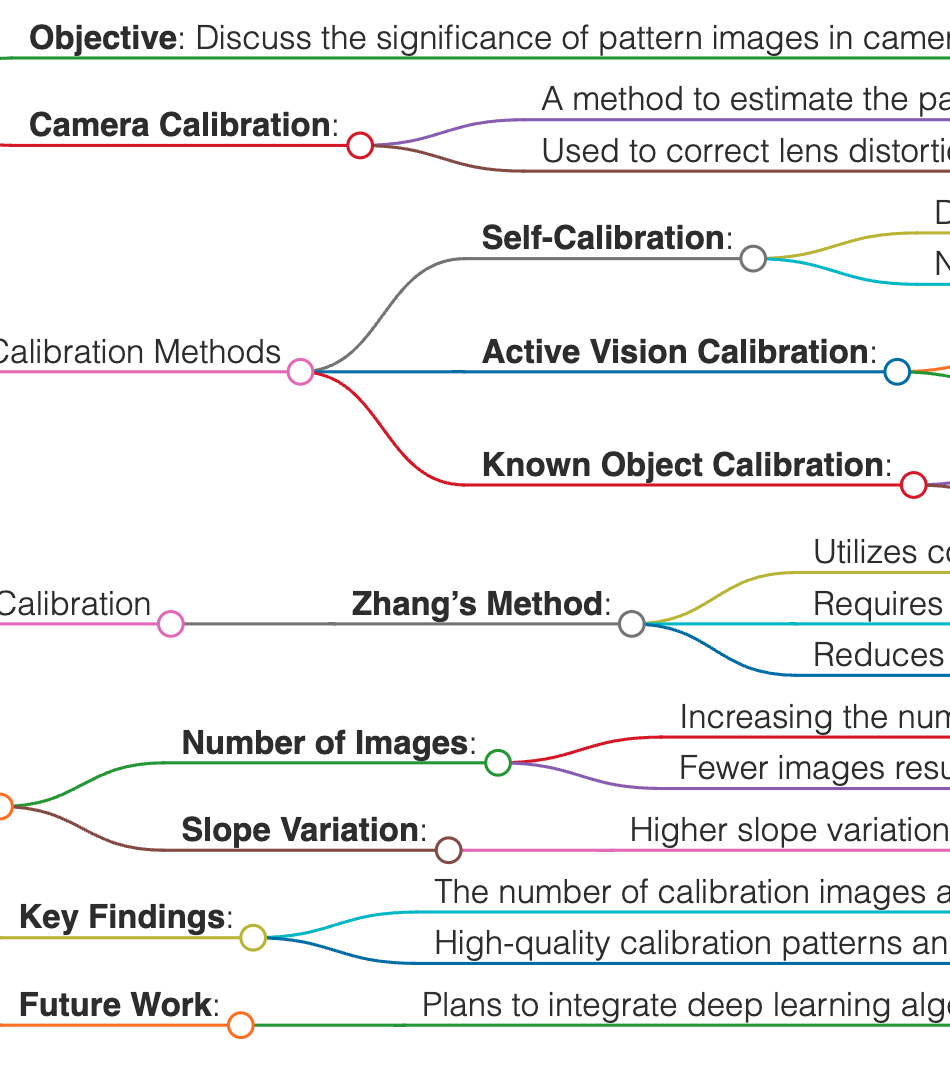
 # Pattern Image Significance for Camera Calibration
## 1. Introduction
- **Objective**: Discuss the significance of pattern images in camera calibration.
- **Camera Calibration**:
- A method to estimate the parameters of a pinhole camera model.
- Used to correct lens distortion and for 3D reconstruction in applications like machine vision, robotics, and navigation systems.
## 2. Categories of Camera Calibration Methods
- **Self-Calibration**:
- Does not rely on a known calibration object.
- Nonlinear, sensitive to noise, requires more computational power.
- **Active Vision Calibration**:
- Based on controlled camera motion.
- Solves parameters by using images captured during known motions.
- **Known Object Calibration**:
- Traditional method using calibration patterns like chessboards.
- High accuracy but requires specific knowledge of the calibration environment.
## 3. Algorithms for Camera Calibration
- **Zhang’s Method**:
- Utilizes common calibration points and self-calibration algorithms.
- Requires multiple images of a known calibration pattern from different angles.
- Reduces reprojection errors and enhances calibration accuracy.
## 4. Experimental Findings
- **Number of Images**:
- Increasing the number of calibration images improves accuracy.
- Fewer images result in higher re-projection errors.
- **Slope Variation**:
- Higher slope variation in calibration pattern images reduces reprojection errors.
## 5. Conclusion
- **Key Findings**:
- The number of calibration images and slope variation play a crucial role in calibration accuracy.
- High-quality calibration patterns and field of view improve calibration results.
- **Future Work**:
- Plans to integrate deep learning algorithms to optimize camera calibration.
---
## PSNR Threshold for Image Segmentation
URL: https://pirahansiah.com/farshid/content/journals-psnr-segmentation.md
PSNR-based thresholding method for image segmentation in automated visual inspection.
PEAK_SIGNAL-TO-NOISE_RATIO_BASED_ON_THRESHOLD_METHOD_FOR_IMAGE_SEGMENTATION
https://www.pirahansiah.com/notes/pubs/journals/PEAK_SIGNAL-TO-NOISE_RATIO_BASED_ON_THRESHOLD_METHOD_FOR_IMAGE_SEGMENTATION/
[spotify](https://podcasters.spotify.com/pod/show/pirahansiah/episodes/PEAK-SIGNAL-TO-NOISE-RATIO-BASED-ON-THRESHOLD-METHOD-FOR-IMAGE-SEGMENTATION-e2prep9)
[PDF Download](http://www.jatit.org/volumes/Vol57No2/4Vol57No2.pdf )
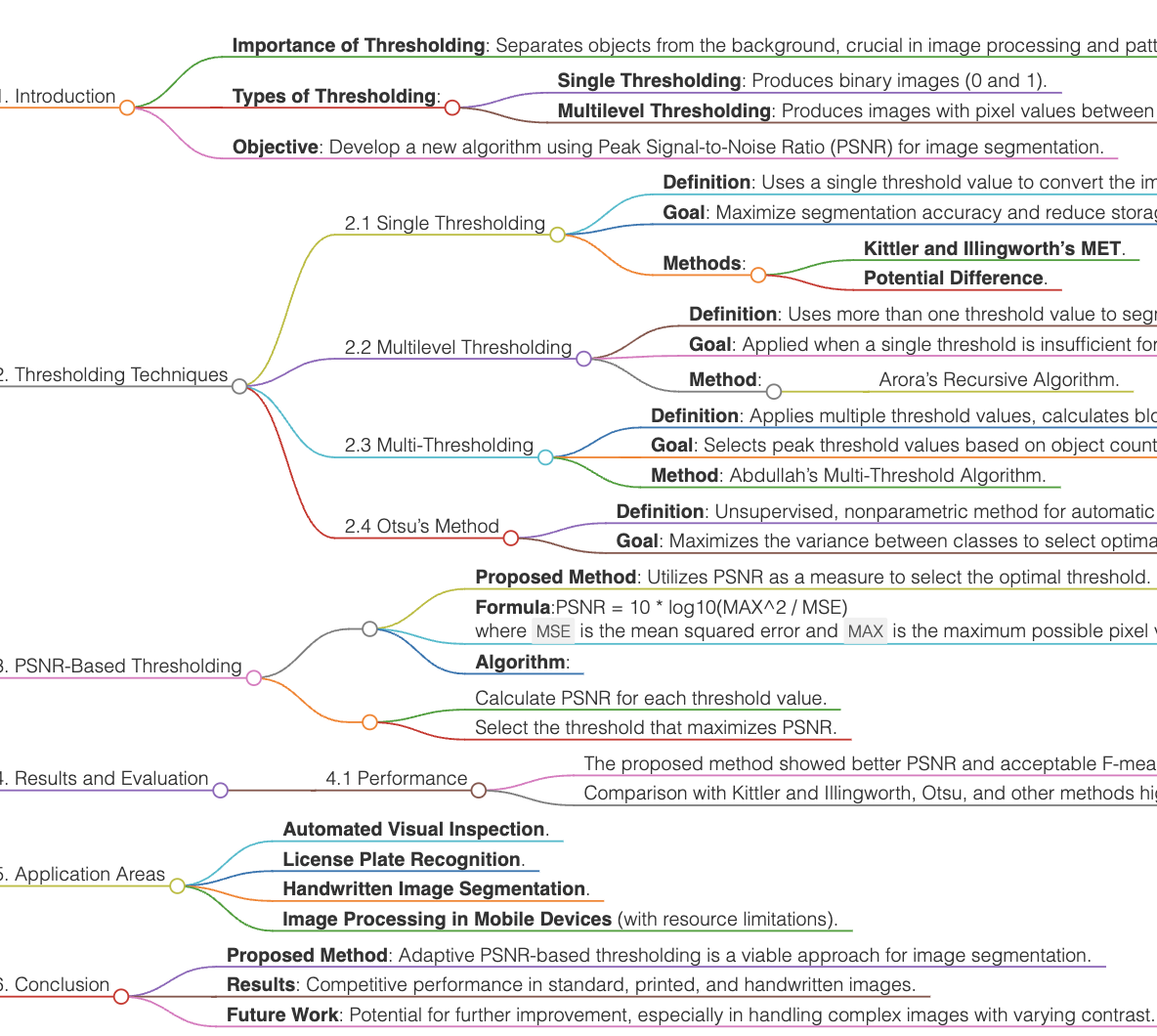
 # Mind Map: Peak Signal-to-Noise Ratio Based on Threshold Method for Image Segmentation
## 1. Introduction
- **Importance of Thresholding**: Separates objects from the background, crucial in image processing and pattern recognition.
- **Types of Thresholding**:
- **Single Thresholding**: Produces binary images (0 and 1).
- **Multilevel Thresholding**: Produces images with pixel values between 0 and 255.
- **Objective**: Develop a new algorithm using Peak Signal-to-Noise Ratio (PSNR) for image segmentation.
## 2. Thresholding Techniques
### 2.1 Single Thresholding
- **Definition**: Uses a single threshold value to convert the image into binary.
- **Goal**: Maximize segmentation accuracy and reduce storage requirements.
- **Methods**:
- **Kittler and Illingworth’s MET**.
- **Potential Difference**.
### 2.2 Multilevel Thresholding
- **Definition**: Uses more than one threshold value to segment images.
- **Goal**: Applied when a single threshold is insufficient for global segmentation.
- **Method**:
- Arora’s Recursive Algorithm.
### 2.3 Multi-Thresholding
- **Definition**: Applies multiple threshold values, calculates blobs/objects in the image.
- **Goal**: Selects peak threshold values based on object count.
- **Method**: Abdullah’s Multi-Threshold Algorithm.
### 2.4 Otsu’s Method
- **Definition**: Unsupervised, nonparametric method for automatic threshold selection.
- **Goal**: Maximizes the variance between classes to select optimal thresholds.
## 3. PSNR-Based Thresholding
- **Proposed Method**: Utilizes PSNR as a measure to select the optimal threshold.
- **Formula**:PSNR = 10 * log10(MAX^2 / MSE)
where `MSE` is the mean squared error and `MAX` is the maximum possible pixel value.
- **Algorithm**:
1. Calculate PSNR for each threshold value.
2. Select the threshold that maximizes PSNR.
## 4. Results and Evaluation
- **Datasets**:
- DIBCO 2011 (handwritten and printed images).
- **Metrics**:
- **F-Measure**: Evaluates binary classification accuracy.
- **PSNR**: Measures similarity between the original and thresholded images.
### 4.1 Performance
- The proposed method showed better PSNR and acceptable F-measure for printed images.
- Comparison with Kittler and Illingworth, Otsu, and other methods highlighted superior performance of the proposed method in certain conditions.
## 5. Application Areas
- **Automated Visual Inspection**.
- **License Plate Recognition**.
- **Handwritten Image Segmentation**.
- **Image Processing in Mobile Devices** (with resource limitations).
## 6. Conclusion
- **Proposed Method**: Adaptive PSNR-based thresholding is a viable approach for image segmentation.
- **Results**: Competitive performance in standard, printed, and handwritten images.
- **Future Work**: Potential for further improvement, especially in handling complex images with varying contrast.
---
## PSNR-Based Segmentation for LPR
URL: https://pirahansiah.com/farshid/content/papers-adaptive-segmentation.md
Adaptive image segmentation using PSNR for license plate recognition systems.
Adaptive_Image_Segmentation_Based_on_PSNR_for_License_Plate_Recognition
https://www.pirahansiah.com/notes/pubs/papers/Adaptive_Image_Segmentation_Based_on_PSNR_for_License_Plate_Recognition
[spotify]( https://podcasters.spotify.com/pod/show/pirahansiah/episodes/My-paper-Adaptive-image-segmentation-based-on-Peak-Signal-to-Noise-Ratio-for-a-license-plate-recognition-system-e2ps0ue)
[PDF Download My Conference Paper](https://doi.org/10.1109/ICCAIE.2010.5735125 )
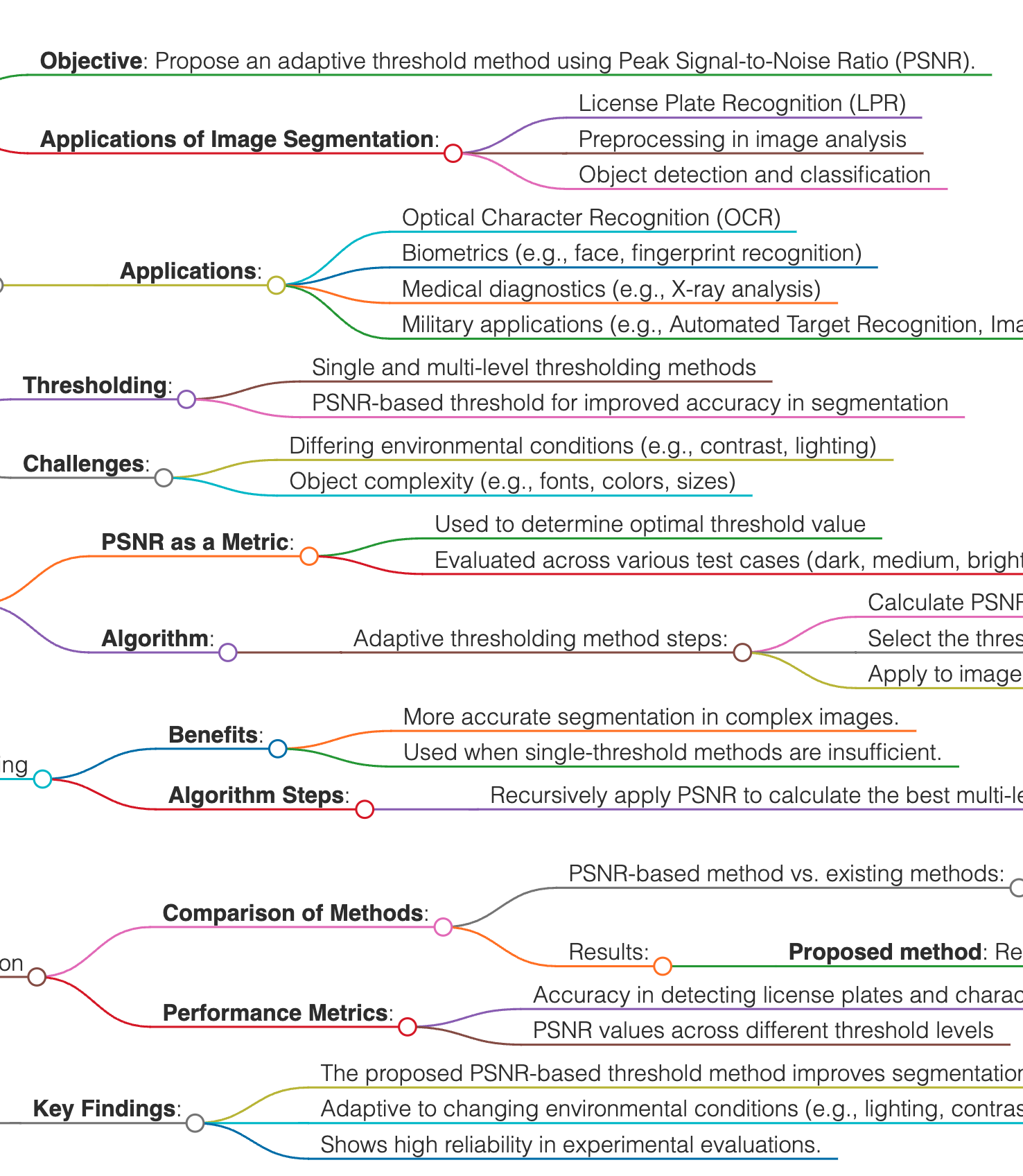
 # Adaptive Image Segmentation Based on PSNR for License Plate Recognition
## 1. Introduction
- **Objective**: Propose an adaptive threshold method using Peak Signal-to-Noise Ratio (PSNR).
- **Applications of Image Segmentation**:
- License Plate Recognition (LPR)
- Preprocessing in image analysis
- Object detection and classification
## 2. Pattern Recognition
- **Applications**:
- Optical Character Recognition (OCR)
- Biometrics (e.g., face, fingerprint recognition)
- Medical diagnostics (e.g., X-ray analysis)
- Military applications (e.g., Automated Target Recognition, Image Segmentation)
## 3. Motivation
- **Thresholding**:
- Single and multi-level thresholding methods
- PSNR-based threshold for improved accuracy in segmentation
- **Challenges**:
- Differing environmental conditions (e.g., contrast, lighting)
- Object complexity (e.g., fonts, colors, sizes)
## 4. Proposed Method
- **PSNR as a Metric**:
- Used to determine optimal threshold value
- Evaluated across various test cases (dark, medium, bright images)
- **Algorithm**:
- Adaptive thresholding method steps:
1. Calculate PSNR for different threshold values.
2. Select the threshold value with the highest PSNR.
3. Apply to image segmentation for license plate detection.
## 5. Multi-Level Thresholding
- **Benefits**:
- More accurate segmentation in complex images.
- Used when single-threshold methods are insufficient.
- **Algorithm Steps**:
- Recursively apply PSNR to calculate the best multi-level thresholds.
## 6. Experimental Evaluation
- **Comparison of Methods**:
- PSNR-based method vs. existing methods:
- Kittler and Illingworth’s MET
- Potential Difference
- Otsu's method
- Results:
- **Proposed method**: Reliable for high/low contrast situations (e.g., night, midday, rainy conditions).
- **Performance Metrics**:
- Accuracy in detecting license plates and characters
- PSNR values across different threshold levels
## 7. Conclusion
- **Key Findings**:
- The proposed PSNR-based threshold method improves segmentation in license plate recognition.
- Adaptive to changing environmental conditions (e.g., lighting, contrast).
- Shows high reliability in experimental evaluations.
---
## TafreshGrid: Grid Computing
URL: https://pirahansiah.com/farshid/content/papers-grid-computing.md
Grid computing infrastructure implementation and evaluation at Tafresh University.
TafreshGrid_Grid_computing_in_Tafresh_university
https://www.pirahansiah.com/notes/pubs/papers/TafreshGrid_Grid_computing_in_Tafresh_university
[spotify]( https://podcasters.spotify.com/pod/show/pirahansiah/episodes/My-Conference-Paper-TafreshGrid-Grid-computing-in-Tafresh-university-e2ps3ma)
[PDF Download My Conference Paper](http://ieeexplore.ieee.org/stamp/stamp.jsp?tp=&arnumber=6014009&isnumber=6013532 )
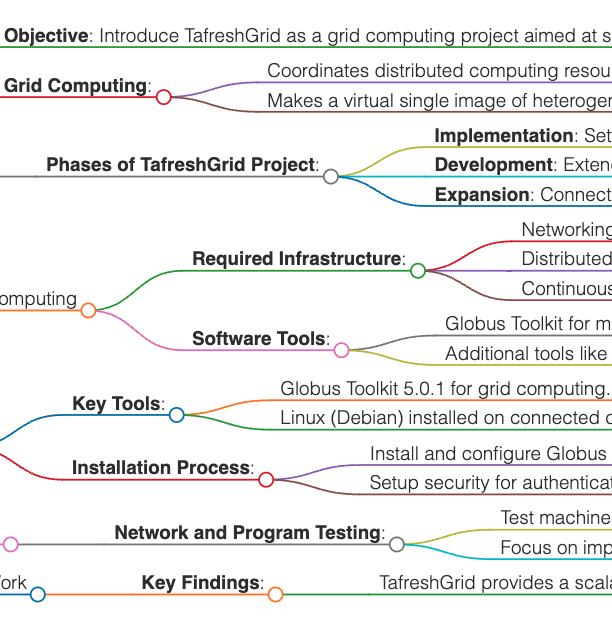
 # TafreshGrid: Grid Computing in Tafresh University
## 1. Introduction
- **Objective**: Introduce TafreshGrid as a grid computing project aimed at solving computational problems in multiple institutions.
- **Grid Computing**:
- Coordinates distributed computing resources.
- Makes a virtual single image of heterogeneous resources to solve complex problems.
## 2. Project Overview
- **Phases of TafreshGrid Project**:
1. **Implementation**: Setting up the grid infrastructure at Azad University, Tafresh branch.
2. **Development**: Extending the project to all Azad University branches.
3. **Expansion**: Connecting TafreshGrid to the national grid computing infrastructure.
## 3. Pre-Requisites for Grid Computing
- **Required Infrastructure**:
- Networking infrastructure (wired/wireless).
- Distributed computational resources.
- Continuous resource-sharing requirements.
- **Software Tools**:
- Globus Toolkit for managing grid computing tasks.
- Additional tools like J2SDK, APACHE ANT, and Perl for system configuration.
## 4. Software Installation
- **Key Tools**:
- Globus Toolkit 5.0.1 for grid computing.
- Linux (Debian) installed on connected computers.
- **Installation Process**:
- Install and configure Globus on all compute nodes.
- Setup security for authentication and authorization.
## 5. Testing and Performance
- **Network and Program Testing**:
- Test machines with grid computing applications to ensure system performance.
- Focus on improving performance compared to non-grid systems.
## 6. Conclusion and Future Work
- **Key Findings**:
- TafreshGrid provides a scalable platform for solving national problems requiring heavy computing.
This paper introduces TafreshGrid, a grid computing project developed at Azad University, Tafresh branch. The aim is to coordinate distributed computing resources to create a virtual system capable of solving large-scale computational problems across multiple institutions.
The project is implemented in three phases, starting with the setup of the grid infrastructure at Tafresh University, followed by its expansion to other branches of Azad University , and finally connecting it to a national grid computing network. Key software tools, including the Globus Toolkit, are used to manage the grid computing tasks.
The project demonstrates the successful installation of the grid computing environment, with plans to extend the project for solving national computational challenges that require high-performance computing.
---
## Thresholding for Handwritten Segmentation
URL: https://pirahansiah.com/farshid/content/papers-handwritten-thresholding.md
Comparison of PSNR and Otsu thresholding for handwritten image segmentation.
Comparison_single_thresholding_method_for_handwritten_images_segmentation
https://www.pirahansiah.com/notes/pubs/papers/Comparison_single_thresholding_method_for_handwritten_images_segmentation
[spotify](https://podcasters.spotify.com/pod/show/pirahansiah/episodes/My-Conference-Paper-Comparison-single-thresholding-method-for-handwritten-images-segmentation-e2ps22i )
[PDF Download My Conference Paper](https://doi.org/10.1109/ICPAIR.2011.5976918 )
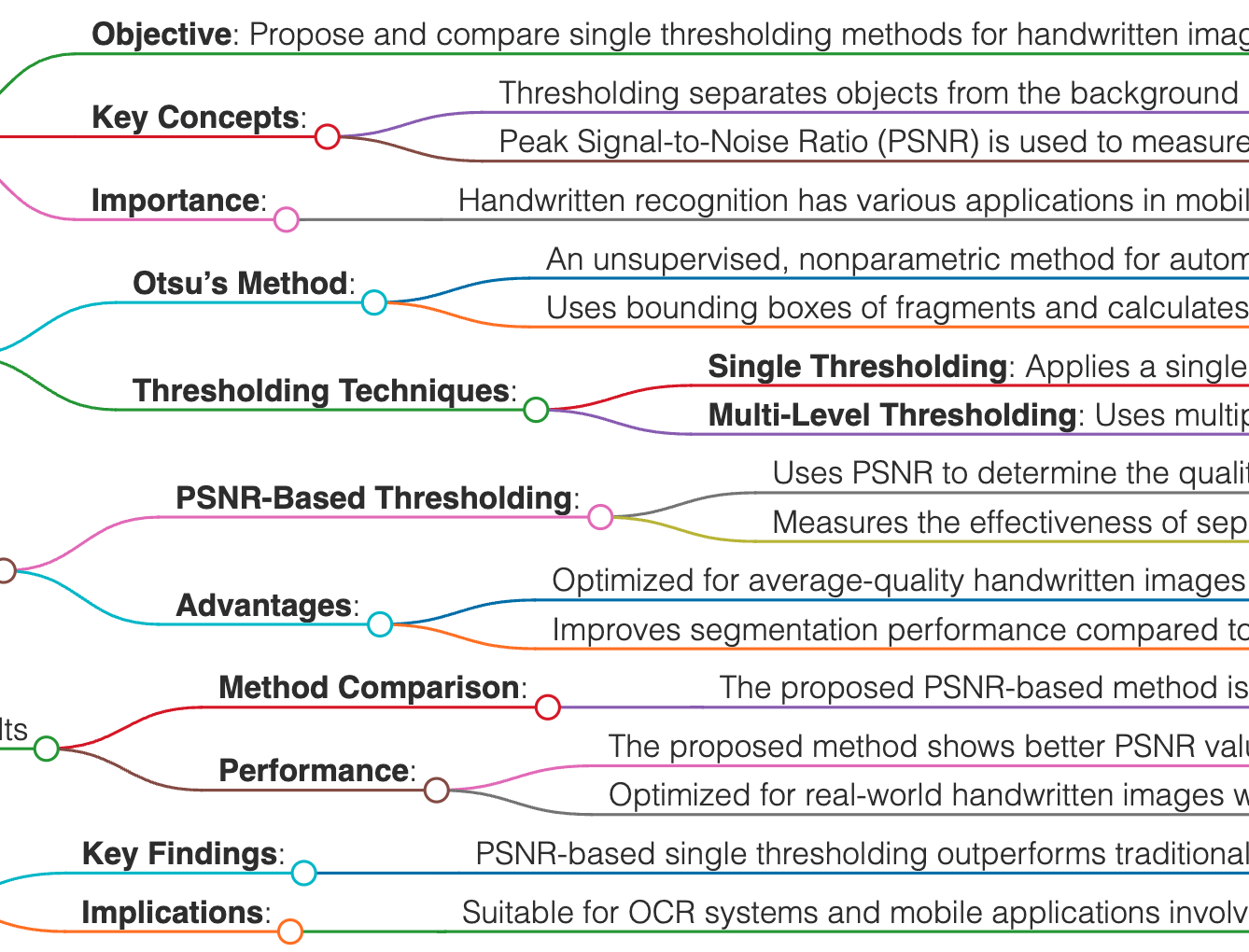
 # Comparison Single Thresholding Method for Handwritten Images Segmentation
## 1. Introduction
- **Objective**: Propose and compare single thresholding methods for handwritten image segmentation.
- **Key Concepts**:
- Thresholding separates objects from the background in images.
- Peak Signal-to-Noise Ratio (PSNR) is used to measure image quality.
- **Importance**:
- Handwritten recognition has various applications in mobile devices and OCR systems.
## 2. State of the Art
- **Otsu’s Method**:
- An unsupervised, nonparametric method for automatic threshold selection.
- Uses bounding boxes of fragments and calculates global thresholds by maximizing class variance.
- **Thresholding Techniques**:
- **Single Thresholding**: Applies a single threshold value to the entire image.
- **Multi-Level Thresholding**: Uses multiple threshold values for segmenting complex images.
## 3. Proposed Method
- **PSNR-Based Thresholding**:
- Uses PSNR to determine the quality of image segmentation.
- Measures the effectiveness of separating objects (characters) from the background in handwritten images.
- **Advantages**:
- Optimized for average-quality handwritten images.
- Improves segmentation performance compared to other methods.
## 4. Experimental Results
- **Method Comparison**:
- The proposed PSNR-based method is compared with Otsu's method and other techniques.
- **Performance**:
- The proposed method shows better PSNR values, indicating superior image segmentation quality.
- Optimized for real-world handwritten images where object-background separation is crucial.
## 5. Conclusion
- **Key Findings**:
- PSNR-based single thresholding outperforms traditional methods like Otsu's in segmenting handwritten images.
- **Implications**:
- Suitable for OCR systems and mobile applications involving handwritten text recognition.
---
# Notes & Guides
## 3D Vision & Real-Time Multi-Camera Systems
URL: https://pirahansiah.com/farshid/content/note-3d-vision.md
Real-time 3D point cloud generation, depth sensing, and multi-camera synchronization for computer vision applications.
- [MASt3R-SLAM: Real-Time Dense SLAM with 3D Reconstruction Priors](https://edexheim.github.io/mast3r-slam/)
-
# Real-Time 3D Point Cloud Generation and Visualization from Depth Data
The fusion of depth sensing and 3D visualization opens remarkable possibilities for interactive applications. By converting 2D depth maps into 3D point clouds, we can build systems that bridge physical and digital realms in real-time.
## Depth to 3D Conversion
The foundation of this approach lies in the deprojection process - transforming pixel coordinates and their associated depth values into 3D space. This requires camera intrinsic parameters (focal length, principal point) to perform the perspective transformation:
```python
def deproject_point(u, v, depth, camera_matrix):
fx = camera_matrix[0, 0] # Focal length X
fy = camera_matrix[1, 1] # Focal length Y
cx = camera_matrix[0, 2] # Principal point X
cy = camera_matrix[1, 2] # Principal point Y
# Convert to 3D coordinates
x = (u - cx) * depth / fx
y = (v - cy) * depth / fy
z = depth
return np.array([x, y, z])
```
## Real-Time Visualization Strategies
Visualizing 3D data interactively requires threading to prevent blocking the main application loop. A separate thread can handle display updates while maintaining responsive input handling:
```python
def start_visualizer_thread():
global visualizer_thread, visualizer_active
visualizer_active = True
visualizer_thread = threading.Thread(target=visualizer_loop)
visualizer_thread.daemon = True
visualizer_thread.start()
```
## Multi-Camera Fusion
Depth data from multiple cameras can create a more complete 3D representation. This requires transformation matrices to convert points between coordinate systems:
```python
def transform_point(point, matrix):
point_homog = np.append(point, 1.0) # Convert to homogeneous coordinates
transformed = np.dot(matrix, point_homog)
return transformed[:3] # Return Cartesian coordinates
```
## Trajectory Analysis
By maintaining a history of 3D positions, we can analyze trajectories to detect motion patterns. This enables advanced behaviors like distinguishing between stationary and moving objects:
```python
def detect_motion_from_point_cloud():
if len(position_history) < 2:
return False
threshold_movement = 0.05
threshold_time = 0.5
recent_time, recent_pos = position_history[-1]
for i in range(len(position_history)-2, -1, -1):
prev_time, prev_pos = position_history[i]
time_diff = recent_time - prev_time
if time_diff > threshold_time:
break
position_diff = np.linalg.norm(recent_pos - prev_pos)
if position_diff > threshold_movement:
return True
return False
```
## Robust Depth Sampling
Raw depth data often contains noise and gaps. Implementing window-based analysis improves reliability:
```python
def get_depth_at_point(depth_image, u, v, depth_scale, window_size=7):
h, w = depth_image.shape[:2]
# Extract window around point
x_min = max(0, u - window_size // 2)
x_max = min(w, u + window_size // 2 + 1)
y_min = max(0, v - window_size // 2)
y_max = min(h, v + window_size // 2 + 1)
window = depth_image[y_min:y_max, x_min:x_max]
# Filter valid depths
valid_depths = window[(window > 100) & (window < 65000)]
if valid_depths.size > 0:
return np.median(valid_depths) * depth_scale
return 0
```
## Visualization Options
Different visualization approaches offer tradeoffs between performance and visual fidelity:
1. **Real-time interactive display** using Matplotlib or Open3D
2. **Static image rendering** for systems with limited GUI capabilities
3. **3D file export** (PLY, OBJ) for offline analysis in specialized software
The choice depends on the specific requirements of your application and the computational resources available.
By combining these techniques, we can create systems that understand and respond to motion in three-dimensional space, opening possibilities for contactless interfaces, motion analysis, and spatial computing applications.
## 🚨 Reality Check: Why This Is Hard
- **Bandwidth**: 100 HD (720p) cameras @ 30 FPS ≈ 6.5 Gbps raw data (uncompressed).
- **CPU/GPU Load**: Decoding 100 video streams simultaneously requires massive parallel compute.
- **USB/PCIe Bottlenecks**: USB controllers share bandwidth. PCIe lanes limit capture cards.
- **Memory**: 100 frames in memory ≈ 2–4 GB just for buffers (depending on resolution).
- **Latency & Sync**: Hardware-level sync (e.g., genlock) is needed for true frame alignment.
---
## ✅ Goals Clarification
Define what “sync” means:
1. **Temporal Sync (Frame Alignment)**: All cameras capture frames at the same physical time.
2. **Software Sync (Display/Processing Sync)**: All frames are read/displayed together in your app.
3. **Trigger Sync**: Cameras start/stop recording simultaneously.
We’ll focus on **software sync** for display/processing using OpenCV. True hardware sync requires specialized cameras and capture hardware.
---
# 🧩 Architecture Overview
```
[100 Webcams]
↓ (USB / Ethernet / PCIe)
[Windows Machine(s) + Capture Hardware]
↓
[Multi-threaded Capture Layer (C++/Python)]
↓
[Frame Buffer + Synchronization Queue]
↓
[Display / Processing Thread (OpenCV GUI / Analysis)]
```
---
# 🖥️ Option 1: Single Machine (Theoretical, Not Recommended)
### Hardware Requirements
- Multiple PCIe USB 3.0/3.1 expansion cards (each with independent controllers).
- Possibly multiple capture cards if using SDI/HDMI cameras.
- 64+ GB RAM, 32+ logical cores, high-end GPU (RTX 4090 or multi-GPU).
- NVMe SSD for buffering if needed.
### Software Stack (C++ Recommended)
#### Step 1: Multi-threaded Camera Capture
Use `std::thread` per camera (or thread pool) to avoid blocking.
```cpp
#include
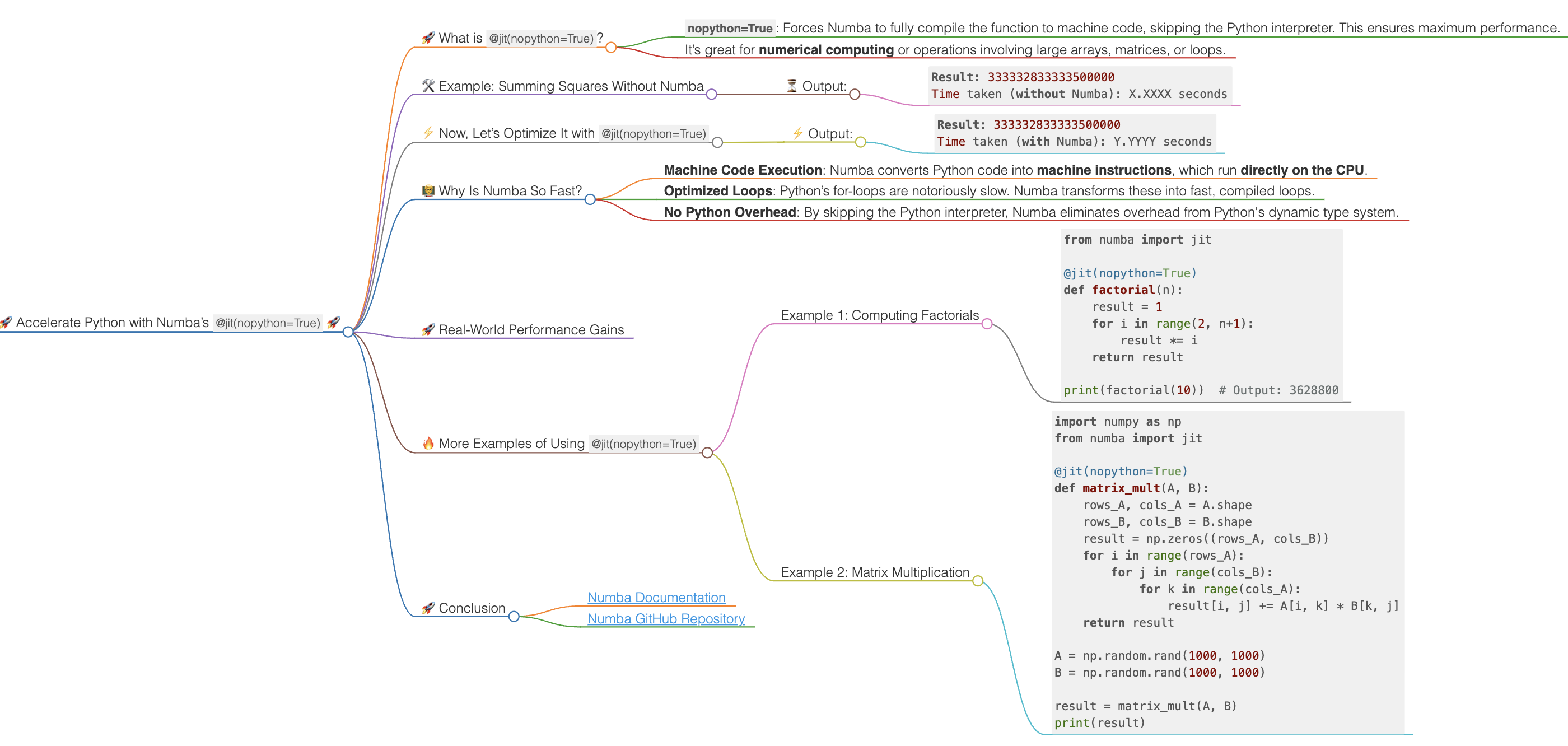 # 🚀 Accelerate Python with Numba’s `@jit(nopython=True)` 🚀
Are you looking to **optimize your Python code** for better performance? If you work with **large datasets** or run complex numerical computations, the **Numba** library can be a game-changer!
With **`@jit(nopython=True)`**, Numba translates Python functions into **machine code** using Just-In-Time (JIT) compilation. This drastically reduces execution time, especially for **loops** and **numerical operations**.
Let me show you how it works! 👇
## 🚀 What is `@jit(nopython=True)`?
`@jit(nopython=True)` is a decorator from the Numba library. It compiles the entire function into machine code at runtime. Here’s why it’s special:
- **`nopython=True`**: Forces Numba to fully compile the function to machine code, skipping the Python interpreter. This ensures maximum performance.
- It’s great for **numerical computing** or operations involving large arrays, matrices, or loops.
💡 If Numba detects a dynamic type (like Python objects), it will throw an error with `nopython=True`, ensuring you stay in the compiled mode.
---
## 🛠️ Example: Summing Squares Without Numba
Let’s start with a simple Python function that computes the sum of squares of a list of numbers.
```python
import time
# Regular Python function (without Numba)
def sum_of_squares(arr):
total = 0
for num in arr:
total += num * num
return total
arr = list(range(10000000)) # A list of 10 million numbers
start_time = time.time()
result = sum_of_squares(arr)
end_time = time.time()
print(f"Result: {result}")
print(f"Time taken (without Numba): {end_time - start_time:.4f} seconds")
```
### ⏳ Output:
```
Result: 333332833333500000
Time taken (without Numba): X.XXXX seconds
```
---
## ⚡ Now, Let’s Optimize It with `@jit(nopython=True)`
Here’s the same function, but this time we’ll add **Numba’s `@jit(nopython=True)`** to speed it up.
```python
import time
from numba import jit
# Numba-optimized function using @jit(nopython=True)
@jit(nopython=True)
def sum_of_squares_jit(arr):
total = 0
for num in arr:
total += num * num
return total
arr = list(range(10000000)) # A list of 10 million numbers
start_time = time.time()
result = sum_of_squares_jit(arr)
end_time = time.time()
print(f"Result: {result}")
print(f"Time taken (with Numba): {end_time - start_time:.4f} seconds")
```
### ⚡ Output:
```
Result: 333332833333500000
Time taken (with Numba): Y.YYYY seconds
```
---
## 🧑🏫 Why Is Numba So Fast?
- **Machine Code Execution**: Numba converts Python code into **machine instructions**, which run **directly on the CPU**.
- **Optimized Loops**: Python’s for-loops are notoriously slow. Numba transforms these into fast, compiled loops.
- **No Python Overhead**: By skipping the Python interpreter, Numba eliminates overhead from Python's dynamic type system.
---
## 🚀 Real-World Performance Gains
In this example, for 10 million numbers, the Numba-optimized function can run **several times faster** compared to the pure Python version. With even larger datasets or more complex computations, the performance gains will be even more impressive!
---
## 🔥 More Examples of Using `@jit(nopython=True)`
### Example 1: Computing Factorials
```python
from numba import jit
@jit(nopython=True)
def factorial(n):
result = 1
for i in range(2, n+1):
result *= i
return result
print(factorial(10)) # Output: 3628800
```
### Example 2: Matrix Multiplication
```python
import numpy as np
from numba import jit
@jit(nopython=True)
def matrix_mult(A, B):
rows_A, cols_A = A.shape
rows_B, cols_B = B.shape
result = np.zeros((rows_A, cols_B))
for i in range(rows_A):
for j in range(cols_B):
for k in range(cols_A):
result[i, j] += A[i, k] * B[k, j]
return result
A = np.random.rand(1000, 1000)
B = np.random.rand(1000, 1000)
result = matrix_mult(A, B)
print(result)
```
---
## 🚀 Conclusion
**Numba** is a powerful tool to boost the performance of your Python code, especially when dealing with **numerical computations** and **large datasets**. Using `@jit(nopython=True)`, you can transform your slow Python functions into **blazing-fast machine code** with minimal effort.
Next time you need to optimize your Python code, give **Numba** a try!
---
🔗 **Resources**:
- [Numba Documentation](https://numba.pydata.org/)
- [Numba GitHub Repository](https://github.com/numba/numba)
Feel free to connect with me for more tips on optimizing your Python code! 👨💻
#Python #Numba #MachineLearning #PerformanceOptimization #BigData #DataScience
---
## Advanced LLM Concepts
URL: https://pirahansiah.com/farshid/content/note-llm-concepts.md
Comprehensive mind map covering advanced LLM concepts including RAG, embeddings, multimodal models, and production deployment.
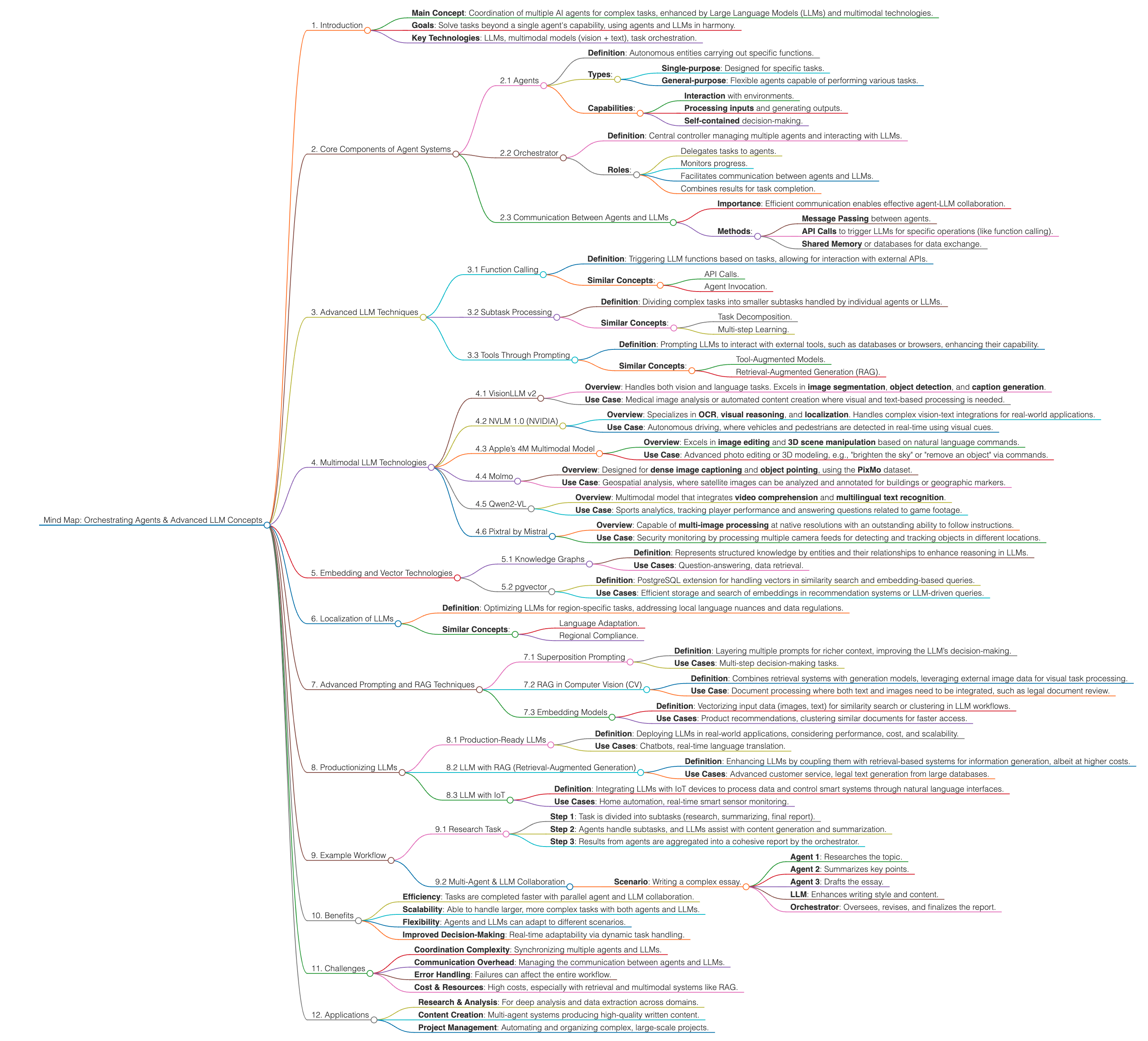 # Mind Map: Orchestrating Agents & Advanced LLM Concepts
## 1. Introduction
- **Main Concept**: Coordination of multiple AI agents for complex tasks, enhanced by Large Language Models (LLMs) and multimodal technologies.
- **Goals**: Solve tasks beyond a single agent's capability, using agents and LLMs in harmony.
- **Key Technologies**: LLMs, multimodal models (vision + text), task orchestration.
## 2. Core Components of Agent Systems
### 2.1 Agents
- **Definition**: Autonomous entities carrying out specific functions.
- **Types**:
- **Single-purpose**: Designed for specific tasks.
- **General-purpose**: Flexible agents capable of performing various tasks.
- **Capabilities**:
- **Interaction** with environments.
- **Processing inputs** and generating outputs.
- **Self-contained** decision-making.
### 2.2 Orchestrator
- **Definition**: Central controller managing multiple agents and interacting with LLMs.
- **Roles**:
- Delegates tasks to agents.
- Monitors progress.
- Facilitates communication between agents and LLMs.
- Combines results for task completion.
### 2.3 Communication Between Agents and LLMs
- **Importance**: Efficient communication enables effective agent-LLM collaboration.
- **Methods**:
- **Message Passing** between agents.
- **API Calls** to trigger LLMs for specific operations (like function calling).
- **Shared Memory** or databases for data exchange.
## 3. Advanced LLM Techniques
### 3.1 Function Calling
- **Definition**: Triggering LLM functions based on tasks, allowing for interaction with external APIs.
- **Similar Concepts**:
- API Calls.
- Agent Invocation.
### 3.2 Subtask Processing
- **Definition**: Dividing complex tasks into smaller subtasks handled by individual agents or LLMs.
- **Similar Concepts**:
- Task Decomposition.
- Multi-step Learning.
### 3.3 Tools Through Prompting
- **Definition**: Prompting LLMs to interact with external tools, such as databases or browsers, enhancing their capability.
- **Similar Concepts**:
- Tool-Augmented Models.
- Retrieval-Augmented Generation (RAG).
## 4. Multimodal LLM Technologies
### 4.1 VisionLLM v2
- **Overview**: Handles both vision and language tasks. Excels in **image segmentation**, **object detection**, and **caption generation**.
- **Use Case**: Medical image analysis or automated content creation where visual and text-based processing is needed.
### 4.2 NVLM 1.0 (NVIDIA)
- **Overview**: Specializes in **OCR**, **visual reasoning**, and **localization**. Handles complex vision-text integrations for real-world applications.
- **Use Case**: Autonomous driving, where vehicles and pedestrians are detected in real-time using visual cues.
### 4.3 Apple’s 4M Multimodal Model
- **Overview**: Excels in **image editing** and **3D scene manipulation** based on natural language commands.
- **Use Case**: Advanced photo editing or 3D modeling, e.g., "brighten the sky" or "remove an object" via commands.
### 4.4 Molmo
- **Overview**: Designed for **dense image captioning** and **object pointing**, using the **PixMo** dataset.
- **Use Case**: Geospatial analysis, where satellite images can be analyzed and annotated for buildings or geographic markers.
### 4.5 Qwen2-VL
- **Overview**: Multimodal model that integrates **video comprehension** and **multilingual text recognition**.
- **Use Case**: Sports analytics, tracking player performance and answering questions related to game footage.
### 4.6 Pixtral by Mistral
- **Overview**: Capable of **multi-image processing** at native resolutions with an outstanding ability to follow instructions.
- **Use Case**: Security monitoring by processing multiple camera feeds for detecting and tracking objects in different locations.
## 5. Embedding and Vector Technologies
### 5.1 Knowledge Graphs
- **Definition**: Represents structured knowledge by entities and their relationships to enhance reasoning in LLMs.
- **Use Cases**: Question-answering, data retrieval.
### 5.2 pgvector
- **Definition**: PostgreSQL extension for handling vectors in similarity search and embedding-based queries.
- **Use Cases**: Efficient storage and search of embeddings in recommendation systems or LLM-driven queries.
## 6. Localization of LLMs
- **Definition**: Optimizing LLMs for region-specific tasks, addressing local language nuances and data regulations.
- **Similar Concepts**:
- Language Adaptation.
- Regional Compliance.
## 7. Advanced Prompting and RAG Techniques
### 7.1 Superposition Prompting
- **Definition**: Layering multiple prompts for richer context, improving the LLM’s decision-making.
- **Use Cases**: Multi-step decision-making tasks.
### 7.2 RAG in Computer Vision (CV)
- **Definition**: Combines retrieval systems with generation models, leveraging external image data for visual task processing.
- **Use Case**: Document processing where both text and images need to be integrated, such as legal document review.
### 7.3 Embedding Models
- **Definition**: Vectorizing input data (images, text) for similarity search or clustering in LLM workflows.
- **Use Cases**: Product recommendations, clustering similar documents for faster access.
## 8. Productionizing LLMs
### 8.1 Production-Ready LLMs
- **Definition**: Deploying LLMs in real-world applications, considering performance, cost, and scalability.
- **Use Cases**: Chatbots, real-time language translation.
### 8.2 LLM with RAG (Retrieval-Augmented Generation)
- **Definition**: Enhancing LLMs by coupling them with retrieval-based systems for information generation, albeit at higher costs.
- **Use Cases**: Advanced customer service, legal text generation from large databases.
### 8.3 LLM with IoT
- **Definition**: Integrating LLMs with IoT devices to process data and control smart systems through natural language interfaces.
- **Use Cases**: Home automation, real-time smart sensor monitoring.
## 9. Example Workflow
### 9.1 Research Task
- **Step 1**: Task is divided into subtasks (research, summarizing, final report).
- **Step 2**: Agents handle subtasks, and LLMs assist with content generation and summarization.
- **Step 3**: Results from agents are aggregated into a cohesive report by the orchestrator.
### 9.2 Multi-Agent & LLM Collaboration
- **Scenario**: Writing a complex essay.
- **Agent 1**: Researches the topic.
- **Agent 2**: Summarizes key points.
- **Agent 3**: Drafts the essay.
- **LLM**: Enhances writing style and content.
- **Orchestrator**: Oversees, revises, and finalizes the report.
## 10. Benefits
- **Efficiency**: Tasks are completed faster with parallel agent and LLM collaboration.
- **Scalability**: Able to handle larger, more complex tasks with both agents and LLMs.
- **Flexibility**: Agents and LLMs can adapt to different scenarios.
- **Improved Decision-Making**: Real-time adaptability via dynamic task handling.
## 11. Challenges
- **Coordination Complexity**: Synchronizing multiple agents and LLMs.
- **Communication Overhead**: Managing the communication between agents and LLMs.
- **Error Handling**: Failures can affect the entire workflow.
- **Cost & Resources**: High costs, especially with retrieval and multimodal systems like RAG.
## 12. Applications
- **Research & Analysis**: For deep analysis and data extraction across domains.
- **Content Creation**: Multi-agent systems producing high-quality written content.
- **Project Management**: Automating and organizing complex, large-scale projects.
---
- Function Calling
- Subtasks
- Tools Using Prompting
- Knowledge Graphs
- pgVector
- open source LLM
- Superposition Prompting
- Retrieval-Augmented Generation (RAG) in Computer vision
- Embedding Models
- Production-Level LLMs
- Production-Level LLMs with RAG
- Production-Level LLMs in IoT
- Cost Management
---
- In managing costs for production-level LLMs with RAG, strategies like embedding retrieval systems and optimizing model queries can help reduce resource use. Leveraging cloud-based solutions or fine-tuning smaller models for specific tasks are also common methods to reduce the expense of running these models in real-time .
- Running LLMs in production at scale can be expensive, particularly when combined with RAG (Retrieval-Augmented Generation). This is because both the LLM and the external retrieval system (like a knowledge graph) need to work in tandem, which can increase computational overhead. When applied to IoT (Internet of Things), where data sources are vast and diverse, the cost of maintaining such systems can become prohibitive .
- Embedding models help LLMs convert text into vector representations, enabling tasks like search, similarity comparison, and context retrieval. These models, when integrated with LLMs, allow for scaling up chunk processing for large datasets, making them essential for production environments where real-time data retrieval is required .
- Function calling within LLMs allows these models to interact with external APIs and tools by converting user queries into function calls. For example, if a user asks about the weather, the model can trigger a function like get_current_weather(location), passing the necessary parameters to retrieve the correct data. This capability enhances the integration of LLMs with external systems, enabling a more interactive and task-specific approach .
- When combined with subtasks, LLMs can divide complex tasks into manageable parts. For instance, a user query can trigger multiple functions or tools to handle different subtasks, such as searching databases or summarizing documents .
Tool integration with LLMs through prompting enables the models to call upon specialized tools for tasks that require external data or specific functionality. For example, using tools like LangChain, LLMs can be prompted to interact with knowledge graphs, retrieve data from external APIs, or handle subtasks like document chunking or embedding generation . These prompts allow the LLM to understand when and how to invoke external resources, ensuring more accurate responses.
- A knowledge graph allows LLMs to structure unstructured data by mapping entities and relationships in a graph format, making it easier for models to retrieve, reason about, and respond to queries based on complex datasets . Tools like pgVector enhance this by enabling vectorized searches, allowing models to retrieve semantically similar content from large datasets efficiently.
- Superposition prompting is an advanced technique that presents multiple prompts to the model at once, helping it learn or decide between different potential tasks. This method increases the model’s ability to handle ambiguity or multiple concurrent tasks efficiently. The application of such techniques can be seen in sectors like Apple, where AI-driven interfaces need to handle complex decision-making processes.
- Keyword Search vs. Vector Search:
• When comparing keyword search and vector search, an alpha-based selection helps determine which method is more appropriate depending on the data and task.
• Chunking Data: Data can be divided or “chunked” into meaningful units such as paraphrases, pages, or chapters. This approach helps structure information for more efficient retrieval and processing.
• Imagine an 8MP picture: Whether it’s an image of one person or many people, the resolution remains 8MP. In the same way, the numerical representation of data, like vectors, maintains its “size” regardless of what is being represented.
• GraphQL: GraphQL offers a flexible query system, enabling precise data retrieval by requesting only the fields needed, making it an effective alternative to traditional REST APIs in many cases.
- Best Methods for Keyword Search:
• For a keyword-only search, BM25 is considered one of the most effective models. It excels in ranking documents based on keyword occurrences and relevance.
• To measure keyword frequency or how common a keyword is, approaches like term frequency (TF) and inverse document frequency (IDF) can provide insight into the importance of keywords within a dataset.
---
## Agent Swarm
URL: https://pirahansiah.com/farshid/content/note-swarm.md
# Agent Swarm
Agent Swarm — ask a question and watch a live swarm of research agents map and synthesize the whole pirahansiah.com knowledge base.
> Agent Swarm is an interactive tool: ask a question and a swarm of AI research agents explores the site — papers, journals, books, patents, keynotes, courses, CV — maps the knowledge graph, and synthesizes an answer with related pages, tags, and relations.
## What it does
- **Ask anything** — e.g. camera calibration, optical flow, multi-agent LLMs, patents, OpenCV 5
- **Live swarm animation** — each node is an agent with a specialty: text retrieval, graph mapping, tag mining, categorization, relation weaving, synthesis
- **Swarm synthesis** — key points, categories covered, top tags, related pages, and relations between findings
- **Dynamic knowledge graph** — built live for your question (blue = pages & publications, purple = tags, grey = categories)
- **Ready-to-post X summary** — copy or open in X
This tool runs in-browser against the site index and knowledge graph. It previously lived at `/swarm/`.
---
## All Pages — pirahansiah.com
URL: https://pirahansiah.com/farshid/content/wiki.md
A complete alphabetical index of every page on pirahansiah.com — computer vision, AI, LLM, CUDA and edge-deployment knowledge base.
*Last updated: 2026-08-16.*
All Pages
From pirahansiah.com, the free knowledge base
Home
- Dr. Farshid Pirahansiah — Main landing page
- Computer Vision — CV overview and research
Computer Vision
Optimization
Business & Career
- Startup Guide — Edge AI business in Germany
- SEO for LLMs
- Top LinkedIn Posts 2024
PKM & Knowledge
Journal Articles
Conference Papers
Books & Chapters
Keynotes
Courses & Workshops
Presentations
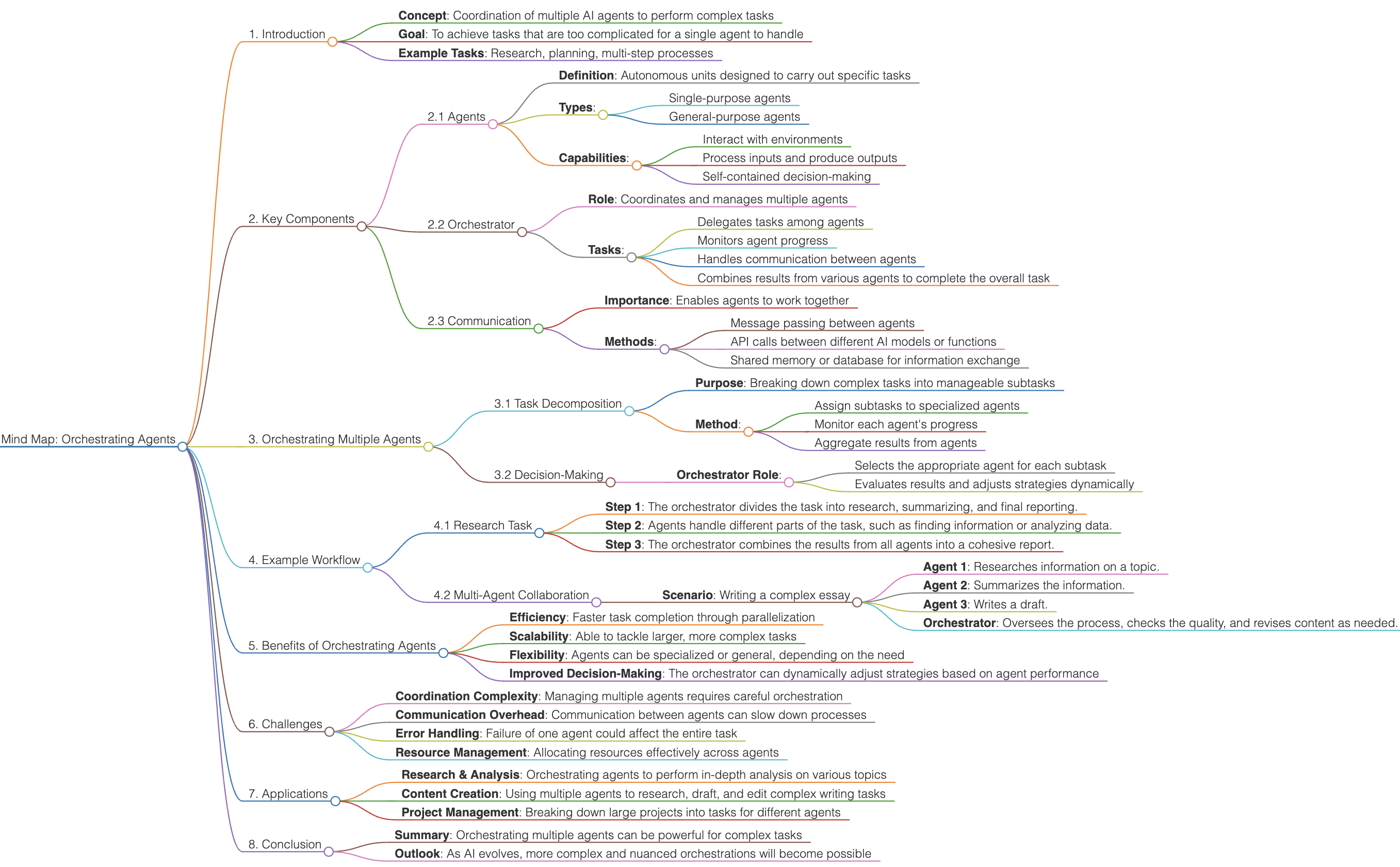 ## Orchestrating AI Agents
Coordinating multiple AI agents for complex tasks like research, planning, and multi-step processes. By breaking tasks into subtasks, agents work together efficiently.
**Key Frameworks:**
- [LangChain](https://github.com/hwchase17/langchain) — Agent logic, memory, tool usage
- [Ray](https://github.com/ray-project/ray) — Scalable distributed computing
- [Auto-GPT](https://github.com/Significant-Gravitas/Auto-GPT) — Autonomous task planning
- [MetaGPT](https://github.com/geekan/MetaGPT) — Multi-agent software company
- [Phidata](https://github.com/phidatahq/phidata) — Multi-modal agents with memory
- [SWE-agent](https://github.com/SWE-agent/SWE-agent) — AI software engineering agent
- [Awesome AI Agents](https://github.com/e2b-dev/awesome-agents) — Curated list of AI agent projects
**Multi-Agent Architecture:**
- Database agent, process agent, frontend/backend agent, UX/UI agent
- Each agent specializes in its domain with its own memory and tools
- Agents collaborate to solve complex problems like a real team
---
## TheAgentCompany Benchmark
The paper "TheAgentCompany: Benchmarking LLM Agents on Consequential Real World Tasks" introduces a benchmark evaluating AI agents on tasks like web browsing, coding, and collaborating. The best agent autonomously completed 24% of tasks — complex, long-term tasks remain challenging.
**Agent Frameworks Compared:**
| Framework | Description |
|-----------|-------------|
| [MetaGPT](https://github.com/geekan/MetaGPT) | Multi-agent software company framework |
| [AGiXT](https://github.com/Josh-XT/AGiXT) | AI automation with adaptive memory |
| [AgentVerse](https://github.com/OpenBMB/AgentVerse) | Multi-agent deployment framework |
| [AgentGPT](https://github.com/reworkd/AgentGPT) | Browser-based autonomous agent platform |
| [AFlow](https://github.com/geekan/MetaGPT) | Automated agentic workflow generation via MCTS |
---
# Silent Tsunami: The Greatest Wealth Transfer in History
A brief overview of the most critical event that will challenge humanity in the next few years, replacing over **70% of administrative/industrial jobs globally**.
## Why Will Most Jobs Become Obsolete?
Stunning forecasts by **McKinsey** and **Goldman Sachs** predict AI agents will take over **70% of administrative jobs** and add **$7 trillion** to the global economy.
## The AI-Powered Workplace of the Future
AI agents are not merely chatbots — they are **independent systems** capable of understanding their environment and performing tasks **entirely without human intervention**.
**Key Abilities:**
1. **Task Execution** — Respond to emails, schedule meetings, write reports, manage projects, analyze data
2. **Simultaneous Multi-tasking** — Perform tasks simultaneously at unbelievable speeds
3. **Decision-Making** — Analyze data, weigh options, make informed decisions
4. **Context Awareness** — Interpret conversations, understand intent and dependencies
## Beyond Automation: Human Capital Transformation
Value will shift toward those with **superior ideas and creativity**. New roles will emerge:
- AI Supervisors
- Creative AI Managers
- Human-AI Collaboration Specialists
- Digital Workforce Managers
## Preparing for the Future
1. Learn to collaborate with AI systems
2. Develop unique human skills
3. Focus on creative and strategic thinking
---
# LLM Multi-Agent Swarm Architecture
A **Multi-Agent Swarm Architecture** entails multiple (semi)autonomous agents cooperating in a decentralized manner to solve complex tasks.
**Core Principles:**
- **Decentralized Decision-Making** — Agents act independently while coordinating for a common goal
- **Emergent Behavior** — Complex global outcomes arise from simple local interactions
- **Adaptability** — System reconfigures automatically based on context
## Relevant LLMs
- **Meta's Llama** — Open-source, multiple parameter sizes, fine-tunable. Coordinate via LangChain or Ray.
- **Mistral AI's Mistral** — Efficient 7B model. Multiple instances can run in parallel for swarm behavior.
- **Anthropic's Claude** — Commercial API, large context windows. Integrate as agents within an orchestrator.
## Frameworks & Techniques
- **LangChain** — Agent logic with memory modules and tool integration
- **Ray** — Scalable distributed computing for LLM workers
- **PettingZoo** — Multi-agent reinforcement learning environments
- **Auto-GPT / BabyAGI / AgentGPT** — Autonomous task planning and execution
## Example Architectures
1. **LangChain + Ray** — LangChain manages agent logic, Ray handles concurrency
2. **Docker Swarm / Kubernetes** — Multiple LLM microservices with Kafka/RabbitMQ coordination
3. **MARL with LLM Observers** — RLlib for multi-agent training with LLM policy modules
## Further Reading
- *Emergent Tool Use from Multi-Agent Autocurricula* (OpenAI)
- *Learning to Collaborate in Multi-Agent Games* (DeepMind)
- Experiment with smaller models (Mistral 7B, Llama 2 7B) for parallel deployment
---
## C++ Quick Reference
URL: https://pirahansiah.com/farshid/content/note-cpp.md
Quick reference for C++ memory management, data structures, debugging tools, and shell basics.
C++
### hash
std::map
Support via Crypto
If my open-source computer vision and edge AI work has helped you, you can support it directly with cryptocurrency. Select the token below to reveal the matching wallet address.
0xFcE7…53B0C). Sending on the wrong network — for example Base instead of Ethereum — can permanently lose your funds. Always verify the network in your wallet before confirming.info@pirahansiah.com instead.
🎮 Arcade
Snake · Flappy Bird · 2048 — play right here, or open it inside Telegram as a Mini App.
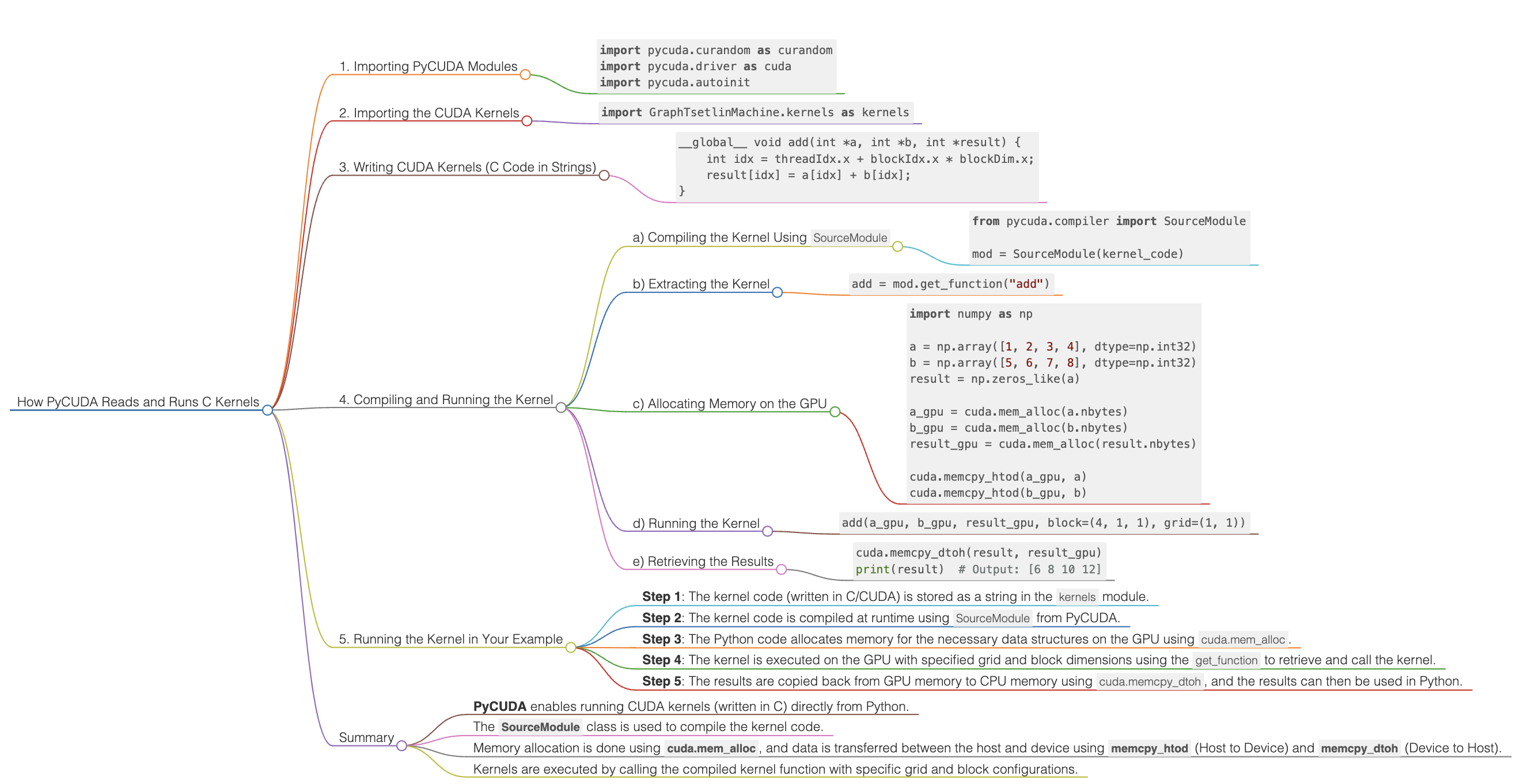 # How PyCUDA Reads and Runs C Kernels
In **PyCUDA**, you can run **CUDA kernels** (which are typically written in C or C++) directly from Python. PyCUDA provides a way to write CUDA code as a string, compile it at runtime, and execute it on the GPU. Let's walk through the process step-by-step, explaining how PyCUDA interacts with a kernel written in C and runs it.
## 1. Importing PyCUDA Modules
The following lines import PyCUDA’s functionalities:
```python
import pycuda.curandom as curandom
import pycuda.driver as cuda
import pycuda.autoinit
```
- **`pycuda.driver as cuda`**: This module provides the basic interface to communicate with the CUDA driver, which manages GPU resources and executes code.
- **`pycuda.autoinit`**: This module automatically initializes CUDA when you import it, setting up the GPU and its context (the memory space for the program to run).
- **`pycuda.curandom`**: This module is used to generate random numbers on the GPU using CUDA’s random number generation capabilities.
## 2. Importing the CUDA Kernels
```python
import GraphTsetlinMachine.kernels as kernels
```
- This imports a module named **`kernels`** from `GraphTsetlinMachine`. Presumably, this module contains CUDA code (written in C) in the form of strings or functions that will later be compiled and executed using PyCUDA.
## 3. Writing CUDA Kernels (C Code in Strings)
In PyCUDA, CUDA kernels (written in C or C++) are typically embedded as string literals in Python code. Here is an example of what that might look like:
```c
__global__ void add(int *a, int *b, int *result) {
int idx = threadIdx.x + blockIdx.x * blockDim.x;
result[idx] = a[idx] + b[idx];
}
```
This is a simple CUDA kernel written in C:
- **`__global__`**: This indicates that `add` is a CUDA kernel that can be called from the host (Python) and will run on the GPU.
- The kernel adds two arrays element-wise on the GPU.
## 4. Compiling and Running the Kernel
In PyCUDA, you compile and run this CUDA code from Python. Here’s how PyCUDA reads and executes the kernel:
### a) Compiling the Kernel Using `SourceModule`
You use PyCUDA’s **`SourceModule`** class to compile the kernel code at runtime:
```python
from pycuda.compiler import SourceModule
mod = SourceModule(kernel_code)
```
- **`SourceModule`** takes the kernel code as a string and compiles it into machine code that can be executed on the GPU.
- At this point, the CUDA kernel is ready to be called from Python.
### b) Extracting the Kernel
Once the kernel is compiled, you can extract it from the `SourceModule` object using its function name:
```python
add = mod.get_function("add")
```
- **`get_function("add")`**: This retrieves the **compiled CUDA function** (kernel) called `add`.
### c) Allocating Memory on the GPU
Before running the kernel, you need to allocate memory on the GPU. This can be done using PyCUDA’s **`cuda.mem_alloc()`** function:
```python
import numpy as np
a = np.array([1, 2, 3, 4], dtype=np.int32)
b = np.array([5, 6, 7, 8], dtype=np.int32)
result = np.zeros_like(a)
a_gpu = cuda.mem_alloc(a.nbytes)
b_gpu = cuda.mem_alloc(b.nbytes)
result_gpu = cuda.mem_alloc(result.nbytes)
cuda.memcpy_htod(a_gpu, a)
cuda.memcpy_htod(b_gpu, b)
```
- **`cuda.mem_alloc()`**: Allocates GPU memory for the arrays.
- **`cuda.memcpy_htod()`**: Copies data from the host (CPU) to the device (GPU).
### d) Running the Kernel
Now that the memory is allocated and the kernel is compiled, you can execute the kernel on the GPU:
```python
add(a_gpu, b_gpu, result_gpu, block=(4, 1, 1), grid=(1, 1))
```
- **`block=(4, 1, 1)`**: Specifies that we want to launch 4 threads per block (1-dimensional thread block).
- **`grid=(1, 1)`**: Specifies that we are using 1 block in the grid.
This launches the **`add`** kernel on the GPU, which performs element-wise addition of the arrays `a` and `b` and stores the result in `result`.
### e) Retrieving the Results
Once the kernel has completed execution, the results can be copied back from GPU memory to the host:
```python
cuda.memcpy_dtoh(result, result_gpu)
print(result) # Output: [6 8 10 12]
```
- **`cuda.memcpy_dtoh()`**: Copies the result from the device (GPU) back to the host (CPU).
- Finally, the result is printed, showing the sum of the arrays.
## 5. Running the Kernel in Your Example
In your case, the code seems to be using kernels from the `GraphTsetlinMachine.kernels` module. These kernels are most likely stored as C code in string format within the module. Here's a simplified explanation of what happens:
- **Step 1**: The kernel code (written in C/CUDA) is stored as a string in the `kernels` module.
- **Step 2**: The kernel code is compiled at runtime using `SourceModule` from PyCUDA.
- **Step 3**: The Python code allocates memory for the necessary data structures on the GPU using `cuda.mem_alloc`.
- **Step 4**: The kernel is executed on the GPU with specified grid and block dimensions using the `get_function` to retrieve and call the kernel.
- **Step 5**: The results are copied back from GPU memory to CPU memory using `cuda.memcpy_dtoh`, and the results can then be used in Python.
## Summary
- **PyCUDA** enables running CUDA kernels (written in C) directly from Python.
- The **`SourceModule`** class is used to compile the kernel code.
- Memory allocation is done using **`cuda.mem_alloc`**, and data is transferred between the host and device using **`memcpy_htod`** (Host to Device) and **`memcpy_dtoh`** (Device to Host).
- Kernels are executed by calling the compiled kernel function with specific grid and block configurations.
In your specific example, `GraphTsetlinMachine.kernels` likely contains CUDA kernel code for running Tsetlin Machine operations on the GPU, and PyCUDA is handling the compilation and execution of this code.
---
## LLM Prompts for Knowledge Graph
URL: https://pirahansiah.com/farshid/content/prompts.md
# LLM Prompts for Knowledge Graph
## Summarize Note
Write ONE short sentence (max 20 words) summarising a technical note.
Title: {title}
Key terms: {top_terms}
Headings: {headings}
Reply with the sentence only, no labels.
---
## Rank Knowledge Files
Select the smallest, highest-value set of files needed to understand this project's knowledge, domain model, architecture, and core behavior.
Goal:
- Keep files that explain WHAT the project does, HOW the main system works, and WHERE the important domain logic lives.
- Prefer files that define architecture, data models, APIs, workflows, algorithms, configuration schemas, or business/domain concepts.
- Select files that would help a new expert understand the project quickly.
Strongly prefer:
- Core source files: .py, .cpp, .hpp, .h, .cc, .cxx, .ts, .js, .go, .rs
- Entry points, main services, routers/controllers, orchestrators, pipelines, engines, managers
- Domain models, schemas, interfaces, abstractions, protocol definitions
- Important config files only if they define project behavior, architecture, or domain concepts
- README or docs only if they contain substantial project-specific architecture/domain knowledge
Deprioritize or exclude:
- Environment/tooling files: .conda, venv, .venv, node_modules, __pycache__, .idea, .vscode
- Lockfiles and dependency manifests unless uniquely important to understanding architecture
- Build outputs, generated files, caches, logs, binaries, datasets, notebooks with only experiments
- Generic CI/CD, formatting, linting, launch settings, editor settings
- Tests unless they are the clearest documentation of critical behavior or domain rules
Selection rules:
- Return at most {max_files} file indices.
- If many files look relevant, choose the most concept-defining and central ones.
- Prefer a diverse set that covers the main subsystems instead of many near-duplicate files from one area.
- Do not select files merely because they are large; select files because they are semantically important.
- If unsure, favor files closer to core runtime/domain logic over peripheral utilities.
Output requirements:
- Return valid JSON only.
- Do not include explanations, markdown, comments, or trailing text.
- Use exactly this schema: {{"keep":[indices]}}
- Indices must be integers from the provided file list.
- Do not invent indices.
- The keep array may be empty if no files are relevant.
- Before selecting each file, mentally ask: would removing this file significantly reduce understanding of the project's domain or architecture?
---
## Local Video Avatar Generator with Ollama
URL: https://pirahansiah.com/farshid/content/note-llm-avatar.md
Build a fully local video avatar generator using Ollama LLM, Piper TTS, and Wav2Lip without cloud services.
# Building a Local Video Avatar Generator Using Ollama and Open-Source Tools
Creating a video avatar generator completely locally without cloud services or API keys is challenging but possible. Here's a step-by-step guide to build a system that generates talking video avatars using locally-run models.
## Prerequisites
- A computer with decent GPU (at least 8GB VRAM recommended)
- 16GB+ RAM
- 50GB+ free storage space
- Linux or macOS (Windows with WSL also works)
- Basic familiarity with command line
## Step 1: Set Up Ollama for Local LLM
Ollama allows you to run large language models locally for text generation.
1. Install Ollama:
```bash
# For macOS/Linux
curl -fsSL https://ollama.com/install.sh | sh
# For Windows (via WSL)
# First install WSL, then run the Linux command above
```
2. Pull a suitable model (Llama3 recommended for better performance):
```bash
ollama pull llama3
```
3. Test your Ollama installation:
```bash
ollama run llama3 "Write a short 30-second script about climate change"
```
## Step 2: Install Local Text-to-Speech Engine
We'll use Piper, a fast local TTS system:
1. Install dependencies:
```bash
sudo apt-get update
sudo apt-get install -y build-essential python3-pip python3-venv
```
2. Set up a Python virtual environment:
```bash
python3 -m venv ~/venv-tts
source ~/venv-tts/bin/activate
```
3. Install Piper:
```bash
pip install piper-tts
```
4. Download a voice model:
```bash
mkdir -p ~/.local/share/piper-tts/voices
cd ~/.local/share/piper-tts/voices
wget https://huggingface.co/rhasspy/piper-voices/resolve/main/en/en_US/lessac/medium/en_US-lessac-medium.onnx
wget https://huggingface.co/rhasspy/piper-voices/resolve/main/en/en_US/lessac/medium/en_US-lessac-medium.onnx.json
```
5. Test Piper:
```bash
echo "This is a test of the text to speech system." | piper \
--model ~/.local/share/piper-tts/voices/en_US-lessac-medium.onnx \
--output-raw | aplay -r 22050 -f S16_LE -c 1
```
## Step 3: Install Wav2Lip for Avatar Animation
1. Clone the repository:
```bash
git clone https://github.com/Rudrabha/Wav2Lip.git
cd Wav2Lip
```
2. Set up environment:
```bash
python3 -m venv ~/venv-wav2lip
source ~/venv-wav2lip/bin/activate
pip install -r requirements.txt
```
3. Download the pre-trained model:
```bash
mkdir -p checkpoints
wget -O checkpoints/wav2lip.pth https://github.com/Rudrabha/Wav2Lip/releases/download/v1.0/wav2lip.pth
```
4. Prepare a reference face image or video clip to be animated (save as "face.jpg" or "face.mp4")
## Step 4: Install FFmpeg for Video Processing
```bash
sudo apt-get install -y ffmpeg
```
## Step 5: Create the Pipeline Script
Create a file called `avatar_generator.py`:
```python
#!/usr/bin/env python3
import os
import subprocess
import argparse
import tempfile
import json
def generate_script(prompt):
"""Generate script text using Ollama"""
print("Generating script with Ollama...")
cmd = f'ollama run llama3 "{prompt}"'
result = subprocess.run(cmd, shell=True, capture_output=True, text=True)
return result.stdout.strip()
def text_to_speech(text, output_wav):
"""Convert text to speech using Piper"""
print("Converting text to speech...")
voice_model = os.path.expanduser("~/.local/share/piper-tts/voices/en_US-lessac-medium.onnx")
with tempfile.NamedTemporaryFile(mode='w', suffix='.txt') as f:
f.write(text)
f.flush()
cmd = f'cat {f.name} | piper --model {voice_model} --output_file {output_wav}'
subprocess.run(cmd, shell=True)
def animate_avatar(face_path, audio_path, output_video):
"""Animate the avatar using Wav2Lip"""
print("Animating avatar...")
wav2lip_path = os.path.expanduser("~/Wav2Lip")
os.chdir(wav2lip_path)
cmd = f'python inference.py --checkpoint_path checkpoints/wav2lip.pth --face {face_path} --audio {audio_path} --outfile {output_video} --nosmooth'
subprocess.run(cmd, shell=True)
def main():
parser = argparse.ArgumentParser(description='Generate a talking avatar video locally')
parser.add_argument('--prompt', required=True, help='Prompt for script generation')
parser.add_argument('--face', required=True, help='Path to face image or video')
parser.add_argument('--output', default='output.mp4', help='Output video path')
args = parser.parse_args()
# Create temporary directory for intermediate files
with tempfile.TemporaryDirectory() as tmpdir:
script_file = os.path.join(tmpdir, 'script.txt')
audio_file = os.path.join(tmpdir, 'speech.wav')
# Generate script
script = generate_script(args.prompt)
with open(script_file, 'w') as f:
f.write(script)
print(f"Generated script:\n{script}\n")
# Convert script to speech
text_to_speech(script, audio_file)
# Animate avatar
animate_avatar(args.face, audio_file, args.output)
print(f"Video generated and saved to {args.output}")
if __name__ == "__main__":
main()
```
Make the script executable:
```bash
chmod +x avatar_generator.py
```
## Step 6: Run the Avatar Generator
1. Prepare a face image or short video clip of the avatar you want to animate
2. Run the script:
```bash
./avatar_generator.py --prompt "Write a short introduction about renewable energy" --face face.jpg --output avatar_video.mp4
```
## Step 7: Add Optional Captions (Using Local Whisper)
1. Install the local version of Whisper:
```bash
python3 -m venv ~/venv-whisper
source ~/venv-whisper/bin/activate
pip install openai-whisper
```
2. Create a caption script:
```python
#!/usr/bin/env python3
import whisper
import subprocess
import os
import argparse
def generate_captions(audio_file):
"""Generate captions using Whisper"""
print("Generating captions...")
model = whisper.load_model("base")
result = model.transcribe(audio_file)
return result["text"]
def add_captions_to_video(video_file, caption_text, output_file):
"""Add captions to video using FFmpeg"""
print("Adding captions to video...")
with open("captions.srt", "w") as f:
f.write("1\n00:00:00,000 --> 00:05:00,000\n" + caption_text)
cmd = f'ffmpeg -i {video_file} -vf subtitles=captions.srt {output_file}'
subprocess.run(cmd, shell=True)
os.remove("captions.srt")
def main():
parser = argparse.ArgumentParser(description='Add captions to a video')
parser.add_argument('--video', required=True, help='Input video file')
parser.add_argument('--audio', required=True, help='Input audio file for transcription')
parser.add_argument('--output', default='captioned_video.mp4', help='Output video path')
args = parser.parse_args()
captions = generate_captions(args.audio)
add_captions_to_video(args.video, captions, args.output)
print(f"Captioned video saved to {args.output}")
if __name__ == "__main__":
main()
```
## Troubleshooting Tips
1. **Memory Issues**: If you encounter memory errors with Ollama or Wav2Lip, try using a smaller model or reducing batch sizes.
2. **GPU Problems**: Some models require CUDA. Make sure your GPU drivers are properly installed:
```bash
# Check CUDA installation
nvidia-smi
```
3. **Video Quality**: For better results:
- Use high-quality reference faces
- Ensure good lighting in the reference image
- Try different models or parameters in Wav2Lip
4. **Integration Issues**: If components don't work together, ensure all paths are correctly specified in the scripts.
## Conclusion
You now have a completely local video avatar generator pipeline that:
- Generates script text using a local LLM (Ollama)
- Converts text to speech using Piper
- Animates a face to match the speech using Wav2Lip
- Optionally adds captions using Whisper
All components run locally without any cloud services, online dependencies, or API keys. This approach gives you full control over the process and protects your privacy, though it requires more computational resources than cloud-based alternatives.
---
## MetaMask — Connect & Receive
URL: https://pirahansiah.com/farshid/content/metamask.md
> **MetaMask Connect** — Connect your wallet, receive, or send crypto automatically. — https://pirahansiah.com/metamask/
Connect MetaMask to auto-fill your EVM address, send crypto, or reveal a receive address. Private test page.
*Last updated: 2026-08-16.*
MetaMask — Connect & Receive
Connect your wallet, then receive or send crypto automatically. Select a token to switch networks.
0xFcE7…53B0C). Sending on the wrong network — for example Base instead of Ethereum — can permanently lose your funds. The page auto-switches to the right network before sending.info@pirahansiah.com instead.
Send crypto
Sends native tokens from your connected wallet to the support address (auto-switches network).
Private test page — not linked from anywhere on the site. Requires the MetaMask browser extension.
--- ## Mind Map: Orchestrating AI Agents URL: https://pirahansiah.com/farshid/content/note-llm-agents.md Mind map and guide to orchestrating multiple AI agents for complex task completion using LLMs.
# Mind Map: Orchestrating Agents
## 1. Introduction
- **Concept**: Coordination of multiple AI agents to perform complex tasks
- **Goal**: To achieve tasks that are too complicated for a single agent to handle
- **Example Tasks**: Research, planning, multi-step processes
## 2. Key Components
### 2.1 Agents
- **Definition**: Autonomous units designed to carry out specific tasks
- **Types**:
- Single-purpose agents
- General-purpose agents
- **Capabilities**:
- Interact with environments
- Process inputs and produce outputs
- Self-contained decision-making
### 2.2 Orchestrator
- **Role**: Coordinates and manages multiple agents
- **Tasks**:
- Delegates tasks among agents
- Monitors agent progress
- Handles communication between agents
- Combines results from various agents to complete the overall task
### 2.3 Communication
- **Importance**: Enables agents to work together
- **Methods**:
- Message passing between agents
- API calls between different AI models or functions
- Shared memory or database for information exchange
## 3. Orchestrating Multiple Agents
### 3.1 Task Decomposition
- **Purpose**: Breaking down complex tasks into manageable subtasks
- **Method**:
- Assign subtasks to specialized agents
- Monitor each agent's progress
- Aggregate results from agents
### 3.2 Decision-Making
- **Orchestrator Role**:
- Selects the appropriate agent for each subtask
- Evaluates results and adjusts strategies dynamically
## 4. Example Workflow
### 4.1 Research Task
- **Step 1**: The orchestrator divides the task into research, summarizing, and final reporting.
- **Step 2**: Agents handle different parts of the task, such as finding information or analyzing data.
- **Step 3**: The orchestrator combines the results from all agents into a cohesive report.
### 4.2 Multi-Agent Collaboration
- **Scenario**: Writing a complex essay
- **Agent 1**: Researches information on a topic.
- **Agent 2**: Summarizes the information.
- **Agent 3**: Writes a draft.
- **Orchestrator**: Oversees the process, checks the quality, and revises content as needed.
## 5. Benefits of Orchestrating Agents
- **Efficiency**: Faster task completion through parallelization
- **Scalability**: Able to tackle larger, more complex tasks
- **Flexibility**: Agents can be specialized or general, depending on the need
- **Improved Decision-Making**: The orchestrator can dynamically adjust strategies based on agent performance
## 6. Challenges
- **Coordination Complexity**: Managing multiple agents requires careful orchestration
- **Communication Overhead**: Communication between agents can slow down processes
- **Error Handling**: Failure of one agent could affect the entire task
- **Resource Management**: Allocating resources effectively across agents
## 7. Applications
- **Research & Analysis**: Orchestrating agents to perform in-depth analysis on various topics
- **Content Creation**: Using multiple agents to research, draft, and edit complex writing tasks
- **Project Management**: Breaking down large projects into tasks for different agents
## 8. Conclusion
- **Summary**: Orchestrating multiple agents can be powerful for complex tasks
- **Outlook**: As AI evolves, more complex and nuanced orchestrations will become possible
---
## MLX, CoreML, and Metal for Apple Silicon
URL: https://pirahansiah.com/farshid/content/note-apple-ml.md
Guide to Numba JIT, PyCUDA-to-Metal transition, CoreML conversion, and MLX framework on Apple Silicon.
# Numba JIT Tutorial and PyCUDA with Apple Silicon Adaptation
## Numba JIT on Apple Silicon
This tutorial explores using Numba’s `@jit(nopython=True)` decorator to optimize Python code for faster execution. The `@jit(nopython=True)` decorator from Numba compiles Python functions into machine code for improved performance, especially for numerical tasks.
### Basic Example: Sum of Squares
```python
from numba import jit
@jit(nopython=True)
def sum_of_squares(n):
total = 0
for i in range(n):
total += i * i
return total
print(sum_of_squares(10)) # Output: 285
```
On Apple Silicon, Numba can be used to optimize CPU-bound tasks. Although it doesn’t directly support GPU via Metal or NPU, you can use it to significantly speed up CPU computations, which Apple’s **M1/M2** chips handle efficiently with multiple cores.
### Transition to Metal for GPU
To offload heavy parallel tasks to the GPU, Apple uses **Metal**, an API for high-performance graphics and computation on macOS. Metal's **Metal Shading Language (MSL)** provides a way to run GPU tasks that would otherwise be written for CUDA in environments like PyCUDA.
## PyCUDA to Metal for Apple Silicon
PyCUDA is typically used for running GPU tasks on NVIDIA hardware using CUDA. However, on Apple Silicon, you can transition from PyCUDA to **Metal** for GPU programming. Metal can handle parallel GPU tasks on macOS or iOS.
### Metal Shading Language (MSL) for Compute Kernels
Here is an example of using MSL for performing an addition operation on two arrays:
```c
#include Product
Embedded computer vision & edge AI systems
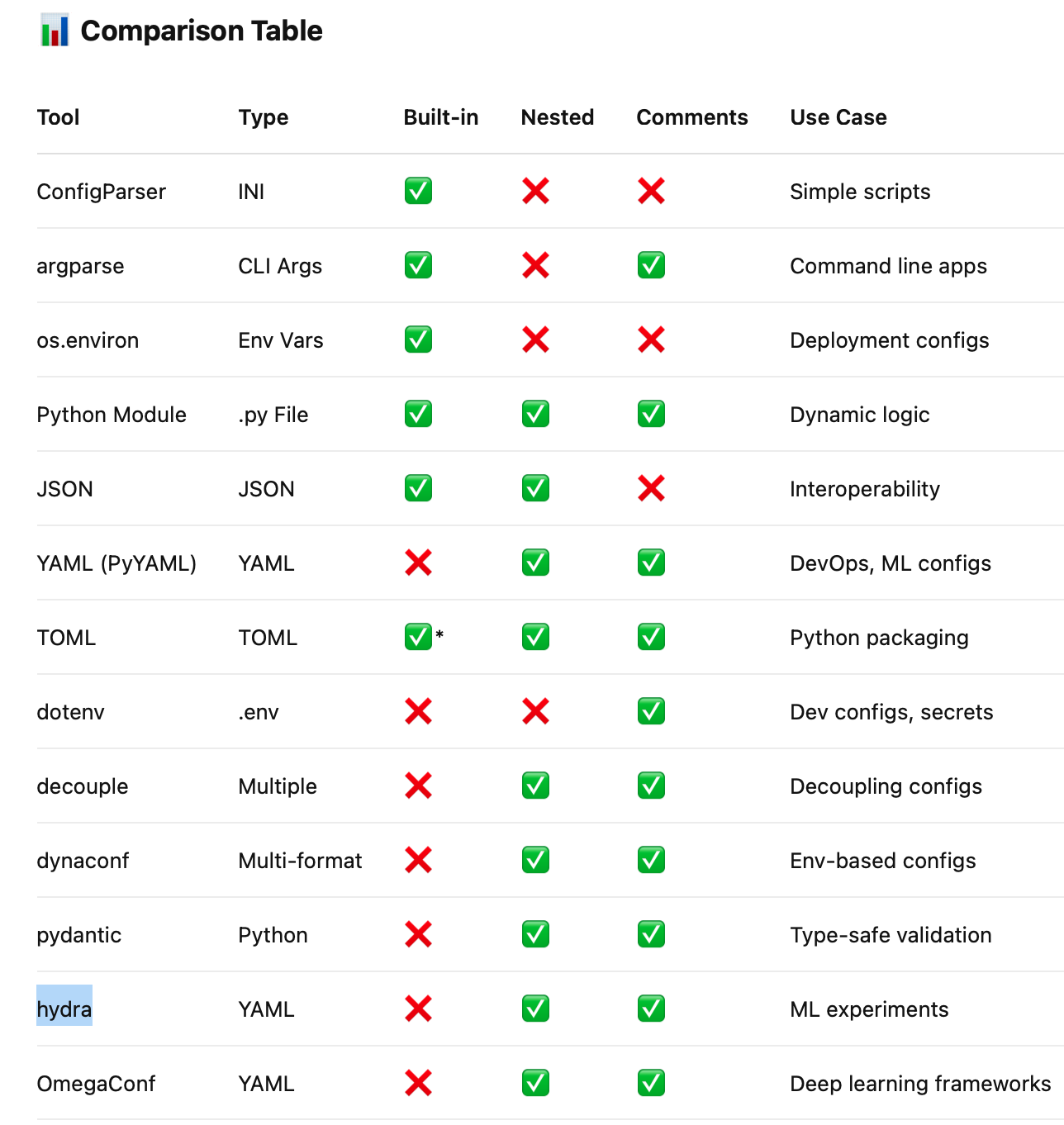 [Python Configuration Management](#python-configuration-management)
- Tips and tricks python scale up projects
[Ttips](#tips)
# Python Configuration Management
A comparison of built-in and third-party configuration options for Python projects
📌 Summary
This guide compares Python's native configuration methods and popular third-party libraries, helping developers choose the best fit for their project's needs.
⸻
🔧 Built-in Configuration Tools
ConfigParser (INI Files)
• 📄 Simple structured text files
• ✅ Built-in
• ❗ Limitations: String-only, no nesting
argparse (Command Line Arguments)
• 🧰 Used in CLI tools
• ✅ Built-in
• 📝 Supports help text, types, defaults
Environment Variables (os.environ)
• 🔒 Ideal for secrets and deployment
• ✅ Built-in
• ❗ Flat and string-only
Python Module as Config
• 🐍 Python file for configuration
• ✅ Built-in
• 🚀 Full flexibility and dynamic logic
JSON Files
• 📦 Structured data format
• ✅ Built-in
• ❗ No comments, strict format
TOML (e.g. pyproject.toml)
• 🧪 Used in packaging
• ✅ Built-in (Python 3.11+)
• ✅ Easy syntax and nesting
YAML (via PyYAML)
• 📚 Readable with nested structures
• ❌ Not built-in (requires install)
• ✅ Human-friendly and widely used
⸻
🔌 Third-Party Configuration Libraries
python-dotenv
• 📁 Loads .env into os.environ
• ✅ Simple and effective
python-decouple
• 🔒 Separates config from code
• ✅ Supports .env, .ini, etc.
dynaconf
• 🔁 Supports multi-environment configs
• ✅ Compatible with YAML, JSON, TOML
pydantic
• 🛡️ Type-safe configs with validation
• ✅ Popular in FastAPI
hydra
• 🧪 Hierarchical configs for ML apps
• ✅ Handles complex parameter sweeps
OmegaConf
• 🌊 YAML-based hierarchical config
• ✅ Designed for deep learning projects
---
# tips
### mmap -> optimization memory usage best
```
df =pd.series()
all=pd.dataFrame()
df['a']=x
all=pd.Concat([all, pd.DataFrame(df).T])
all.to_csv('fn.csv', index=false, na_rep="NULL')
def pow(*arge):
x,y,z=args
def pow (x,y,z=None,/): #The forward slash (/) ensures you must call it like pow(2, 3) and not pow(x=2, y=3).
*args
**kwargs
/ positional
def timer(func):
def wrapper(*args, ** kwargs):
start_t=time.time()
result=func(*args,**kwargs)
end_t=time.time()
print(f" function {func.__name__!r} took: {end_t - start_t: 0.4f} sec")
return result
return wrapper
@functools.cash
@dataclass
from collections import deque
stk=deque()
stk.append('asadfas')
stk.pop()
- o(n)
stk=[]
stk.pop().rstk[-1]
collections import lifo
deque()
appendLeft(5)
pop
```
---
```
more *.md
```
pip install pybind11
// add.cpp
#include
Scan, open, copy
Point a phone camera at a code, or press Open. Every card also carries a Copy button for the link or the address, and the code itself downloads for sharing. This page is the permanent short link pirahansiah.com/qr.
Social & web



LinkedIn — page & group
Company page and the computer-vision group.
linkedin.com/groups/10320678




Visual updates and highlights.
instagram.com/computer_vision_deep_learning

Community group and page.
facebook.com/groups/computervisiondeeplearning








Hermes Agent — talk slides
The slides of my talk introducing Hermes Agent (Google Slides).
docs.google.com/presentation/d/14HX-99rGO9x1AtOnEigZ_2gAzZaPwvxqCEnnG0dk870/edit?usp=sharing
Referrals & invites
Invite links to services I hold accounts with. Using one is optional — it earns me a small referral credit at no cost to you, and every link can be copied or downloaded like any other.


Trade Republic
Invest, spend and bank — free account, welcome bonus via the link.
refnocode.trade.re/z28xmjp6

Scalable Capital
Investing platform — €25 start bonus via the invite.
de.scalable.capital/en/invitation/bj2bkn

Wise
Send and receive money internationally, low fees.
wise.com/invite/ilpn/farshidp1


Kraken
Buy, sell and trade crypto; join with the invite.
invite.kraken.com/JDNW/sqqgzc9a
Crypto tip addresses
Purely optional — this is a tip jar, nothing more, for the open-source projects and free tools I build and maintain. No invoice, no obligation, nothing to sign. If you would rather not, everything stays free to use.
Bitcoin (BTC)
Bitcoin network · BTC only
Ethereum (ETH)
Ethereum mainnet · ETH & ERC-20

BNB
BNB Smart Chain · BNB & BEP-20

Solana (SOL)
Solana network · SOL & SPL tokens

Base
Base L2 · ETH on Base only
The same address covers ETH, BNB and Base — copy it once, then check it on the device that signs before sending, and send only on the network named above each code.
Computer Vision, Generative AI, Edge Computing, Fine-tune Multimodal LLMs, Robotics, IoT, AR/VR, Medical Imaging, Autonomous Vehicles, Smart Cities, Industrial Automation, Surveillance Systems, Gesture Recognition, Facial Recognition, Emotion Detection, Object Tracking, 3D Reconstruction, Augmented Reality Applications, Virtual Reality Experiences, Edge AI Model Optimization, Real-time Video Analytics, Deep Learning Model Deployment, AI-powered Drones, AI in Healthcare Imaging
Every code on this page can be opened with a tap, copied with one button, or downloaded as an image to share.
--- ## Real-Time Multi-Camera Vision Systems URL: https://pirahansiah.com/farshid/content/note-multi-camera.md Deep technical guide to building real-time multi-camera vision systems with heterogeneous processing and scaling to 100+ cameras. # Real-Time Multi-Camera Vision Systems Building real-time multi-camera AI requires synchronizing 10–100 cameras while processing with CPU, GPU, NPU, and direct I/O in parallel. This guide covers frameworks (OpenCV, GStreamer, DeepStream, OpenVINO), low-level optimizations (USB DMA, UVC driver tweaks), and scaling strategies. --- ## 1. System Architecture ### Pipeline 1. **Capture** – RTSP, USB, MIPI-CSI input 2. **Decode** – CPU, GPU hardware decoder, or FPGA 3. **Preprocess** – resize, color convert, normalization 4. **Inference** – DNNs on GPU/NPU/CPU 5. **Post-process** – tracking, feature extraction 6. **Output** – GUI, storage, or network stream ### Framework Examples - **NVIDIA DeepStream**: GPU-accelerated multi-camera inference with batching (nvstreammux), inference (nvinfer), trackers, and OSD - **Intel OpenVINO**: Multi-Camera Multi-Target demo with detector + re-ID + tracker - **GStreamer**: Flexible pipelines with hardware decoders, multithreaded elements, and timestamp handling --- ## 2. Heterogeneous Processing (CPU/GPU/NPU) | Processor | Role | |-----------|------| | CPU | I/O, buffering, lightweight pre/post-processing | | GPU | High-throughput DNN inference, CUDA/Vulkan processing | | NPU/DLA/TPU | Dedicated ML accelerators for extra streams | | Multi-threading | Double/triple buffering, async pipelines | Research shows speedup from ~21 FPS (CPU-only) to ~55 FPS with GPU+NPU double buffering — a 2.6x improvement. Beyond 2 NPUs, CPU stages become the bottleneck (Amdahl's Law). --- ## 3. Scaling to 10–100+ Cameras | Camera Count | Architecture | |-------------|--------------| | < 10 | Single GPU system | | 10–50 | Multiple GPUs or edge cluster (Jetson Thor, PCIe grabbers) | | 50–100 | Datacenter with distributed pipeline (Kafka/MQTT) | | 100+ | Server cluster with edge ingestion + cloud aggregation | **Key constraints:** - Single GPU decodes ~10–20 1080p streams (limited by hardware decoders) - Multi-GPU: each GPU handles a batch, aggregate via messaging - Network bandwidth and I/O are common bottlenecks --- ## 4. Software Frameworks | Framework | Strengths | Best For | |-----------|-----------|----------| | **OpenCV** | Easy prototyping, Python/C++, DNN module | Small-scale, custom logic | | **GStreamer** | Flexible pipelines, hardware acceleration, multi-source sync | High-performance, real-time | | **FFmpeg** | Mature video I/O, codec support | Encoding/streaming | | **NVIDIA DeepStream** | GPU/DLA inference, batching, tracking | Jetson/dGPU multi-camera | | **Intel OpenVINO** | CPU+GPU+VPU heterogeneous execution | Intel hardware | | **OBS + NTP/PTP** | Software sync across consumer cameras | Prototyping | --- ## 5. Camera Synchronization ### Hardware Sync (Best) - **Genlock**: Shared clock signal across cameras (pro cameras only) - **FSYNC**: Frame start trigger from master sensor - **PTP (IEEE 1588)**: Network-based precision clock sync ### Software Sync (Consumer Cameras) - **Timestamp alignment**: Each frame tagged with PTS, align within ±1 frame time - **NTP/PTP network sync**: Align internal clocks across IP cameras - **Timecode (LTC)**: SMPTE timecode via audio or metadata (libltc) ### OpenCV Python Sync Example ```python import cv2, time, threading from collections import deque CAM_IDS = [0, 1] TOLERANCE_MS = 30 class CamReader(threading.Thread): def __init__(self, id, buf): super().__init__(daemon=True) self.id = id self.cap = cv2.VideoCapture(id) self.buf = buf def run(self): while True: ret, frame = self.cap.read() if not ret: time.sleep(0.01) continue self.buf.append((time.time() * 1000, frame)) def pop_synced(buffers, tol_ms): heads = [b[0][0] for b in buffers if b] if len(heads) < len(buffers): return None if max(heads) - min(heads) <= tol_ms: return [b.popleft()[1] for b in buffers] buffers[heads.index(min(heads))].popleft() return None bufs = [deque() for _ in CAM_IDS] for i, cid in enumerate(CAM_IDS): CamReader(cid, bufs[i]).start() while True: synced = pop_synced(bufs, TOLERANCE_MS) if synced: for i, frm in enumerate(synced): cv2.imshow(f'cam{i}', frm) if cv2.waitKey(1) == 27: break ``` ### GStreamer Quick Start ```bash # Side-by-side display of two cameras gst-launch-1.0 videomixer name=mix ! videoconvert ! autovideosink \ v4l2src device=/dev/video0 ! video/x-raw,width=640,height=480 ! videoconvert ! mix. \ v4l2src device=/dev/video1 ! video/x-raw,width=640,height=480 ! videoconvert ! mix. # RTP/UDP camera sync gst-launch-1.0 -v udpsrc port=5000 caps="application/x-rtp" \ ! rtph264depay ! h264parse ! avdec_h264 ! videoconvert ! autovideosink ``` --- ## 6. Low-Level Camera & Buffer Handling ### USB Transfer - USB bulk transfer sends 1024-byte packets - Camera stream split into packets, reassembled in buffer - Match USB frame pacing to avoid drops ### Buffer Management - **Skip/lock/unlock strategy**: Single buffer with selective access - **Triple buffering**: Capture, process, display simultaneously - **Threading**: One thread per camera, central sync manager ### UVC (USB Video Class) - UVC adds 12-byte headers per packet - Driver strips headers before passing buffer - Can bypass for raw access ### Direct Memory Access (DMA) - Stream frames directly into memory without CPU copy - Direct USB → buffer via DMA - Zero-copy frame access for GPU/OpenGL/DirectX ### Driver-Level Optimizations - Remove UVC headers early to free CPU - Use raw capture (no buffering at driver level) - Enable overwrite mode for DMA buffer --- ## 7. Hardware Technologies | Hardware | Camera Capacity | Bandwidth | Use Case | |----------|----------------|-----------|----------| | Jetson Thor | 20+ CSI/MIPI | >400 Gbps | Robotics, medical AI | | AverMedia T4000 (PCIe) | 20 USB/MIPI | PCIe Gen4 ~128 Gbps | Surveillance, multi-view | | MIPI C-PHY | 1–4 per lane | ~17.1 Gbps/lane | High-res industrial/medical | | MIPI D-PHY | 1–4 per lane | ~4.5 Gbps/lane | Smartphones, IoT | | QSFP (40/100/200G) | 50–100 aggregated | 40–200 Gbps | Datacenter clusters | | USB 3.0 Hub | 4–8 per hub | ~5–10 Gbps/controller | Prototyping | ### Scaling Decision Flow ``` 1–4 cameras → USB 3.0 ports/hubs 5–10 cameras → Multiple USB hubs + PCIe expansion 10–20 cameras → PCIe capture cards (T4000) or Jetson Thor 20–50 cameras → Multiple PCIe grabbers or MIPI C/D-PHY 50–100 cameras → QSFP aggregation + datacenter GPU/NPU 100+ cameras → Distributed cluster + PTP sync ``` --- ## 8. Medical Computer Vision Multi-camera systems in healthcare: - **Surgery**: Multi-angle views to reduce occlusion, staff tracking - **Endoscopy**: Stereo/multi-view depth reconstruction - **ICU monitoring**: Fall detection, movement tracking - **Medical robotics**: Robot navigation with multi-camera fusion Studies show multiple camera angles are essential in OR settings to overcome instrument/hand occlusion. --- ## 9. OCR and Redaction Pipeline For real-time text detection and sensitive data masking across multiple streams: 1. **Text Detection**: EAST/CRAFT detector on GPU (~250 FPS on V100 vs ~10 FPS on CPU) 2. **PII Classification**: Regex or NLP model to tag sensitive text 3. **Redaction**: Gaussian blur or black bar on detected regions 4. **Frame Output**: Filtered frame to display or stream Target: ≥15 FPS per camera with GPU-accelerated OCR. --- ## 10. Key References - NVIDIA DeepStream SDK documentation - Intel OpenVINO Multi-Camera demos - GStreamer multi-camera pipeline examples - RidgeRun GstCUDA zero-copy framework - Oh et al. (2023) — heterogeneous NPU processing benchmarks - Hu et al. (2022) — OR multi-camera surveillance system --- ## Running K2-Horizon Locally on Apple Silicon URL: https://pirahansiah.com/farshid/content/k2-horizon-local.md > **Running K2-Horizon Locally on Apple Silicon** — Serve IFM's K2-Horizon GGUF via the MBZUAI-IFM llama.cpp fork and wire it into Hermes at 64K context. — https://www.pirahansiah.com/notes/docs/llm/k2-horizon-local/ # Running K2-Horizon Locally on Apple Silicon (M3, 16GB) K2-Horizon (by IFM / MBZUAI) is a compact *reasoning* model family. The published weights (`IFM/K2-Horizon-0.9B-GGUF`) are **GGUF only** in a **custom `k2-horizon` architecture** (a MoVA-style attention/value-router). That breaks the usual local paths: *Last updated: 2026-09-05.* ## Why oMLX and Ollama cannot load it (verified) - **oMLX** (the MLX server) ingests only **MLX safetensors** (`config.json` + `*.safetensors`). A `.gguf` is not ingestible by oMLX at all — there is no `add`/`pull` for GGUF. - **Ollama** bundles **mainline llama.cpp**, which has **no `k2-horizon` support** yet. The upstream PR is still in progress. - The model's own README states it requires *"a version of llama.cpp containing K2 Horizon architecture support"* — i.e. the **MBZUAI-IFM fork** at `github.com/MBZUAI-IFM/llama.cpp` (`model/K2Horizon` branch). Grepping the ollama 0.30.6 and oMLX 0.6.4 binaries confirms **zero** `k2-horizon` references, whereas the fork's `src/models/k2-horizon.cpp` + `libllama.0.3.0.dylib` do contain it. ## Build the MBZUAI-IFM llama.cpp fork (Metal) ```bash # Use the exact validated commit the model authors recommend. git clone --branch model/K2Horizon --single-branch \ https://github.com/MBZUAI-IFM/llama.cpp.git llama.cpp-k2 cd llama.cpp-k2 git log -1 --format='%H %s' # expect 35999d101... "model: K2 Horizon chat template ..." # Apple Silicon: Metal backend, embed the Metal lib, Release. cmake -B build -DGGML_METAL=ON -DGGML_METAL_EMBED_LIBRARY=ON \ -DCMAKE_BUILD_TYPE=Release -DLLAMA_CURL=ON cmake --build build --target llama-server -j $(sysctl -n hw.ncpu) ``` Verify the architecture is compiled in: ```bash strings build/bin/libllama.0.3.0.dylib | grep -c k2-horizon # expect > 0 ./build/bin/llama-server --version # 0.3.0-dev, commit 35999d101 ``` ## Download the GGUF ```bash mkdir -p ~/models/k2-horizon curl -L -o ~/models/k2-horizon/K2-Horizon-1B-BF16.gguf \ "https://huggingface.co/IFM/K2-Horizon-0.9B-GGUF/resolve/main/K2-Horizon-1B-BF16.gguf" # ~2.16 GB, BF16 full precision (fine for 0.9B/1B class on 16 GB unified RAM) ``` ## Serve on :8080 ```bash ./build/bin/llama-server \ --model ~/models/k2-horizon/K2-Horizon-1B-BF16.gguf \ --alias k2-horizon:latest \ --host 127.0.0.1 --port 8080 \ --ctx-size 65536 --n-gpu-layers 99 --flash-attn on \ --reasoning-format deepseek --reasoning-effort default ``` - `--ctx-size 65536` — Hermes enforces a **64K context floor** for the default model; smaller and it refuses with *"Choose a model with at least 64K context."* - `--reasoning-format deepseek` — populates `message.reasoning_content` (K2 is a reasoner). - `--flash-attn on` (not a bare flag — the server needs the `on` value). Health + generation check: ```bash curl -s http://127.0.0.1:8080/health # {"status":"ok"} curl -s http://127.0.0.1:8080/v1/models | grep -o 'k2-horizon:latest' ``` ## Wire into Hermes (separate endpoint, do NOT touch oMLX's :8000) Point Hermes at the **:8080** server via a new custom provider — keep oMLX on :8000 as-is: ```bash hermes config set model.base_url "http://127.0.0.1:8080/v1" hermes config set model.default "k2-horizon:latest" hermes config set agent.model "k2-horizon:latest" hermes config set delegation.base_url "http://127.0.0.1:8080/v1" hermes config set delegation.model "k2-horizon:latest" hermes gateway restart ``` Verify: `hermes chat -q "hi"` → gateway log shows `model=k2-horizon:latest provider=custom base_url=http://127.0.0.1:8080/v1`. ## Persistence (survives reboot / logout) `~/Library/LaunchAgents/com.farshid.k2-horizon-serve.plist` — `RunAtLoad` + `KeepAlive`, mirroring the oMLX agent in the [Local LLM Optimization](/notes/docs/llm/local-llm-optimization/) guide (§7a). Only one process may hold :8080. ## Gotchas - **It is a reasoner.** Every reply includes a `reasoning_content` trace and is slow (~24 s for a 40-token answer) — that is the model's nature, not a misconfig. - **BF16 GGUF is large.** 2.16 GB for ~1B params; watch RAM if you add bigger BF16 GGUFs on 16 GB. - **No oMLX/Ollama route.** If you need K2-Horizon in oMLX, you must first convert the GGUF to MLX safetensors (and even then the custom arch's grouped RMSNorm needs a custom loader), which is not provided for the 0.9B/1B size as of this writing (community MLX conversions exist only for 3.7B/7B, and require `--trust-remote-code`). The llama.cpp fork is the supported path. ## Related - [Why Hermes: One Agent Over Dots, Muse Code & Grok Build](/notes/docs/llm/why-hermes/) — how Hermes stacks up against OpenAI Dots, Meta Muse Code and xAI Grok Build. --- ## SEO for LLM-Powered Search URL: https://pirahansiah.com/farshid/content/note-seo-for-llms.md How to optimize websites for LLM-powered search engines using structured data and AI-friendly content. # The New Era of SEO: Optimizing Websites for LLMs In today's rapidly evolving digital landscape, search engine optimization (SEO) is undergoing a fundamental transformation with the rise of Large Language Models (LLMs) like ChatGPT, Claude, and Gemini. These sophisticated AI systems are now integrated into search experiences, creating a new frontier for website visibility and discoverability. ## How LLMs Are Changing SEO LLMs don't just understand keywords—they comprehend context, semantics, and user intent at unprecedented levels. This shift requires website owners to adapt their SEO strategies beyond traditional keyword stuffing and backlink building. ## Key Strategies for LLM-Optimized SEO ### 1. Structured Data & Machine-Readable Content LLMs thrive on well-organized, structured information. Implementing JSON-LD schema markup (FAQ, HowTo, Article, Product) helps these models understand and extract information from your content efficiently. For example: ```json { "@context": "https://schema.org", "@type": "FAQPage", "mainEntity": [ { "@type": "Question", "name": "How do I optimize my website for AI search?", "acceptedAnswer": { "@type": "Answer", "text": "To optimize for AI search, use structured data, clear headlines, and authoritative sources." } } ] } ``` This structured approach increases the likelihood that LLMs will reference your website when answering relevant queries. ### 2. Creating AI-Friendly Content LLMs favor precise, fact-based, and well-structured content. Consider incorporating: - Conversational but informative tone - Clear Q&A formats that directly address common queries - Concise, to-the-point information with minimal fluff - Summaries and key takeaways for easy extraction When writing content, focus on answering questions thoroughly rather than keyword density. For instance, instead of vague introductions like "You might be wondering about LLM optimization...", directly state: "To optimize your website for AI-driven search, implement structured data, create FAQ sections, and build authority through quality backlinks." ### 3. Building Authority Through Citations LLMs prioritize authoritative sources when generating responses. To position your website as such: - Earn high-quality backlinks from reputable websites - Showcase expertise through detailed author credentials - Include research citations and case studies - Get mentioned in academic papers, news sites, or trusted resources - Develop comprehensive "About" pages highlighting expertise ### 4. Technical SEO for LLM Visibility Beyond traditional technical SEO, consider: - Providing structured APIs or feeds for AI systems to access your content - Creating machine-readable sitemaps - Organizing content in logical hierarchies with clear topic clusters - Using semantic HTML5 elements (article, section, nav) for better content parsing ### 5. Content Optimization Tactics LLMs can also help improve your existing SEO efforts by: - Generating high-quality, keyword-rich blog posts and articles - Creating semantic topic clusters that align with Google's E-E-A-T principles - Suggesting long-tail keywords and related search queries - Structuring content for featured snippets through lists, tables, and concise definitions - Automating personalized outreach for link building ## Monitoring LLM Visibility Track your progress by: - Asking LLMs directly about the best resources in your niche - Setting up alerts for website mentions in AI responses - Testing how your content appears in AI-powered search engines like Bing AI Chat or Google SGE ## The Future of SEO As LLMs become more integrated into search experiences, the line between traditional SEO and LLM optimization will continue to blur. Website owners who adapt early to these changes will gain significant advantages in visibility and traffic. The fundamental principles of quality content, authority, and relevance remain crucial—but the mechanisms through which these are evaluated and surfaced to users are evolving dramatically with AI technology. By implementing structured data, creating AI-friendly content, building authoritative citations, and monitoring AI search visibility, you'll position your website for success in this new era of SEO. BUY: - 749 [BenQ RD320UA 32 Inch 4K 3840 x 2160 Monitor for Programmers with 2000:1 Contrast Ratio, Nano Matte Display, Coding Mode, MoonHalo Backlight, Ergo Arm, Night Hours Protection, Coding HotKey](https://amzn.to/3EI9v4e) - 135 [UGREEN USB C Charger, Nexode 300W Charger PD 3.1 GaN Power Supply 5 Ports PPS Compatible with MacBook Pro 2021 16 Inch, MacBook Air, Surface Book, iPhone 16 Pro Max, 16 Pro]() --- ## Shell & Vim Quick Reference URL: https://pirahansiah.com/farshid/content/note-shell-vim.md Quick reference for shell commands, vim basics, and essential CLI tools. - [NeoHtop](https://github.com/Abdenasser/neohtop) - - The Shell - echo - "" \ - $PATH - cd - - ctrl+L to clean - ctrl+r - >> append - output into | input - # into root or sudo su - xdg-open opent the file with reletive app - foo=bar ; must be without space - echo "value is $foo" -> value is bar - echo 'value is $foo' -> value is $foo - mcd () { mkdir -p "$1" cv "$1" } source mcd.sh !! command + / option+shif+a #!/usr/bin/env python import sys for arg in reversed(sys.argv[1:]): print(arg) # tools tldr locate grep ripgrep = rg fzf broot nnn # vim i esc r k s-v c-v : --- ## Sitemap & Page Summaries URL: https://pirahansiah.com/farshid/content/menus.md Complete navigation index with summaries of all site pages *Last updated: 2026-09-04.* # Sitemap — All Pages ## Product ### Computer Vision - **[3D Vision & Multi-Camera](/notes/docs/cv/3d/)** — Real-time 3D point cloud generation, depth sensing, multi-camera sync with OpenCV, GStreamer, and C++ - **[Optical Flow](/notes/docs/cv/optical-flow/)** — Challenges and solutions: illumination, occlusions, fast motion, textureless regions, GPU acceleration - **[Multi-Camera Systems](/notes/docs/cv/multi-camera/)** — Architecture guide for scaling to 100+ cameras: sync, GPU/NPU, USB/DMA - **[CV Overview](/notes/docs/cv-overview/)** — Computer vision research and overview - **[CV Coaching](/notes/docs/coaching/)** — Computer vision teaching and coaching services ### AI & LLMs - **[Advanced LLM Concepts](/notes/docs/llm/llm-concepts/)** — RAG, embeddings, knowledge graphs, multimodal models, production deployment - **[Orchestrating Agents](/notes/docs/llm/agents/)** — Multi-agent systems, task decomposition, LLM orchestration - **[Blog: AI & LLMs](/notes/docs/llm/blog/)** — RAG vs CAG, multi-agent architectures, AI's impact - **[Avatar Generator](/notes/docs/llm/avatar/)** — Local video avatar with Ollama + Wav2Lip (no cloud) - **[Local LLM Optimization](/notes/docs/llm/local-llm-optimization/)** — Fastest Qwen3.5 at 64K context on Apple M3 via MLX (oMLX/llama.cpp), with downloadable scripts - **[K2-Horizon Locally](/notes/docs/llm/k2-horizon-local/)** — Serve IFM K2-Horizon GGUF via the MBZUAI-IFM llama.cpp fork on Apple Silicon, wired into Hermes at 64K ### CUDA & GPU - **[Numba JIT](/notes/docs/cuda/numba/)** — Python 10-100x speedup with @jit(nopython=True) - **[PyCUDA Kernels](/notes/docs/cuda/pycuda/)** — CUDA C kernels from Python with GPU memory management - **[CUDA in VS Code](/notes/docs/cuda/cuda-vscode/)** — Dev environment setup on Windows - **[MLX, CoreML & Metal](/notes/docs/cuda/apple-ml/)** — Apple Silicon ML frameworks --- ## Solution ### Courses - **[All Topics](/notes/courses/)** — Complete topics index - **[ML Specialization](/notes/courses/ml-spec/)** — Coursera ML notes - **[Full Stack DL](/notes/courses/fsdl/)** — ML production, data lifecycle - **[FSDL 2022](/notes/courses/fsdl-2022/)** — Continual learning, data management, testing - **[MLOps](/notes/courses/mlops/)** — ML engineering for production - **[ROS](/notes/courses/ros/)** — Robot Operating System - **[Parallel Programming](/notes/courses/parallel/)** — Python parallel CV - **[Modern C++](/notes/courses/modern-cpp/)** — C++29 for image processing - **[Cloud-Native](/notes/courses/cloud-native/)** — Docker & Kubernetes - **[TF Deployment](/notes/courses/tf-deploy/)** — TF.js, TF Lite, mobile ML - **[RISC-V](/notes/courses/risc-v/)** — Open-source processor architecture - **[Edge AI Summit](/notes/courses/edge-ai-summit/)** — TinyML, neuromorphic, edge inference - **[Embedded IoT](/notes/courses/iot/)** — Embedded systems - **[Tesla AI](/notes/courses/tesla/)** — Autonomous driving - **[AI Hardware](/notes/courses/ai-hardware/)** — Accelerators & NPUs - **[OpenVINO](/notes/courses/openvino/)** — Intel inference optimization - **[Metaverse](/notes/courses/metaverse/)** — XR & spatial computing - **[Book Summaries](/notes/courses/book-summary/)** — Knowledge management, PKM - **[IoT Scholarship](/notes/courses/iot-scholarship/)** — OpenVINO edge AI, object detection ### Business - **[Startup Guide](/notes/docs/startup/)** — Edge AI business plans, fundraising in Germany, pitch decks - **[SEO for LLMs](/notes/docs/seo/)** — Structured data, AI-friendly content optimization - **[Top LinkedIn Posts](/notes/docs/linkedin/)** — Top posts: camera calibration, C++, robotics - **[10 Years of Bug Fixing](/notes/pubs/10-years/)** — Lessons from fixing bugs in CV systems - **[Solutions](/notes/docs/solutions/)** — Industry solutions and business - **[Connect](/notes/docs/solutions/#connect)** — Get in touch --- ## Atlas ### About - **[Crypto](/farshid/content/crypto.md)** — Support the site with crypto donations (ETH, BTC, SOL, Base, BNB) - **[MetaMask](/farshid/content/metamask.md)** — Connect a crypto wallet and test send/receive - **[Game](/farshid/content/game.md)** — Play Snake, Flappy Bird and 2048 in your browser - **[QR Codes](/farshid/content/qr.md)** — Scan QR codes to open referral & join links (OpenCode, Trade Republic, Scalable, Wise, eToro) - **[Solana Games](/farshid/content/solana-games.md)** — Simple Solana games and on-chain mini-games - **[Shop](/shop/)** — Digital downloads: branded PDF guides and ebooks - **[Book](/book/)** — Computer Vision & AI Engineer's Guide (free PDF) ### Research - **[Patents](/notes/pubs/patents/)** — 3 patents: face augmentation, vehicle detection, facial analysis - **[Papers](/notes/pubs/papers/)** — 11 conference papers: camera calibration, license plates, thresholding - **[Journals](/notes/pubs/journals/)** — 6 journals: PSNR, SLAM, ant colony, character recognition - **[Books](/notes/pubs/books/)** — 7 books: optical flow, camera calibration, OpenCV 5 chapters, CV meets LLM - **[Keynotes](/notes/pubs/keynotes/)** — LLMs meet Computer Vision - **[CV](/notes/pubs/cv/)** — Full curriculum vitae ### Programming - **[C++ Reference](/notes/docs/cpp/)** — Memory (stack/heap), STL, debugging, Linux essentials - **[Python Config](/notes/docs/python/)** — ConfigParser, argparse, pydantic, hydra, pybind11, Cython - **[Developer Tools](/notes/docs/dev-tools/)** — Docker, GitHub tricks, CLI tools - **[Shell & Vim](/notes/docs/shell-vim/)** — Terminal essentials, vim basics ### Optimization - **[CV/DL/ML Optimization](/notes/docs/optimization/)** — Quantization, pruning, TensorRT, ONNX, frameworks - **[Prompts](/notes/docs/prompts/)** — Reusable LLM prompt templates ### Knowledge - **[Wiki](/notes/wiki/)** — Wikipedia-style index of all pages - **[Sitemap](/notes/sitemap/)** — Complete page listing - **[Presentations](/notes/slides/)** — All research-tool decks - **[The New Era of Research Tools](/notes/slides/research-tools/)** — Passive chat → autonomous workflows: Hermes, LeapSpace, PaperBanana, citation finders, swarms - **[New LLM Optimization Methods](/notes/slides/llm-optimization/)** — Unsloth Dynamic 3.0, MTP, DFlash2, oMLX/MLX, FlashAttention-2; Qwen3.8-Flash synthesis - **[Hermes for Research Assistance](/notes/slides/presentation/)** — Literature sweeps, code reproduction, paper drafting - **[Hermes for Big CV Projects](/notes/slides/presentation-cv/)** — Production-scale CV engineering with agents - **[Hermes Updates & Feature Guide](/notes/slides/presentation-updates/)** — Complete feature tour with examples - **[Portfolio](/notes/pkm/use-cases/)** — Publications, patents, books, journals, papers, keynotes - **[Resources](/notes/docs/resources/)** — Patents, books, papers, projects - **[Curated Links](/notes/docs/links/)** — Tools, tutorials, reading, YouTube - **[Content Hub](/notes/docs/)** — All content categories --- ## Solana Arcade — Snake & Tetris URL: https://pirahansiah.com/farshid/content/solana-games.md > **Solana Arcade** — Play Snake & Tetris, connect Phantom, and sign your high score as a cryptographic proof. — https://pirahansiah.com/solana-games/ Play Snake and Tetris in your browser, connect a Phantom wallet, and sign your high score as a cryptographic proof on Solana. No install, no account, runs locally. *Last updated: 2026-08-16.*Solana Arcade
Play Snake and Tetris right in your browser, connect a Phantom wallet, and sign your high score as a cryptographic proof on Solana. No install, no account — everything runs locally.
📱 On mobile or inside Telegram? Solana wallets can't connect inside Telegram's browser — the games still work everywhere, and you can send a tip to the SOL address below.
signMessage only — a free message signature. It can never move, send, or spend any SOL.Sign your score
Connect your wallet, play a game, then sign your best score as a cryptographic proof. Signing is free and never sends SOL — it only proves you own the address that earned the score.
Tip the developer — if the games made you smile, a small SOL tip helps keep this open-source work going. Send any amount to this address:
4Ub6VYF69PdCjpCMWDysU54WPb1xB7s628ASkCuJmcib
Works in Telegram and mobile browsers too — no wallet connection needed to send.
Solutions
Turn AI research into production-ready products
 ---
## Qwen-Image-2.1 on an 8 GB laptop GPU: install, configure, and the one node that broke it
URL: https://pirahansiah.com/farshid/content/qwen-image-21-local.md
# Qwen-Image-2.1 on an 8 GB laptop GPU: install, configure, and the one node that broke it
This page records the full setup, configuration, and testing of **Qwen-Image-2.1** as a local text-to-image generator on a Windows laptop with an 8 GB GPU. It ends with a working one-command script that turns a text file into an image.
It also records a failure worth reading. The pipeline loaded without error, ran to completion in 120 seconds, and produced pure noise on every prompt. The cause was one wrong node type. The diagnosis is included because the same class of error will appear in other GGUF-plus-safetensors pipelines.
The companion page for language models on the same hardware is [Tips and tricks to run a local model for Hermes Agent on your laptop](/farshid/content/localAI.md).
## The target hardware
| Component | Value |
|---|---|
| GPU | NVIDIA GeForce RTX 4060 Laptop |
| VRAM | 8,188 MiB total |
| Driver | 596.08, CUDA 13.2 capable |
| RAM | 32 GB |
| CPU | Intel Core Ultra 7 155H |
| OS | Windows 11 |
The 8 GB of VRAM is the binding constraint. Every choice below follows from it.
## What Qwen-Image-2.1 is
Published 20 September 2026 by the Qwen team. It is a unified text-to-image **and** image-editing model.
| Property | Value |
|---|---|
| Visual generator | 7B parameters, 32-layer single-stream DiT |
| Text encoder | Qwen3-VL 8B |
| VAE | 64-channel RGBA, 16x spatial compression |
| Default inference | 40 steps |
| Licence | Qwen Research License, no commercial use without permission |
Two notes that matter before downloading anything:
**A vision model is not an image generator.** "Vision" or "VL" means image in, text out. Qwen-Image-2.1 is the reverse: text in, image out. Do not confuse it with Qwen2.5-VL or Qwen3-VL, which only read images.
**The licence bars commercial use.** This is a change from Qwen-Image 1.0 and 2.0, which shipped under Apache 2.0.
## Files and disk layout
The model runs as three separate files. All of them are needed.
| File | Size | Purpose |
|---|---|---|
| `qwen-image-2.1-Q4_K_M.gguf` | 4.29 GiB | the transformer |
| `qwen3vl_8b_int8_convrot.safetensors` | 8.71 GiB | the text encoder |
| `qwen_image_2.1_vae_bf16.safetensors` | 644 MiB | the VAE |
The layout used here keeps one copy of each file:
```
D:\ollama\
im.txt <- your prompt goes here
gen.py <- prompt file to image
gen.bat <- double-click version
start-imggen.bat <- start the server once
qwen-image-2.1\
diffusion_models\
qwen-image-2.1-Q4_K_M-arch.gguf
text_encoders\
qwen3vl_8b_int8_convrot.safetensors
vae\
qwen_image_2.1_vae_bf16.safetensors
comfyui\
.venv\
models\
output\ <- images land here
server.log
```
A file named `extra_model_paths.yaml` in the ComfyUI folder points ComfyUI at `D:\ollama\qwen-image-2.1`, so the 14 GB of weights are not duplicated into the ComfyUI tree.
### The `-arch.gguf` file
The downloaded GGUF had no `general.architecture` key in its header. ComfyUI's GGUF loader reads that key to identify the model. Without it, the loader falls back to guessing from tensor names and logs a compatibility-mode warning.
The fix is to declare the key. A two-key header was written for `general.architecture = qwen_image21` and `general.name = qwen_image21`, producing the `-arch.gguf` file. Both files hold the same 297 tensors; only the header differs.
Verify it worked:
```python
from gguf import GGUFReader
r = GGUFReader("qwen-image-2.1-Q4_K_M-arch.gguf")
print(r.fields["general.architecture"]) # must print a ReaderField, not None
```
## Install
Python 3.11 virtual environment, then PyTorch with **cu130**.
```bash
cd /d/ollama
git clone https://github.com/comfyanonymous/ComfyUI comfyui
cd comfyui
python -m venv .venv
./.venv/Scripts/python.exe -m pip install --upgrade pip
./.venv/Scripts/python.exe -m pip install -r requirements.txt
```
Then install PyTorch for CUDA 13:
```bash
./.venv/Scripts/python.exe -m pip install \
"torch==2.14.0+cu130" \
"torchvision==0.29.0+cu130" \
"torchaudio==2.11.0+cu130" \
--index-url https://download.pytorch.org/whl/cu130
```
Verify before going further:
```bash
./.venv/Scripts/python.exe -c "
import torch
print('torch :', torch.__version__)
print('cuda :', torch.version.cuda)
print('avail :', torch.cuda.is_available())
print('device:', torch.cuda.get_device_name(0))
"
```
Expected output:
```
torch : 2.14.0+cu130
cuda : 13.0
avail : True
device: NVIDIA GeForce RTX 4060 Laptop GPU
```
Finally, the GGUF loader custom node:
```bash
cd custom_nodes
git clone https://github.com/city96/ComfyUI-GGUF
cd ..
./.venv/Scripts/python.exe -m pip install -r custom_nodes/ComfyUI-GGUF/requirements.txt
```
### Why cu130 and not cu128
The text encoder uses `convrot` int8 quantization. ComfyUI's native int8 path routes through `comfy_kitchen`, which disables its CUDA backend on any torch below cu130 and prints:
```
WARNING: You need pytorch with cu130 or higher to use optimized CUDA operations.
```
On cu128 the warning appears and the optimized kernel is unavailable. Driver 596.08 reports CUDA 13.2 capability, so cu130 is both available and correct.
## Configure
`D:\ollama\comfyui\extra_model_paths.yaml`:
```yaml
qwen_image_21:
base_path: D:/ollama/qwen-image-2.1/
diffusion_models: |
diffusion_models
unet: |
diffusion_models
text_encoders: |
text_encoders
clip: |
text_encoders
vae: |
vae
```
## The pipeline
Five nodes. The settings are taken from the official ComfyUI template `image_qwen_image_2_1_t2i.json` and must not be "improved".
| Node | Class | Setting |
|---|---|---|
| transformer | `UnetLoaderGGUF` | `qwen-image-2.1-Q4_K_M-arch.gguf` |
| text encoder | **`CLIPLoader`** | `qwen3vl_8b_int8_convrot.safetensors`, type `qwen_image` |
| VAE | `VAELoader` | `qwen_image_2.1_vae_bf16.safetensors` |
| conditioning | `TextEncodeQwenImage21` | prompt, negative, resolution 1024 |
| latent | `EmptyLatentImage` | 1024 x 1024, batch 1 |
| sampler | `KSampler` | euler, simple, 25 steps, cfg 1.0, denoise 1.0 |
| decode | `VAEDecode` | |
## The bug: `CLIPLoaderGGUF` destroys the prompt
This is the part worth keeping.
### The symptom
The pipeline ran with no error. ComfyUI reported `Prompt executed in 140.44 seconds`. The output image was pure noise, and it was noise for **every** prompt, at 25 steps and at 40 steps, with cu128 and with cu130.
### What made it hard to see
The text encoder loaded without complaint. Its output tensors had the correct shape `(1, 15, 4096)`, contained no NaN and were not zero. The model detected correctly as `qwen_image21` with 32 layers and 64 channels. The VAE round-trip test was exact. Every part looked healthy.
### The cause
The original script loaded the **safetensors** text encoder with `CLIPLoaderGGUF`, the node from the ComfyUI-GGUF custom node pack. That node does this:
```python
model_options = {
"custom_operations": GGMLOps,
"initial_device": comfy.model_management.text_encoder_offload_device()
}
```
`GGMLOps` extends `comfy.ops.manual_cast` and replaces Linear, Conv2d, Embedding and LayerNorm with GGML versions that **dequantize weights on the fly before compute**. That is correct for a GGUF file.
For an int8 `convrot` safetensors file it is wrong. It bypasses ComfyUI's native int8 convrot kernel, which is the component that applies the rotation the quantization depends on. The encoder still runs and still returns correctly shaped tensors — but the values no longer carry a usable prompt signal. The sampler then denoises toward texture instead of toward the prompt.
The failure is silent. Nothing errors. The shape and dtype checks all pass.
### The fix
One node type:
```python
"2": {"class_type": "CLIPLoader", # was: CLIPLoaderGGUF
"inputs": {"clip_name": CLIP, "type": "qwen_image",
"device": "default"}},
```
The transformer keeps `UnetLoaderGGUF`, because the repository ships only a GGUF file for it. The rule is: **match the loader to the file format.** `UnetLoaderGGUF` for the `.gguf` transformer, the built-in `CLIPLoader` for the `.safetensors` encoder.
### How it was found
The turning point was a 10-step run with `UnetLoaderGGUFAdvanced` set to `dequant_dtype=bfloat16`. The output changed from pure noise to a coherent but wrong texture — rusted metal instead of an apple. That proved the sampler worked and the prompt was not arriving. Everything upstream of the conditioning was then verified correct, which left the loader as the only candidate.
## The script
`D:\ollama\gen.py` reads a prompt from a text file and writes an image.
```python
#!/usr/bin/env python
"""gen.py - prompt file to image."""
import argparse, json, os, sys, time, urllib.error, urllib.request, uuid
COMFY = "http://127.0.0.1:8188"
HERE = os.path.dirname(os.path.abspath(__file__))
UNET = "qwen-image-2.1-Q4_K_M-arch.gguf"
CLIP = "qwen3vl_8b_int8_convrot.safetensors"
VAE = "qwen_image_2.1_vae_bf16.safetensors"
def build(prompt, negative, steps, width, height, seed, cfg, prefix):
return {
"1": {"class_type": "UnetLoaderGGUF",
"inputs": {"unet_name": UNET}},
"2": {"class_type": "CLIPLoader",
"inputs": {"clip_name": CLIP, "type": "qwen_image",
"device": "default"}},
"3": {"class_type": "VAELoader",
"inputs": {"vae_name": VAE}},
"4": {"class_type": "TextEncodeQwenImage21",
"inputs": {"clip": ["2", 0], "prompt": prompt,
"negative_prompt": negative, "resolution": 1024}},
"6": {"class_type": "EmptyLatentImage",
"inputs": {"width": width, "height": height, "batch_size": 1}},
"7": {"class_type": "KSampler",
"inputs": {"model": ["1", 0], "positive": ["4", 0],
"negative": ["4", 1], "latent_image": ["6", 0],
"seed": seed, "steps": steps, "cfg": cfg,
"sampler_name": "euler", "scheduler": "simple",
"denoise": 1.0}},
"8": {"class_type": "VAEDecode",
"inputs": {"samples": ["7", 0], "vae": ["3", 0]}},
"9": {"class_type": "SaveImage",
"inputs": {"images": ["8", 0], "filename_prefix": prefix}},
}
```
The rest of the script posts the graph to `/prompt`, polls `/history/